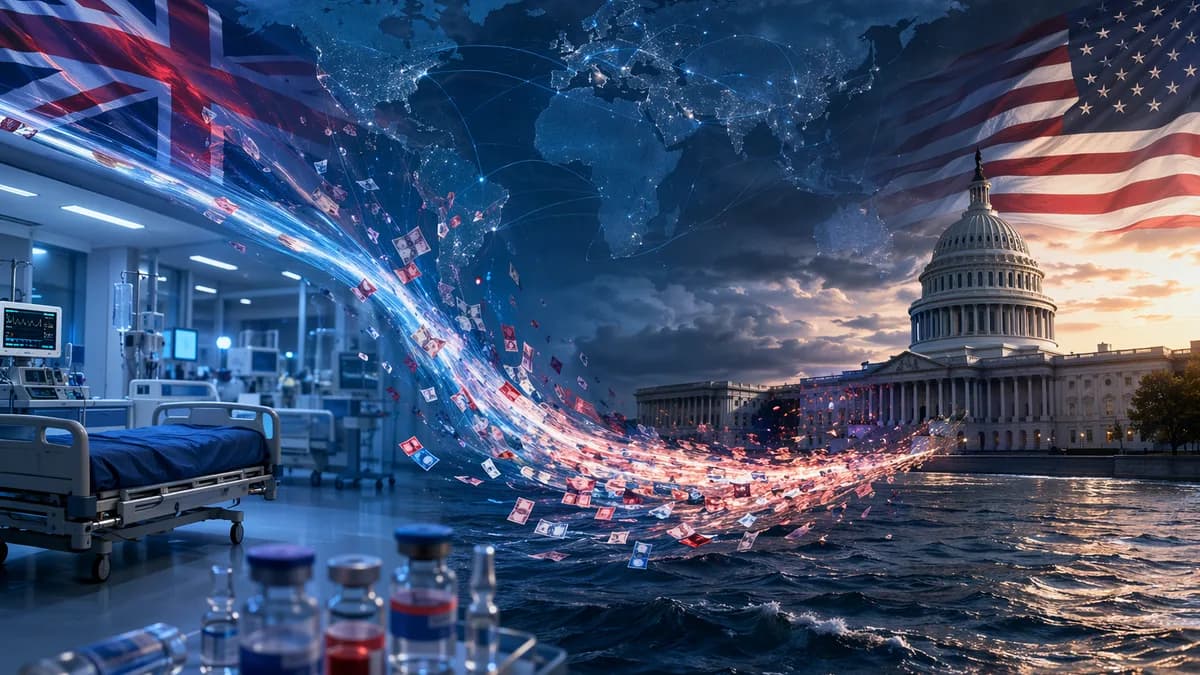
On Wednesday, analysis of the US-UK trade deal turned a diplomatic win into an NHS warning siren: the deal agreed on 1 December 2025 could force the health service to divert billions of pounds from essential care into higher spending on new medicines.
XOOMAR Intelligence
Analyst Take
That is the central charge in reporting from Guardian World, which says the NHS could shift funds away from services under the terms of the agreement, while ministers defend it as a route to avoid threatened US tariffs and give patients access to vital drugs. My view is blunt: if Labour protected pharmaceutical exports by exposing NHS budgets to higher medicine costs, patients are being asked to pay for a trade concession.
On 1 December 2025, Labour accepted Trump’s tariff threat over NHS patients
The deal was announced on 1 December 2025 and hailed by the Labour government as a “landmark” agreement, according to the supplied reporting. The political bargain was clear enough. UK medicines imported into the US would avoid tariffs of up to 100% threatened by Donald Trump, while Britain accepted reforms to medicine pricing that could push up what the NHS pays for new drugs.
That may sound like trade policy. It isn’t only trade policy.
Medicine pricing lands inside a fixed health service. If extra drug spending is not covered by genuinely additional funding, the money has to come from somewhere else. That is why this deal cuts straight into Labour’s claim that it will protect the NHS. A government can’t say the health service is sacred at home, then let it become a bargaining chip in Washington.
The moral imbalance is stark. Shielding drug exports from US tariffs may be politically useful. But an NHS already under strain should not be forced to absorb higher medicine costs by squeezing the care that keeps people alive.
The December US-UK trade deal turns NHS budgets into a bargaining chip
The reported trade-off is simple, and ugly: Britain pays more for new medicines, while ministers argue the arrangement protects UK drug exports from punitive US tariffs and improves access to treatments that might otherwise have been judged too expensive.
The government’s case deserves to be stated fairly. Faster access to new medicines can matter enormously for patients. Some drugs are not marginal upgrades. Some change lives. Ministers also say the deal helps make the UK a better place to develop, launch and manufacture new medicines.
But the hard question is not whether new drugs can help patients. Of course they can. The hard question is who pays, how much, and what gets squeezed if the bill rises.
The analysis published in the British Medical Journal, as reported by related sources, says the NHS may have to divert £44.7bn by 2036 to pay more for new medicines if no extra funding is provided to cover the additional costs. Other reporting rounds that to £45bn. Either way, that is not a footnote. It is a structural claim on NHS cash.
| Claim | Government position | Critical analysis cited in reporting |
|---|---|---|
| Short-term cost | Extra £1bn between 2025-26 and 2028-29 | Costs rise after 2028-29, with no later government estimate given |
| Longer-term NHS cost | The £45bn figure is “not recognised” by the department | £44.7bn could be diverted by 2036 if no extra funding is made available |
| Patient impact | More access to life-changing new medicines | Up to 229,000 avoidable deaths by 2036, according to the analysis |
| Trade benefit | UK drug exports avoid tariffs of up to 100% | Critics say Labour caved to Trump’s pressure |
The phrase “if no extra funding is made available” matters. It is the hinge of the whole dispute. If ministers have ringfenced new money, they should show it. If they haven’t, then the US-UK trade deal is effectively writing a claim on NHS services before patients, staff, or Parliament can see the full bill.
By 2036, billions for new drugs could mean less money for the care that saves lives
The headline number is brutal: the analysis projects 229,000 avoidable patient deaths by 2036. The Guardian’s summary says the deal could lead to more than 200,000 excess deaths. That estimate will be challenged. It should be interrogated closely, because numbers this grave must survive scrutiny.
But Labour cannot hide behind uncertainty over the exact figure. The broader logic is harder to dismiss. If billions are diverted from essential services to meet higher drug costs, the NHS loses capacity elsewhere.
The source material does not prove that specific services will be cut in specific places. It does, however, point to the risk of money moving away from essential and frontline care. Ciarán Devane, chief executive of the NHS Alliance, warned that if billions are diverted away from frontline care, the consequences for prevention, community services and the treatment of long-term conditions could be “profound.”
“The government must urgently publish the full impact assessment and ensure there is appropriate scrutiny of the deal if it could have such far-reaching implications for population health.”
That is the key demand. Publish the impact assessment. Show the assumptions. Identify the budget lines. Explain whether the NHS is paying more because the government chose a trade concession over a tougher negotiation.
This is also where the Trump pattern matters. In trade disputes, tariff threats are not abstract. They are pressure tools. XOOMAR has covered that same coercive logic in Trump Turns USMCA Renewal Into a Trade Pressure Trap. The NHS version is more alarming because the bargaining chip is not an auto rule or a border measure. It is public health spending.
Trump’s tariff pressure exposed Britain’s weak hand after December
The political damage for Labour is not just the cost. It is the posture.
Critics accuse the party of caving to Donald Trump. That accusation sticks because the deal appears to accept the US priority, higher returns for medicines supplied into the NHS, in exchange for relief from threatened tariffs on British drug exports.
XOOMAR analysis: this is what weakness looks like in a trade negotiation. Not because Britain made a concession. Trade deals require concessions. The weakness is agreeing to terms that may reshape NHS spending, while the full details have not been made public and the long-term cost remains contested.
The government says the agreement will be funded through allocations made at the spending review, where it says record NHS funding was secured. A Department of Health and Social Care spokesperson said:
“Through our partnership with the US, we have reformed medicine pricing, allowing NHS patients to access life-changing new medicines they previously would have been denied. We are also making the UK one of the best places in the world to develop, launch and manufacture new medicines.”
That defence is polished. It is also incomplete. “Record funding” does not answer the core question. If the NHS receives more money but also inherits larger obligations, patients still need to know what loses out.
Labour should not pretend this is only a technical pricing reform. It is a decision about whether the NHS can be used to settle a tariff fight with Washington.
Patients need new medicines, not a raid on essential NHS care
The strongest counterargument is real. Patients with serious conditions may benefit from faster access to innovative medicines. A system that rejects effective drugs solely because they are too expensive can feel cruel to the people waiting for them.
Ministers are also right that drug exports and medicine manufacturing matter. The source material says the deal helped UK medicines imported to the US avoid tariffs of up to 100%. That is not a trivial threat.
But none of that justifies secrecy or budget fog. New medicines should be paid for through transparent health spending, value assessments, and hard negotiation with industry. They should not be smuggled into NHS budgets through a trade deal shaped by tariff pressure.
There is a difference between funding innovation and blank-cheque politics. If a medicine is worth paying more for, ministers should make that case in public. If the NHS needs extra money to absorb the cost, they should provide it openly. If the trade deal hands too much to pharmaceutical companies, they should renegotiate.
That standard should apply whether the pressure comes from Trump, industry, or any future US administration. Britain’s health service cannot become collateral for someone else’s tariff threat.
The next spending review must expose the NHS cost of the Trump trade deal
The next decision point is transparency. Ministers should publish the full financial impact of the US-UK trade deal on NHS budgets, including the period after 2028-29, where the government admits costs will rise but has not supplied estimates in the source material.
Parliament should scrutinise any trade provisions that affect drug pricing, NHS spending, or patient access to care. Not after the money has moved. Before.
There are three practical tests Labour should meet now:
- Cost: Publish the year-by-year NHS exposure through 2036.
- Services: Identify which parts of NHS spending would be protected if drug costs rise.
- Scrutiny: Put the relevant trade provisions before Parliament for proper examination.
This follows a broader problem in Trump-era politics, where pressure campaigns are often dressed up as bilateral dealmaking. As we noted in E Jean Carroll Demands $5M From Trump After High Court Snub, Trump’s political orbit thrives on force, spectacle, and refusal to concede ground. Labour should have understood that before letting NHS funding become part of the negotiation.
The watch item is simple: if ministers can prove this deal brings new medicines without draining essential NHS care, they should publish the evidence. If they can’t, they should reopen the deal.
A government that claims to rescue the NHS cannot quietly mortgage it to keep Donald Trump away from the tariff button.
Impact Analysis
- The deal could shift billions of pounds away from NHS services into higher drug spending.
- Avoiding US tariffs of up to 100% may come at a direct cost to UK health budgets.
- The agreement raises questions about whether the NHS was used as leverage in trade negotiations.
Trade Deal Trade-Offs
| Area | Reported Benefit | Reported Risk |
|---|---|---|
| UK medicines exported to the US | Avoided threatened US tariffs of up to 100% | Protection may depend on UK concessions over medicine pricing |
| NHS medicine spending | Ministers argue patients could gain access to vital drugs | Higher prices for new medicines could divert billions of pounds from essential care |
| Labour government | Presented the 1 December 2025 deal as a landmark agreement | Faces criticism that NHS budgets were exposed to higher costs to appease Trump |
Primary Sources & Disclosures

Written by
XOOMAR Insights Team
Research and Editorial Desk
The XOOMAR Insights Team pairs automated research with human editorial judgment. We track hundreds of sources across technology, fintech, trading, SaaS, and cybersecurity, cross-check the facts, and explain what happened, why it matters, and what to watch next. We do not just rewrite headlines. Every article is fact-checked and scored for reliability before it goes live, and we link back to the original sources so you can verify anything yourself.