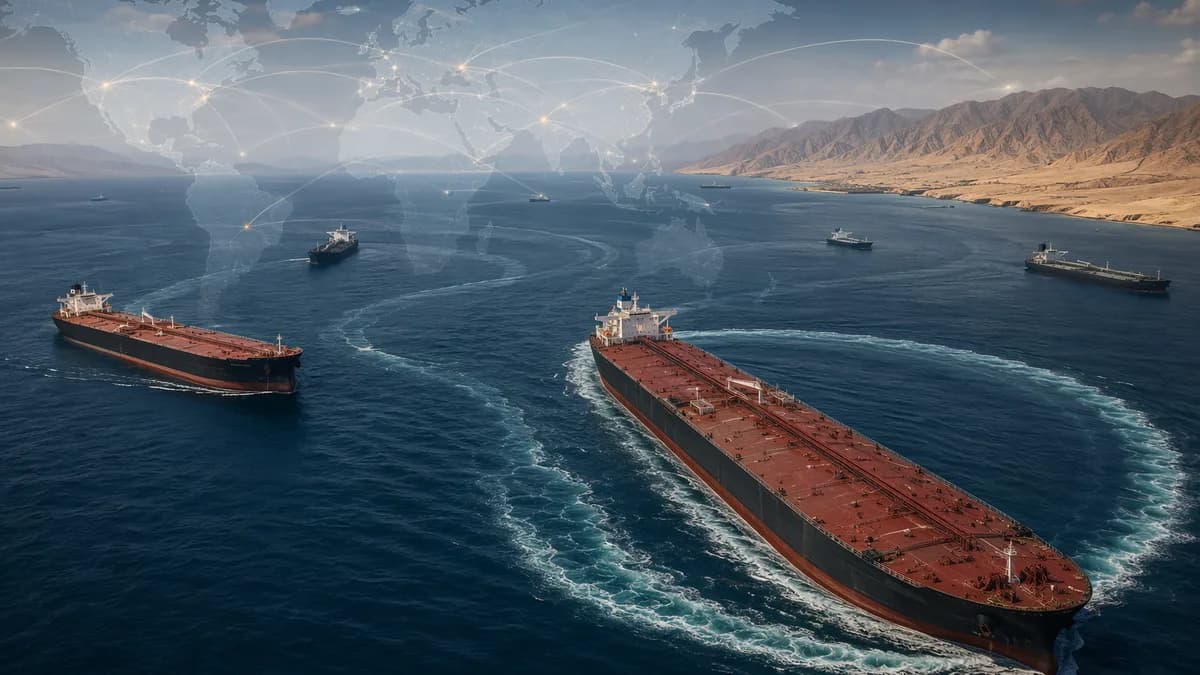
Saudi Arabia’s Red Sea oil route was supposed to ease the pressure from Hormuz, but ship-tracking data now shows at least seven oil tankers making sharp U-turns near Yemen after a new Houthi shipping threat. All of the vessels were travelling to or from Saudi ports before changing course, according to BBC World.
XOOMAR Intelligence
Analyst Take
The timing is the key fact. The Iran-linked Houthi group announced a “maritime embargo” against Saudi Arabia on Monday. The tankers then made abrupt course changes near the Bab al-Mandab Strait, the narrow southern gate into the Red Sea.
Tankers linked to Saudi routes make sudden U-turns after Houthi shipping threat
The Houthi shipping threat targets vessels connected to Saudi ports. In an email to shipowners seen by the BBC, the Houthis said “vessels are banned from loading or discharging cargo at any Saudi ports” and warned that ships “may be subject to targeting in any location within the operational reach”.
That wording is broad. It doesn’t just threaten vessels inside the Red Sea. It raises the perceived risk for any ship that recently called at, or planned to call at, Saudi ports.
“The timing is consistent with the embargo announcement,” maritime risk management company Vanguard said, while noting that the reasons for each course change cannot be independently verified.
MarineTraffic data cited by the BBC showed the crude oil tanker Rodos, loaded with Saudi crude, left the Red Sea port of al-Muajiz for India on Monday evening. The Liberian-flagged ship sailed south toward Bab al-Mandab, then about nine hours later turned north.
The Liberian-flagged oil and chemical tanker Mica also departed Saudi Arabia’s Jazan port on Monday afternoon, headed south, and later reversed course.
Ship-tracking data also showed at least eight ships bound for the Red Sea turning around instead of entering Bab al-Mandab from the south. The Liu Jiang Kou, a Marshall Islands-flagged vehicle carrier, had been sailing from China to Jeddah before changing course in the Gulf of Aden. The New Prime, a Hong Kong-flagged crude tanker from China, also turned around while heading toward Saudi Arabia and appeared to be waiting in the Arabian Sea.
Reuters, cited in related reporting, identified three Saudi crude tankers that turned around: Xin Long Yang, Rodos, and Amazon. Xin Long Yang was described as a VLCC carrying 2 million barrels of Saudi crude for China, while Rodos had loaded about 700,000 barrels for India.
The operators have not publicly confirmed security concerns as the reason for each move. That gap matters. But in shipping, visible behavior often moves faster than official explanation.
Red Sea security fears put Saudi oil routes back under pressure
The Red Sea carries almost 15% of global sea trade. It links the Mediterranean to the Gulf of Aden through the Suez Canal and Bab al-Mandab, two chokepoints that are now central to Saudi export logistics.
That route has become more important since the US-Israeli war with Iran led to the effective closure of the Strait of Hormuz, severely restricting oil and gas flows from the Gulf. Saudi Arabia has shifted more than 70% of its crude exports from the Gulf to the Red Sea port of Yanbu through an east-west pipeline, according to data from Kpler and Signal Ocean cited by the BBC.
Yanbu has been shipping about four million barrels per day in recent weeks, compared with about 973,000 a year earlier.
For a focused read on the embargo itself, see XOOMAR’s Houthi Maritime Embargo Throws Saudi Oil Route in Doubt. For broader global-trends coverage outside this shipping story, XOOMAR is also tracking States Freeze Paramount Warner Merger After DOJ Approval.
The change in routing pressure is stark:
- Before the threat: Saudi Red Sea exports helped offset constraints from Hormuz.
- After the threat: Ships linked to Saudi ports began showing defensive course changes near Yemen.
- If Bab al-Mandab tightens: Saudi oil bound for Asia may need longer routes through the Mediterranean and around southern Africa.
Rosemary Kelanic of the US-based Defense Priorities think tank told BBC Verify that the Red Sea route has played a “major role in relieving pressure to global markets”. If the Houthis further restrict trade, she said, “prices will go up”.
Kelanic also warned that Houthi attacks in the Red Sea or Gulf of Aden “will suppress all international traffic not just Saudi-bound vessels”.
That is the market fear. The declared target is Saudi-linked shipping, but the practical effect of a credible threat in a narrow maritime corridor is wider caution.
The EU naval force Aspides recommended on Wednesday that “merchant vessels linked to Israeli, US or Saudi interests avoid transiting the Red Sea and Gulf of Aden until the threat level decreases”, according to an advisory seen by Reuters.
Shipping firms, oil traders and naval forces face a fresh Red Sea test
The immediate question is whether these U-turns become a wider pattern. Kpler data cited by the BBC showed 20 vessels entered the Red Sea and 22 exited via Bab al-Mandab the day before the Houthis announced the blockade.
The next data points will come from ship behavior: more diversions, disabled transponders, slower approaches to Saudi ports, or tankers holding position outside the chokepoint.
Reuters reported that war-risk insurance costs had already risen in the past 24 hours, with risk assessments for Saudi ports being re-evaluated. British maritime security company Ambrey advised vessels calling at Saudi Arabian ports to reconsider Red Sea transit and implement stronger mitigation measures, assessing those ships as being at “high risk”.
The Houthis have done this before. After the Gaza war began in October 2023, they attacked merchant vessels in the Red Sea and Gulf of Aden, saying they were acting in support of Palestinians. Those attacks led to four ships being sunk, one vessel seized, and nine crew members killed.
That history explains the defensive signaling now visible on the water. At least 50 vessels in the region are broadcasting that they have armed guards on board, according to MarineTraffic data cited by the BBC.
Martin Kelly of EOS Risk Group told BBC Verify that captains will worry the “Houthis might read your situation wrong” and assume a vessel “called at a Saudi port in the past, then therefore you could be attacked”.
“A lot of these ships are very large crude oil carriers. I think the damage would be catastrophic. There would be certainly be deaths onboard these ships,” Kelly said.
Saudi Arabia has rejected the Houthis’ allegation that the embargo is retaliation for a Saudi blockade of ports and airports in Houthi-controlled north-western Yemen. Riyadh has vowed to “take all necessary measures to protect its ships in accordance with international law”.
The practical watch item is Bab al-Mandab traffic. Even without a confirmed attack, enough tanker U-turns can push insurers, charterers, and shipowners into defensive mode. If Saudi-linked traffic keeps hesitating near Yemen, the Red Sea stops looking like the relief valve for Hormuz and starts looking like the next pressure point.
Impact Analysis
- The Houthi threat raises security risks for vessels linked to Saudi ports, even beyond the Red Sea.
- Abrupt tanker U-turns suggest shippers may be reassessing routes near the Bab al-Mandab Strait.
- Disruption on Saudi Red Sea routes could add pressure to global oil logistics already exposed to regional chokepoints.
Ships reversing course near Bab al-Mandab
Primary Sources & Disclosures

Written by
XOOMAR Insights Team
Research and Editorial Desk
The XOOMAR Insights Team pairs automated research with human editorial judgment. We track hundreds of sources across technology, fintech, trading, SaaS, and cybersecurity, cross-check the facts, and explain what happened, why it matters, and what to watch next. We do not just rewrite headlines. Every article is fact-checked and scored for reliability before it goes live, and we link back to the original sources so you can verify anything yourself.