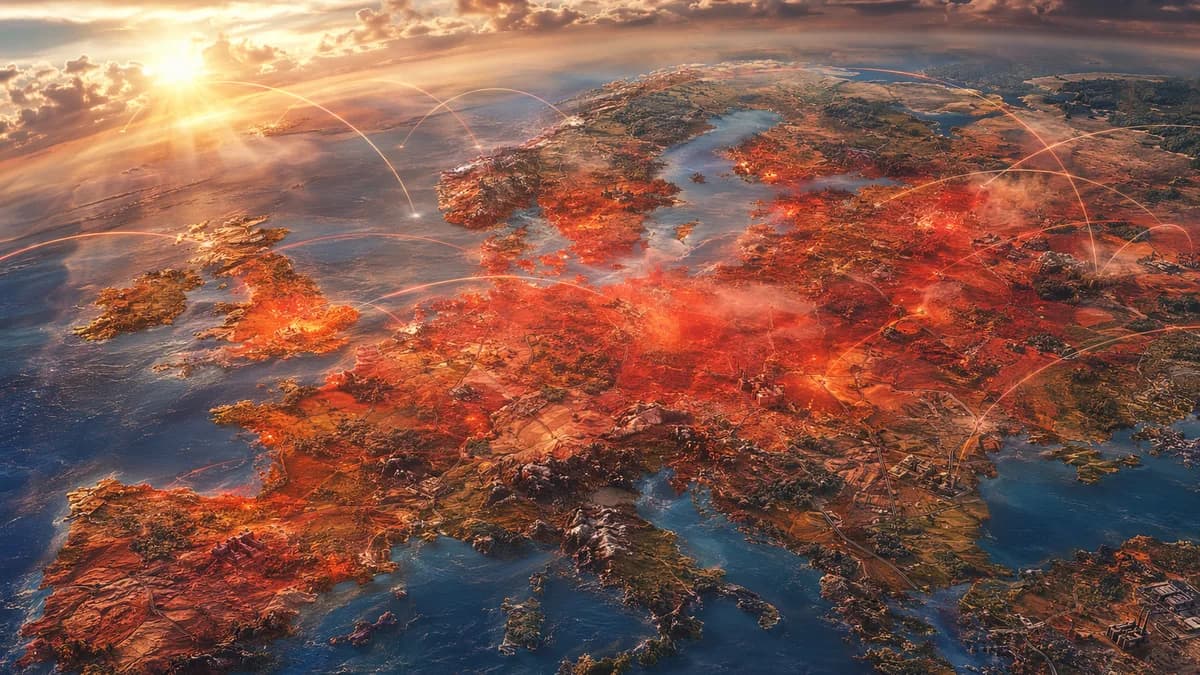
The Europe heatwave records broken on Saturday now sit alongside the larger shock: an estimated 150 million people are experiencing temperatures above 35C. That hits residents first, but it also puts transport networks, public health systems and local authorities under stress at the same time.
XOOMAR Intelligence
Analyst Take
Germany, Denmark and the Czech Republic all reported new all-time highs as extreme heat moved north and east from the Iberian peninsula, including Budapest toward a 40C danger zone, according to BBC World. The central signal is clear: this is no longer a southern Europe story. The current heatwave has pushed record conditions into countries that do not usually sit at the center of Europe’s worst summer heat.
Europe's heatwave records have moved north, and 150 million people are in the heat zone
Germany set a provisional national high of 41.5C in Möckern-Drewitz in Saxony-Anhalt, its second all-time record in two days. Denmark reported a provisional 37C in Odum, near Aarhus, above its previous 36.4C record from 1976. The Czech Republic recorded 40.8C at Doksany, north of Prague.
The practical question is blunt: how many systems can cope when the same heatwave hits roads, rail, cities and health services at once?
"This heat isn't pleasant summer weather. It's a health crisis," Katrin Goering-Eckardt, a German politician and former leader of the Green Party, said on X.
That framing matters. The BBC reports the heatwave has already been linked to deaths across Europe. France has recorded at least 55 drowning deaths since the heatwave began, with an estimated two-thirds involving swimming in unsupervised areas. Spain’s MoMo monitoring system recorded 327 deaths that could be linked to heat between Sunday and Thursday.
XOOMAR analysis: The record readings matter less as isolated numbers than as a systems test. When Germany breaks an all-time high one day and then breaks it again the next, the concern shifts from “hot weather” to whether public services can keep adjusting fast enough.
For related context on the same heat episode, see XOOMAR’s coverage of France Hits Top Alert as Europe Heatwave Turns Deadly and 40C Europe Heatwave Cracks Rails, Schools and Cities.
Meteorological agencies now own the hard part: verifying 41.5C, 40.8C and 37C
The reported Europe heatwave records are based on provisional or national meteorological readings, which means some figures may still require formal verification. That caveat does not weaken the story. It shows how quickly the heat has moved through multiple national record books.
| Country or region | Reported reading | Location | Record status in source |
|---|---|---|---|
| Germany | 41.5C | Möckern-Drewitz, Saxony-Anhalt | Provisional all-time high |
| Czech Republic | 40.8C | Doksany, north of Prague | Highest-ever temperature reported by CHMI |
| Denmark | 37C | Odum, near Aarhus | Provisional all-time high, above 36.4C from 1976 |
| Switzerland | 39C in BBC, 38.8C in AP | Basel | Hottest-ever June day, third day in a row in BBC report |
The supplied reports do not provide normal seasonal averages, overnight minimums, humidity readings or urban heat measurements. That limits any precise comparison with typical late-June conditions. The cleaner comparison is against prior records, and those were broken in several places at once.
A full heat risk assessment would need more than afternoon peaks. It would include:
- Duration: How many consecutive days remain dangerously hot.
- Night temperatures: Whether people and buildings cool down after sunset.
- Humidity: How hard it is for the body to shed heat.
- Urban exposure: How much heat is retained by dense city surfaces.
- Infrastructure tolerance: Whether roads, rails and power systems stay functional.
The BBC says the extreme heat will continue through the weekend into Monday, with temperatures above 40C still possible in places. Cooler conditions developing in western Europe are expected to move east later in the week.
City operators and transport chiefs face heat as an infrastructure stress test
The physical driver, according to BBC lead weather presenter Ben Rich, is a slow-moving high-pressure system, described as a "heat dome". Under that system, sinking air compressed and warmed, while largely cloud-free skies let strong sunshine keep pushing temperatures higher.
"Underneath the high pressure system sinking air compressed and warmed, lifting temperatures day by day."
The operating question for city and transport managers is no longer whether heat is uncomfortable. It is whether assets designed for one range of conditions can keep working when records reset.
AP reported that Germany’s Autobahn was affected as temperatures were expected to hit 40C, with concrete on the A2 bursting in two places outside Berlin and forcing closures. AP also reported that Deutsche Bahn and other rail companies advised against all nonessential train travel over the weekend.
"Germany’s transportation infrastructure is being severely affected by the record-breaking heat this weekend," Deutsche Bahn said in a statement.
In Berlin, police deployed two water cannons to spray mist onto people. That is a striking image because it turns emergency hardware into public cooling equipment. XOOMAR analysis: when a city uses police water cannons for heat relief, the line between weather response and civil infrastructure gets thin.
Households and workers get the least abstract version of the Europe heatwave records
For households, the immediate issue is not climate modeling. It is whether homes, commutes and daily routines remain safe when outdoor temperatures exceed 35C across such a large population.
The question for families is practical: who needs checking, where is the nearest cool indoor space, and what happens if transport fails?
The source material does not break down heat illness by age, occupation or income. It also does not provide hospital admission data. What it does provide is enough to show public risk: the World Meteorological Organization warned the heatwave would have "major impacts" to health and ecosystems, while deaths in France and Spain have already been linked or potentially linked to the heat.
XOOMAR analysis: That makes communication a central part of the response. Public advice is useful, but the harder test is whether cities and employers can reduce exposure when heat peaks during travel, work and school hours. The BBC source does not say how individual governments are adjusting labor rules, opening cooling centers or changing school operations, so those remain gaps to track rather than facts to assert.
Farmers, insurers and businesses must price a hazard that does not break cleanly
The WMO warning explicitly includes ecosystems, but the supplied reports do not provide crop-loss figures, livestock data, wildfire statistics, irrigation demand or electricity demand. That absence matters. Heat often damages systems in scattered ways before it creates one clean headline event.
The business question is how to measure a hazard that spreads across health, transport, water, productivity and infrastructure at the same time.
Known disruptions already include transport damage and travel warnings in Germany. Known human impacts include heat-linked mortality data from Spain’s MoMo system and drowning deaths in France during the heatwave. Known meteorological impacts include all-time or monthly records across Germany, Denmark, the Czech Republic and Switzerland.
XOOMAR analysis: For insurers, infrastructure owners and corporate risk teams, that pattern is difficult because heat does not always produce a single claimable disaster. It can show up as road damage, delayed trains, staff absence, spoiled goods, stressed public services and emergency response costs. The current reporting does not quantify those losses, but it shows the channels through which they can emerge.
Europe's next heat records will test politics before they test thermometers
The BBC reports that Europe is the world's fastest-warming continent, citing factors including rapid Arctic heating and changes in the jet stream. Scientists from World Weather Attribution say a heatwave of this magnitude so early in summer would have been virtually impossible 50 years ago, and say climate change is "unequivocally" to blame.
The political question is what governments do after the temperatures drop.
If the next few days confirm more Europe heatwave records, or if the same event produces wider transport shutdowns and higher death counts, the pressure on heat action plans will rise. If cooler air arrives quickly from the west and impacts remain contained, officials may get a short reprieve. They should not confuse that with proof of resilience.
The evidence to watch now is specific: final validation of national records, updated mortality data, rail and road repair reports, public health surveillance, and whether cooler conditions reach the east as forecast. The thesis stands or weakens on those facts. Europe’s climate challenge is moving from proving that heat risk exists to deciding, in operational detail, who pays to live safely with it.
Impact Analysis
- About 150 million people are facing temperatures above 35C, raising public health risks across Europe.
- Record heat in northern and central Europe shows extreme conditions are expanding beyond traditional southern hotspots.
- Transport, healthcare and local government systems are being tested simultaneously by the scale of the heatwave.
New Heat Records Across Europe
| Country | New Record | Location | Context |
|---|---|---|---|
| Germany | 41.5C | Möckern-Drewitz, Saxony-Anhalt | Provisional national high and second all-time record in two days |
| Denmark | 37C | Odum, near Aarhus | Above the previous 36.4C record from 1976 |
| Czech Republic | 40.8C | Doksany, north of Prague | New national heat record reported |
Reported National Heat Records
Primary Sources & Disclosures

Written by
XOOMAR Insights Team
Research and Editorial Desk
The XOOMAR Insights Team pairs automated research with human editorial judgment. We track hundreds of sources across technology, fintech, trading, SaaS, and cybersecurity, cross-check the facts, and explain what happened, why it matters, and what to watch next. We do not just rewrite headlines. Every article is fact-checked and scored for reliability before it goes live, and we link back to the original sources so you can verify anything yourself.