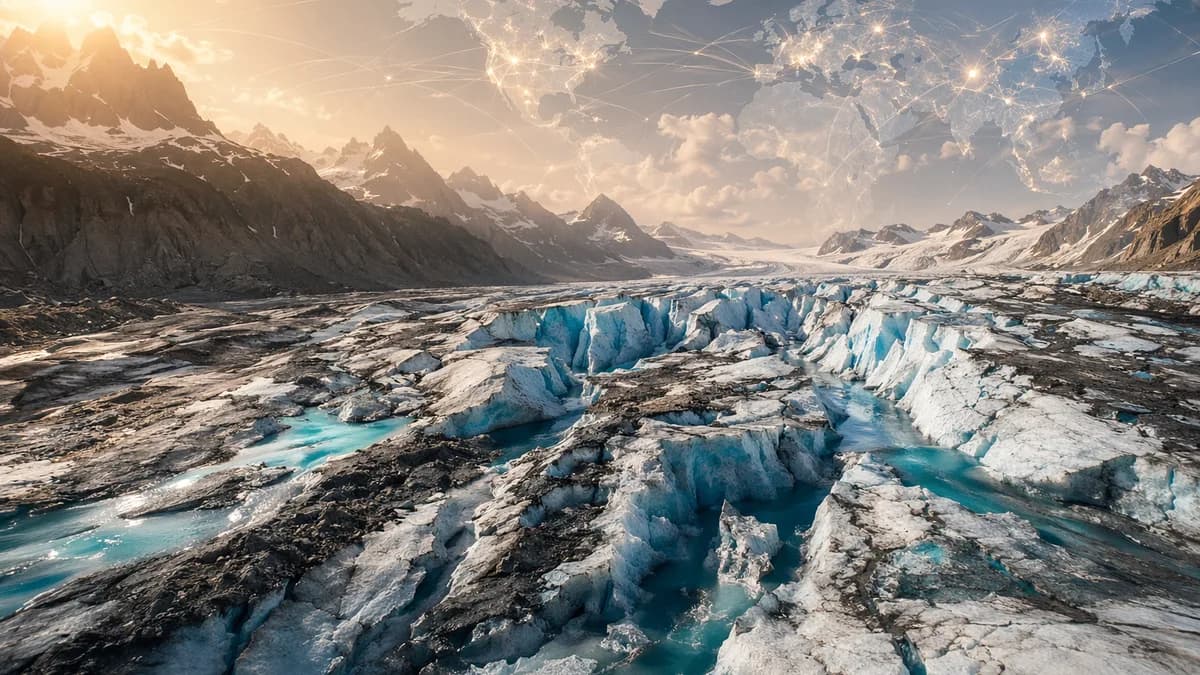
Swiss glaciers are about to burn through last winter’s snow and start losing older ice months before a healthy season should allow it.
XOOMAR Intelligence
Analyst Take
That is the signal behind glacier loss day, the point when winter accumulation has vanished and every further melt episode cuts into the glacier itself. Switzerland is expected to hit that point by Monday, the second-earliest arrival in data going back to 2000, according to Guardian World.
The primary keyword here is Swiss glaciers, but the real story is broader than one hot week. The current European heatwave is landing on glaciers already weakened by poor snowfall, a warm May, and a spring dust event from the Sahara desert. XOOMAR has been tracking the same heat stress across Europe, including Europe heatwave deaths, Europe Heatwave Turns Deadly as Paris Sounds Alarm, and France Hits Top Alert as Europe Heatwave Turns Deadly.
Swiss glaciers are spending their winter savings before summer peaks
Swiss glaciers normally rely on winter snow as a temporary shield. That snow reflects sunlight and delays exposure of the older glacier ice beneath it. Once the seasonal layer disappears, the glacier is no longer spending this year’s deposit. It is drawing down capital.
That is why Monday matters. It is not a calendar curiosity. It marks the point when the mass-balance year turns structurally negative unless cold, snowy weather interrupts the melt season.
Matthias Huss, head of Glacier Monitoring in Switzerland (Glamos), told AFP the Alps are already seeing severe losses:
“We’re just seeing enormous ablation, ice melt rates and snow melt rates all over the Alps.”
He added:
“We are three months too early compared to a healthy state.”
XOOMAR analysis: That framing is the clearest way to read the data. A glacier can survive a bad afternoon. It struggles when the protective snowpack disappears before the main summer melt period has even fully played out.
The numbers behind Switzerland’s glacier loss day and the Alpine heatwave
The expected glacier loss day would be the second-earliest in Switzerland’s record since 2000. The only earlier instance was in 2022, when it arrived on 26 June.
This century, the tipping point has arrived on average in mid-August. That average is already poor for Swiss glaciers, which have been shrinking fast. Moving the date into late June means the glaciers face weeks of additional exposure before October, when the annual measurement season closes.
The numbers are stark:
| Metric | Reported figure |
|---|---|
| Expected glacier loss day in 2026 | By Monday |
| Earliest glacier loss day in data since 2000 | 26 June 2022 |
| Average glacier loss day this century | Mid-August |
| 2026 snow replenishment versus 2010-20 | 25% less |
| Swiss glacier volume loss from 2000 to 2024 | 38% |
| Glaciers lost in Switzerland over past 50 years | 1,200 |
| Glaciers left in Switzerland | 1,300 |
The comparison with 2022 is worrying because Huss described that year as “by far the most extreme year ever recorded in the Alps, with melt rates shattering everything we had seen before.” Reuters-linked 2025 context also shows how compressed the damage has become: Switzerland’s glaciers lost 5.9% of volume in 2022 and 4.4% in 2023, while 2025 brought another loss of nearly 3%.
Early snow loss turns heat into a feedback loop
The mechanism is simple and brutal. Fresh snow is bright. Bare glacier ice is darker. Once the white cover disappears, the exposed grey surface absorbs more radiation and melts faster.
That is the feedback loop now threatening Swiss glaciers. A snow-poor winter left less material on the glacier surface. A warm May helped remove it early. The current heatwave is accelerating the exposure of old ice.
France24’s AFP report adds an important physical detail: once the reflective winter snow is gone, darker bare ice absorbs radiation more quickly, worsening the melt. That means the timing of snow loss can matter almost as much as the peak temperature.
Huss also pointed to a “combination of bad circumstances,” including reduced snowfall and the arrival of Sahara desert dust in March. Dust can darken snow surfaces, which weakens their reflective role. The supplied sources do not quantify that effect for this season, but they identify it as part of the current glacier stress.
One heatwave alone does not explain the damage. Huss put it plainly:
“The problem is rather that we have very high temperatures that last for a very long time.”
The Rhone Glacier measurement shows how fast the loss is moving
Huss said he had just returned from the Rhone Glacier. In the 10 days since his previous visit, he said, “there was one metre of ice melted in the vertical direction.”
That is not a model output. It is a field observation from one glacier during the current heatwave.
“It’s very impressive to see, and this is just the effect of the heatwave.”
XOOMAR analysis: The Rhone Glacier example matters because it converts an abstract loss day into a measurable vertical cut. A metre of ice thickness in 10 days is the kind of observation that makes the season’s direction hard to dismiss, even before final September measurements arrive.
The longer record is even harsher. Swiss glaciers began retreating about 170 years ago, initially slowly. In recent decades, the retreat has accelerated as the climate has warmed. Between 2000 and 2024, their volume shrank by 38%.
The same melt signal reaches rivers and mountain hazards
The supplied sources do not detail effects on ski operators, hydropower output, or tourism balance sheets, so those should not be overstated. What they do support is more direct: glacier retreat changes high-mountain risk and touches major river systems.
Much of the water that flows into the Rhine and the Rhone comes from Alpine glaciers. That does not by itself prove a specific operational impact this week, but it explains why glacier loss is not only a mountain issue.
There is also the hazard side. ETH Zurich’s 2025 glacier reporting quoted Huss saying:
“The continuous diminishing of glaciers also contributes to the destabilizing of mountains.”
That source linked glacier decline to risks such as rock and ice avalanches, citing the Lötschental valley event where an avalanche of rock and ice buried the village of Blatten.
XOOMAR analysis: The lesson is that melting ice changes the physical structure of Alpine terrain. Less ice can mean more exposed, unstable mountain material. That matters for monitoring, land-use planning, emergency preparation, and the cost of keeping high mountain areas safe.
Swiss glaciers are visible climate accounting
Glacier melt is easy to sentimentalize. The stronger reading is accounting. Snowfall is income. Summer melt is spending. Old ice is the balance sheet.
This year’s account is already weak. The glaciers started with 25% less snow replenishment than the 2010-20 comparison period. They then faced a warm May and a severe heatwave. If the winter layer is gone by Monday, all further melt into October reduces the underlying glacier mass.
That is why Swiss glaciers are such a hard climate indicator. The losses accumulate. They do not reset after a cool week.
The forward watch is now specific. September measurements will show the full scale of this year’s damage. Evidence that would confirm the worst reading includes continued high temperatures, more early bare-ice exposure, and large negative mass-balance readings across multiple monitored glaciers. Evidence that would soften it would be sustained cooler weather and enough high-altitude snow to slow exposed ice melt.
Huss’s long-term warning is blunt:
“If warming continues as it did over the last decades, by 2100 we will only be left with some little remnants of ice.”
The Alps are not waiting for a distant climate milestone. Their glaciers are already marking the ledger, one early loss day at a time.
Impact Analysis
- Swiss glaciers are losing protective winter snow far earlier than expected.
- Early exposure of older ice increases the risk of severe glacier mass loss this season.
- The heatwave shows how poor snowfall, warm spring weather, and dust events can compound climate stress.
Swiss Glacier Season: Current Conditions vs. Healthy State
| Aspect | Current Conditions | Healthy State |
|---|---|---|
| Glacier loss day | Expected by Monday, the second-earliest in data since 2000 | Would arrive much later in the melt season |
| Snow cover | Winter snow nearly exhausted before summer peaks | Winter snow shields older glacier ice through more of summer |
| Timing | About three months too early, according to Matthias Huss | Seasonal melt remains delayed by cold and snow |
Primary Sources & Disclosures

Written by
XOOMAR Insights Team
Research and Editorial Desk
The XOOMAR Insights Team pairs automated research with human editorial judgment. We track hundreds of sources across technology, fintech, trading, SaaS, and cybersecurity, cross-check the facts, and explain what happened, why it matters, and what to watch next. We do not just rewrite headlines. Every article is fact-checked and scored for reliability before it goes live, and we link back to the original sources so you can verify anything yourself.