
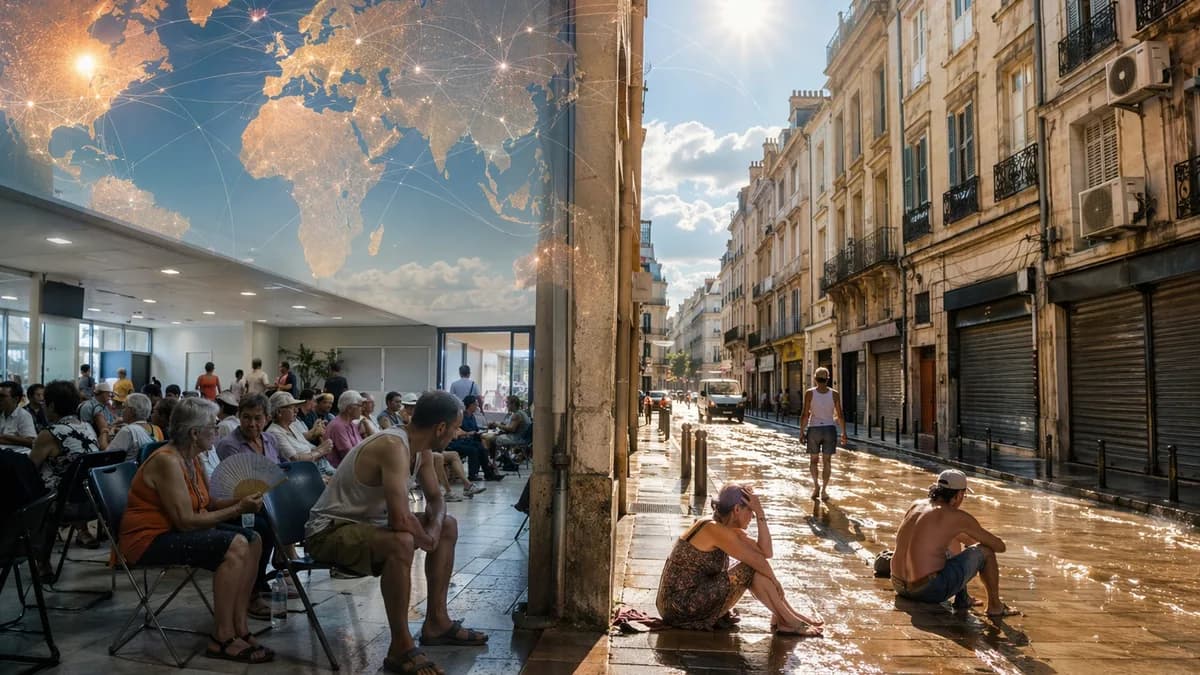
On Tuesday, France recorded its hottest day on record, and that should end the fiction that France air conditioning is mainly a question of taste. It is now a public health argument, a schools argument, a hospital argument, and yes, a climate adaptation argument.
Global TrendsJune 24, 2026· 8 min read· By XOOMAR Insights Team
Record Heat Ignites France's Air Conditioning Fight
Updated on June 25, 2026
XOOMAR Intelligence
Analyst Take
58/ 100
4 sources analyzedLow confidenceTrend10Freshness97Source Trust92Factual Grounding88Signal Cluster20
Only 25% of French households have an air-con unit, compared with 50% in Spain and Italy and 90% in the US and Japan, according to BBC World. That gap was once treated as cultural restraint. In a week when temperatures nudged 40C, it looks more like under-preparation.
On Tuesday, France Air Conditioning Stopped Being a Lifestyle Fight
France's suspicion of air-conditioning is no longer proof of environmental seriousness. During dangerous heat, cooling becomes basic infrastructure.
The old divide is familiar. One side sees la clim as wasteful, ugly, individualistic, and too close to American-style overconsumption. The other sees it as overdue adaptation to a hotter France. That split now runs straight through French politics: Marine Le Pen wants a mass subsidised roll-out, while Greens who long resisted air conditioning are conceding that some cooling is unavoidable.
XOOMAR analysis: The useful argument is not comfort versus climate. That framing is stale. The real choice is between planned, efficient, targeted cooling and a refusal to adapt that pushes people toward panic purchases, overheated schools, strained hospitals, and unequal protection.
"There are places where we just can't do without it now," Marie Tondelier, head of the Ecologists party, said.
That sentence matters because it breaks with what she called "anti- clim dogma". It also gives the French left a way out of a trap it helped build.
This Week's School Closures Made Heat a State Capacity Test
The heatwave has dragged French schools and hospitals into the center of the fight. Thousands of schools have had to shut this week, while medical and nursing staff complain that conditions are becoming intolerable.
That changes the debate. Once classrooms close and hospital staff struggle to work, air conditioning is no longer a private indulgence. It becomes a measure of whether public services can function under the climate France already has.
The same pressure is visible in homes. The BBC reports a rush to buy portable air-conditioning appliances so children can spend a few hours in class or apartment-dwellers can get through the night. That is not a national plan. It is improvisation.
Recent XOOMAR coverage has tracked the wider public safety strain around French heat, including France Heat Wave Forces Alcohol Curbs as 40 C Looms, Canal Dips Reveal France Red Heatwave Alert Crisis, France's top heat alert, and Europe heatwave death warnings. The air-conditioning fight belongs in that same category: heat is now disrupting ordinary systems.
France can admire shutters, stone walls, greenery, and good design. It should. But architecture alone will not protect every patient, student, worker, or tenant when heat keeps pressing into the night.
The Air Conditioning Taboo Hid a Bigger Climate Adaptation Failure
France has been more comfortable talking about reducing emissions than redesigning daily life for heat that has already arrived.
That is not unique to France, but France made la clim unusually symbolic. To many environmentalists, air conditioning did not attack the root cause of global warming. It softened the effects, consumed electricity, used refrigerant gases that can leak, and expelled hot air into streets. The BBC notes that some studies suggest the urban heating effect can raise city temperatures by two or three degrees.
Those objections are serious. They are not enough.
Insulation, greenery, and high-tech air circulation are necessary. French building and renovation norms already emphasize those measures, with the express aim of making air conditioning unnecessary. But this week shows the flaw in making "unnecessary" the central goal. In some buildings, during some heatwaves, for some people, cooling is necessary.
Analysis: Climate adaptation is not surrender. It is the refusal to let people suffer while emissions cuts work on a longer clock.
Nuclear Power Gives France a Better Starting Point, Not a Free Pass
France has one advantage many countries do not: most of its electricity comes from nuclear power, according to the BBC. That does not make air conditioning consequence-free, but it does weaken the argument that every new cooling unit automatically means more fossil-fuel burn in the French case.
Still, unmanaged demand can create its own problem. If households, schools, hospitals, and transport operators all buy whatever units are available during peak heat, France gets the least efficient version of adaptation.
A serious France air conditioning policy should not simply subsidise boxes in windows and call it done. It should set efficiency rules, plan for peak demand, and tie cooling to building upgrades where possible. It should also protect the grid before emergency demand explodes on its own.
Here is the political choice now forming:
| Approach | Strength | Risk |
|---|---|---|
| Passive cooling first | Cuts demand through insulation, shade, greenery, and ventilation | Fails when buildings still become unsafe |
| Mass air-con roll-out | Quickly reduces heat exposure in schools, hospitals, and homes | Can raise demand, waste heat, and refrigerant risks |
| Targeted efficient cooling | Protects vulnerable places while limiting waste | Requires planning, standards, and public money |
The third path is the only serious one.
The Green Case Against La Clim Deserves Respect, Then a Rebuttal
The strongest counterargument is not anti-modern nostalgia. It is practical. More air conditioning can raise electricity demand. It can worsen hot streets through waste heat. It can excuse lazy building design. Refrigerant gases are greenhouse gases and often leak.
That is the best case against a careless roll-out.
But shaming cooling will not stop demand. The BBC already reports a rush to buy portable units. That is what happens when politics refuses to plan: households solve the immediate problem with whatever they can find, while poorer people wait, sweat, and hope public buildings stay open.
XOOMAR analysis: The environmental answer is regulation, not denial. Cleaner refrigerants, repair obligations, building codes, passive cooling, shaded public spaces, and targeted subsidies can sit inside one policy. France does not need to choose between concrete heat traps and full-throttle overcooling.
Le Pen Has Found the Opening, Because the Center Left It Open
The political right has long been more pro-clim than the left, and National Rally is now pressing that advantage. Le Pen is calling for a nationwide "plan clim" to equip all schools and hospitals with air-conditioning.
According to RN spokesman Jean-Philippe Tanguy, the plan would include government-backed interest-free loans worth €20bn ($22.7bn; £17.2bn) to allow 30 to 40 million householders to install cooling units.
Critics call the plan opportunistic and uncosted. They also argue that the populist right was late to accept the reality of climate change, which weakens its credibility when talking about climate effects.
That criticism lands. But it does not solve the problem.
When a political movement offers cooling and its opponents offer moral discomfort, voters will notice. The way to beat a bad plan is a better plan, not a lecture on virtue.
Cooling Must Reach the Poor Before It Flatters the Comfortable
The equity problem is blunt. Wealthier households can install cooling quietly. Poorer renters, patients, schoolchildren, and public-sector workers depend on landlords, budgets, and ministries.
A national cooling strategy should start with schools, hospitals, nursing facilities, dense apartments, and public transport, not luxury overcooling. The Nantes hospital controversy shows the stakes: a giant new hospital being built there will have air-conditioning in only half its rooms, provoking anger from medical trade unions.
"In the environmental context, we should have la clim everywhere," said Olivier Terrien of the CGT union.
That line is striking because it flips the old script. In a hotter country, leaving essential buildings without cooling can itself become the irresponsible choice.
Valerie Pécresse, the conservative president of the Paris regional council, is pushing in the same direction. She hopes to have all buses and trains equipped with aircon by 2032.
Before the Next Heatwave, France Needs a Cooling Plan With Teeth
France should stop letting air conditioning become a culture-war trophy. The government needs a national cooling strategy that is blunt about trade-offs and strict about waste.
The priorities are clear:
- Retrofits: insulation, shade, greenery, and ventilation where they work.
- Essential cooling: schools, hospitals, care settings, and public transport first.
- Efficiency: standards that avoid a rush into weak, power-hungry units.
- Grid planning: preparation for heatwave peaks before they hit.
- Refrigerants: tighter rules to prevent leaks from becoming the next climate bill.
- Access: help for households most exposed to dangerous heat.
France does not have to copy the worst habits of overcooled societies. But it does have to keep people alive in the century it now inhabits.
Impact Analysis
- France’s record heat is turning air conditioning from a lifestyle debate into a public health issue.
- Low household AC adoption leaves France more exposed than countries such as Spain, Italy, the US and Japan.
- The political fight is shifting toward how to deliver targeted, efficient cooling without worsening climate pressures.
France's Air Conditioning Divide
| Side | Position |
|---|---|
| Marine Le Pen | Supports a mass subsidised air-conditioning roll-out |
| Greens/Ecologists | Long resisted air conditioning but now concede some cooling is unavoidable |
Household Air-Conditioning Adoption
France
%25
Spain
%50
Italy
%50
US
%90
Japan
%90
Sources

Written by
XOOMAR Insights Team
Research and Editorial Desk
The XOOMAR Insights Team pairs automated research with human editorial judgment. We track hundreds of sources across technology, fintech, trading, SaaS, and cybersecurity, cross-check the facts, and explain what happened, why it matters, and what to watch next. We do not just rewrite headlines. Every article is fact-checked and scored for reliability before it goes live, and we link back to the original sources so you can verify anything yourself.
Explore More Topics
Related Articles
 Global Trends
Heatwave Squeezes Crews at France and Spain Wildfires
Crews in France and Spain have a shrinking window to contain massive fires before heat and wind threaten new flare-ups.
Aug 2, 20267 min
 Global Trends
Pope Leo Schedules Abuse Survivor Meeting in France
Pope Leo's upcoming state visit to France now features a pre-planned meeting with clergy sexual abuse survivors, set to become the central public focus of the t
Aug 7, 20269 min
 Global Trends
Migrants Refuse French Aid in Channel Fire Standoff
A boat with over 150 people refused French rescue attempts until their vessel's engine ignited, forcing their evacuation. The incident highlights migrants' dete
Aug 4, 20265 min
 Global Trends
Record Cyclospora Outbreak Kills Two in Michigan
Two people in Michigan have died in a record U.S. Cyclospora outbreak, marking the first fatalities and showing the parasite's dangerous potential for the medic
Aug 4, 20267 min
 Global Trends
London Temporary Housing Blocks AC As Kids Go to Hospital
Homeless families in a glass London block were reportedly barred from built-in AC as heat sent two children to hospital.
Aug 3, 20267 min
 Fintech
Banks Invade Earned Wage Access, Force Fintechs Out
Major banks and credit unions are launching earned wage access to retain customers and gather data, forcing original fintech providers into a defensive scramble
Aug 10, 20264 min
 Fintech
Brazil Aims Pix Payments at Global Payment Giants
Brazil's central bank is pushing its dominant Pix instant payment system onto the global stage, aiming to reshape cross-border payments and challenge establishe
Aug 10, 20267 min
 Technology
Zuckerberg's Personal AI Pitch Betrays Meta's True Motive
Mark Zuckerberg's new AI manifesto, promising universal 'personal superintelligence,' inadvertently exposes the commercial engagement and data-harvesting logic
Aug 10, 20265 min
 Technology
Tech Giants Lose Major Ruling, Face 2,400 Addiction Suits
A federal appeals court refused to let Meta, Google, TikTok, and Snapchat use Section 230 to quickly dismiss thousands of lawsuits accusing them of intentionall
Aug 10, 20266 min
 Fintech
CFPB Opens Gate for Banks to Charge Open Banking Fees
The CFPB may scrap its ban on data-access fees, allowing banks to charge third-party apps for your transaction history and potentially crippling the free flow o
Aug 10, 202610 min
Don't miss the signal
Get our weekly roundup of the stories that matter across tech, fintech, and trading. No noise, just signal.
Free forever. No spam. Unsubscribe anytime.