
About a third of France is under a France heatwave red alert as authorities restrict public alcohol consumption, cancel some outdoor sports events, and put emergency services and military forces on wildfire alert during a worsening France heat wave.
Global TrendsJune 21, 2026· 6 min read· By XOOMAR Insights Team
France Heat Wave Forces Alcohol Curbs as 40 C Looms
Updated on June 22, 2026
XOOMAR Intelligence
Analyst Take
60/ 100
3 sources analyzedLow confidenceTrend20Freshness98Source Trust85Factual Grounding91Signal Cluster20
National and local officials are acting as temperatures are expected to reach 40 C (104 F) in some areas on Sunday, with Monday forecast to be hotter, according to ABC International. The measures are aimed at reducing health risks during a period when large crowds, outdoor events, and limited air-conditioning could combine into a serious test for public services.
One-third of France is on heat red alert as alcohol and sports limits hit
The immediate flashpoint is France’s annual Music Day on Sunday, a nationwide summer solstice celebration that brings thousands of concerts to village squares, rave venues, Paris clubs, and other public spaces.
The government ordered Music Day organizers to limit alcohol use to:
“preserve emergency services and allow medics to concentrate on taking care of the most vulnerable.”
That phrasing matters. Officials aren’t treating alcohol restrictions as a lifestyle nudge. They’re treating them as emergency load management during a dangerous heat event.
Some outdoor sports events are also being canceled. The source does not specify which events or regions are affected, but the logic is clear from the broader heat posture: strenuous activity in extreme temperatures increases the chance that people need urgent care, especially during the hottest parts of the day.
XOOMAR analysis: The restrictions show how French authorities are prioritizing emergency capacity. Music Day crowds, alcohol, and high temperatures can create a dense cluster of risk at the exact moment medics are needed for older people, isolated residents, and people living on the streets.
| Measure | Immediate target | Source-backed purpose |
|---|---|---|
| Alcohol limits at Music Day events | Large public gatherings | Preserve emergency services and let medics focus on vulnerable people |
| Outdoor sports cancellations | Strenuous activity in extreme heat | Reduce exposure during dangerous temperatures |
| Misting stations in Paris | Crowds at major venues | Cool people in public spaces |
| Wildfire readiness | Emergency services and military forces | Prepare for fire risk during the heat wave |
| Nuclear water-supply surveillance | France’s reactors | Tighten monitoring as heat stresses water systems |
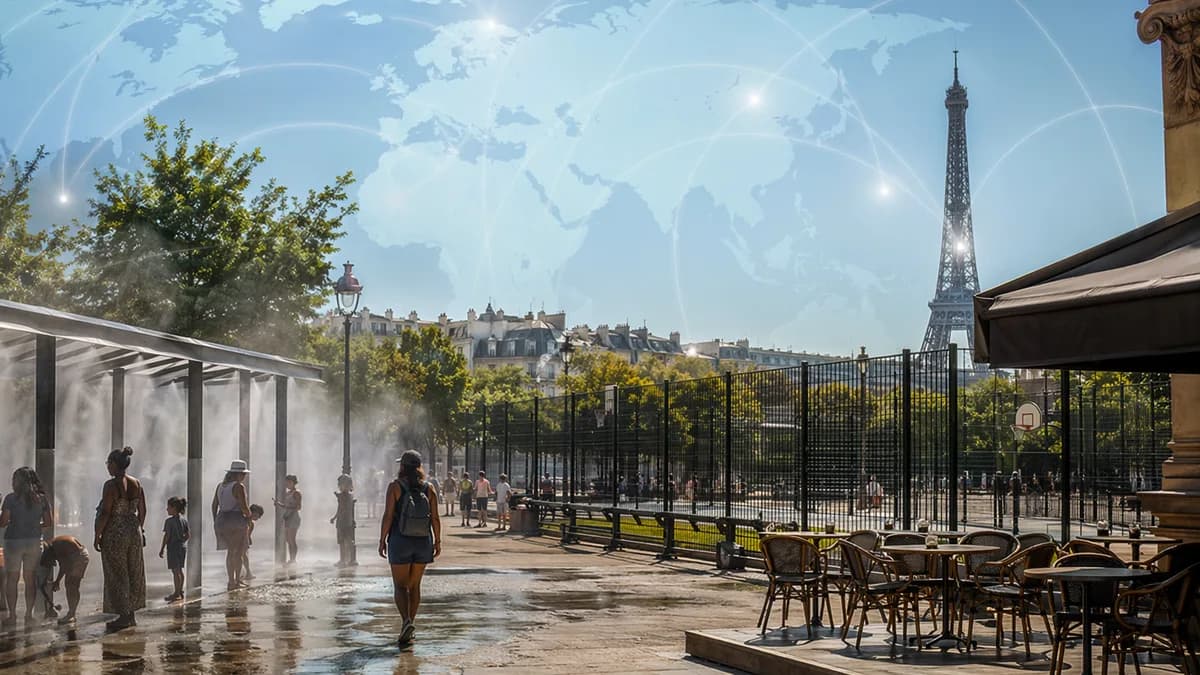
The Eiffel Tower and other Paris venues have set up misting stations for crowds. That is one of several measures announced by national and local authorities as the France heat wave spreads across the country.
40 C temperatures turn public health into an emergency-services problem
The World Health Organization’s Europe office said this month that more than 200,000 people across Europe died from heat-related causes over the last four years, and that most of those deaths were preventable.
The health risks named in the source are direct: heat exhaustion and life-threatening heat stroke. More above-average temperatures are expected this summer, according to WHO’s Europe office, which called for heat plans such as cooling centers, breaks, or flexible shifts that keep workers out of the midday sun.
France has a sharp national memory here. About 15,000 older people died in a 2003 heat wave, a disaster that became a reckoning for the country.
Authorities are now especially worried about people living in “baking streets,” elderly people in nursing homes, and older residents isolated at home. Those groups are more likely to be exposed for long periods or unable to cool down quickly.
Schools will close only as a last recourse, the government said. End-of-year exams scheduled in the afternoons may be delayed until the following morning or otherwise rearranged.
That detail shows how officials are trying to avoid a full shutdown while still changing schedules around peak heat. The operational goal is narrower than a lockdown: reduce the highest-risk exposure windows, keep essential services functioning, and avoid flooding medics with preventable emergencies.
For readers following how public systems absorb sudden shocks, XOOMAR’s broader global-trends coverage includes separate reporting on Russian Warning Shots Rattle British Yacht in the Channel and Trump Meloni G7 Photo Claim Erupts Into Alliance Fight. Those are distinct stories, but they sit in the same reader lane: government response under pressure.
Wildfire alert adds military readiness to France’s heat response
France is also putting emergency services and military forces on wildfire alert. The government announced reinforced wildfire readiness on Saturday as the heat wave intensified.
The source does not describe the specific military role, the regions where forces are positioned, or whether any major fires are already underway. What is clear is that authorities are preparing for a scenario in which heat becomes more than a public health problem.
The government also ordered tightened surveillance of water supplies to France’s many nuclear reactors. That is a critical infrastructure detail, not a footnote. France is not only managing public events and health risks. It is also monitoring systems that depend on water availability during extreme heat.
Prime Minister Sebastien Lecornu convened a government heat crisis meeting on Saturday and planned another one on Sunday. The national weather service described the hot spell as:
“widespread, long-lasting and intense”
Lecornu ordered ministers to plan for better adaptation to future heat waves, including:
“via air conditioning, if necessary.”
That line is politically and practically significant because the source notes that air-conditioning isn’t widespread in France. If this heat wave pushes air-conditioning higher on the adaptation agenda, the debate could shift from emergency response to building standards, public cooling access, and electricity demand during future summers.
The next test comes Monday, when the forecast gets hotter
The near-term watch item is Monday’s temperature peak. Sunday is already severe, with 40 C (104 F) expected in some areas, but the forecast for Monday is even hotter.
Residents and travelers should expect local restrictions to remain fluid. The clearest practical moves from the source-backed measures are simple: check local heat alerts, verify whether outdoor events or exams have been rearranged, follow alcohol limits at public gatherings, use cooling points where available, and check on vulnerable people.
France’s response now rests on two clocks. One is immediate, getting through Music Day, Sunday heat, and a hotter Monday without overwhelming medics. The other is longer-term: whether this France heat wave forces faster planning for cooling, wildfire readiness, and infrastructure stress before the next hot spell arrives.
Impact Analysis
- Restrictions on alcohol and outdoor sports are meant to reduce emergency-room demand during extreme heat.
- Music Day crowds create added risk because alcohol, heat, and dense public gatherings can worsen health emergencies.
- The alert shows authorities are preparing for broader strain on medics, emergency services, and wildfire response teams.
Expected Heat Wave Temperature in Parts of France
Sunday forecast in some areas
°C40
Sources

Written by
XOOMAR Insights Team
Research and Editorial Desk
The XOOMAR Insights Team pairs automated research with human editorial judgment. We track hundreds of sources across technology, fintech, trading, SaaS, and cybersecurity, cross-check the facts, and explain what happened, why it matters, and what to watch next. We do not just rewrite headlines. Every article is fact-checked and scored for reliability before it goes live, and we link back to the original sources so you can verify anything yourself.
Explore More Topics
Related Articles
 Global Trends
Heatwave Squeezes Crews at France and Spain Wildfires
Crews in France and Spain have a shrinking window to contain massive fires before heat and wind threaten new flare-ups.
Aug 2, 20267 min
 Global Trends
Pope Leo Schedules Abuse Survivor Meeting in France
Pope Leo's upcoming state visit to France now features a pre-planned meeting with clergy sexual abuse survivors, set to become the central public focus of the t
Aug 7, 20269 min
 Global Trends
Migrants Refuse French Aid in Channel Fire Standoff
A boat with over 150 people refused French rescue attempts until their vessel's engine ignited, forcing their evacuation. The incident highlights migrants' dete
Aug 4, 20265 min
 Global Trends
Ebola River Ship Quarantined After Five Mysterious Deaths
A major river ferry in the DRC has been quarantined with 255 people on board after five deaths, as authorities desperately screen for Ebola to prevent the virus
Aug 9, 20265 min
 Global Trends
Feeding Digital Self-Harm on Starving Celebrities
Viral 'concern' over celebrity weight loss is a form of digital self-harm, experts say. It fuels harmful ideals and hurts those in recovery, showing we've not e
Aug 8, 20265 min
 Fintech
Banks Invade Earned Wage Access, Force Fintechs Out
Major banks and credit unions are launching earned wage access to retain customers and gather data, forcing original fintech providers into a defensive scramble
Aug 10, 20264 min
 Fintech
Brazil Aims Pix Payments at Global Payment Giants
Brazil's central bank is pushing its dominant Pix instant payment system onto the global stage, aiming to reshape cross-border payments and challenge establishe
Aug 10, 20267 min
 Technology
Zuckerberg's Personal AI Pitch Betrays Meta's True Motive
Mark Zuckerberg's new AI manifesto, promising universal 'personal superintelligence,' inadvertently exposes the commercial engagement and data-harvesting logic
Aug 10, 20265 min
 Technology
Tech Giants Lose Major Ruling, Face 2,400 Addiction Suits
A federal appeals court refused to let Meta, Google, TikTok, and Snapchat use Section 230 to quickly dismiss thousands of lawsuits accusing them of intentionall
Aug 10, 20266 min
 Fintech
CFPB Opens Gate for Banks to Charge Open Banking Fees
The CFPB may scrap its ban on data-access fees, allowing banks to charge third-party apps for your transaction history and potentially crippling the free flow o
Aug 10, 202610 min
Don't miss the signal
Get our weekly roundup of the stories that matter across tech, fintech, and trading. No noise, just signal.
Free forever. No spam. Unsubscribe anytime.