
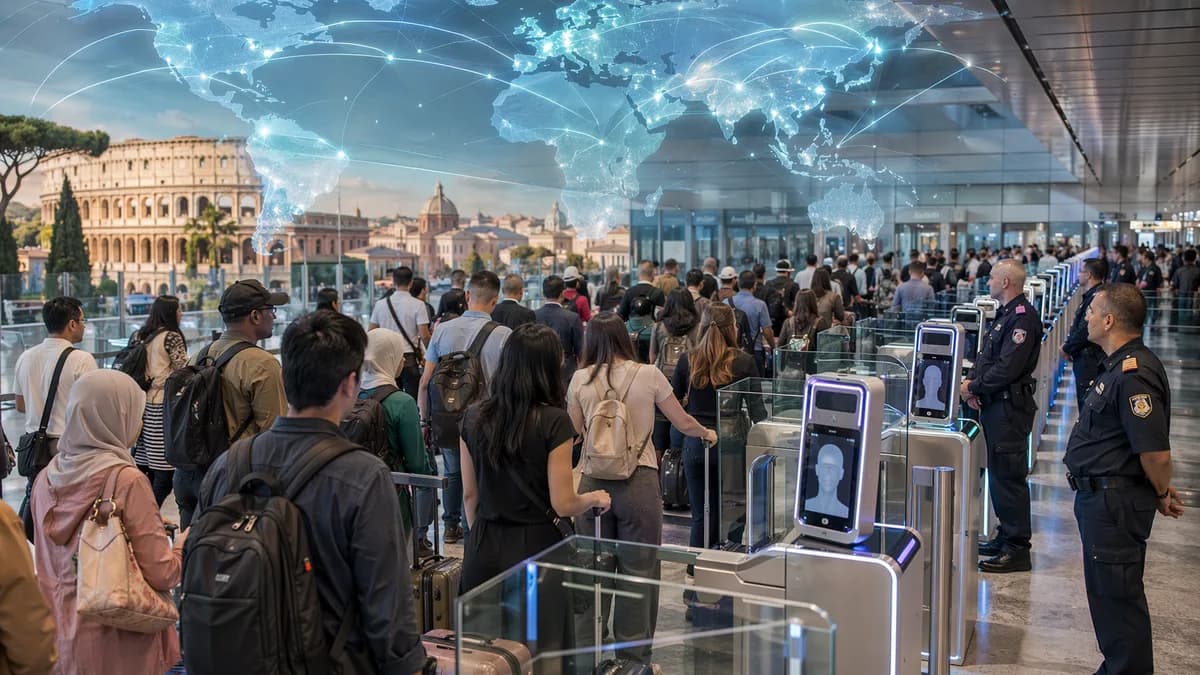
Rome’s airport operator says Rome Fiumicino and Ciampino may need to let non-EU passengers bypass the EU Entry/Exit System this summer to avoid a border-control “disaster.”
Global TrendsJune 26, 2026· 7 min read· By XOOMAR Insights Team
Summer Crush May Halt EU Entry/Exit Checks in Rome
Updated on June 26, 2026
XOOMAR Intelligence
Analyst Take
69/ 100
4 sources analyzedMedium confidenceTrend10Freshness98Source Trust90Factual Grounding92Signal Cluster20
That warning matters most for Britons and other non-EU travelers entering Italy during peak tourism months, especially anyone with tight onward flights. Marco Troncone, chief executive of Aeroporti di Roma, said the new biometric checks are colliding with summer passenger volumes, according to Guardian World.
“The process proves to be incompatible with the peak volumes that we are going to face. So the only way is to open up the valve. There is no way that we can deliver 100% of the enrolment.”
Rome airport operators face the first real summer stress test
The core problem is simple: the EU Entry/Exit System, or EES, requires many non-EU travelers to register biometric data when they first enter the bloc. That takes longer than a passport stamp.
Troncone told the Financial Times he was “very worried for the summer.” On a scale of one to 10, he put his concern at “eight or nine.” Aeroporti di Roma runs Fiumicino, Rome’s main international airport, and the smaller Ciampino.
The pressure is not theoretical. The Guardian reports that EES has already been linked to long queues, faulty technology, and passengers missing flights before the full summer peak. The system was first introduced last October and fully rolled out in mid-April after delays.
Could Rome simply keep processing everyone through EES? Troncone’s answer is no. His argument is that during peak volumes, full enrolment of every eligible passenger may not be operationally possible.
For more on how the same system has already snarled travel elsewhere, see XOOMAR’s coverage of six-hour queues trapping UK travellers in the EU Entry/Exit System.
Non-EU travelers face biometric checks instead of passport stamps
The EU Entry/Exit System replaces manual passport stamping for many non-EU visitors with a digital border record. It applies to non-EU citizens, including Britons, entering the EU for short stays.
At first entry, travelers must have fingerprints and facial images taken. Additional context from Wanted in Rome says the system captures passport data and is designed to calculate how many days visa-free travelers have spent in the Schengen Area, including whether they exceed the 90-day limit.
Who is affected?
The system is aimed at:
- Tourists: Non-EU visitors entering Schengen for short stays.
- Business travelers: Frequent visitors who may be hit if repeat recognition fails.
- UK passengers: Specifically cited in the Guardian’s reporting as facing delays in some countries.
- Visa-free visitors: Travelers whose days in Schengen must be tracked automatically.
EU citizens are not processed the same way under this system.
Why build it at all? The policy goal is tighter, more consistent border control. EES is meant to reduce overstays, improve identity checks, and create a digital entry and exit trail across Schengen countries.
The friction comes from the first-time registration step. Once a traveler has passed through EES before, they should be able to avoid full repeat registration. But the Guardian reports that some passengers who previously went through EES have still been forced to complete the checks again.
Border agencies, not airports, control the off switch
Rome’s airports can warn about the queues. They don’t appear to hold the final authority over whether EES gets suspended.
That distinction matters. Airports are responsible for passenger flow inside terminals, but border checks are run by national authorities under EU rules. If queues become unmanageable, the pressure lands across several desks at once: airport operators, border police, airlines, national governments, EU agencies, and Brussels.
Troncone’s warning is therefore not just a complaint about airport logistics. It is a request for operational room when passenger volumes and biometric enrolment collide. The question is how much flexibility authorities are willing to allow at the busiest moments, and whether any pause or bypass can be used without undermining the wider rollout.
So can Rome let non-EU passengers skip EES without breaking the rollout? The answer depends on how border authorities apply the system in practice. A temporary bypass could preserve passenger flow, but it would also expose the credibility problem at the heart of the launch: a digital border system that cannot handle the busiest border moments is not yet behaving like production infrastructure.
Airlines inherit the passenger anger when border queues break
Airlines do not control EES booths, biometric kiosks, or border staffing. They still absorb part of the fallout when passengers miss flights or connections.
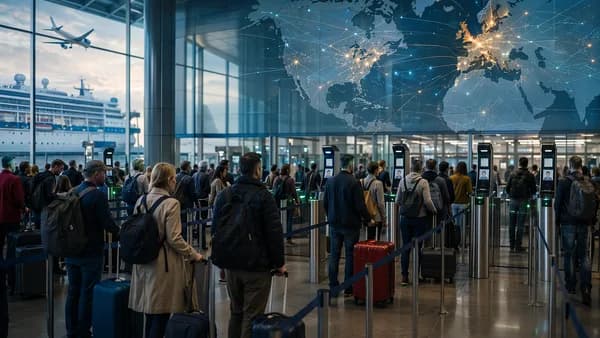
Airport industry warnings have suggested that queues could reach six hours in some airports over the summer, with the concern tied to how first-time biometric registration slows passenger processing when arrivals surge.
That is the clearest operational risk in the reporting. A border process that adds time for each eligible passenger can scale badly when several international flights arrive close together. The Guardian does not provide per-passenger processing times, so any precise queue model would be guesswork. But the reported outcome is already visible: long lines, missed flights, and airport executives pushing for suspension powers.
The impact is also uneven. A traveler arriving at a quiet hour may move through without major disruption, while a passenger landing behind several long-haul flights can face a very different border hall. That variability is exactly what makes summer operations hard to manage: airlines, airports, and passengers all need predictable transfer times, but EES enrolment can turn a normal arrival wave into a backlog.
A useful comparison:
| Process | Main action | Reported issue |
|---|---|---|
| Manual passport stamping | Officer checks and stamps passport | Older process being replaced |
| EES first-time registration | Fingerprints and facial image captured | Longer queues reported at airports |
| Repeat EES passage | Traveler should avoid full re-registration | Some passengers still forced to repeat checks |
For airlines, the customer-service problem starts even if the cause sits outside their control. Missed connections still lead to rebooking desks, delayed baggage plans, and frustrated passengers who may not distinguish between an airline failure and a border-processing delay.
Rome-bound passengers should plan as if EES disruption is real
Non-EU travelers flying into Italy should not assume the EU Entry/Exit System will be suspended, but they should plan for disruption if it isn’t.
Practical steps are limited, but useful:
- Avoid tight onward flights: The Guardian reports missed flights already.
- Check airport and airline updates: Especially before peak summer travel days.
- Keep documents ready: Passport validity, visa status, and Schengen stay limits still apply even if some EES functions are paused.
- Expect repeat checks: The system is supposed to recognize previous EES users, but some travelers have reportedly been asked to complete checks again.
- Track Schengen days carefully: EES is designed to calculate time spent in the area, but travelers should not rely on airport disruption as a compliance buffer.
The summer test for Europe is now clear. If Rome and other pressure points keep reaching for exemptions, the issue won’t be whether biometric borders are politically desirable. It’ll be whether the EU Entry/Exit System can work at full travel volume without turning major gateways into bottlenecks.
Impact Analysis
- Britons and other non-EU travelers could face longer border queues at Rome Fiumicino and Ciampino this summer.
- Airport officials warn full biometric enrolment may not be workable during peak tourism volumes.
- Any suspension or bypass of EES would signal wider pressure on the EU’s new border-control rollout.
Border Processing Options at Rome Airports
| Option | What Happens | Operational Impact |
|---|---|---|
| Full EU Entry/Exit System enrolment | Non-EU travelers register biometric data on first entry | Airport operator says it may be incompatible with peak summer volumes |
| Temporary bypass or reduced enrolment | Some non-EU passengers could be allowed through without full EES processing | Could reduce queues and missed connections during the summer peak |
Sources

Written by
XOOMAR Insights Team
Research and Editorial Desk
The XOOMAR Insights Team pairs automated research with human editorial judgment. We track hundreds of sources across technology, fintech, trading, SaaS, and cybersecurity, cross-check the facts, and explain what happened, why it matters, and what to watch next. We do not just rewrite headlines. Every article is fact-checked and scored for reliability before it goes live, and we link back to the original sources so you can verify anything yourself.
Explore More Topics
Related Articles
 Global Trends
Six-Hour Queues Trap UK Travellers in EU Entry/Exit System
New biometric checks could leave UK holidaymakers stuck for hours at Schengen borders, with missed flights now a real summer risk.
Jun 24, 20269 min
 Global Trends
Cheap Chinese Steel Forces UK Steel Tariffs to 50%
Britain will halve duty-free steel quotas and slap 50% duties above them, turning cheap Chinese metal into an industrial fight.
Jun 25, 20268 min
 Global Trends
Europe Heatwave Turns Deadly as Paris Sounds Alarm
Paris says mortality is rising as 101 million Europeans face 35C heat, turning the heatwave into a systems test for cities.
Jun 25, 20267 min
 Global Trends
40C Europe Heatwave Cracks Rails, Schools and Cities
Europe's 40C heatwave is forcing UK travel warnings and Italian red alerts, showing infrastructure can't keep up with rising heat.
Jun 24, 20269 min
 Global Trends
Burnham May Force Keir Starmer Resignation Clock to Start
Starmer may set a resignation timetable as Burnham enters Parliament, trying to turn Labour’s crisis into a managed handover.
Jun 22, 20268 min
 Fintech
July 1 Clock Traps Binance MiCA License Hunt in EU
Binance pulled its Greek MiCA bid days before July 1, leaving its EU access tied to a fast licensing pivot.
Jun 25, 20267 min
 Technology
Anthropic Access Ban Drags EU Into White House Fight
Europe's fight for Anthropic access is now a Washington problem, turning frontier AI models into strategic infrastructure.
Jun 25, 20267 min
 Global Trends
California Billionaire Tax Puts Tech Fortunes on Trial
California voters will decide whether to tax billionaire net worth directly, a fight that could rattle Silicon Valley wealth.
Jun 26, 202612 min
 Global Trends
5% Wealth Fight Forces California Billionaire Tax Vote
California voters will decide a one-time 5% billionaire wealth tax after talks failed to keep it off November’s ballot.
Jun 26, 20268 min
 Fintech
Nvidia AI Fraud Detection Hunts $403B Card Crime Rings
Nvidia wants banks to hunt fraud rings by mapping accounts, devices and stolen cards, not just scoring isolated payments.
Jun 26, 20267 min
Don't miss the signal
Get our weekly roundup of the stories that matter across tech, fintech, and trading. No noise, just signal.
Free forever. No spam. Unsubscribe anytime.