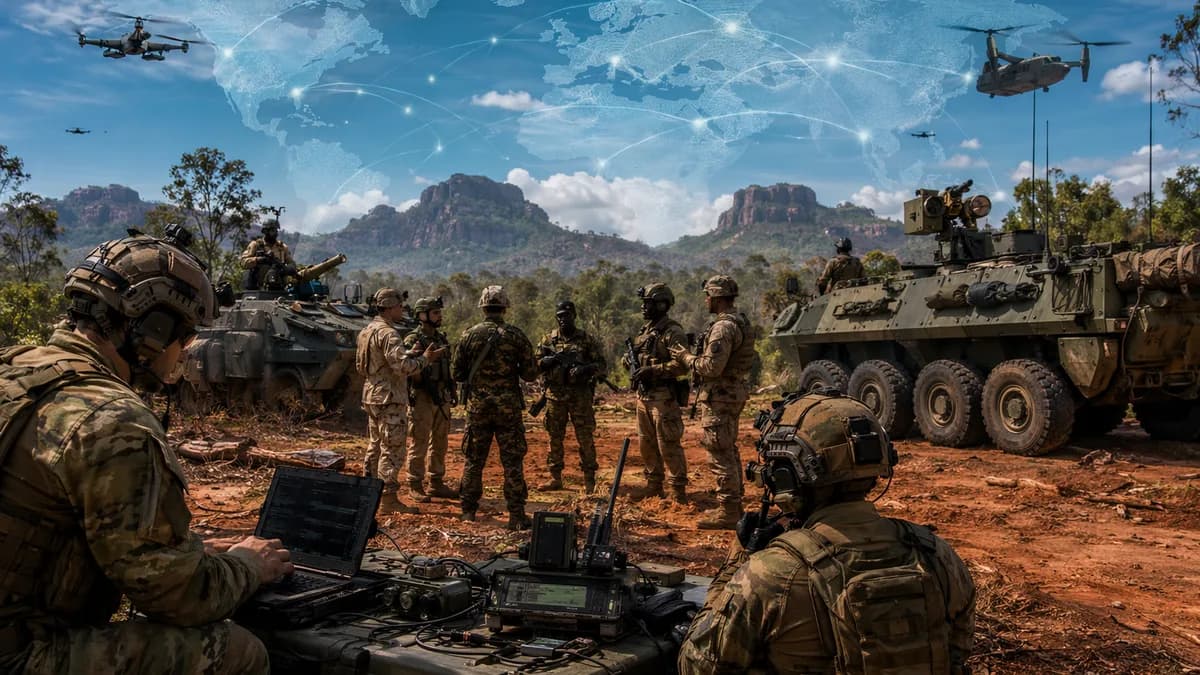
US and Japanese soldiers are training in the Australian bush because a country at peace is being used to rehearse the kind of allied warfare that would have to work before a crisis starts.
XOOMAR Intelligence
Analyst Take
The BBC joined US, Japanese, and Australian troops in remote North Queensland, where they trained in some of Australia’s toughest terrain, according to BBC World. The contradiction is the story: Australia is not at war and sits thousands of kilometres from today’s major conflicts, yet its remote training areas are becoming a place where allied forces test whether they can fight together under pressure.
US and Japanese troops in Australia are rehearsing alliance warfare, not just bush survival
The primary keyword here is simple: US and Japanese troops in Australia. That phrase captures the strategic signal beneath the BBC’s video. These aren’t symbolic visits. The available defence material describes hard field training involving Australian, US Marine Corps, and Japan Ground Self-Defense Force soldiers standing together before deploying into demanding terrain.
Australia’s Department of Defence framed Exercise Southern Jackaroo in unusually blunt language. At Lavarack Barracks on 26 May 2025, Commander 1st (Australian) Division Major General Ash Collingburn told troops the exercise would not be easy.
“Let me be blunt, this will not be a walk in the park.”
He went further:
“This exercise is more than just training, it is a rehearsal for the realities of war and a proving ground for partnerships.”
That matters because it strips away the polite language usually wrapped around joint drills. The point is not just fitness, field craft, or national friendship. The point is to make different militaries act as one force before they are forced to do it for real.
The BBC asks why US and Japanese soldiers are in remote Australia. The answer, based on the defence material, is that Australia offers terrain, distance, and space to stress-test cooperation in ways that classroom planning cannot.
North Queensland gives allied forces room to make mistakes before war does
The exercise described by Australia’s Defence Department involved thousands of personnel, backed by armoured vehicles, artillery, and aircraft. Over four weeks, soldiers were set to move hundreds of kilometres by road and air, secure population centres, defend positions, conduct attacks against an opposing force, and finish with a combined live-fire event.
That is not a narrow infantry drill. It is an attempt to connect movement, communications, fires, logistics, and command under physical strain.
The before and after is stark:
- Before: Allies can claim shared values, joint statements, and common strategy.
- After: Radios either connect or fail. Units either understand each other’s tactics or slow each other down. Fire missions either land on time or expose gaps.
- Before: Australia looks geographically distant from current wars.
- After: Its distance becomes the point, offering space for large, punishing training.
Major General Collingburn put the interoperability problem in battlefield terms:
“When the first shot is fired, it’s too late to ask how the other bloke operates; that understanding must already be instinct.”
This is the core of US and Japanese troops in Australia. The bush is not just a backdrop. It is a filter. Heat, distance, fatigue, wildlife, dust, and long movement routes expose weak procedures faster than a conference room ever could.
Japan’s larger role changes the signal from bilateral to trilateral
Japan’s presence is one of the sharpest parts of the story. The Defence Department said Japan’s contribution tripled for that year’s exercise. Colonel Morita Yuya, commander of the 46th Infantry Regiment of the Japan Ground Self-Defense Force, said many of his soldiers were in Australia for the first time.
“We are honoured to join this exercise. The attitude toward training is very serious and the training infrastructure in Australia strengthens our response capability in the Pacific region,” Colonel Morita said.
He added:
“Many of our soldiers are here for the first time. Australia has a very high level of tactics and we have already learnt many things.”
That phrasing matters. Japan is not presented here as an observer. It is learning how to operate with allies in a demanding environment. The supplied material does not support claims about Japan’s domestic politics or constitutional debates, so the grounded point is narrower but still important: Tokyo is putting more people into field training with Australia and the United States, and the stated focus is response capability in the Pacific region.
A separate 2026 exercise notice said Exercise Southern Jackaroo 2026 was scheduled from May 29 to July 3, 2026, and officially commenced on June 4, 2026. It listed U.S. Marines and Sailors from 1st Battalion, 5th Marine Regiment and Combat Logistics Battalion 5, both with Marine Rotational Force-Darwin 26, alongside the Australian Defence Force’s 3rd Brigade, US Army maneuver elements, and the Japan Self Defense Force.
That second notice described the focus as interoperability advancement, combined arms integration, force-on-force offensive and defensive operations, mounted machine-gun gunnery, and mortar employment. The pattern is clear enough: these drills are not one narrow training episode.
The official logic is deterrence through practiced cohesion
The allied message is not subtle. The 2026 notice said the training was meant to ensure US, Australian, and Japanese forces are ready to respond to regional challenges “as a unified front in any future crisis.”
Lt. Col. Mark Saville, commanding officer of 1st Bn., 5th Marines, said:
“Exercise Southern Jackaroo enhances our collective capability by integrating U.S. Marines alongside our allies in realistic, demanding scenarios. By practicing how we communicate and work together on the ground, we ensure that our combined forces maintain a high state of combat readiness and a decisive tactical edge.”
For Washington, the supplied source only supports one direct conclusion: US Marines and sailors are using Australian training areas to improve combat readiness with allies. For Canberra, the Defence Department’s own language says the purpose is to avoid strangers meeting on the battlefield. For Tokyo, the quoted Japanese commander ties the training to Pacific response capability.
Here is the grounded comparison:
| Actor | What the source supports |
|---|---|
| Australia | Hosting and leading demanding training to build allied battlefield cohesion |
| United States | Sending Marines, sailors, and soldiers to practice communications, tactics, combined arms, and readiness |
| Japan | Increasing participation and using Australian training infrastructure to improve Pacific response capability |
| Local or regional critics | Not covered in the supplied source material |
That last row matters. It would be easy to add reactions from Beijing, regional governments, local communities, or environmental groups. The supplied material does not provide them. A serious analysis should not pretend otherwise.
For broader context on Australia’s regional security posture, XOOMAR has also covered how Canberra’s defence relationships are drawing attention in the Pacific in Australia Vanuatu Military Deal Boxes Out China in Pacific. And where security intersects with technology inside Australia, our reporting on Shark-Spotting Drones Patrol 70 NSW Beaches Year-Round shows how surveillance and remote operations have become familiar tools in civilian settings too, though the Southern Jackaroo material does not say drones were used in this exercise.
The outback drills expose the real bottleneck: fighting together under stress
The hardest problem in coalition warfare is not agreeing on strategy. It is making equipment, people, and procedures work together when everyone is tired, hungry, and moving fast.
Major Nicholas Foust, a USMC Task Force Commander, said the North Queensland area helps prepare Marines for environmental hazards. His quote is more practical than strategic, which makes it more revealing.
“The marines will be working hard. They’ll be tired, hungry and pushing through, but they’re also concerned about being bitten by snakes and spiders here, so that’s a valuable field craft lesson.”
He also said:
“Littorals are the most likely place that conflict will occur, so that’s our primary focus with this training.”
That sentence is one of the clearest clues in the source. Littorals mean coastal zones where land and sea operations collide. In a Pacific setting, that points to the difficult business of moving forces, weapons, supplies, and command systems across contested coastlines and island-adjacent terrain.
The exercise material does not mention specific adversaries. It does not name a target country. It does not say Australia is preparing for a particular war. The supported conclusion is more disciplined: US and Japanese troops in Australia are training for environments and operational problems that allied commanders believe could define a future regional crisis.
The next test is whether these drills stay routine or become politically heavier
The strongest watch item is scale. The supplied material already shows thousands of personnel, a four-week exercise, hundreds of kilometres of movement, live-fire training, combined arms work, and Japan tripling its contribution in the 2025 iteration. The 2026 notice points to continued emphasis on communications, tactics, procedures, gunnery, mortars, and multinational live-fire.
Evidence that would confirm the thesis: larger Japanese participation, more complex combined arms events, deeper integration with Marine Rotational Force-Darwin, and repeated references to allied forces operating as one unit across the Indo-Pacific.
Evidence that would weaken it: smaller drills, reduced Japanese involvement, fewer live-fire or combined arms components, or official language shifting back toward symbolic cooperation rather than combat readiness.
Australia is still not at war. That is the tension the BBC captured. But in remote North Queensland, allied troops are training as if peace depends on being ready before the first shot is fired.
Impact Analysis
- Australia is becoming a key training ground for allied military coordination before any crisis begins.
- The drills show the US, Japan, and Australia are preparing to operate as a combined force.
- The exercise signals rising concern about future conflict scenarios in the Indo-Pacific.
Allied roles in Exercise Southern Jackaroo
| Country | Forces mentioned | Role in the exercise |
|---|---|---|
| Australia | Australian troops | Hosted training in remote North Queensland and provided demanding terrain |
| United States | US Marine Corps | Trained with allies to rehearse joint warfare under pressure |
| Japan | Japan Ground Self-Defense Force | Trained with Australian and US forces to test interoperability |
Primary Sources & Disclosures

Written by
XOOMAR Insights Team
Research and Editorial Desk
The XOOMAR Insights Team pairs automated research with human editorial judgment. We track hundreds of sources across technology, fintech, trading, SaaS, and cybersecurity, cross-check the facts, and explain what happened, why it matters, and what to watch next. We do not just rewrite headlines. Every article is fact-checked and scored for reliability before it goes live, and we link back to the original sources so you can verify anything yourself.