
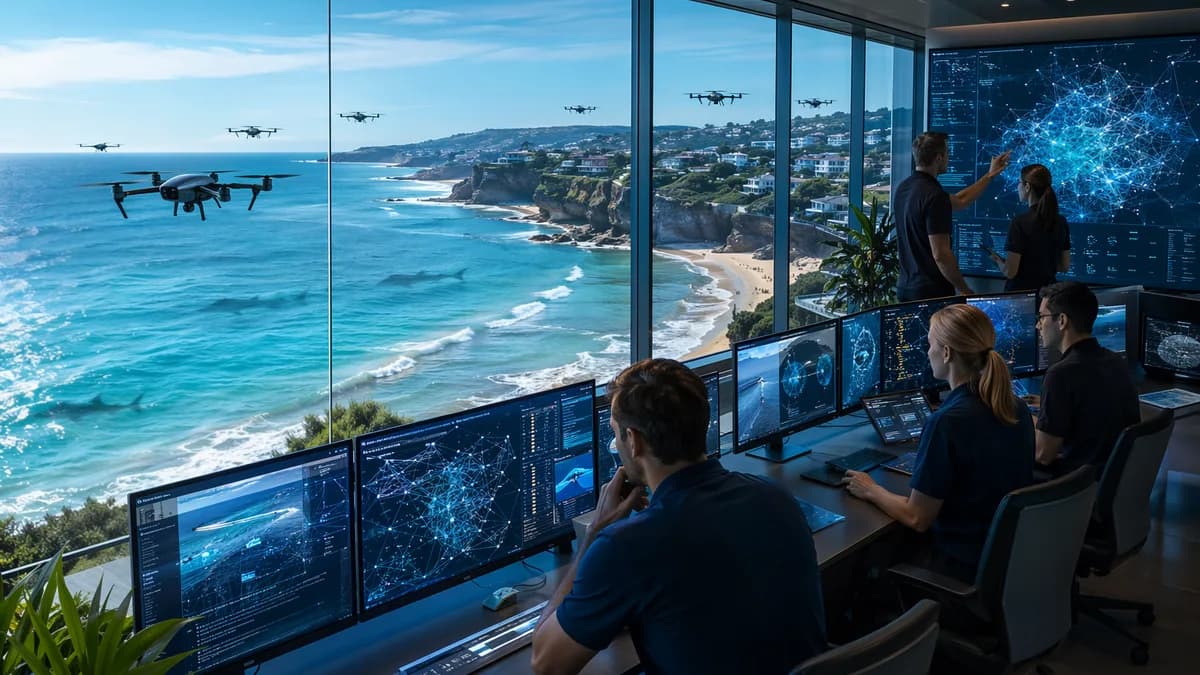
About 70 NSW beaches are set to get year-round shark-spotting drones, a scale-up Premier Chris Minns is pitching as the world’s largest expansion of aerial shark surveillance and a direct response to falling beach confidence after recent attacks.
TechnologyJune 28, 2026· 7 min read· By XOOMAR Insights Team
Shark-Spotting Drones Patrol 70 NSW Beaches Year-Round
Updated on June 28, 2026
XOOMAR Intelligence
Analyst Take
73/ 100
4 sources analyzedMedium confidenceTrend10Freshness98Source Trust90Factual Grounding94Signal Cluster20
The political bet is clear: NSW wants people back in the water without promising the impossible. Minns said the expansion came after “a reduction in the number of people who are enjoying our beaches and enjoying the Pacific Ocean,” according to Guardian World.
NSW shark-spotting drones put confidence ahead of culling
Minns is deliberately lowering expectations. The government is not selling NSW shark-spotting drones as a shield. It is selling them as risk reduction, visibility, and public reassurance.
“It’s not going to be foolproof. We can’t promise it won’t lead to further shark attacks in the future, but we think it’ll mitigate the risk.”
That caveat matters. It tells beachgoers the state won’t claim total control over open water. It also avoids the political trap of overpromising after a shark attack, then losing credibility when the next incident happens.
Minns also pushed back on killing sharks as a solution, noting that sharks are protected and that wide-ranging species don’t behave in ways that make culling a clean policy lever.
“They’re a protected species. They’ve been a protected species since the 90s, and I’m not convinced it would work. I mean, the distances these sharks travel are massive.”
XOOMAR analysis: That framing makes the drone program a middle path. It avoids culling, gives surf lifesavers better visibility, and lets the government show action without claiming it can remove sharks from the ocean.
$34 million more brings the shark program to $120 million
The numbers make this more than a symbolic announcement. NSW is investing another $34 million in shark-spotting drones as part of a $120 million shark mitigation program over the next two years, ABC reported.
The expansion covers about 70 beaches across the NSW coast. Every ocean beach from Palm Beach to Cronulla is due to receive 365-day drone coverage, with all Sydney beaches covered from July 1. Regional operations will expand too, with weekend flights year-round and daily flights from December 1 to April 30.
| Program element | Source-supported detail |
|---|---|
| Coverage | About 70 beaches across NSW |
| Sydney rollout | Every ocean beach from Palm Beach to Cronulla covered 365 days |
| Start date | Expanded program comes into effect on July 1 |
| Funding | Extra $34 million, total shark mitigation program at $120 million over two years |
| Operator | Conducted by Surf Life Saving NSW |
| AI | Trials of two new artificial intelligence shark detection systems over the coming summer |
Surf Life Saving NSW chief executive Steve Pearce called it the “largest ever funding commitment to shark management in Australia.” He also said the existing Shark UAV surveillance program has “this year alone identified and prevented over 2000 sharks interacting with swimmers and surfers, and conducting over 100,000 flights.”
Those are the strongest performance markers in the supplied material. They show activity and intervention. They do not, by themselves, prove a reduction in attacks.
XOOMAR analysis: The next credibility test is measurement. NSW will need to show not just how many drones fly, but how often detections lead to warnings, how quickly beaches respond, and whether swimmers trust the alerts enough to change behavior.
Drones add “more eyes in the sky,” but not certainty
Minns’ strongest line is also the program’s limitation: drones can spot risk earlier, but they can’t make the ocean predictable.
His official statement put it plainly:
“While no-one can ever promise no shark interactions, this investment is about putting more eyes in the sky so we can spot sharks earlier and give people a clear heads-up when they’re in the water.”
That is a narrower and more defensible claim than “beaches will be safe.” The purpose is earlier detection and clearer warning. If that works, NSW shark-spotting drones become a public safety layer, not a standalone answer.
The AI trials are the more forward-looking piece. The sources say NSW will test two new artificial intelligence shark detection systems over the coming summer. They do not say how those systems work, what data they were trained on, or what accuracy thresholds will be used.
XOOMAR analysis: Public trust will depend on how transparent NSW is about AI performance. False reassurance would be dangerous. Too many alerts could also weaken compliance. The sources don’t provide false alarm rates, response times, or beach closure data, which are exactly the metrics needed to judge whether AI improves the program or just makes it look more advanced.
This mirrors a wider government pattern: technology is being used to enforce or manage public-risk problems, but the hard part is accountability. In a separate policy arena, Australia is also tightening pressure on platforms, as we covered in Australia’s social media ban fight with big tech. Different issue, same question: who proves the system works?
Coogee attack turned surveillance gaps into a political problem
The timing is not abstract. The expansion follows the attack on Leah Stewart, a 34-year-old Sydney mother who was critically injured by a suspected white shark while swimming between the flags at Coogee Beach.
ABC reported there were no drone patrols at Coogee at the time because of the beach’s proximity to Sydney Airport’s flight path. Stewart received first aid at the scene and underwent surgery to remove her arm. Her online fundraiser had collected more than $520,000 in donations for the family.
That detail sharpens the operational challenge. A statewide drone program still has local constraints. The supplied sources identify one specific constraint, flight path proximity near Coogee. They do not explain how NSW will solve that issue.
XOOMAR analysis: Coogee makes the politics harder because the attack happened between the flags, the zone swimmers are conditioned to see as supervised. The drone expansion is partly about restoring confidence in that supervision model. If the public believes “between the flags” no longer feels safe enough, the state has a bigger trust problem than any single technology can solve.
Bull sharks and Sydney Harbour may force a different playbook
Minns separated open-ocean shark policy from bull sharks, saying they are “generally” in estuaries and that the government is looking at “an audit of the number of sharks in Sydney Harbour.”
That matters because the policy question changes in enclosed or semi-enclosed waters. Open coast surveillance can focus on ocean beaches, surf lifesaving patrols, and visible swimming zones. Harbour and estuary risks may push the government toward more localized monitoring.
The sources do not say what the Sydney Harbour audit will measure, when it will finish, or what policy would follow. They only show that the government sees bull sharks as a distinct issue.
Drones also fit into a broader race to turn remote observation into operational decisions. In security, the same logic is visible in our coverage of North Korea weapons tests and South Korea’s drone race. In NSW, the stakes are different, but the pattern is familiar: governments want faster detection, faster alerts, and less reliance on human line-of-sight alone.
The proof test for NSW shark-spotting drones starts after July 1
The expanded NSW shark-spotting drones program gives the Minns government a visible answer to beach fear. It also creates a new standard it will now be judged against.
The useful questions are practical:
- Detection: How many sharks are spotted, and how many sightings are confirmed?
- Response: How quickly do warnings reach lifeguards and swimmers?
- Coverage: Which beaches are excluded or limited, and why?
- AI performance: What do the new systems improve, and how will accuracy be reported?
- Public confidence: Do beach visits recover after the expansion?
The strongest version of this policy treats drones as infrastructure: funded, measured, audited, and improved. The weaker version treats them as a press conference with propellers.
For now, Minns has chosen the politically durable lane. No promise of zero attacks. No return to shark-killing rhetoric. More surveillance, more warnings, and a public bet that visible risk management can get people back into the Pacific. The evidence to watch is simple: whether the drones produce faster decisions at the beach, and whether swimmers believe those decisions.
Impact Analysis
- About 70 NSW beaches will get year-round drone surveillance aimed at restoring public confidence.
- The policy signals a shift toward monitoring and risk mitigation rather than shark culling.
- The added $34 million lifts the shark program to $120 million, making it a major public safety investment.
NSW shark safety approaches
| Approach | Government framing | Limitations |
|---|---|---|
| Year-round shark-spotting drones | Risk reduction, better visibility, and public reassurance at about 70 beaches | Not foolproof and cannot guarantee attacks will not happen |
| Shark culling | Rejected as an ineffective policy lever | Sharks are protected and travel large distances |
NSW shark program funding
Additional funding
$m34
Total program funding
$m120
Sources

Written by
XOOMAR Insights Team
Research and Editorial Desk
The XOOMAR Insights Team pairs automated research with human editorial judgment. We track hundreds of sources across technology, fintech, trading, SaaS, and cybersecurity, cross-check the facts, and explain what happened, why it matters, and what to watch next. We do not just rewrite headlines. Every article is fact-checked and scored for reliability before it goes live, and we link back to the original sources so you can verify anything yourself.
Explore More Topics
Related Articles
 Technology
Australia Forces Tech Giants Pay News Publishers
Australia's major parties united to pass a law forcing digital platforms like Meta and Google to pay media companies for news content, shifting from negotiation
Aug 12, 20266 min
 Trading
Crypto's Failed Breakout Leaves Bitcoin Trapped Below $65,000
A brief rally on hopes of Strait of Hormuz de-escalation evaporated overnight, leaving Bitcoin stuck and revealing crypto's inability to decouple from tradition
Aug 13, 20267 min
 Global Trends
Mangione's Representors Confront Potential Life Term Deal
Luigi Mangione's attorneys are meeting federal prosecutors this Friday amid strong signals he may accept a plea deal to avoid a life sentence for the 2024 murde
Aug 13, 20265 min
 SaaS & Tools
Air India Panic-Screens Pilots After Drug Test, Plunge
Air India will test every pilot for drugs after one failed a marijuana test and a flight they were involved in plunged dramatically, injuring 17 people.
Aug 13, 20267 min
 Fintech
Tariff Rebates Send $9.6 Billion to Apple, Nike
Corporate giants, led by Apple and Nike, are cashing billions in retroactive tariff refunds, creating an unexpected windfall while consumers get nothing.
Aug 13, 20267 min
 Technology
OpenAI Sells ChatGPT 'Premium' Seats for $125 a Month
OpenAI's new "Premium ChatGPT Business" tier sells five times the unspecified "usage" for five times the price ($125/user/month), turning AI access into a ratio
Aug 13, 20267 min
 Technology
AI Film's Biggest Secret Is a Human Screenwriter and Prompter
The most advanced AI-generated movie to date relies on a human screenplay and heavily curated prompts, revealing that true narrative coherence remains a stubbor
Aug 13, 20266 min
 Fintech
Paysafe's Profits Avoid Its Main Wallet Product
Paysafe added 8% more wallet users, but total spending through wallets stayed frozen at $6.6 billion, exposing a crucial shift to powering iGaming volume instea
Aug 13, 20269 min
 SaaS & Tools
Content Teams Lose Hours Surviving Tool Sprawl Catastrophe
Teams using disconnected niche tools waste hours on manual transfers, while integrated suites often lack the cutting-edge features that deliver standout results
Aug 13, 202612 min
 SaaS & Tools
Free and Paid Screencast Tools for Video Tutorials
A guide to choosing the best screen recording software for creating professional tutorials, balancing features, ease of use, and budget for 2026.
Aug 13, 202613 min
Don't miss the signal
Get our weekly roundup of the stories that matter across tech, fintech, and trading. No noise, just signal.
Free forever. No spam. Unsubscribe anytime.