
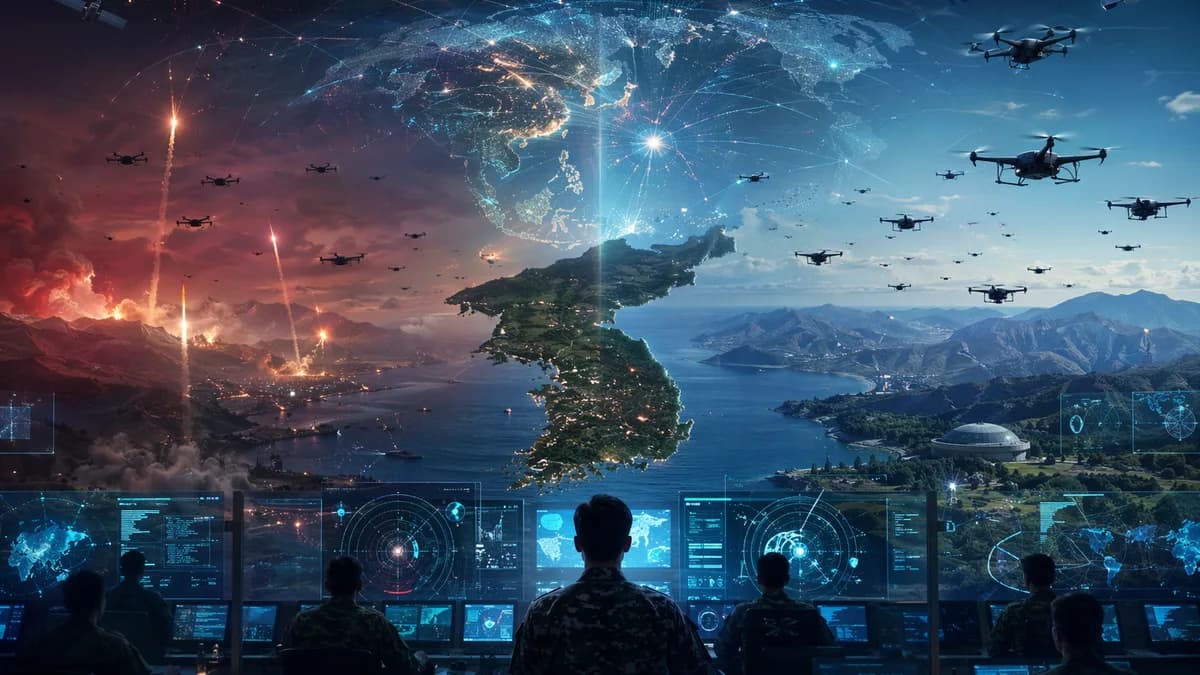
The question raised by North Korea weapons tests is whether Seoul can adapt fast enough to a threat that is spreading from missiles and artillery into mass drone warfare.
Global TrendsJune 26, 2026· 7 min read· By XOOMAR Insights Team
North Korea Weapons Tests Jolt Seoul Into Drone Race
Updated on June 28, 2026
XOOMAR Intelligence
Analyst Take
62/ 100
4 sources analyzedLow confidenceTrend20Freshness96Source Trust85Factual Grounding91Signal Cluster40
North Korean leader Kim Jong Un observed major weapons tests on June 25, 2026, then called for a “deadly and destructive offensive posture,” according to Al Jazeera. South Korea’s answer, announced the next day, was not only more conventional readiness. Seoul said it plans to train 500,000 “drone warriors” who can use drones like “personal firearms.”
That pairing is the real story. Pyongyang is trying to show it can threaten targets across the South. Seoul is trying to make drone operations ordinary at scale.
Are the North Korea weapons tests a show of force or a rehearsal for faster coercion?
They look like both.
KCNA said the tested weapons included a “special mission” ballistic missile warhead, an upgraded rocket launcher with extended range, and a self-propelled gun-howitzer, according to the AP account cited by Al Jazeera. Kim also demanded that North Korea’s military make its enemies feel “constant uneasiness and fear.”
Kim Jong Un called for a “deadly and destructive offensive posture” and said enemies should feel “constant uneasiness and fear.”
That language matters because it shifts the emphasis from simple possession of weapons to readiness to use them as pressure tools. XOOMAR analysis: Pyongyang is signaling that deterrence, in its view, depends on visible offensive capability, publicized testing, and psychological pressure on South Korea.
KCNA also said the warhead was designed to inflict “fatal damage on major targets including airfields, ports and power facilities of the enemy.” That target list is not abstract. It points at the systems that keep a modern state moving: military aviation, logistics, electricity, and transport nodes.
The source does not provide launch counts, ranges, flight paths, or independent test verification. That limits any technical assessment. But the political message is clear enough: North Korea wants Seoul to treat escalation as costly from the first move, not only at the nuclear threshold.
Can North Korea put all of South Korea under pressure without crossing the nuclear line?
Analysts cited by Al Jazeera suggested the upgrades are aimed at giving North Korea the ability to strike across the whole of the South. That is the core military signal.
The tested mix matters:
| System cited in source | Stated or implied role |
|---|---|
| “Special mission” ballistic missile warhead | KCNA said it targets airfields, ports, and power facilities |
| Upgraded rocket launcher | Reported to have an extended firing range |
| Self-propelled gun-howitzer | Adds another conventional strike option near the southern border |
| Naval nuclear armament plan | Kim said earlier in the week the navy would receive nuclear weapons and larger warships |
This is not one weapon category doing all the work. It is layered pressure.
North Korea has sought to strengthen its military since talks with the United States stalled in 2019. Kim has also said US efforts to restart diplomacy require Washington to drop its demand that North Korea dispose of its nuclear weapons.
The US factor remains embedded in the peninsula’s security equation. The United States has several military bases in South Korea, hosting about 28,500 personnel, according to Al Jazeera. That means any North Korean claim about deterrence against “enemies” lands in a South Korean and US alliance context, even when KCNA does not name every intended audience.
Why is Seoul training 500,000 “drone warriors” instead of only buying more hardware?
Because South Korea is treating drones as a force-wide skill, not a niche capability.
South Korean Defence Minister Ahn Gyu-back said the military plans to train 500,000 “drone warriors” able to use drones like “personal firearms.” He also said there is an urgent need to respond to the changing environment and said Pyongyang is receiving technological assistance from Russia.
That “personal firearms” phrase is important. It suggests drones are being pushed toward ordinary tactical use by large numbers of personnel. XOOMAR analysis: if Seoul follows through, drone competence becomes part of baseline military literacy rather than a specialist-only function.
The source says South Korea plans to expand drone capacity in both numbers and range. It does not specify the drone types, unit structure, training schedule, command integration, or whether the program focuses more on reconnaissance, strike roles, or counter-drone defense.
Still, the direction is visible. Seoul is preparing for a battlefield where small unmanned systems sit beside artillery, air defense, and missile alerts. That fits the broader pattern of drone-driven infrastructure risk seen in other conflicts, including XOOMAR’s coverage of a Ukraine drone strike that plunged Sevastopol into darkness.
What does the South Korean defense industry plan add to the military signal?
President Lee Jae Myung announced plans to develop five defence firms worth $650m by 2030. That gives the drone buildup an industrial frame.
The source does not name the firms or explain whether the money targets drones specifically. It only says the announcement came as Seoul described plans to expand drone capacity and respond to the North’s growing threat.
XOOMAR analysis: the timing links operational urgency with domestic production capacity. South Korea is not only talking about training operators. It is also positioning defense firms as part of the response.
Last week, Lee said President Donald Trump had told him that “the time had come to pay attention to the North Korea issue.” That line signals Seoul’s hope for increased US focus, but the concrete South Korean steps announced Friday are domestic: more drones, more trained operators, and a defense-sector push through 2030.
For readers tracking state preparedness beyond military affairs, this has a familiar policy pattern: crises expose whether institutions can build capacity before conditions worsen. XOOMAR has seen similar questions in nonmilitary stress tests, including France hitting top alert as Europe’s heatwave turned deadly.
Are Pyongyang and Seoul now competing below the nuclear threshold?
Yes, based on the source, but with an important caveat: nuclear weapons still frame the outer edge of the confrontation.
Earlier this week, Kim said North Korea’s navy would be equipped with nuclear weapons and larger warships, claiming this would support “multifaceted and efficient” operations. On June 23, 2026, state media linked warships such as the Choe Hyon to the navy’s nuclear armament progress.
But Friday’s test package emphasized weapons that can pressure South Korea without immediately invoking nuclear use. Ballistic warheads, rocket launchers, gun-howitzers, and drones all occupy the dangerous middle zone between routine border tension and nuclear escalation.
That middle zone is where miscalculation risk grows. The source does not describe a specific incident or imminent clash. It does show both sides moving toward faster, more distributed military tools.
Which evidence will show whether this is escalation theater or a durable shift?
The next test is repetition.
If North Korea continues publicizing systems aimed at airfields, ports, power facilities, and border-area firing capability, the North Korea weapons tests will look less like episodic messaging and more like a sustained doctrine of offensive readiness.
If South Korea turns the 500,000 “drone warriors” target into funded units, regular exercises, and expanded drone range, Seoul’s response will also move from announcement to doctrine.
Three signals matter now:
- North Korean testing tempo: More tests tied to “ultra precision” and long-range capability would support the thesis that Pyongyang is normalizing offensive pressure.
- South Korean implementation: Details on training, drone procurement, counter-drone systems, and defense firms will show whether Seoul can execute at scale.
- US attention: Follow-on statements or alliance activity after Trump’s reported comment will indicate whether Washington is moving beyond rhetorical focus.
The practical takeaway is stark. The Korean Peninsula’s next crisis may not begin with the largest weapons. It may begin with drones, alerts, and publicized strike capabilities designed to make the other side hesitate.
The Stakes
- North Korea is signaling a more aggressive posture aimed at creating fear and pressure in South Korea.
- South Korea’s plan to train 500,000 drone operators shows how quickly warfare is shifting toward mass drone use.
- The focus on airfields, ports, and power facilities raises the risk that future conflict could target critical infrastructure.
North Korea’s Weapons Tests vs. South Korea’s Drone Response
| Side | Action | Strategic Signal |
|---|---|---|
| North Korea | Tested a special mission ballistic missile warhead, upgraded rocket launcher, and self-propelled gun-howitzer | Emphasizing offensive pressure and the ability to threaten key targets such as airfields, ports, and power facilities |
| South Korea | Announced plans to train 500,000 “drone warriors” | Aiming to make drone operations widespread and routine across its defense posture |
South Korea’s Planned Drone Warrior Force
Drone warriors
people500,000
Sources

Written by
XOOMAR Insights Team
Research and Editorial Desk
The XOOMAR Insights Team pairs automated research with human editorial judgment. We track hundreds of sources across technology, fintech, trading, SaaS, and cybersecurity, cross-check the facts, and explain what happened, why it matters, and what to watch next. We do not just rewrite headlines. Every article is fact-checked and scored for reliability before it goes live, and we link back to the original sources so you can verify anything yourself.
Explore More Topics
Related Articles
 Global Trends
Korean Police Raid Starbucks Over Ghoulish Uprising Tumbler
South Korean police executed a raid on Starbucks Korea’s headquarters, sharply escalating a criminal investigation into the company’s controversial ‘Tank Day’ p
Aug 9, 20264 min
 Global Trends
Zelenskyy Demands Patriots as Kyiv Missile Toll Rises
Ukraine lacks the specific Patriot systems needed to intercept ballistic missiles, a critical weakness laid bare by a deadly Russian attack on Kyiv.
Aug 9, 20266 min
 Global Trends
Ukraine's Interceptor Gap Is Killing Civilians Now
A deadly overnight barrage in Kyiv succeeded entirely because Ukraine had no Patriot interceptors left to stop Russia's ballistic missiles. Officials say this i
Aug 5, 20265 min
 Global Trends
Russian Ballistic Missile Pierces Kyiv Air Defenses
A Russian ballistic missile strike on Kyiv killed one person and wounded at least a dozen, exposing a critical escalation as these harder-to-intercept weapons t
Aug 5, 20265 min
 Global Trends
Ukraine's 'Deep Strike' Strategy Cripples Russia's Oil Revenue
Ukraine has shifted to a strategy of 'deep strikes', using drones to attack oil refineries and military hubs inside Russia, aiming to cripple the economic engin
Aug 6, 20267 min
 Cybersecurity
North Korea's Cyber Arsenal Now Runs on Local AI
A new report warns that North Korean hacking groups are now operating fully localized, AI-driven cyber infrastructure to build malware and analyze stolen intell
Aug 10, 20266 min
 Fintech
Erebor Quadruples Deposits In 100 Days For $8B Valuation
Startup-focused Erebor Bank has quadrupled deposits in three months and is now raising $1.5 billion at an $8 billion valuation, a giant bet on its post-SVB nich
Aug 10, 20265 min
 Trading
Stocks Ignore Record Job Losses as Fed Pledge Trumps Payrolls
The Dow Jones Industrial Average showed no fear after July's shocking job losses, as investors bet weak labor data will keep the Federal Reserve from raising ra
Aug 10, 20266 min
 Fintech
DOJ Charges 455 Providers for $6.5B in Healthcare Fraud
The Department of Justice has replaced traditional fraud investigations with AI-driven analytics, charging 455 defendants in a $6.5 billion scheme and forcing p
Aug 10, 20267 min
 Fintech
Poland Launch Tests Paysafe's Legacy Card Pivot
Paysafe's launch in Poland is a strategic test of whether it can upgrade its existing prepaid card users into full digital wallet customers, following a wave of
Aug 10, 20266 min
Don't miss the signal
Get our weekly roundup of the stories that matter across tech, fintech, and trading. No noise, just signal.
Free forever. No spam. Unsubscribe anytime.