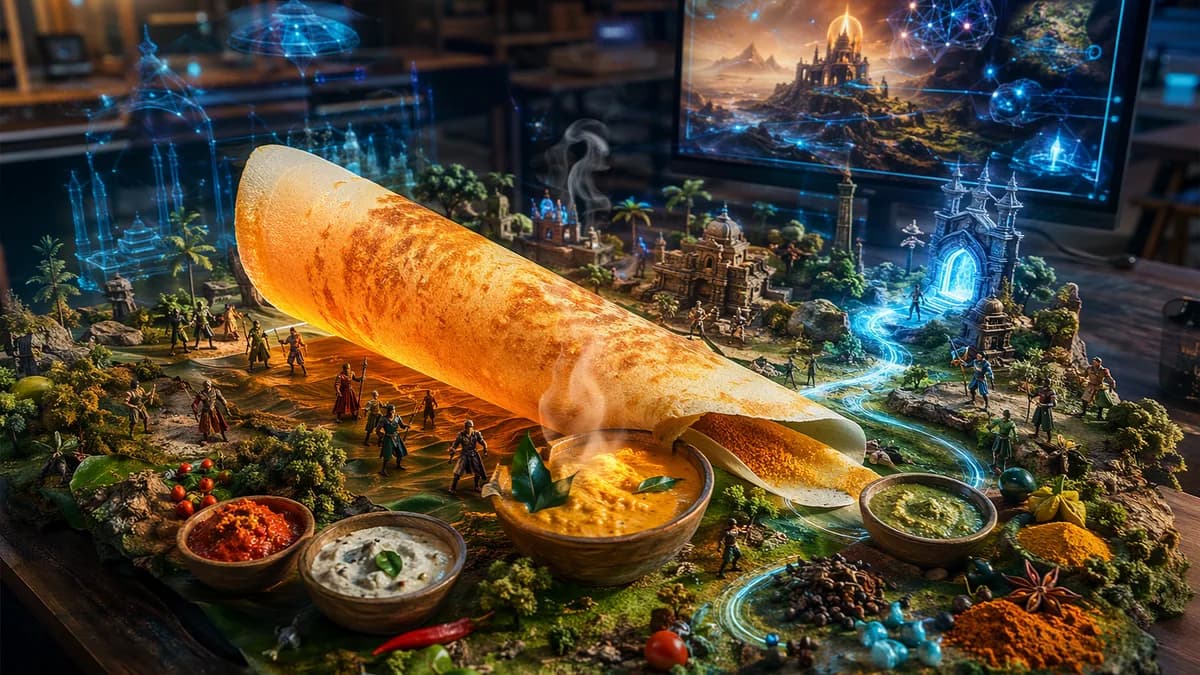
Dosa Divas makes its strongest argument in under 10 hours: RPG scale doesn’t have to mean RPG sprawl.
XOOMAR Intelligence
Analyst Take
That is the real signal beneath this Dosa Divas review. The new game from Outerloop Games, reviewed by Andrew Webster at The Verge, keeps the recognizable bones of a turn-based RPG, including party battles, leveling, towns, abilities, and boss fights. Then it cuts away the padding that often turns the genre into a scheduling commitment.
“There’s just one big drawback: This game will make you very hungry.”
That line sounds like a joke, but it points to the game’s sharper trick. Dosa Divas uses food as plot, mechanic, politics, memory, and family pressure. The hunger isn’t only visual. It’s structural.
Dosa Divas bets that RPG grandeur doesn't need a 60-hour appetite
Roleplaying games often sell excess as virtue: huge maps, huge casts, huge quest logs, huge runtimes. Dosa Divas moves in the opposite direction. According to The Verge, it captures much of the “epic adventure” feeling in a package that lasts less than 10 hours.
That brevity matters because the game still reaches for big material. Its towns have been taken over by a corporation that has made cooking illegal, replacing local food culture with a monopoly on “food-like nutrient paste.” You play as Samara and Amani, sisters trying to bring that system down. The complication is personal: the corporation is run by their little sister, Lina.
So the game’s conflict works on several levels at once. It’s about anti-corporate rebellion. It’s about the cultural role of food. It’s about sisters who don’t fit neatly into hero and villain boxes.
XOOMAR analysis: that combination is why the short runtime doesn’t read as small ambition. The game isn’t shrinking the stakes. It’s compressing them.
The numbers behind Dosa Divas: less than 10 hours, fewer excuses, tighter storytelling
The most important number in this Dosa Divas review is not a score, because the supplied source does not provide one. It’s the runtime: less than 10 hours.
That changes the design bargain. A shorter RPG has less room to hide weak pacing behind optional content. It has to make towns, fights, upgrades, and character scenes count quickly. The Verge says Dosa Divas does that by cutting the busywork while preserving the loop that makes RPGs satisfying.
The game still has leveling. It still has character customization. But the choices are deliberately narrow: each level-up lets players improve strength, health, or special abilities. The review also notes that characters only learn a couple of abilities over the course of the game, but each matters in combat strategy.
| RPG element | Traditional sprawl model | Dosa Divas approach |
|---|---|---|
| Runtime | Dozens of hours | Less than 10 hours |
| Abilities | Large skill trees or broad move sets | A few important abilities |
| Leveling | Many customization paths | Strength, health, or special abilities |
| Progression pressure | Often includes grinding | The Verge highlights “no grinding!” |
| World design | Massive maps and long side content | A small collection of towns |
For time-poor players, that’s not a downgrade. It’s the product pitch. A complete RPG that respects the player’s calendar has a different kind of value.
Food turns Dosa Divas into a character system, not just a visual gimmick
The food premise could have been cosmetic. In Dosa Divas, it appears to do more work than that.
Cooking is illegal in the game’s world, which turns food into a form of resistance. The towns aren’t just hungry because they need calories. Their histories are connected to food, and The Verge specifically raises the question of what happens to a traditional fishing village when it can’t fish anymore.
Mechanically, cooking lets players create healing items and feed hungry citizens through brief minigames. The review compares the food break to cooking in Final Fantasy XV, while the battle timing recalls Mario & Luigi, where attacks and defenses depend on pressing a button at the right moment.
That matters because food isn’t only an aesthetic layer. It connects the game’s systems to its story. Healing, helping townspeople, resisting propaganda, and recovering culture all point in the same direction.
XOOMAR analysis: the risk for any food-centered RPG is that the cuisine becomes branding: pretty plates, cute puns, no deeper function. The supplied review suggests Dosa Divas avoids that trap because food changes how the player interacts with the world and how the sisters’ family history is revealed.
For adjacent XOOMAR coverage on how interactive formats are being repackaged around user participation, see Viewers Bend the Plot as Character.ai Microdramas Launch and 60-Day Prices Hand Product Finder a Google AI Edge.
From epic RPG sprawl to indie precision: where Dosa Divas fits in the genre's long shift
The Verge frames Dosa Divas against the classic RPG model: long stories, big side quests, huge worlds, complex maps, and casts large enough that players forget names. That framing is important because the game is not presented as a minimalist experiment. It’s a full RPG, just stripped down.
The turn-based combat stays familiar. The enemies range from “pesky lawyers” to the sisters’ own parents. There are sentient mech suits, including one that remains in the party throughout the game. There are towns to help, corporate propaganda to tear down, and citizens whose hunger alerts the player to someone in need.
The difference is density. Dosa Divas seems to ask what happens if an RPG keeps the emotional arc and cuts the genre’s tendency to over-explain itself.
The family material is where that precision pays off. Through flashbacks and candid conversations, the review says the game reveals the complex relationships between Samara, Amani, and Lina, and shows how food shaped their lives beyond sustenance. The boss fight with their parents stands out because it feels like “a real, raw argument” between people who love one another but struggle with change.
That is a sharper use of a boss battle than simply raising the health bar.
Players, developers, and publishers will read Dosa Divas very differently
Different audiences will see different trade-offs.
Time-poor players get the cleanest win. Dosa Divas offers a beginning, middle, and end without demanding weeks of attention. The absence of grinding, as highlighted by The Verge, strengthens that appeal.
RPG traditionalists may read the same facts more skeptically. A sub-10-hour runtime can limit exploration, party depth, long-term attachment, and mechanical complexity. The source review argues that the game’s few abilities all matter, but players who want sprawling customization may still want more.
Indie developers and publishers get the more interesting lesson. The game’s identity is easy to explain: sisters, illegal cooking, corporate nutrient paste, turn-based battles, mech suits, and food that looks good enough to make players hungry. That kind of specificity is hard to fake.
XOOMAR analysis: Dosa Divas shows how a smaller game can compete on clarity rather than volume. The premise does a lot of marketing work because it’s concrete. Players can understand the fantasy quickly.
What Dosa Divas means for players tired of oversized RPGs
The strongest case for Dosa Divas is that it treats finishing a roleplaying game as a reasonable expectation, not a lifestyle choice.
That has design consequences. Shorter games can invite more experimentation because the cost of trying something unusual is lower. A player may be more willing to take a chance on a cooking-centered, family-driven RPG with sentient mech suits if it doesn’t require a massive time commitment.
The game may also reach players who bounce off heavier RPGs. Food, family conflict, and visual style are more immediate entry points than lore dumps or dense stat systems. The Verge’s description suggests Dosa Divas still respects RPG structure, but it doesn’t make mastery of RPG excess the price of admission.
This is where the Dosa Divas review becomes more than a recommendation. It’s a design argument: a smaller RPG can still feel complete if its mechanics, world, and emotional stakes are pointed in the same direction.
The next wave of RPGs will copy Dosa Divas' portion control
The watch item now is not whether every RPG should become shorter. They shouldn’t. Scale still has a place when the world, systems, and story justify it.
The question is whether more indie RPGs start selling finite playtime as confidence rather than compromise. Dosa Divas gives them a clear model: strong premise, compact structure, no grinding, recognizable combat, and a story that can move from corporate satire to family pain without ballooning.
Evidence that would strengthen this thesis: players praising the runtime as a feature, not a limitation, and more small RPGs foregrounding completion time, tight pacing, and cultural specificity. Evidence that would weaken it: players treating Dosa Divas as charming but too thin, especially on exploration or progression.
For now, the game’s most useful lesson is simple. Portion control can be a design philosophy. In Dosa Divas, the meal is smaller, but The Verge’s review suggests it still leaves a taste.
Key Takeaways
- Dosa Divas argues that RPGs can feel ambitious without demanding dozens of hours.
- Its food-centered story turns cooking into a lens for culture, politics, and family tension.
- The game may appeal to players who want classic RPG structure in a tighter package.
Dosa Divas vs. sprawling RPG conventions
| Dosa Divas | Traditional sprawling RPGs |
|---|---|
| Less than 10-hour runtime | Often framed around 60-hour scale |
| Compressed story with towns, leveling, boss fights, and party battles | Large maps, casts, quest logs, and extended runtimes |
| Food drives plot, mechanics, politics, memory, and family conflict | Genre scale often comes from breadth and accumulation |
Runtime contrast highlighted in the review
Primary Sources & Disclosures

Written by
XOOMAR Insights Team
Research and Editorial Desk
The XOOMAR Insights Team pairs automated research with human editorial judgment. We track hundreds of sources across technology, fintech, trading, SaaS, and cybersecurity, cross-check the facts, and explain what happened, why it matters, and what to watch next. We do not just rewrite headlines. Every article is fact-checked and scored for reliability before it goes live, and we link back to the original sources so you can verify anything yourself.