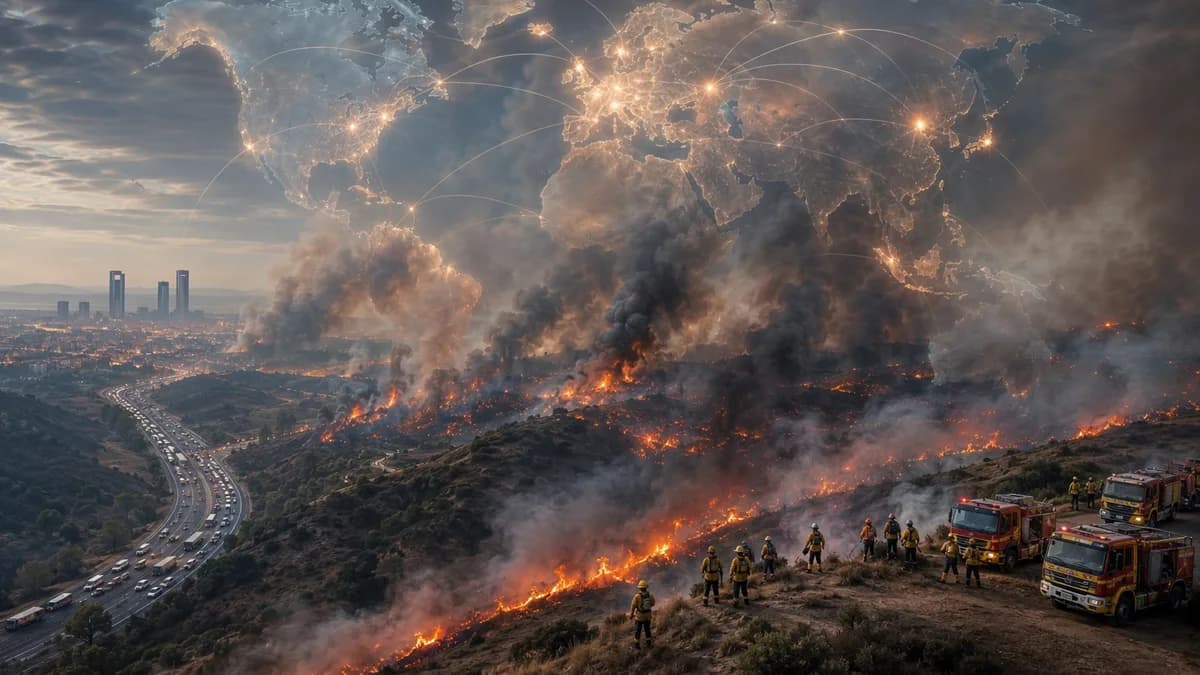
More than 140,000 people have been evacuated across France and Spain as fast-moving wildfires force authorities into defensive operations, with the Madrid wildfires described by regional officials as the worst in the region’s history.
XOOMAR Intelligence
Analyst Take
The crisis spans separate fire zones, but the pattern is the same: heat, wind, dry vegetation, and shifting fire fronts are pushing emergency services faster than they can contain the flames, according to BBC World. The immediate pressure falls on residents west of Madrid, communities in Ávila, evacuees in Gironde and Landes, and firefighters trying to keep flames away from populated areas.
Fast-moving fire fronts turn Madrid and southwest France into one European crisis
The Madrid wildfires have escalated from multiple outbreaks into a regional emergency after three fires west of the Spanish capital merged into a single blaze. Spain’s government has declared a national emergency, with at least 30,000 people evacuated in areas close to Madrid.
In France, more than 110,000 people have been evacuated in the south-west after French wildfires tore through the Gironde and Landes regions. A separate wildfire near Biscarrosse in Landes forced more than 23,000 people to leave homes, campsites, a nursing home, and a summer camp.
The shared question for authorities is blunt: how do you protect people when fires move faster than crews can safely attack them?
| Area | Main pressure point | Reported scale |
|---|---|---|
| Madrid region | Merged fire fronts west of the capital | 30,000 evacuated, 20,000 under lockdown |
| Ávila province | Burgohondo blaze may merge with Madrid fire | Almost 9,000 hectares burned |
| Gironde, France | “XXL fire” moving toward Bordeaux | More than 19,000 hectares burned |
| Landes, France | Biscarrosse-area evacuations | More than 23,000 evacuated |
Madrid region fights its worst wildfire as crews shift to defense
Madrid’s regional president Isabel Díaz Ayuso called the blaze the “worst fire in the history of the region”, citing a “perfect storm” of high temperatures, relentless wind, and merging fire fronts.
The operational reality is even harsher. Carlos Novillo, the Madrid regional government’s emergency management chief, said firefighters could not directly contain the fire in some areas.
“The wildfire is at its peak and is currently beyond the capacity of firefighters to contain,” Novillo told reporters.
“It’s not possible to attack the fire in that area, so defensive measures are being taken.”
That means crews are prioritizing protection of towns and evacuation zones over direct suppression where conditions are too dangerous. The Military Emergency Unit (UME) has been deployed, with a focus on protecting areas near El Escorial.
For residents, the fire has already redrawn daily life. Authorities said more than 60,000 people have been affected in the Madrid region, including 30,000 forced to evacuate and 20,000 placed under lockdown. The hardest question for local officials is when to move people before a front arrives, especially when embers are carrying the threat beyond the visible fire line.
Evacuees carry the cost as towns empty before the flames arrive
Evacuation is the clearest measure of this crisis’s scale. In Spain, eight municipalities have been evacuated: Chapinería, Navas del Rey, Colmenar del Arroyo, Fresnedillas de la Oliva, Robledo de Chavela, Aldea del Fresno, Navalagamella, and Zarzalejo.
Several other towns, including San Martín de Valdeiglesias, Pelayos de la Presa, and Villa del Prado, remain under lockdown. The Madrid fires were also moving toward Robledo de Chavela and Fresnedillas de la Olivia, around 50km (31 miles) from the capital.
The human toll is visible in the stories of people forced out. Ecologio Cabrera, 86, fled his village west of Madrid and spoke from a sports hall in Vilamanta, where hundreds of evacuees had sought refuge.
“If you don’t run from it and you try to face it, it devours you,” Cabrera told AFP.
“They arrived and told everybody to get out... I have never experienced anything like this.”
What happens after people leave is still unresolved. Officials have reported burned land and destroyed homes in some areas, but for many evacuees the immediate uncertainty is simpler: whether they can return, and what will still be there.
Fire moving toward Bordeaux puts southwest France on alert
France’s most urgent concern is the Gironde blaze, which local prefect Sophie Brocas described as an “XXL fire”. It has burned through more than 19,000 hectares (46,000 acres) of forest and destroyed about 80 homes.
The fire changed direction on Friday and began moving east toward Bordeaux, according to French officials. France’s Interior Minister Laurent Nuñez said the response would be reorganized to fight the blaze from the ground and prevent it from advancing toward the city.
“We have never seen a convective fire of this magnitude,” Nuñez told TF1, adding that around 50 firefighters had been injured.
Authorities evacuated the entire Cap Ferret peninsula, with hundreds escaping by boat after flames swept through the popular tourist destination. The area has a year-round population of just under 8,000, but that can increase 10 fold during the summer holiday season.
The question for French authorities is how to defend populated areas while keeping evacuation routes open. President Emmanuel Macron has mobilised the military, described the wildfire situation as “very tense”, and said France had activated the European Union’s civil protection mechanism.
Heat, wind, and dry vegetation turn local fires into national emergencies
The source of each fire is not the same, and officials have not assigned a single cause across the crisis. In Spain, the Civil Guard has arrested one person and is investigating another over the Burgohondo fire, which officials said could have been caused by negligence involving heavy machinery used during a period of restrictions, local media reported.
The conditions, though, are consistent across the affected regions. Officials cited high temperatures, relentless wind, drought, and dry vegetation as factors making the fires harder to control.
The physics are straightforward. Dry vegetation becomes fuel. Wind pushes embers ahead of the main front. Heat and low moisture give crews fewer safe windows to slow the advance. When those factors align, a rural fire can become a national emergency within hours.
The broader climate signal is also in the source material. The EU’s Copernicus Climate Change Service says Europe is the fastest-warming continent, heating at more than twice the global average since the 1980s. The European Forest Fire Information System says wildfires have already burned more land in Europe this year than the annual average for the past two decades.
Emergency services face the brutal math of moving people first
Firefighters are not just fighting flames. They’re managing timing. Which towns evacuate first? Which areas lock down? Where do military units go when separate fronts may merge?
In Madrid, officials are watching whether the Burgohondo blaze in Ávila could merge with the Madrid fire. Spain’s Interior Minister Fernando Grande-Marlaska said authorities were doing “everything we can” to prevent that from happening.
This is where the public-safety trade-off becomes clear. Directly attacking a blaze may be impossible in some zones, so crews shift to defensive work: protecting towns, holding lines where conditions allow, and moving people before the fire arrives.
For readers tracking how officials manage fast-moving emergencies in other contexts, XOOMAR has also covered evacuation and crisis-response pressure in 99,000 Cut Off as Chile Floods Trigger Catastrophe Decree and firefighter-risk reporting in Bordeaux Airport Fire Turns Deadly, Kills 2 Firefighters. These are separate events, but they point to the same governance problem: emergency systems are judged most harshly in the narrow window before the worst damage lands.
The bigger picture: Europe’s wildfire season is becoming a public safety stress test
The Madrid wildfires, the mass evacuations in France, and the fire moving toward Bordeaux show a clear shift in the burden on governments. The central challenge is no longer only how to extinguish fires. It is how to move people, protect towns, reinforce exhausted crews, and keep instructions clear while conditions change by the hour.
The immediate watch item is coordination. Spain has deployed the UME. France has mobilised the military and activated the EU civil protection mechanism, with reinforcements including two Black Hawk helicopters from the Czech Republic and Slovakia.
The practical lesson is already visible. Fire seasons like this reward preparation before ignition: faster warnings, rehearsed evacuation plans, enough firefighting capacity, and land management that reduces fuel where possible.
Europe is entering fire seasons where the firefight starts long before the first flame reaches a town. Preparation and coordination now matter as much as suppression.
Impact Analysis
- More than 140,000 people have been forced from their homes across France and Spain.
- Firefighters are facing merged and fast-moving fire fronts that are difficult to contain safely.
- The crisis shows how heat, wind, and dry vegetation are intensifying wildfire risks near populated areas.
Wildfire pressure points across France and Spain
| Area | Main pressure point | Reported scale |
|---|---|---|
| Madrid region | Merged fire fronts west of the capital | 30,000 evacuated; 20,000 under lockdown |
| Ávila province | Burgohondo blaze may merge with Madrid fire | Almost 9,000 hectares burned |
| Gironde, France | Large fire moving toward Bordeaux | More than 19,000 hectares burned |
| Landes, France | Biscarrosse-area evacuations | More than 23,000 evacuated |
Reported wildfire evacuations
Primary Sources & Disclosures

Written by
XOOMAR Insights Team
Research and Editorial Desk
The XOOMAR Insights Team pairs automated research with human editorial judgment. We track hundreds of sources across technology, fintech, trading, SaaS, and cybersecurity, cross-check the facts, and explain what happened, why it matters, and what to watch next. We do not just rewrite headlines. Every article is fact-checked and scored for reliability before it goes live, and we link back to the original sources so you can verify anything yourself.