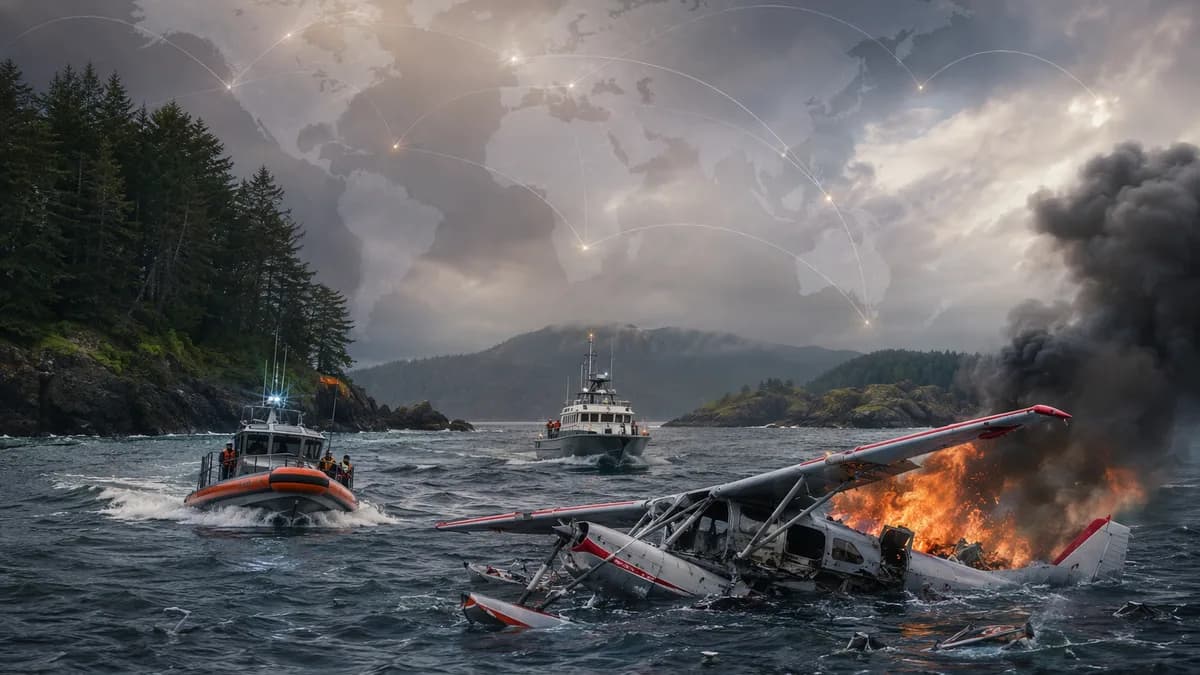
A Kenmore Air seaplane carrying 11 people crashed into Shallow Bay off Washington state and caught fire, leaving one person in critical condition while all aboard were pulled from the water. The Washington seaplane crash involved a de Havilland DHC-3 Otter near Sucia Island, about 80 nautical miles from Seattle, according to Independent World.
XOOMAR Intelligence
Analyst Take
The aircraft had 10 passengers and one pilot onboard. Officials said everyone was accounted for after the emergency landing, but several people were hospitalized with injuries ranging from head injuries to broken bones and lacerations.
Washington seaplane crash leaves one person critical after all 11 are pulled from water
The plane was headed from Lake Union in Seattle to Roche Harbor when it went down in Shallow Bay near Sucia Island. A Kenmore Air spokesperson told KING 5 that the aircraft took off at 4.30 p.m. and crashed at around 5.15 p.m.
The U.S. Coast Guard Sector Puget Sound said it received reports of the crash at around 5.25 p.m. Thursday and immediately deployed search and rescue assets.
The first question for rescuers was brutally simple: could everyone get away before fire consumed the aircraft?
Footage from the scene showed the seaplane flying just above the water before appearing to make contact with the surface. Later clips showed rescuers helping passengers from the crashed aircraft toward shore, followed by the plane burning with black smoke rising from the crash site.
The Coast Guard said the plane caught fire after the landing and remained against rocks on Sucia Island.
“We are grateful that everyone aboard has been accounted for, and our immediate focus is ensuring our passengers and pilot receive the care and support they need,” Kenmore Air CEO David Gudgel said.
Gudgel also thanked the Coast Guard, local emergency responders and others assisting in the response, and said Kenmore Air is cooperating with investigators.
Rescuers beat the flames after the Kenmore Air plane hits Shallow Bay
The rescue moved fast. San Juan County Sheriff Eric Peter told ABC News that a civilian vessel saw the crash and helped get people out of the water. By the time the sheriff’s office arrived, the aircraft was already burning.
The Coast Guard, Canadian responders, local agencies and “numerous Good Samaritan vessels” responded, according to related reporting from NBC News. Newsweek reported that the Coast Guard also said the U.S. Navy was among the responders that launched assets to assist.
For passengers, the key fact is the timing: officials say all 11 people were accounted for before the fire became the dominant threat.
The San Juan County Sheriff’s Office told KING 5 that one person remained in critical condition. Injuries ranged from “head injuries to broken bones and lacerations,” the sheriff’s office said.
Hospital transfers were split across the region:
| Person or group | Destination reported |
|---|---|
| 6 passengers | PeaceHealth St Joseph Medical Center in Bellingham |
| 4 passengers | PeaceHealth Peace Island Medical Center in Friday Harbor |
| Pilot | Skagit Valley Hospital |
Analysis: the crash sequence described by officials shows why the rescue window mattered. A water landing near rocks, followed by fire, leaves little margin. The confirmed outcome so far is narrow but significant: no deaths have been reported in the supplied official accounts, while one person remains critically injured.
Kenmore Air cancels July 24 flights as families wait for answers
Kenmore Air canceled all scheduled flights on July 24. The company said the move was to support the passengers, pilot, families and employees affected by the emergency landing.
What does that mean for travelers using the operator today? The supplied reporting confirms the cancellation, but not when regular service will resume.
Kenmore Air confirmed the aircraft was a de Havilland DHC-3 Otter. NBC News described Kenmore Air as the largest U.S. seaplane airline. Newsweek reported that the company flies more than 90,000 passengers annually on scheduled, scenic and charter flights to more than 45 destinations in the Pacific Northwest and British Columbia.
That context matters because this was not an obscure aircraft operating on a one-off route. It was part of a regional seaplane network that connects island destinations and mainland departure points.
The Washington seaplane crash also puts renewed attention on a company with a long operating history. Newsweek reported that Kenmore Air was founded in 1946 and operates 25 aircraft, including de Havilland Beavers, de Havilland Otters and Cessna Caravans.
Newsweek also reported that Kenmore Air has had one fatal crash in its history, in October 1977, when all seven people onboard a DHC-2 Beaver died in Stevens Pass, Washington. An investigation found the pilot made “improper in-flight decisions,” including not balancing the aircraft’s load and flying too low.
Island air service faces scrutiny after a DHC-3 Otter burns near rocks
Early crash scenes are messy. Passenger counts, injury totals, hospital destinations and timeline details can shift as agencies reconcile reports from pilots, rescuers, hospitals and witnesses.
Here, several core facts now line up across official and company accounts:
- Aircraft: Kenmore Air de Havilland DHC-3 Otter
- People onboard: 10 passengers and 1 pilot
- Route: Lake Union in Seattle to Roche Harbor
- Crash site: Shallow Bay near Sucia Island
- Status: all aboard accounted for
- Injuries: several hospitalized, one critical
- Investigators: FAA and NTSB
The main uncertainty is not whether the aircraft crashed or burned. Officials have confirmed both. The central unanswered question is why the emergency landing happened in the first place.
Related XOOMAR risk coverage is separate from this crash, but readers tracking fast-moving transport and regulatory stories may also want our reporting on Tankers Flee Saudi Route After Houthi Shipping Threat and States Freeze Paramount Warner Merger After DOJ Approval. In all three cases, the useful signal is the same: confirmed agency action matters more than early chatter.
FAA and NTSB take over questions on the cause and the fire
The Federal Aviation Administration and the National Transportation Safety Board are investigating the cause of the crash and the fire, the Coast Guard said.
The immediate questions are specific: what forced the emergency landing, whether the aircraft had a mechanical problem, how the fire started, and whether weather or visibility played any role.
The supplied reporting does not establish a cause. It also does not say the aircraft lost power, that pilot error was involved, or that weather caused the crash.
The next useful updates should come from four places: local authorities on patient conditions, Kenmore Air on operations and support for families, the Coast Guard on response details, and the FAA or NTSB on the investigation. Until then, the hard fact is stark enough: a Washington seaplane crash turned into a fire near Sucia Island, and rescuers got all 11 people away from the aircraft before the death toll could rise.
Key Takeaways
- All 11 people onboard were rescued after the seaplane crashed and caught fire near Sucia Island.
- One person was reported in critical condition, with others hospitalized for injuries including head trauma, broken bones and lacerations.
- The crash raises safety questions about the flight from Seattle’s Lake Union to Roche Harbor and the emergency response in remote waters.
People Onboard the Kenmore Air Seaplane
Primary Sources & Disclosures

Written by
XOOMAR Insights Team
Research and Editorial Desk
The XOOMAR Insights Team pairs automated research with human editorial judgment. We track hundreds of sources across technology, fintech, trading, SaaS, and cybersecurity, cross-check the facts, and explain what happened, why it matters, and what to watch next. We do not just rewrite headlines. Every article is fact-checked and scored for reliability before it goes live, and we link back to the original sources so you can verify anything yourself.