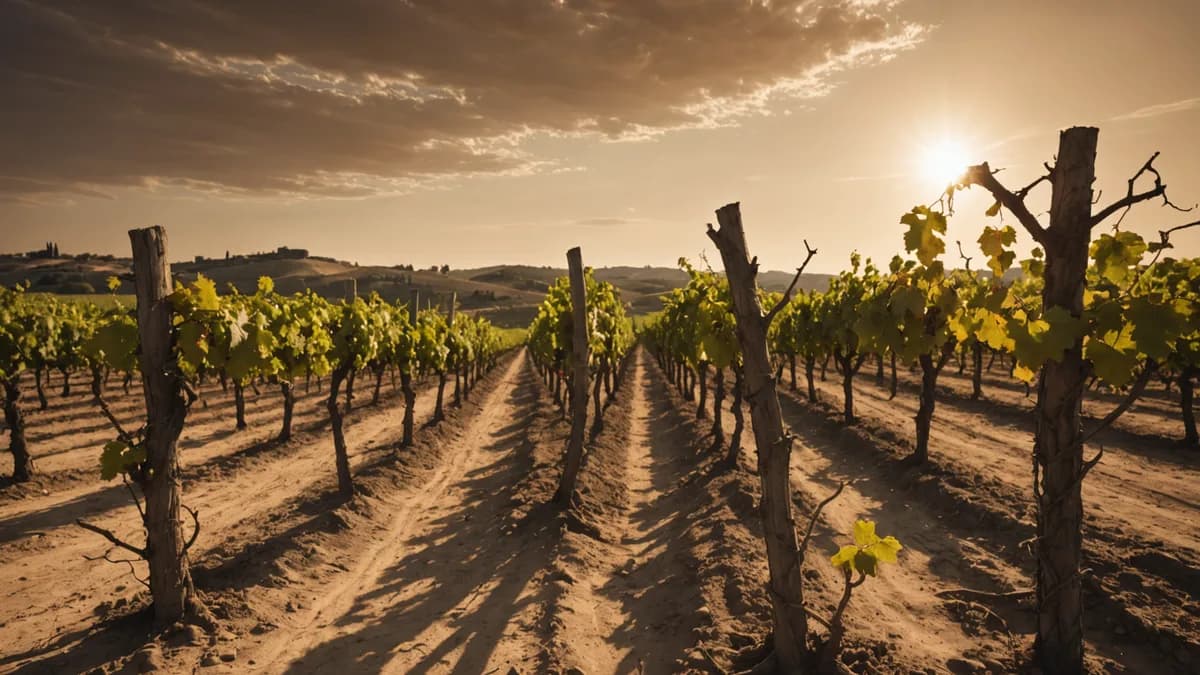
Preliminary French ministry figures point to the smallest wine harvest in three decades, projecting a national yield of just under 34 million hectolitres after the country's hottest summer on record according to Guardian World. This isn't a simple off-year. It's a data point confirming a structural crisis for an industry where geography is destiny, and that geography is now in violent flux.
XOOMAR Intelligence
Analyst Take
30-Year Low Yield Meets 40-Degree Heat
The numbers from the agriculture ministry's statistics body, Agreste, tell a blunt story of climate impact. The forecasted 6% drop from last year and 17% shortfall against the 2021-2025 five-year average stems directly from conditions officials describe with clinical severity. "The summer was particularly hot and dry," Agreste reported. "Soil drought has intensified... and heatwaves have caused localised sun scald, scorching, defoliation, and wilting of the grapes."
The quantitative damage maps directly onto qualitative terror for winemakers: burned grapes and abandoned vines. With an average temperature of 24C across June, July, and August and nearly half the country hitting 40C or above, the 2026 vintage was cooked on the vine before it could be harvested.
Regional Damage Shows a National Fracture
The crisis is universal, but its severity is not. Agreste's estimates reveal staggering regional disparities, a fragmentation of France's wine map by micro-climates of extreme heat.
| Region | Estimated Loss vs. Last Year | Key Factor |
|---|---|---|
| Champagne | Nearly 50% | Early, heat-accelerated harvest |
| Jura | 37% | Severe drought impact |
| Burgundy-Beaujolais | Approx. 33% | Combined heat and drought stress |
| National Average | 6% | Aggregate of all regions |
This table underscores a critical point. While regions like Bordeaux and Languedoc-Roussillon report higher harvests than 2025, they remain below the five-year average. Only Savoie bucks the trend entirely. The story isn't one bad year, it's the acceleration of a long-term decline, with some appellations falling off a cliff.
The human response to these ministry figures is telling. Cécile Mathiaud of the Burgundy wine producers' association expressed shock at the "disastrous" government forecast for her region. "We have no definite figures and there's no suggestion the situation is a disaster," she countered, highlighting the tension between macro-modeling and on-the-ground reality where some parcels outperformed expectations. This disconnect points to the high level of uncertainty Agreste itself cited, which delayed its initial forecast.
The Invisible Threat Hanging Over Bordeaux
Beyond the sun-scorched grapes lies a more insidious concern: smoke taint. While no major Bordeaux vineyards burned, fires came within 15km (9 miles) of the city. The threat isn't flame, but smoke absorption into grape skins, which can impart unwanted smoky, ashy characters to the finished wine. This creates a cruel "wait-and-see" anxiety. A vineyard might have physically survived the heat with a decent yield, only to discover its wine is commercially unsalvageable months later. The quality risk compounds the quantity crisis.
Harvests Creep Earlier, Markets Creep Away
The source material reveals a parallel, long-term stress beyond the weather. The climate emergency has pushed harvest dates forward slightly each year for the last four decades. In 2026, the national harvest timetable advanced by at least a week, with some Bordeaux vineyards starting two weeks early. This shifts the entire growing cycle, altering grape development and, ultimately, wine profile.
At the same time, the market foundation is eroding. French domestic wine consumption has plummeted from 127 litres per person annually in the 1960s to 40 litres today. Its largest export market, the U.S., is also drinking less, and has been subject to the disruptive variable of Donald Trump's tariffs. The 2026 harvest catastrophe isn't hitting a robust industry; it's assaulting one already under significant pressure. This combination of collapsing supply and softening demand creates a perilous economic equation.
XOOMAR Interpretation: The End of Average Vintages
Our analysis reads this data as a decisive break from the past. Previous adaptations, like gradually moving harvest dates, were designed for a slowly warming climate. The 2026 season, marked by prolonged soil drought, record-shattering heatwaves, and collateral wildfire damage, represents a different category of threat: climate volatility. It's a scenario where multiple extreme stressors converge within a single growing season, overwhelming incremental adaptations.
For the industry, this means the business of winegrowing bifurcates. Large négociants with deep pools of supply across regions can blend their way to consistency, as seen in our coverage of Fed Ignores Jobs Report, Zeroes in on Inflation Battle, where a single-minded focus can be a strategic choice. For small, estate-bound vignerons, especially in ravaged regions like Champagne or Jura, the shortfall is existential. Their vintage isn't just small, it's potentially unviable.
What to Watch Now: Quality Reports and Policy Shifts
The immediate watch item is the post-harvest quality assessment. The quantity is dire, but the final judgment on 2026 will hinge on laboratory and tasting analysis for smoke taint in affected zones and the overall phenolic maturity of heat-stressed grapes. A small harvest of high-quality wine commands a premium. A small harvest of flawed wine is a financial disaster.
Longer-term, watch for policy and practice shifts. This level of loss will intensify debates over once-unthinkable changes in hallowed grounds:
- Irrigation: Expanding access in drought-stricken AOCs.
- Authorized Grapes: Experimenting with more drought-resistant varieties.
- Blending Rules: Relaxing appellation rules to allow vintners more flexibility to compensate for climate damage.
The future of French wine now hinges on a brutal calculus: can it adapt its centuries-old traditions fast enough to keep pace with the changing climate, or will the very concept of terroir need to be redefined to survive? The 2026 harvest isn't just a low yield, it's a landmark on that difficult path.
Impact Analysis
- This 30-year low harvest threatens the economic stability of France's iconic wine industry, a key national export.
- Extreme heat and drought are causing severe regional disparities, potentially reshaping France's wine map and availability of famous appellations.
- The harvest data provides concrete evidence linking climate change to immediate, large-scale agricultural disruption, affecting global supply and prices.
Regional Harvest Loss Comparison (2026 vs 2025)
| Region | Estimated Loss vs. Last Year | Key Factor |
|---|---|---|
| Champagne | Nearly 50% | Early, heat-accelerated harvest |
| Jura | 37% | Severe drought impact |
| Burgundy-Beaujolais | Approx. 33% | Combined heat and drought stress |
| National Average | 6% | Aggregate of all regions |
French Wine Harvest Forecast & Trends
Primary Sources & Disclosures

Written by
XOOMAR Insights Team
Research and Editorial Desk
The XOOMAR Insights Team pairs automated research with human editorial judgment. We track hundreds of sources across technology, fintech, trading, SaaS, and cybersecurity, cross-check the facts, and explain what happened, why it matters, and what to watch next. We do not just rewrite headlines. Every article is fact-checked and scored for reliability before it goes live, and we link back to the original sources so you can verify anything yourself.