
The uncomfortable question raised by CryptoBandits malware is why crypto defenses still depend on a Windows clipboard users barely think about.
CybersecurityJune 19, 2026· 7 min read· By XOOMAR Insights Team
CryptoBandits Malware Hijacks Wallets Through USB Sticks
Updated on June 20, 2026
XOOMAR Intelligence
Analyst Take
58/ 100
4 sources analyzedLow confidenceTrend10Freshness97Source Trust88Factual Grounding92Signal Cluster20
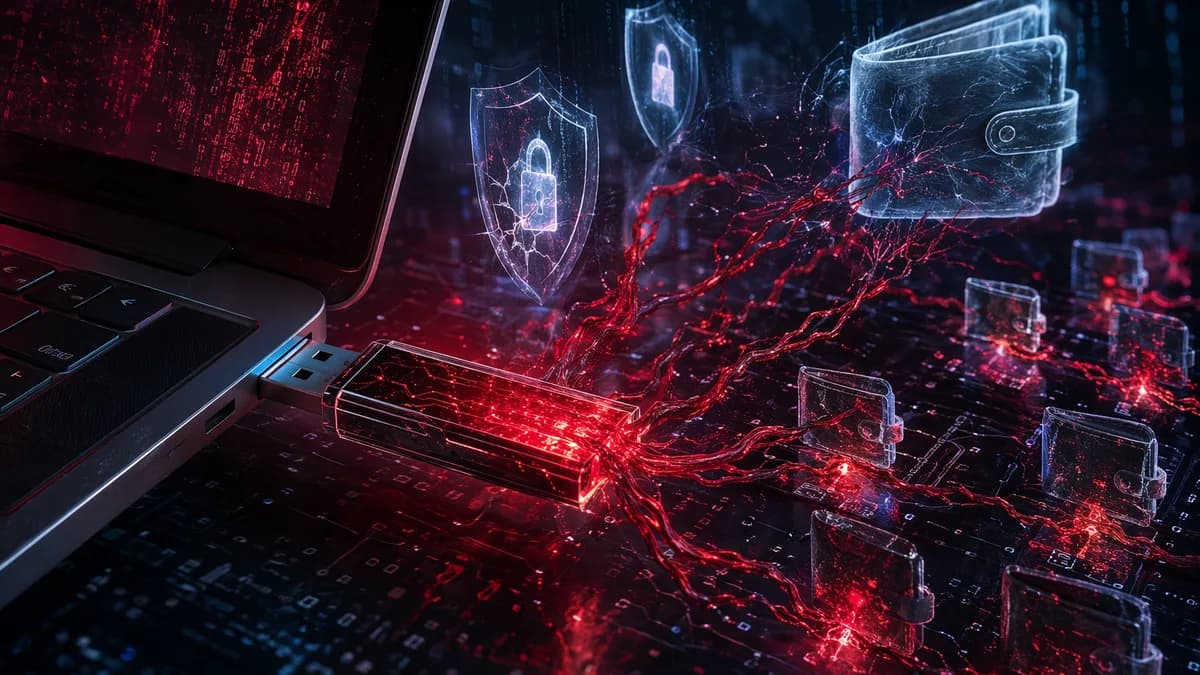
Microsoft found a USB-spreading crypto wallet malware campaign that has targeted Windows users since February, using malicious .lnk shortcut files to install a worm that steals wallet data and can swap crypto recipient addresses before funds are sent, according to CoinDesk.
That makes this attack less glamorous than a protocol exploit and more uncomfortable. The blockchain doesn’t have to break. The user’s endpoint does.
Why does a USB stick still threaten crypto wallets in 2026?
Because the attack sits in a boring place where users still make fast trust decisions: removable media and copied text.
Microsoft identifies the malware as Trojan:Win32/CryptoBandits. CoinDesk describes it as a “crypto clipper,” a category of malware that monitors clipboard activity for crypto-related data. The infection starts when a user opens an infected USB drive and clicks a malicious Windows shortcut file ending in .lnk.
That shortcut doesn’t just open a document. It directs Windows to execute code that installs a worm on the PC. Once installed, the malware has two jobs:
- Steal wallet data: Watch the clipboard for seed phrases, private keys, and wallet addresses.
- Spread itself: Wait for clean USB drives, then infect them by replacing ordinary files with malicious shortcuts using the same names.
XOOMAR analysis: this is the sharp edge of endpoint risk in crypto. Users can run hardened wallets, enable exchange 2FA, and avoid suspicious links, then still lose funds because their local machine silently changed what they pasted into a transaction field.
That same endpoint-first lesson runs through broader security coverage, including our reporting on Paid ShapedPlugin Updates Smuggle Malware Into WordPress and Spies Could Listen Through Patched Beats Studio Buds Flaw. Different targets, same warning: trusted interfaces can become delivery channels.
How does CryptoBandits hijack a transfer before the user notices?
The worm watches the clipboard roughly every 500 milliseconds, according to the source material. That timing matters. It means the malware doesn’t need to wait long or guess much. It sits between copy and paste.
If a user copies a Bitcoin or Ethereum private key, seed phrase, or recipient address, the malware can capture it. Microsoft’s reporting, as summarized by CoinDesk, says the data is exfiltrated over the Tor network. The malware also takes five screenshots, spaced ten seconds apart, and sends those too.
The more immediate theft path is address substitution. When the malware detects that a user copied a recipient wallet address, it silently replaces that address with an attacker-controlled one. The transfer then goes to the attacker if the user pastes and confirms without checking the full destination.
That is the cruel part. Nothing needs to “look hacked” at the point of confirmation if the pasted address appears plausible.
| Attack step | What the user thinks is happening | What the malware is doing |
|---|---|---|
| Clicks a USB shortcut | Opening a document or file | Installing the worm |
| Copies a seed phrase or private key | Moving wallet data temporarily | Capturing account-control material |
| Copies a recipient address | Preparing a transfer | Replacing it with attacker address |
| Inserts a clean USB drive | Moving files normally | Creating new malicious shortcuts |
Private keys and seed phrases are especially dangerous here because clipboard exposure can hand over control of the wallet itself. A bad destination address can steal one transfer. A stolen seed phrase can compromise the wallet.
What do the actual numbers tell us, and what don’t they tell us?
The supplied reporting gives useful operational numbers, not campaign-scale numbers.
Here’s what is documented:
- February: Microsoft says the malware has been spreading since then.
- 500 milliseconds: Approximate clipboard polling interval.
- Five screenshots: Captured after crypto-related clipboard activity.
- Ten seconds apart: Screenshot timing.
- Port 9050: Microsoft told Defender customers to hunt for connections to a local Tor proxy on this port.
- 12 or 24 words: Related reporting says the stealer looks for standardized BIP39 seed phrases.
What the source does not provide is equally important. It does not say how many machines were infected. It does not give stolen-funds totals. It does not identify victims, countries, exchanges, wallet brands, or attacker wallets.
So the right conclusion is not that this is a massive campaign. The right conclusion is narrower and more useful: Microsoft found a working theft chain that combines USB propagation, clipboard monitoring, Tor-routed exfiltration, screenshots, and wallet-address replacement.
That combination is enough to matter.
“The execution of this clipper is notable because it does not depend on a traditional installer or exposed IP-based C2 infrastructure,” Microsoft said, according to related reporting from Ars Technica. “Instead, it deploys a portable Tor client, routes traffic through a local SOCKS5 proxy, and blends data theft with remote code execution, turning a financially motivated stealer into a lightweight backdoor.”
XOOMAR analysis: the absence of exposed IP-based command-and-control infrastructure makes this harder to treat as a simple blocklist problem. The local Tor proxy and hidden-service routing reduce some of the obvious network signals defenders often rely on.
Why is the shortcut-file trick more dangerous than it sounds?
A .lnk file looks mundane. That’s the point.
Windows shortcuts are familiar enough that users often don’t inspect them. In this campaign, the worm propagates by scanning a clean USB drive for ordinary files, including Word documents, Excel sheets, and PDFs, then replacing them with shortcut files using the same names. The next user sees familiar filenames. The trap resets.
Microsoft’s mitigation advice tells you where the weak points are:
- Disable AutoRun for removable media.
- Block .lnk execution on USB drives through group policy.
- Restrict script hosts such as wscript.exe and cscript.exe.
- Check indicators of compromise, including file hashes and .onion domains published by Microsoft.
- Hunt for local Tor proxy activity on port 9050.
This is not just consumer hygiene. Businesses with crypto exposure need to treat one infected workstation as both a wallet-theft device and a distribution point. If a machine touches finance workflows and accepts removable media, the risk compounds.
Which groups have the hardest decisions after Microsoft’s finding?
Individual users have the simplest lesson and the hardest habit to maintain: don’t trust pasted wallet addresses blindly. Verify the full address, not just the first and last few characters. Avoid copying seed phrases or private keys into the clipboard. Don’t open unknown USB drives.
IT teams face a policy question. If removable media remains allowed, controls need to be explicit. Blocking shortcut execution from USB drives is not cosmetic here. It attacks the initial trigger.
Wallet developers and exchanges face a different problem, and this is XOOMAR analysis. If malware can alter clipboard contents before transaction signing, user interfaces need to assume the clipboard is hostile. Stronger transaction previews, trusted address books, hardware-wallet confirmations, and warnings when clipboard content changes unexpectedly would reduce the room for silent substitution.
Crypto tax and portfolio workflows also sit near this risk because they often involve addresses, exports, and multiple accounts. That’s why operational security matters beyond trading desks, as we covered in Crypto Tax Software Must Beat the 1099-DA Trap in 2026.
What evidence would show whether this becomes a wider crypto threat?
The next signal is not a token price move. It’s defender telemetry.
Watch for whether Microsoft or other security teams report broader detections of CryptoBandits malware, more attacker infrastructure, or new variants that target browser wallets, exchange sessions, passkeys, or additional address formats. Evidence of stolen funds would strengthen the threat assessment. Lack of follow-up detections would weaken it.
For now, the practical read is clear. Crypto security can’t stop at exchange passwords, hardware wallets, or chain analytics. If a Windows machine can rewrite the destination address between copy and paste, attackers don’t need a spectacular blockchain exploit.
They just need the user to trust the clipboard.
Impact Analysis
- CryptoBandits shows that crypto theft can happen through ordinary Windows clipboard and USB behavior, not just blockchain exploits.
- The malware can silently swap recipient wallet addresses before a user sends funds, making transactions risky even when users think they are careful.
- Its USB-based spread highlights how removable media remains a practical infection path for crypto wallet attacks.
Sources

Written by
XOOMAR Insights Team
Research and Editorial Desk
The XOOMAR Insights Team pairs automated research with human editorial judgment. We track hundreds of sources across technology, fintech, trading, SaaS, and cybersecurity, cross-check the facts, and explain what happened, why it matters, and what to watch next. We do not just rewrite headlines. Every article is fact-checked and scored for reliability before it goes live, and we link back to the original sources so you can verify anything yourself.
Explore More Topics
Related Articles
 Cybersecurity
Windows Bind Link Attacks Trick EDR Into Clean Scans
Bitdefender says Windows bind links can split file views, letting malware trick EDR into scanning clean files while hostile code runs.
Jul 19, 20268 min
 Cybersecurity
AI Buries Microsoft Patch Tuesday Under Record 570 Fixes
Microsoft’s 570-fix Patch Tuesday shows AI is finding bugs faster than enterprises can patch them.
Jul 19, 20267 min
 Cybersecurity
AI Slop Hijacks Brian Chesky's X in Tokenization Scare
A hacked Brian Chesky X account pushed vague tokenization hype, showing how AI slop can turn CEO credibility into crypto bait.
Jul 17, 20267 min
 Cybersecurity
FTC Says Hims & Hers Fed Patient Data to Ad Giants
The FTC says Hims & Hers shared sensitive health data with ad platforms, turning telehealth growth tactics into a major privacy fight.
Jul 30, 20268 min
 Cybersecurity
$110M Inforcer Series C Run Crowns the MSP Security Bet
Inforcer’s $50M Series C lifts its 18-month haul to $110M, backing MSPs as the control layer for SMB AI and security risk.
Jul 30, 20267 min
 Fintech
Mystery Deadline Hangs Over Landmark Crypto Bill
A landmark crypto regulation bill faces a silent, last-minute deadline in the U.S. Senate, with a critical ethics provision targeting presidential profits holdi
Aug 6, 20267 min
 Technology
TechCrunch Dangles $400 Discount as Disrupt Loyalty Test
TechCrunch's $400 flash sale for Disrupt 2026 is a high-pressure tactic to lock in founders and investors early, testing their confidence in the event's future
Aug 6, 20266 min
 Technology
DeepSeek Demands $8bn as China's AI Plays Catch-Up
DeepSeek is pushing to close an $8 billion funding round at a $74 billion valuation, a massive jump just weeks after its last raise, underscoring China's aggres
Aug 6, 20264 min
 Global Trends
Watch Every NFL Preseason Game Free Legally
A complete guide to legally watching the entire 2026 NFL preseason for free using official trials, the DAZN platform, and VPNs, covering every game without a ca
Aug 6, 20266 min
 Technology
Google Pixel 11 Unveil Targets AI Gripes on August 12
Google will unveil its Pixel 11 smartphones at a live event on August 12. This guide shows you how to watch the keynote and analyze the real upgrades in chips,
Aug 6, 20266 min
Don't miss the signal
Get our weekly roundup of the stories that matter across tech, fintech, and trading. No noise, just signal.
Free forever. No spam. Unsubscribe anytime.