
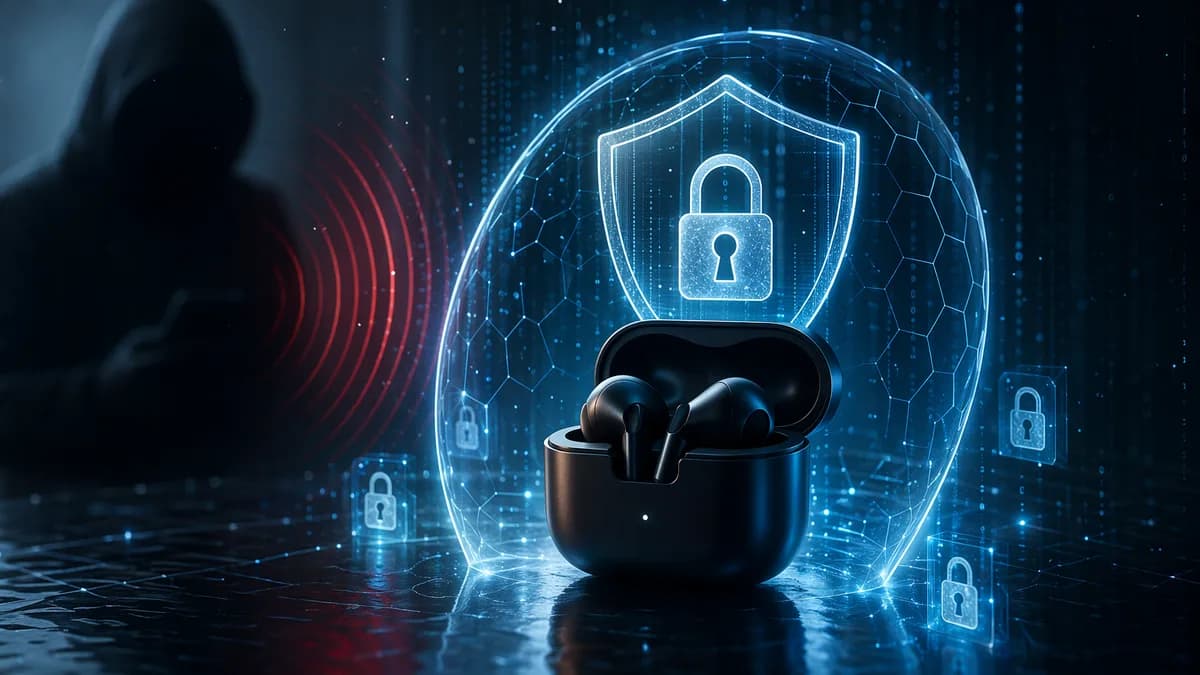
8.8 out of 10 is the number that turns the Beats Studio Buds flaw from a niche Bluetooth bug into a real privacy problem. Apple has shipped Beats Firmware Update 1B211 to patch CVE-2025-20701, a high-severity vulnerability that could let an attacker within Bluetooth range listen through the microphone of certain Beats earbuds, according to BleepingComputer.
CybersecurityJune 19, 2026· 7 min read· By XOOMAR Insights Team
Spies Could Listen Through Patched Beats Studio Buds Flaw
Updated on June 19, 2026
XOOMAR Intelligence
Analyst Take
58/ 100
4 sources analyzedLow confidenceTrend10Freshness98Source Trust88Factual Grounding92Signal Cluster20
The deeper signal is sharper than the headline. Wireless earbuds now sit inside the personal security perimeter. They aren’t passive accessories. They have radios, microphones, firmware, pairing logic, and enough trust from the phone to become a target.
"An attacker within Bluetooth range may be able to listen through the microphone of a device which is not yet paired and actively seeking pair requests," Apple said in its advisory, according to BleepingComputer.
Beats Studio Buds flaw makes the microphone the real target
The Beats Studio Buds flaw matters because the exposed asset wasn’t a playlist or a battery reading. It was the microphone.
Apple’s advisory says the risk involved a device that was "not yet paired and actively seeking pair requests." That detail matters. The attack path was not described as a remote internet compromise. It required proximity. The attacker had to be within Bluetooth range, and the target device had to be in the vulnerable state.
That narrows the threat. It does not make it harmless.
The researchers, Dennis Heinze and Frieder Steinmetz of ERNW GmbH, traced the issue to a missing authentication weakness in the Bluetooth BR/EDR radio of Airoha system-on-a-chip (SoCs). They disclosed the issue one year ago at the TROOPERS security conference in Germany and built a proof-of-concept exploit that could initiate a call and eavesdrop on conversations within earshot of the targeted phone.
XOOMAR analysis: the practical lesson is that audio hardware deserves the same suspicion users already apply to phones and laptops. Earbuds sit close to private speech. That makes any authentication failure more intimate than a normal peripheral bug.
CVE-2025-20701 required proximity, but the chain widened the blast radius
Apple patched CVE-2025-20701 in Beats Firmware Update 1B211. The update is delivered automatically when vulnerable headphones are paired and within Bluetooth range of a user’s iPhone, iPad, or Mac.
Users can check the firmware by opening Bluetooth settings and tapping the info button next to the headphones.
The single flaw was serious enough. The chain was worse. BleepingComputer reported that when CVE-2025-20701 was combined with CVE-2025-20700 and CVE-2025-20702, attackers could use the Bluetooth Hands-Free Profile (HFP) to issue commands to the phone after hijacking the connection between the phone and a paired Bluetooth audio device.
The researchers put it bluntly:
"In most cases, these vulnerabilities allow attackers to fully take over the headphones via Bluetooth. No authentication or pairing is required," they warned.
They also said the flaws could be triggered via Bluetooth BR/EDR or Bluetooth Low Energy (BLE), with Bluetooth range as the only precondition. In their testing, it was possible to read and write the device’s RAM and flash.
Here is the difference between the standalone bug and the chained attack path:
| Scenario | Reported capability | Constraint |
|---|---|---|
| CVE-2025-20701 alone | Listen through the microphone of a device seeking pair requests | Attacker must be within Bluetooth range |
| CVE-2025-20701 plus CVE-2025-20700 and CVE-2025-20702 | Hijack connection, issue HFP commands, access memory, retrieve call history and contacts, call arbitrary numbers | Requires proximity and technical sophistication |
That last constraint is important. The researchers said "real attacks are complex to perform." This was not described as a mass exploitation event.
1B211 is the firmware number Beats users need to verify
The response is simple, but slightly hidden: confirm Beats Firmware Update 1B211.
Apple says the firmware will be delivered automatically when the earbuds are paired and near an iPhone, iPad, or Mac. That puts the burden on the device update pipeline rather than a manual download flow.
For users, the useful checklist is short:
- Firmware: Confirm the Beats Studio Buds show 1B211 in Bluetooth settings.
- Pairing state: Avoid leaving vulnerable earbuds in a state where they are actively seeking pair requests.
- Sensitive audio: Don’t use unpatched earbuds for confidential calls.
- Update path: Keep the earbuds paired with a trusted Apple device long enough for automatic delivery.
A related Ars Technica report described CVE-2025-20701 as carrying a severity rating of 8.8 out of 10 and noted that the flaw was one of three vulnerabilities from the Airoha disclosure.
XOOMAR analysis: the biggest usability problem is visibility. Phones make software updates obvious. Earbud firmware often disappears into a settings pane most users rarely open.
Apple, researchers, and users are looking at three different risks
Apple’s job is to close the vulnerability and preserve confidence that small devices in its orbit are still managed like serious endpoints. This patch does that, but it also reminds users that the Apple device experience extends beyond the iPhone screen.
XOOMAR has covered that broader Apple trust surface in different contexts, including Trump Drags Apple Intel Chip Deal Into Political Fire and Pixi iOS App Sneaks AR Characters Into iMessage Chats. The Beats case adds a sharper security angle: accessories can become part of the attack path.
For researchers, the appeal is obvious. Bluetooth audio combines proprietary firmware, radio behavior, microphones, and paired-device trust. The ERNW findings show how a flaw in one component can spill into phone-level actions when chained with related bugs.
For users, the problem is more basic. Earbuds feel disposable. The conversations they carry are not.
For attackers, the source material supports a narrower conclusion: this kind of flaw is more relevant to targeted spying than broad compromise. The attack requires proximity, skill, and the right device conditions. That limits scale, but it does not erase the risk for people whose conversations are valuable.
Audio devices are no longer simple peripherals
The supplied reporting does not show that every Beats user was exposed to active spying. It also does not say this vulnerability was exploited in the wild.
Still, the technical chain is enough to change how these devices should be treated. ERNW said attackers could retrieve call history and contacts, and even call an arbitrary number after extracting Bluetooth link keys from a vulnerable device’s memory. The researchers added that available commands depend on the mobile operating system, but "all major platforms support at least initiating and receiving calls."
That turns the earbud from a speaker and microphone into a command bridge.
This is where enterprise security teams should pay attention without overreacting. The supported facts point to proximity-based risk, not internet-scale compromise. But companies already treat phones and laptops as controlled endpoints because they carry voice, identity, and access. Wireless audio now belongs in that conversation.
A practical policy does not need drama. It needs inventory awareness, firmware checks for approved devices, and clearer rules for sensitive calls. Teams already reviewing endpoint detection may find adjacent context in Best SIEM Tools That Won't Drown Lean Security Teams, but the Beats lesson is narrower: detection tooling won’t help much if no one treats the microphone-bearing accessory as a managed device.
The next test is whether audio security becomes visible before the next CVE
The Beats Studio Buds flaw is patched. The harder question is whether users will notice the next one fast enough.
Evidence that would support a stronger security posture would be simple: clearer firmware status inside Apple settings, more prominent security notices for audio accessories, and faster visibility when vulnerable devices remain unpatched. Evidence that would weaken confidence would be another Bluetooth audio flaw where the fix exists, but users have no obvious way to know whether their earbuds received it.
For now, the practical move is direct: check for Beats Firmware Update 1B211, keep the earbuds close to a trusted Apple device long enough to update, and treat wireless microphones as part of the security perimeter. Users won’t abandon wireless earbuds. Vendors need to make secure audio feel less like hidden maintenance.
Impact Analysis
- The flaw could let nearby attackers listen through the microphone of vulnerable Beats earbuds.
- The risk highlights how wireless earbuds have become part of users’ personal security perimeter.
- Apple’s firmware update closes a high-severity Bluetooth authentication weakness before broader abuse.
Beats Studio Buds Vulnerability Severity
CVE-2025-20701
CVSS8.8
Sources

Written by
XOOMAR Insights Team
Research and Editorial Desk
The XOOMAR Insights Team pairs automated research with human editorial judgment. We track hundreds of sources across technology, fintech, trading, SaaS, and cybersecurity, cross-check the facts, and explain what happened, why it matters, and what to watch next. We do not just rewrite headlines. Every article is fact-checked and scored for reliability before it goes live, and we link back to the original sources so you can verify anything yourself.
Explore More Topics
Related Articles
 Cybersecurity
App Store Crypto Scam Drags Apple Into $1.8M Fight
Apple faces a lawsuit after users say a fake Sparrow Wallet on the App Store drained $1.8M in Bitcoin, testing its safety pitch.
Jul 27, 20269 min
 Cybersecurity
DHL Cargo Plane Attacked After Bomb Drone Found on Runway
Authorities defused an explosive-laden drone near a Ukrainian plane at a major German cargo hub. In a separate incident, a DHL cargo jet was hit by an unidentif
Aug 5, 20264 min
 Cybersecurity
Evil Twin Apps Slip Past macOS Gatekeeper Warnings
Researchers say macOS can let malicious app replacements inherit Gatekeeper trust after first launch. Apple isn't calling it a major flaw.
Jul 23, 20268 min
 Cybersecurity
Exit Gap Haunts Apple OpenAI Lawsuit Over Data Access
Apple says a former employee got back into its network after joining OpenAI. Offboarding just became a live security fight.
Jul 13, 202611 min
 Cybersecurity
Customer Records Stolen in Lidl Data Breach Across Europe
Lidl says attackers stole online shop customer data via an outside IT provider, but passwords and payment details were spared.
Jul 13, 20266 min
 Technology
AirPods Pro Plunge to $189 in Rare $60 Sale
The AirPods Pro have dropped to $189.99, their lowest price since June, in a coordinated sale across Amazon, Walmart, and Best Buy signaling a final pre-holiday
Aug 6, 20266 min
 Technology
How Her's AI Dream Stalled in Consumer Apathy
Despite billions in investment and inspiration from the movie 'Her,' mainstream consumers aren't adopting AI agents, viewing them as unreliable solutions to pro
Aug 6, 20267 min
 Global Trends
Salmonella Jalapeño Outbreak Sends 36 to Hospital
At least 345 people in 27 states have been sickened, with 36 hospitalized, in a Salmonella outbreak traced to jalapeños served at major restaurant chains and di
Aug 6, 20264 min
 Global Trends
Senators Hold Fauci in Contempt as COVID Probe Collapses
A Senate committee voted to hold Dr. Anthony Fauci in contempt of Congress, a partisan act his lawyer denounced as political theater that blocks real pandemic a
Aug 6, 20267 min
 Trading
Apollo Wins $5.7B EasyJet Takeover With Founder Backing
US private equity giant Apollo Global Management will acquire EasyJet for £5.7 billion (£7.15 per share), backed by the airline's founder, taking the iconic low
Aug 6, 20265 min
Don't miss the signal
Get our weekly roundup of the stories that matter across tech, fintech, and trading. No noise, just signal.
Free forever. No spam. Unsubscribe anytime.