
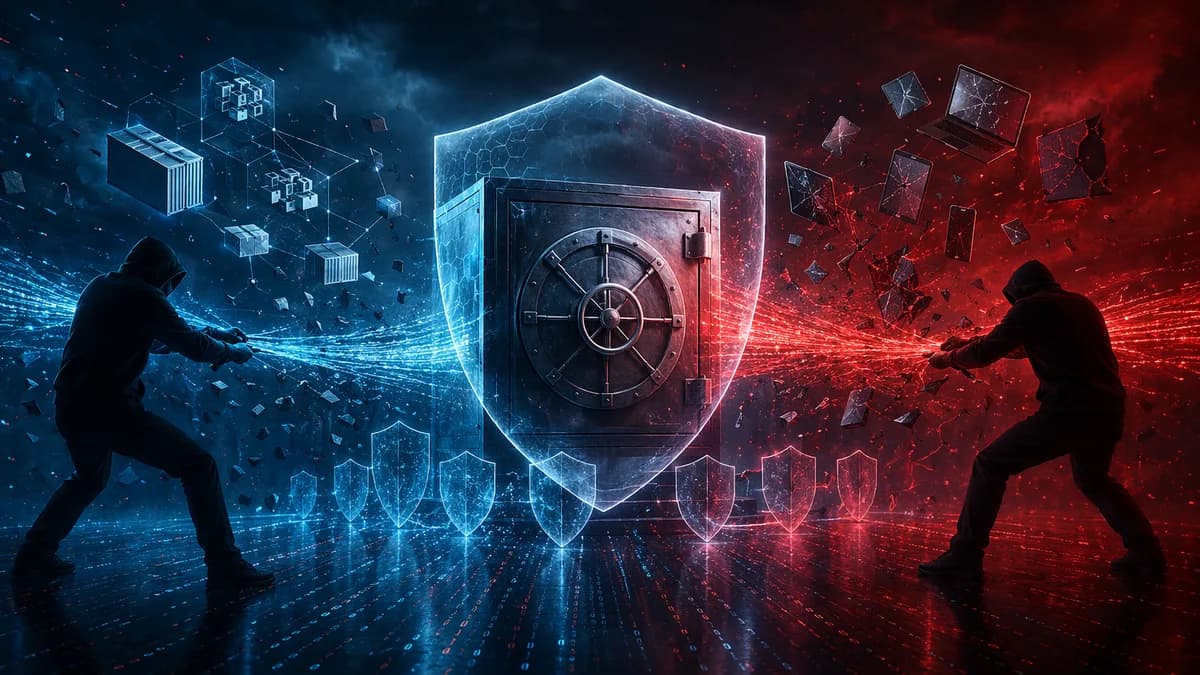
The Klue supply chain hack now signals a deeper problem than the original breach: even the attackers may have lost control of the stolen data they were using for extortion.
CybersecurityJune 28, 2026· 9 min read· By XOOMAR Insights Team
Klue Supply Chain Hack Spirals After Hackers Rob Icarus
Updated on June 28, 2026
XOOMAR Intelligence
Analyst Take
71/ 100
4 sources analyzedMedium confidenceTrend10Freshness99Source Trust85Factual Grounding88Signal Cluster20
That is the strange core of the incident. Klue, a market research provider, was hit by the Icarus ransomware group, and a second unnamed group now claims it broke into Icarus and stole the same customer data, according to TechRadar Pro. The result is a layered extortion mess: Klue customers face the original breach, a possible secondary theft, and competing criminal claims about who has what.
“We continue to communicate with the threat actor we have been in contact with (‘Icarus’). Icarus told us they are taking steps to delete the data taken from Klue customers. The Icarus site remains down and we have indications that Icarus is indeed taking steps to delete data taken from Klue customers.”
That message, shared privately with Klue customers and seen by TechCrunch, should have been a sign of containment. Instead, it became the opening act for a second extortion attempt.
The Klue supply chain hack turned cyber extortion into a thief-robs-thief story
The strangest part of the Klue supply chain hack is not that a vendor became a path into customer data. The sharper signal is that the criminal group accused of stealing the data now appears to have become a target itself.
Klue has said it is in contact with Icarus, which claimed possession of stolen data and threatened to leak it to pressure the company. Then a second unnamed group surfaced, claiming it had accessed a member of Icarus’s environment and taken the customer data Icarus had already stolen from Klue.
That matters because data extortion depends on one idea: the attacker controls the asset. If victims believe the attacker can delete, withhold, sell, or leak the files, the attacker has bargaining power. If another crew has copied the same data, that control collapses.
The strongest counterpoint is that the second group may be exaggerating. Klue told customers that Icarus said the unnamed group had only samples, not the full dataset. But the central risk remains. Once stolen data moves outside the original trusted environment, no victim can rely on one criminal’s promise that deletion has solved the data exposure.
How Icarus allegedly lost control of Klue customer data
The reported chain starts with Klue’s systems and ends inside Icarus’s own infrastructure. TechCrunch reported that Klue said attackers accessed its systems on June 12 using a “compromised legacy credential” tied to an integration tool that let customers connect cloud data to Klue accounts.
That is why this incident hit beyond Klue. The affected companies named in the supplied reporting include LastPass, Gong, Jamf, HackerOne, Huntress, and others. TechCrunch also reported that companies including Insurity, OneTrust, Recorded Future, Snyk, Sprout Social, and Tanium confirmed they had data stolen.
The second breach, if accurate, happened after Icarus had already collected the data. The unnamed group claimed one Icarus member accidentally allowed it to connect to the server hosting the stolen Klue data. That claim has not been independently proven in the supplied material, but it fits the practical problem facing victims: attackers store stolen files somewhere, and those storage points can become new targets.
XOOMAR analysis: this is the part standard breach language often misses. “Exfiltrated data” is not static. It can be copied, mirrored, traded, sampled, reposted, or stolen again. If the second group has meaningful access, Klue’s ability to negotiate with Icarus becomes far less useful.
The evidence burden now sits on samples, logs, and timestamps
Criminal claims are cheap. In the Klue case, the facts that matter now are technical and narrow: who accessed what, when, from where, and how much data left each environment.
The unnamed group reportedly posted a list of affected companies on its own website and claimed to have stolen the data from Icarus. It also alleged that an “Icarus operator who is a teenager living somewhere in the UK or adjacent countries” had been paid by Klue to delete the stolen data. The supplied reporting says there is no evidence Klue paid Icarus.
Klue’s practical advice to customers was revealing. The company suggested customers ask the second group for random samples of their data to test whether the group actually has the full set. That is not comfort. It is triage.
| Data or claim at issue | Status in supplied reporting | Why it matters |
|---|---|---|
| Business contact information | Reported by affected companies via TechCrunch, including names, emails, phone numbers, job titles, and some account information | Useful for phishing and targeted social engineering |
| Number of affected Klue customers | Not confirmed by Klue in supplied reporting | Determines notification, legal, and operational scope |
| Full dataset held by second group | Disputed, Icarus reportedly told Klue the group had only samples | Changes the risk from limited proof to broader exposure |
| Klue payment to Icarus | Alleged by unnamed group, no evidence in supplied reporting | Could affect trust in deletion claims, but remains unverified |
| Credentials, source code, contracts, internal chats, support tickets | Not established in supplied reporting | Should not be assumed exposed without validation |
XOOMAR analysis: file hashes, access logs, validated random samples, and a defensible timeline matter more than screenshots or leak-site theater. If multiple groups handled the same files, responders must prove provenance, not just possession.
Klue, customers, Icarus, and rival hackers all want different outcomes
Klue’s immediate job is to confirm the breach scope, preserve evidence, brief customers, and avoid saying more than its forensics support. The company has already said Icarus claimed to be deleting the data and that Icarus’s site remains down.
Customers have a different priority. They need to know whether their own records, employee details, customer contact data, cloud integrations, or authentication paths are exposed. If Klue’s integration access touched systems such as Salesforce databases, as TechCrunch reported, customers have to inspect connected environments rather than treat this as a vendor-only incident.
Icarus faces a reputational problem inside its own criminal market. A group that loses stolen data looks careless. Its threat to delete data also becomes less persuasive if a rival group can still extort the same victims.
The second group’s incentive is simpler: convert someone else’s theft into its own payday. Klue relayed one striking instruction from Icarus:
“Icarus has asked us to inform Klue customers to not make payment to this other party.”
That is a darkly comic sentence, but it also shows the power struggle. Two criminal actors now appear to be fighting over the same extortion surface.
Hackers stealing from hackers adds a supply chain twist
Cybercriminal infighting is not new. Rival crews expose each other, steal databases, seize leak sites, and weaponize identities. What makes the Klue incident sharper is the vendor chain beneath it.
A traditional breach has one victim and one attacker. Here, the alleged path runs from Klue to Klue customers, then from Icarus to a second unnamed group. The exposure chain now includes the original vendor, the vendor’s customers, the first attacker, and the attacker’s attacker.
For XOOMAR readers tracking how security failures can spill across organizations, this sits alongside broader cyber incident coverage such as Russian Hackers Turn Jaguar Land Rover Hack Into $2.5B Hit and Rogue Root Account Exposes Cisco SD-WAN Zero-Day Hack. The Klue case is different on the facts, but the common thread is concentration risk: one access point can create consequences far beyond the first system touched.
The counterpoint is that the second group’s access may be limited. If it only has samples, the damage is narrower. But breach response cannot assume there is one adversary or one copy of the data. The Klue supply chain hack shows why that assumption is now dangerous.
Klue users should treat the data as out of control until proven otherwise
The practical lesson is blunt: don’t rely on ransom negotiations, takedown claims, or attacker promises of deletion. Even if Icarus is deleting data, the unnamed group’s claim means customers have to plan as if at least some copied material may remain outside Klue’s reach.
XOOMAR analysis: affected organizations should prioritize a short list of actions tied to the reported facts.
- Credential rotation: Review credentials, tokens, and API keys connected to Klue or related integrations.
- Integration audit: Identify which cloud systems were linked to Klue, especially customer-data stores.
- Log review: Check access records around June 12 and after, including unusual exports or third-party activity.
- Phishing monitoring: Treat exposed business contact information as fuel for targeted outreach.
- Notification planning: Prepare customer and regulator communications only around validated data categories.
This is also a governance problem. Companies using SaaS integrations need clearer maps of where data flows, what privileges vendors hold, and which old credentials remain active. The supplied reporting says the attackers used a compromised legacy credential. That phrase should make every security team ask how many forgotten access paths still exist in their own stack.
After Icarus loses Klue data, attribution gets murkier
The next phase will hinge on proof, not claims. Evidence that would support Klue’s containment narrative includes validated deletion signals, limited sample possession by the second group, and logs showing no broader copying from Icarus infrastructure. Evidence that would weaken it includes fresh leaks, independently verified full datasets, or customer-specific files that the second group should not have if it only held samples.
More criminal-on-criminal raids are a rational risk, based on this case alone. Stolen breach archives have value, and the groups holding them may not secure their own servers better than the companies they attack.
The Klue and Icarus episode leaves one hard lesson: once data leaves a trusted environment, even the criminals may not know where it will land next.
Impact Analysis
- The incident shows that stolen customer data can spread beyond the original attackers, making containment harder.
- Victims may face multiple extortion attempts even after a ransomware group claims it will delete data.
- The case highlights the added risk companies inherit when sensitive data is exposed through a vendor.
Actors in the Klue supply chain hack
| Party | Role | Claim or status |
|---|---|---|
| Klue | Market research provider and breach victim | Says it is communicating with Icarus and has indications Icarus is taking steps to delete stolen customer data |
| Icarus | Ransomware group accused of stealing Klue customer data | Claimed possession of stolen data and threatened to leak it for extortion |
| Unnamed hackers | Second criminal group | Claims it broke into Icarus and stole the same Klue customer data |
Sources
- [1] TechRadar Pro
- [2] Klue hack results in data breach at several cybersecurity firms | TechCrunch
- [3] Unnamed hackers steal stolen data from Icarus hackers responsible for Klue supply chain hack — and yes, it's as confusing as it sounds
- [4] Klue says the hackers who stole its customer data are deleting it, but a second group has emerged with extortion demands

Written by
XOOMAR Insights Team
Research and Editorial Desk
The XOOMAR Insights Team pairs automated research with human editorial judgment. We track hundreds of sources across technology, fintech, trading, SaaS, and cybersecurity, cross-check the facts, and explain what happened, why it matters, and what to watch next. We do not just rewrite headlines. Every article is fact-checked and scored for reliability before it goes live, and we link back to the original sources so you can verify anything yourself.
Explore More Topics
Related Articles
 Cybersecurity
$12M Ransom Flops as Stadler Ransomware Hit Stays Contained
Stadler refused a $12.3M Everest demand after supplier files leaked, saying its core systems and production stayed untouched.
Jul 26, 202613 min
 Cybersecurity
Cyber Attackers Destroy Backups Before Demanding Ransom
Modern ransomware attacks deliberately destroy backup data first, forcing companies to shift from passive data copies to provable, automated recovery in hours,
Aug 11, 20266 min
 Cybersecurity
Canadian Hacker’s Snowflake Heist Nets $2.5 Million Ransom
A hacker's guilty plea for the Snowflake data breach reveals a $2.5 million extortion scheme that exploited simple stolen passwords at over 165 companies, highl
Aug 8, 20268 min
 Cybersecurity
Ransomware Payment Trap Pulls Victims Back for More
Proofpoint says over a third of companies that paid a ransom faced another demand. Payment buys time, not control.
Jul 22, 20267 min
 Cybersecurity
Security Teams Miss 77% of Critical Attack Techniques
A formal detection program typically covers only 23% of MITRE ATT&CK techniques, leaving a massive gap attackers exploit. Proactive threat hunting using a SIEM
Aug 13, 202613 min
 Global Trends
Navy’s Record Carrier Deployments Burn Out Sailors
U.S. Navy carriers are pushing past 300-day deployments, leaving sailors on ships like the USS Abraham Lincoln physically depleted and mentally broken in a stra
Aug 18, 20266 min
 Fintech
Fireblocks Hires SEC Veteran As Crypto Rulemaker
Fireblocks hiring ex-SEC Commissioner Elad Roisman signals a pivotal shift: major crypto infrastructure is moving from protesting regulation to directly writing
Aug 18, 20266 min
 Fintech
Labour Suspends MP Over Pandemic Loan Eligibility Probe
Labour MP Bayo Alaba is suspended as his party investigates the eligibility and attempted winding-up of a company that received pandemic loans.
Aug 18, 20265 min
 Technology
Indonesia Quake Paralyzes Island As Death Toll Climbs
A powerful shallow earthquake on Flores Island has killed at least 53 people and overwhelmed local response capabilities, highlighting Indonesia's persistent vu
Aug 18, 20269 min
 Trading
Yen Ignores 80% Bank of Japan Rate Hike Odds
Despite an 80% market probability of a September rate hike, the yen remains weak, highlighting the limited power of domestic policy against overwhelming global
Aug 18, 20267 min
Don't miss the signal
Get our weekly roundup of the stories that matter across tech, fintech, and trading. No noise, just signal.
Free forever. No spam. Unsubscribe anytime.