
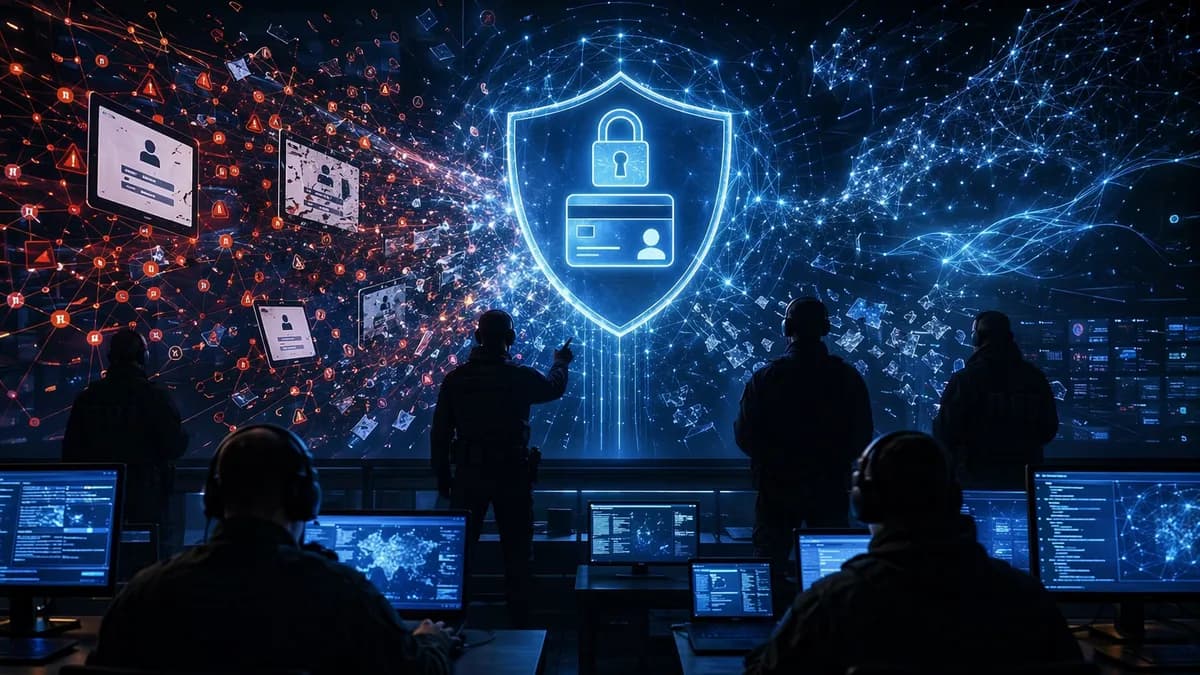
On June 14, the takedown of Outsider Enterprise phishing infrastructure put hard numbers on a sprawling AI-assisted scam service: more than one million fraudulent URLs, about 9,000 fake websites, and more than 3.8 million stolen credit card records tied to an estimated $1.9 billion in losses.
CybersecurityJune 21, 2026· 6 min read· By XOOMAR Insights Team
FBI Crushes $1.9B Outsider Enterprise Phishing Empire
Updated on June 21, 2026
XOOMAR Intelligence
Analyst Take
72/ 100
4 sources analyzedMedium confidenceTrend10Freshness99Source Trust85Factual Grounding92Signal Cluster20
The FBI dismantled the China-based phishing-as-a-service operation, seizing servers, a Shopify storefront, a Telegram bot, and around $100,000 in USDT, according to TechRadar Pro. The operation allegedly helped criminals steal credit card data, passwords, and other personal information through mass SMS phishing campaigns.
June 14: FBI seizes Outsider Enterprise phishing network built on AI-generated scam pages
Outsider Enterprise phishing was not a one-off scam page or a loose group of attackers. Investigators describe it as a phishing-as-a-service business, a rental model that lets criminals buy or subscribe to ready-made phishing kits instead of building their own infrastructure.
The FBI seized multiple administration servers, a Shopify e-commerce storefront, and an account the attackers used to test the phishing service. It also redirected thousands of phishing pages to an FBI announcement site, cutting off live scam pages from victims who might still click old links.
The most damaging figure is scale. The operation was linked to around 9,000 fake websites and at least one million fraudulent URLs, according to the source material. That volume matters because phishing infrastructure is disposable by design. A page gets reported, blocked, or burned, then another URL replaces it.
Authorities also took control of a Telegram bot used to store stolen information. That may prove more useful than the splash-page redirects if the bot contains records that connect victims, customers, and operators.
| Seized item | Why it matters |
|---|---|
| Administration servers | Core control systems for the phishing operation |
| Shopify storefront | Alleged commercial front tied to the service |
| $100,000 in USDT | Funds linked to Outsider payment wallets |
| Telegram bot | Source material says it stored stolen information |
| Phishing domains | Thousands now redirect to an FBI announcement page |
The takedown was part of the FBI's Operation Riptide, a broader push against cybercrime infrastructure and financial networks, according to additional reporting from BleepingComputer.
After the seizure: Telegram and automation show how Outsider scaled phishing
The Outsider Enterprise case shows how phishing has been packaged into a service business. Customers could use phishing kits that impersonated trusted brands, push links through SMS, and collect stolen records through shared infrastructure.
The source material says the operation used AI and distributed phishing kits. In practical terms, that means faster creation of fake pages, easier cloning of brand flows, and more tailored scam lures. The supplied reporting does not detail every model or prompt used, but it does say Google described the operation as AI-powered.
Google filed a civil lawsuit targeting Outsider Enterprise's infrastructure and said the group coordinated through Telegram.
“Our civil lawsuit targets an organized cybercrime operation known as the 'Outsider Enterprise'. Based in China and coordinating through Telegram, this network distributes "phishing kits" that allow criminals to blast out fake text campaigns that look like they’re from Google and other trusted brands," Google said.
Google also said crooks sent around 2.5 million fraudulent SMS messages to Android users in just two weeks. Users flagged 55,000 of those messages as fraudulent.
That gap is the operational problem for defenders. If millions of messages move before reporting catches up, platforms and carriers have to block infrastructure faster than users can identify scams manually.
Google said it is working with AT&T, T-Mobile, and Verizon to block fraudulent messages before they reach subscribers. That puts telecom filtering directly into the cleanup phase, not just browser warnings or takedown notices after victims click.
For readers tracking adjacent security exposure, XOOMAR's coverage of Best Antivirus for Freelancers That Stops Client Data Theft and Texas Data Breach Hands Hackers 3 Million ID Records offers related context on how stolen personal data can become a second-stage risk after the initial compromise.
Now comes the cleanup for cards, passwords, and impersonated brands
The FBI and its partners can take down servers. They can't instantly erase data already stolen.
The source material says Outsider Enterprise was linked to more than 3.8 million credit card records. Those records can still create downstream fraud risk if they were copied, sold, or shared before the seizure. The same logic applies to passwords and personal data collected through fake login pages.
Analysis: The immediate burden now shifts to payment issuers, login platforms, and companies whose brands were spoofed. They need to look for related phishing domains, identify exposed users where possible, and watch for fraud patterns tied to Outsider infrastructure.
Consumers and employees don't need a complex playbook here. They need speed and discipline.
- Passwords: Reset reused passwords, especially on email, banking, shopping, and work accounts.
- Authentication: Turn on multifactor authentication where available.
- Cards: Monitor card activity and report suspicious charges quickly.
- Links: Treat urgent SMS login prompts with suspicion, especially when they claim to come from a trusted brand.
This is also where AI-assisted phishing cuts both ways. The same automation that made Outsider scalable can make scam pages more convincing, but the seized infrastructure may give investigators pattern data that helps platforms block related campaigns faster.
Next filings will show whether the takedown reaches buyers, not just servers
The next phase is legal and forensic. Watch for court filings, named suspects, charges, and more detail on how Outsider Enterprise made money from its customers.
The seized Telegram bot could be central. Source material says it stored stolen information, and additional reporting says it contained information on customers of the phishing service. If investigators can map buyers, affiliates, victims, and payment wallets, the case may reach beyond the operators who maintained the servers.
A seizure can cripple a phishing network. It can also scatter its users. Former customers may look for new phishing kits, new domains, and new chat channels.
That is the harder problem. The FBI has taken a major Outsider Enterprise phishing platform offline, and the numbers make the win real. The watch item now is whether the data seized from servers and Telegram turns this from an infrastructure takedown into a broader case against the people who bought, ran, and profited from the scams.
Impact Analysis
- The takedown shows how phishing-as-a-service can industrialize scams at massive scale.
- Millions of stolen credit card records and estimated losses of $1.9 billion highlight the real financial risk to consumers.
- Seizing servers, a Telegram bot, and crypto assets may disrupt ongoing campaigns and expose more evidence about the network.
Outsider Enterprise phishing operation scale
Fraudulent URLs (more than)
count1,000,000
Fake websites (about)
count9,000
Stolen credit card records (more than)
count3,800,000
Sources

Written by
XOOMAR Insights Team
Research and Editorial Desk
The XOOMAR Insights Team pairs automated research with human editorial judgment. We track hundreds of sources across technology, fintech, trading, SaaS, and cybersecurity, cross-check the facts, and explain what happened, why it matters, and what to watch next. We do not just rewrite headlines. Every article is fact-checked and scored for reliability before it goes live, and we link back to the original sources so you can verify anything yourself.
Explore More Topics
Related Articles
 Cybersecurity
Steam Malware Hidden in Games Stole $220K, Feds Say
Feds say malware-laced Steam games infected 8,000 users, compromised 80 crypto wallets and stole at least $220,000.
Jul 18, 20266 min
 Cybersecurity
FBI Agent Stole $1M in Crypto from Monitored Nation State
An FBI agent used his access to steal $1 million in cryptocurrency from wallets his own national security unit was monitoring, leading to his arrest and a major
Aug 4, 202610 min
 Cybersecurity
FBI Tip Triggers Russian Hacktivist Arrest in Spain
Spain arrested a suspect tied to Russian hacktivist groups after an FBI tip, seizing devices and freezing a crypto wallet.
Jul 7, 20265 min
 Cybersecurity
Chinese Telcos Still Run U.S. Network Backdoors, Report Warns
A U.S. House committee report finds China's state-owned telecom giants maintain deep, persistent access points within American networks despite being officially
Aug 6, 20267 min
 Cybersecurity
30 Minnesota Water Systems Rattled by Cyberattacks
More than 30 Minnesota water systems were hit in two days, exposing weak utility defenses as officials warn about Iranian hackers.
Aug 1, 202611 min
 Technology
Chinese Routers Hide Secret Backdoor in 'Maintenance' Firmware
Security researchers found a hidden remote control trojan, dubbed ENDLESSDOORS, embedded in the firmware of over 20 Zbtlink router models, which the Chinese ven
Aug 6, 20266 min
 Global Trends
Salmonella Jalapeño Outbreak Sends 36 to Hospital
At least 345 people in 27 states have been sickened, with 36 hospitalized, in a Salmonella outbreak traced to jalapeños served at major restaurant chains and di
Aug 6, 20264 min
 Global Trends
Senators Hold Fauci in Contempt as COVID Probe Collapses
A Senate committee voted to hold Dr. Anthony Fauci in contempt of Congress, a partisan act his lawyer denounced as political theater that blocks real pandemic a
Aug 6, 20267 min
 Trading
Apollo Wins $5.7B EasyJet Takeover With Founder Backing
US private equity giant Apollo Global Management will acquire EasyJet for £5.7 billion (£7.15 per share), backed by the airline's founder, taking the iconic low
Aug 6, 20265 min
 Global Trends
Ukraine's 'Deep Strike' Strategy Cripples Russia's Oil Revenue
Ukraine has shifted to a strategy of 'deep strikes', using drones to attack oil refineries and military hubs inside Russia, aiming to cripple the economic engin
Aug 6, 20267 min
Don't miss the signal
Get our weekly roundup of the stories that matter across tech, fintech, and trading. No noise, just signal.
Free forever. No spam. Unsubscribe anytime.