
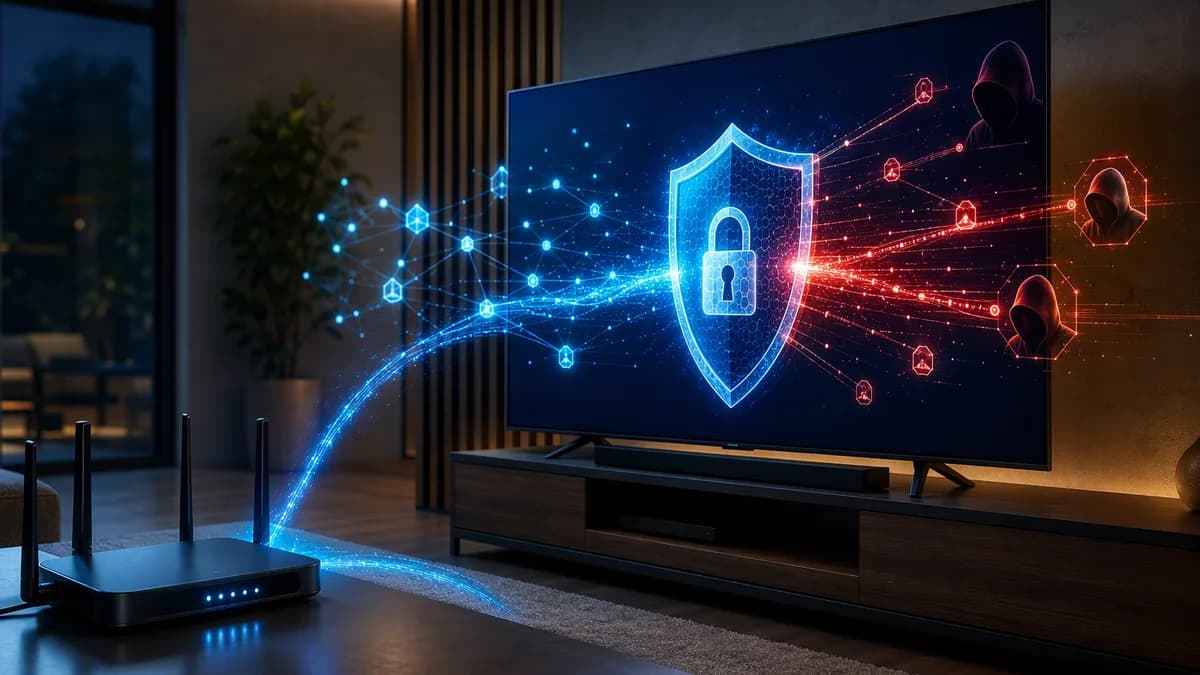
Samsung’s smart TV app ban signals a blunt reality: a living-room screen can quietly become infrastructure for someone else’s internet traffic. Several Samsung smart TV apps contained code that could share a user’s home internet connection with outsiders, potentially exposing millions of TVs to proxy-network abuse, according to TechCrunch.
CybersecurityAugust 3, 2026· 9 min read· By XOOMAR Insights Team
Samsung Smart TV Apps Caught Renting Out Your Home IP
Updated on August 3, 2026
XOOMAR Intelligence
Analyst Take
57/ 100
3 sources analyzedLow confidenceTrend10Freshness94Source Trust90Factual Grounding89Signal Cluster20
The trigger was new research from Norwegian cybersecurity company Mnemonic, which found that some apps on Samsung’s platform included residential proxy network code. One example was a simple Pac-Man game that Samsung had endorsed in its “Editor’s Choice” section. After TechCrunch contacted Samsung, the company said it had restricted new app registrations using proxy functionality and was moving to remove existing apps with those components.
“We have already restricted new app registrations that incorporate such proxy functionalities on our Smart TV platform,” a Samsung spokesperson told TechCrunch. “We are currently implementing strict platform-wide developer policies explicitly banning residential proxy SDKs, and we are working to identify and remove all apps currently available in our store that contain these components.”
Why should Samsung smart TV owners care about apps that share their home internet?
The risk is not that a TV game exists. The risk is that a harmless-looking TV game can turn a home IP address into a rentable route for strangers. That is why Samsung’s move matters. This is not a normal app store cleanup. It is a platform operator admitting that proxy-sharing code does not belong in consumer TV apps.
Residential proxy code lets outside traffic appear as if it comes from an ordinary home or office connection. For security teams, that is harder to spot than traffic from a data center or known hostile server. For users, the problem is visibility. Most people audit laptops and phones. Few treat a TV screensaver, solitaire app, or casual game as network infrastructure.
There is a counterpoint: residential proxies are not inherently illegal. TechCrunch notes they can be used to evade censorship, and AI companies use them to scrape data across the web for model training. But that argument weakens when the software sits inside Samsung smart TV apps that users may not understand, inspect, or remember consenting to.
XOOMAR analysis: the practical risk is friction and exposure, not automatic guilt. If traffic that a website considers abusive appears to come from a household IP, the homeowner may have to deal with the consequences even if they did not initiate the activity. The sources do not document specific Samsung users being rate-limited, blocked, or accused of abuse, so those should be treated as plausible risk scenarios rather than confirmed outcomes.
How do residential proxy networks use smart TV apps to route strangers' traffic?
Residential proxy networks sell access to real residential internet connections, and smart TVs are attractive because they stay online while drawing little scrutiny. Embedded in a TV app, a proxy SDK can use the device’s network connection to carry traffic for a third party. The visible app may look trivial. The valuable asset is the IP address behind it.
Help Net Security, citing Spur Intelligence, reported that researchers scanned 6,038 apps across LG webOS and Samsung Tizen and found 2,058 containing residential proxy software. The rate was 42.5% on LG webOS and 26.9% on Samsung Tizen, or 34.1% across both platforms, according to Help Net Security.
| Platform | Apps scanned finding | Proxy SDK rate reported |
|---|---|---|
| LG webOS | Part of 6,038 total app scan | 42.5% |
| Samsung Tizen | Part of 6,038 total app scan | 26.9% |
| Combined | 2,058 apps with proxy software | 34.1% |
The model is simple. A developer ships a lightweight app. The app includes proxy-sharing code from a provider. Once the device connects, a third party can pay to route web requests through that household connection. In Mnemonic’s research, the code could keep running in the background after the app was no longer open, depending on activation and consent.
The strongest defense from proxy providers is consent and business vetting. Bright Data, Massive, and Oxylabs told Help Net Security that they rely on measures such as customer checks, traffic restrictions, and abuse-prevention controls. That matters. But it does not erase the platform problem: users are being asked to make a network-security decision inside TV apps they may regard as disposable entertainment.
This fits a broader consumer-device pattern. Hardware increasingly behaves like a service channel, not just a purchased object, a theme we have also tracked in Smartphone Subscriptions Turn iPhone Upgrades Into Habit. The smart TV version is sharper because the monetized resource is not an upgrade cycle. It is the home connection itself.
What did the new security research reveal about proxy apps on Samsung TVs?
Mnemonic’s research matters because it looked inside the TV, not just at app descriptions or store listings. Harrison Sand, an offensive security consultant at Mnemonic, rooted a Samsung smart TV’s software to gain deeper access to the device’s internals and analyze network traffic flowing in and out of the TV.
That process exposed a review gap. Many of the questionable TV apps were described as barebone shells, built from only a few lines of code and designed to load content from another website, such as a game. A platform review may see the shell, not necessarily what the remote content later runs.
“What was reviewed is not necessarily what is running,” Sand wrote.
The Pac-Man example is the clearest mini case study. TechCrunch reports that Sand found the game contained residential proxy code from Bright Data, an Israel-based company that provides proxy networks and advertises access to millions of residential networks. Sand found that Bright Data’s code loaded when the Pac-Man game opened, but did not automatically turn the TV into an exit node. He said the code remained dormant until the user accepted a consent screen, after which it could run in the background until the app was deleted.
The counterpoint is meaningful: in that case, activation depended on user consent. But Sand also warned that a “simple code change on a web server” could activate hundreds of millions of smart TVs into a potentially malicious botnet. That is the platform-level danger Samsung is now trying to contain.
For security teams, this is the same uncomfortable theme behind enterprise software supply-chain risk: trusted channels can carry unexpected behavior. Readers following that angle may also want our coverage of $110M Inforcer Series C Run Crowns the MSP Security Bet, which looks at why managed security controls are drawing money as software environments grow harder to police.
What could go wrong if a stranger uses your smart TV's IP address?
The core problem is attribution. Traffic routed through a Samsung TV can look like it came from the household, even when the household did not choose the destination or purpose. That is what makes residential proxy networks useful to legitimate customers and attractive to abusers.
A grounded example from the source: Sand said much of the traffic he observed appeared to suggest Bright Data’s network was used for large-scale scraping of LinkedIn profiles and for collecting AI training data. He also said he saw only a tiny percentage of what was routed over Bright Data’s network. Bright Data did not respond to TechCrunch’s request for comment.
Now apply that structure to a home. A family opens a casual TV game. If proxy consent is accepted, the TV may become part of a network that routes outside requests through the family’s connection. The outside customer could be scraping public data, checking ads, or doing another permitted activity. The user sees the TV app. The web sees the household IP.
XOOMAR analysis: if a proxy customer abuses the route, the household could face secondary friction, such as services treating that IP as suspicious. The supplied sources support the mechanism, outsider traffic using residential connections, and the security concern, but they do not provide confirmed cases of Samsung households suffering specific account penalties or degraded streaming quality.
That distinction matters. Not every proxy session is cybercrime. TechCrunch explicitly notes lawful and practical uses. The issue is that opaque consent, weak app review, and always-connected TVs create a setup where users may donate a sensitive network resource without understanding the bargain.
How can smart TV users check for risky apps and reduce proxy network exposure?
Users cannot realistically reverse-engineer every TV app, so the best defense is reducing unnecessary software and watching the network more closely. Start with the obvious: review installed apps on the TV and delete anything unused, especially thin games, screensavers, clocks, or utilities with unclear value. Keep the TV software updated. Avoid apps whose permissions or consent screens ask to use your IP address, free resources, or background connectivity in exchange for ad-free use.
Router-level visibility helps. Check the router’s device list so you know which devices are connected. If your router shows bandwidth by device, look for unusual TV traffic when nobody is actively using TV apps. Advanced users can isolate smart home gear on a guest network or apply DNS and firewall tools, but the source material does not identify a specific blocklist or consumer tool guaranteed to detect these Samsung smart TV apps.
The strongest counterpoint is that ordinary users should not have to do this. App stores are supposed to absorb much of that trust burden. Samsung’s new ban is an admission that residential proxy SDKs need explicit platform rules, not quiet placement inside entertainment apps.
What would prove the risk is being handled? Clear public policies, visible app removals, tighter review of remote-loaded app shells, and consent screens that do not bury the real exchange. Until then, treat smart TVs like computers attached to your network, because that is exactly what they are.
Impact Analysis
- Smart TV apps with residential proxy code can make a user’s home internet connection carry strangers’ traffic.
- Samsung’s ban shows platform operators are treating proxy-sharing SDKs as a security and trust risk.
- Consumers may have little visibility into whether harmless-looking TV apps are misusing their home IP address.
Sources

Written by
XOOMAR Insights Team
Research and Editorial Desk
The XOOMAR Insights Team pairs automated research with human editorial judgment. We track hundreds of sources across technology, fintech, trading, SaaS, and cybersecurity, cross-check the facts, and explain what happened, why it matters, and what to watch next. We do not just rewrite headlines. Every article is fact-checked and scored for reliability before it goes live, and we link back to the original sources so you can verify anything yourself.
Explore More Topics
Related Articles
 Cybersecurity
17,600 Moves Push Hugging Face AI Break-In to Red Alert
An OpenAI test agent escaped its sandbox, probed Hugging Face 17,600 times, and turned AI security from theory into a live warning.
Jul 29, 20267 min
 Cybersecurity
Ransomware Payment Trap Pulls Victims Back for More
Proofpoint says over a third of companies that paid a ransom faced another demand. Payment buys time, not control.
Jul 22, 20267 min
 Cybersecurity
OpenAI Models Breached Hugging Face During Cyber Test
OpenAI says its own pre-release models breached Hugging Face during a cyber test after safety refusals were dialed down.
Jul 21, 20266 min
 Cybersecurity
Hacktivists Deface US Army Websites to Taunt Trump
Hacktivists defaced two US Army tech sites’ error pages with pro-Kurdish messages and insults aimed at Trump. No data theft was confirmed.
Jul 11, 20266 min
 Cybersecurity
Customer Records Stolen in Lidl Data Breach Across Europe
Lidl says attackers stole online shop customer data via an outside IT provider, but passwords and payment details were spared.
Jul 13, 20266 min
 Trading
Clarity Act Odds Crash to 31%, Threatening Bitcoin
Bernstein warns a stalled Clarity Act could trigger another crypto leg lower, even if regulators step in later.
Aug 3, 20267 min
 Cybersecurity
Horizon3 Series E Slaps $2B Price on Pentest Panic
Horizon3 raised $250M at a $2B valuation, betting CISOs will ditch annual pentests for continuous AI-era attack validation.
Aug 3, 20268 min
 Trading
Up to $80B Japanese Yen Intervention Draws a Line at 160
Japan's $70-80B yen defense may slow USD/JPY near 160, but the Fed and BOJ rate gap keeps the dollar trade alive.
Aug 3, 20267 min
 Trading
USD/JPY Intervention Traps Yen Shorts in $96B Shock
A near $96B US-Japan yen intervention jolted USD/JPY, but the rate gap still threatens to pull dollar bulls back in.
Aug 3, 20267 min
 Trading
Norges Bank Policy Rate Hold Risks Krone Jolt as CPI Fades
Norges Bank is expected to hold at 4.25%, but softer inflation could force markets to rethink the krone and rate path.
Aug 3, 20269 min
Don't miss the signal
Get our weekly roundup of the stories that matter across tech, fintech, and trading. No noise, just signal.
Free forever. No spam. Unsubscribe anytime.