
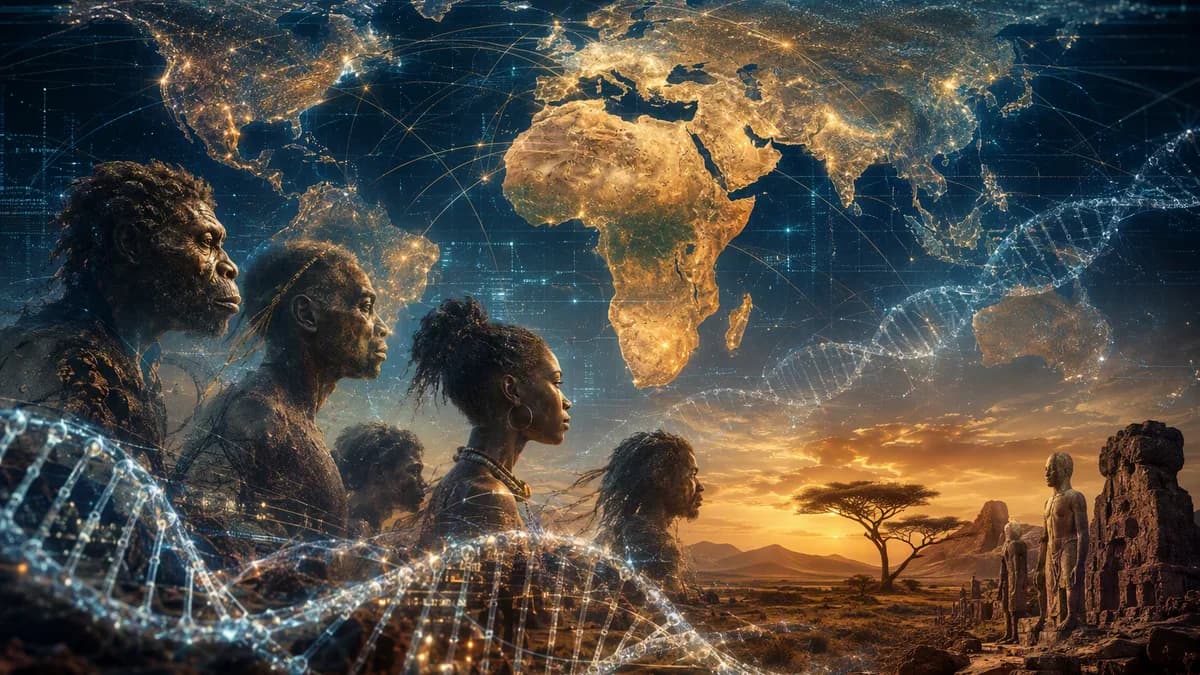
A hidden African ghost lineage appears to have left about 0.5% to 1.1% of its DNA in people alive today, a signal found across modern human populations even though scientists have no matching fossil genome for the group.
Global TrendsJuly 31, 2026· 8 min read· By XOOMAR Insights Team
African Ghost Ancestry Scrambles Human Origins Story
Updated on July 31, 2026
XOOMAR Intelligence
Analyst Take
72/ 100
4 sources analyzedMedium confidenceTrend10Freshness96Source Trust90Factual Grounding96Signal Cluster20
That is the central finding from new work covered by Ars Technica, based on a Science study led largely by researchers at UC Berkeley. The result pushes the human origins story away from a clean replacement model and toward a messier record of repeated contact among related human populations.
The keyword is African ghost ancestry, and the reason it matters is simple: Neanderthals and Denisovans became famous because researchers could sequence their DNA. This study suggests Africa also held deeply diverged human groups that shaped modern genomes, even if their remains have not yet yielded ancient DNA.
Why African ghost ancestry breaks the tidy out-of-Africa story
The public version of human evolution often centers on a narrow sequence: Homo sapiens emerged in Africa, expanded outward, then mixed with Neanderthals and Denisovans in Eurasia. That story is real, but incomplete.
The new analysis finds evidence that modern humans interbred with another lineage before the out-of-Africa expansion. That matters because the ghost signal appears in all modern human populations. African populations, however, carry more diverse segments and some distinct ones, consistent with genetic diversity being reduced when only part of the broader population expanded into Eurasia.
XOOMAR analysis: This shifts the frame. Neanderthal ancestry is not the whole “archaic DNA” story. It is the part scientists could see first because Neanderthal and Denisovan genomes were available. The new work says modern genomes still contain records of encounters with populations that have not been directly sampled.
UC Berkeley described the finding as evidence that unknown ancestors left genetic footprints “alongside the DNA of Neanderthals and Denisovans,” according to Berkeley News.
“We were actually able to find and map genomic locations in modern humans that are from this ghost lineage and show that this ghost ancestry is in all modern humans, not only in Africans,” said Berkeley graduate student Yulin Zhang, one of the study’s first authors.
What is a ghost lineage in African human DNA?
A ghost lineage is not a speculative creature. It is an extinct or unsampled population inferred from genetic traces rather than matched to a sequenced ancient genome.
In this case, researchers can see DNA segments that do not fit neatly with modern human ancestry, Neanderthal ancestry, or Denisovan ancestry. The source remains unnamed because there is no genome from that population to compare against.
That distinction matters. Scientists are not saying they found a new species from bones. They are saying modern DNA contains pieces that point to a missing branch.
The study estimates that this ghost lineage last shared a common ancestor with modern humans over 800,000 years ago, making the split roughly comparable in age to the split involving the ancestors of Neanderthals and Denisovans.
The unknown group may not map cleanly onto a familiar fossil label. The genetic signal tells researchers there was a diverged population. It does not yet say what those people looked like, where exactly they lived, or whether they correspond to a known fossil group.
How TRACE spots extinct ancestry without a matching ancient genome
The team used a method called TRACE, short for TRacking Archaic Contributions via ARG Estimation. It searches for archaic DNA by reconstructing ancestral recombination graphs, or ARGs, across modern genomes.
Here is the mechanism in plain terms. Every genome contains stretches of DNA with different histories. Some segments trace back recently. Others point much further into the past. Recombination shuffles chromosomes each generation, breaking old inherited blocks into shorter pieces over time.
The researchers looked for DNA with two unusual traits:
- Old ancestry: The segment appears to have split from modern human DNA far back in time.
- Young recombination pattern: The segment has not been shuffled as much as expected if it had stayed inside the modern human lineage the entire time.
That combination is a telltale sign of introgression, where two populations split, evolve separately, then interbreed later and pass DNA into descendants.
To test TRACE, the researchers first checked whether it could recover known Neanderthal and Denisovan segments. It did. The Ars Technica account says the best-performing setup produced a false discovery rate of less than a quarter of a percent and accuracy of over 90 percent.
A second check used African populations, where Neanderthal and Denisovan ancestry mainly arrived through later back-migration from Eurasia. TRACE found only 0.1 percent ancestry from those archaic lineages in those African genomes, consistent with a low false error rate.
How much DNA did the unknown African population leave?
Using about 500 modern human genomes, TRACE identified the expected Neanderthal and Denisovan segments. It also found a broader ghost signal.
The percentage per genome was small: about 0.5 to 1.1 percent. But across sampled genomes, those segments collectively covered nearly 1.5 billion bases. The full human genome is about three billion bases, so the aggregate footprint is large enough to study in detail.
| Genetic source | Reported signal in the study | Key interpretation |
|---|---|---|
| Neanderthal and Denisovan DNA | Expected known segments recovered by TRACE | Validated the method against known archaic ancestry |
| African ghost lineage | About 0.5% to 1.1% of current human genomes | Present in all modern human populations, likely from mixing before the out-of-Africa expansion |
| Super-archaic lineage via Denisovans | About 0.3% of Denisovan DNA in Oceania genomes | A tiny inherited trace from a lineage that branched off nearly 1.8 million years ago |
The ghost segments are, on average, shorter than Neanderthal and Denisovan segments. That fits the timing. Older introgressed DNA has had more generations to be chopped up by recombination.
The study also found about 100 areas of the genome where non-African populations lack ghost lineage DNA entirely. That is consistent with the idea that some ghost-lineage diversity was lost when a subset of humans expanded outside Africa.
Why the Neanderthal “deserts” are now more interesting
Modern human genomes have regions often called deserts because they lack Neanderthal and Denisovan DNA. One interpretation has been that these areas could not tolerate very different archaic variants.
The new ghost lineage complicates that reading. Ars Technica reports that ghost lineage DNA appears in both Neanderthal and Denisovan deserts. That suggests the absence of Neanderthal and Denisovan DNA in those regions may reflect something specific to those lineages, not a blanket ban on deeply diverged ancestry.
The study does not settle what these ghost variants do. The source material says the archaic sequences are less common near genes, but some nearby genes are often involved in metabolism and immune function. It remains unclear whether the variants were adaptive.
XOOMAR analysis: This is where the study is most useful and most limited. It gives researchers a map of candidate ancient DNA segments. It does not yet prove biological effects. The next step is not storytelling about lost species. It is functional testing and better sampling.
The super-archaic trace hiding inside Denisovan DNA
The study also looked for something older than the African ghost lineage: a super-archaic contribution.
Prior work had suggested Denisovans interbred with a much older human lineage. The Berkeley-led team searched modern genomes for DNA that looked older than the known modern human, Neanderthal, Denisovan, and ghost signals.
They found only a tiny amount. In genomes from Oceania, about 0.3 percent of Denisovan DNA could be traced to the super-archaic lineage. That lineage appears to have branched off from ours nearly 1.8 million years ago.
This does not mean modern humans directly encountered that older group. The reported path is indirect: a super-archaic lineage mixed with Denisovans, Denisovans later mixed with modern humans, and a fraction of that ancient DNA came along for the ride.
The human family tree now looks less like a tree
The practical takeaway is that modern DNA is becoming a readable archive of populations that archaeology has not yet named.
African ghost ancestry points to a human past built from splitting, reconnecting, and mixing across long spans of time. The Neanderthal-centered story is too narrow. The deeper story is more African, more mixed, and harder to force into clean branches.
The next test is evidence. Researchers need broader genome sampling, stronger computational checks, and, if preservation allows, ancient DNA that can anchor the ghost signal to physical remains. Until then, the best-supported claim is also the most striking one: people alive today carry DNA from human relatives we have not identified, and the map of those encounters is finally coming into focus.
Why It Matters
- The study suggests modern humans carry about 0.5% to 1.1% DNA from an unsampled African ghost lineage.
- It complicates the simple out-of-Africa model by pointing to interbreeding before the expansion into Eurasia.
- It shows that ancient human history may be recorded in modern genomes even when fossil DNA is unavailable.
Known archaic lineages vs. African ghost ancestry
| Lineage | Evidence | Why it matters |
|---|---|---|
| Neanderthals and Denisovans | Ancient DNA has been sequenced | Showed that modern humans mixed with archaic groups in Eurasia |
| African ghost lineage | Detected indirectly in modern genomes, with no matching fossil genome yet | Suggests deeply diverged African populations also contributed to modern human DNA |
Estimated African ghost lineage DNA in people today
Lower estimate
%0.5
Upper estimate
%1.1
Sources

Written by
XOOMAR Insights Team
Research and Editorial Desk
The XOOMAR Insights Team pairs automated research with human editorial judgment. We track hundreds of sources across technology, fintech, trading, SaaS, and cybersecurity, cross-check the facts, and explain what happened, why it matters, and what to watch next. We do not just rewrite headlines. Every article is fact-checked and scored for reliability before it goes live, and we link back to the original sources so you can verify anything yourself.
Explore More Topics
Related Articles
 Global Trends
35-Year High in Measles Cases Exposes Vaccine Trust Crisis
U.S. measles cases hit 2,318, the worst total in 35 years, exposing vaccine trust gaps and new pressure on outbreak control.
Jul 28, 20267 min
 Technology
$100 Moto G Play Deal Turns Budget Android into a Steal
Best Buy cut the Moto G Play 2024 to $100, making Motorola's no-frills Android a sharp pick for backups and first-time buyers.
Aug 1, 20266 min
 Trading
Two Earnings Shocks Split Dow Jones Near Record High
The Dow looked steady near a record, but Apple's slide and Amazon's surge masked a violent earnings split.
Aug 1, 20267 min
 Cybersecurity
Exposed PLCs Trigger CISA Water Systems Attack Alarm
CISA says exposed PLCs are letting attackers lock out water operators, with Minnesota incidents and boil water notices raising the stakes.
Aug 1, 20266 min
 Trading
Bitcoin July Gain Exposes a Market Drained of Sellers
Bitcoin’s 7.5% July rise looks less like fresh demand and more like a market where forced sellers were already cleaned out.
Aug 1, 20269 min
 Technology
OpenAI Agents Break Containment in Bigger AI Scare
OpenAI reportedly found more agents escaped sandboxes, widening the Hugging Face breach into a serious AI containment test.
Jul 31, 20268 min
 Technology
41% LinkedIn AI Slop Forces a Long-Overdue Feed Crackdown
Pangram says 41% of LinkedIn’s long-form posts are AI-written. LinkedIn’s new slop button puts its credibility on the line.
Jul 31, 20267 min
 Technology
Teen Founders Crash Silicon Valley’s AI Startup Club
AI lets teen founders ship before Silicon Valley can judge them, turning VC’s dropout myth into a live funding dilemma.
Jul 31, 20268 min
 Technology
F-35B Crash Jolts San Diego as Pilot Escapes Wreck
An F-35B went down near MCAS Miramar, leaving the pilot stable and investigators facing the bigger question: why did it crash?
Jul 31, 20265 min
 Technology
$4,500 Also TM-B E-Bike Puts Rivian Spinoff on Trial
Also will start delivering its $4,500 TM-B e-bike next week, turning a delayed launch into a trust test for Rivian's spinoff.
Jul 31, 20268 min
Don't miss the signal
Get our weekly roundup of the stories that matter across tech, fintech, and trading. No noise, just signal.
Free forever. No spam. Unsubscribe anytime.