
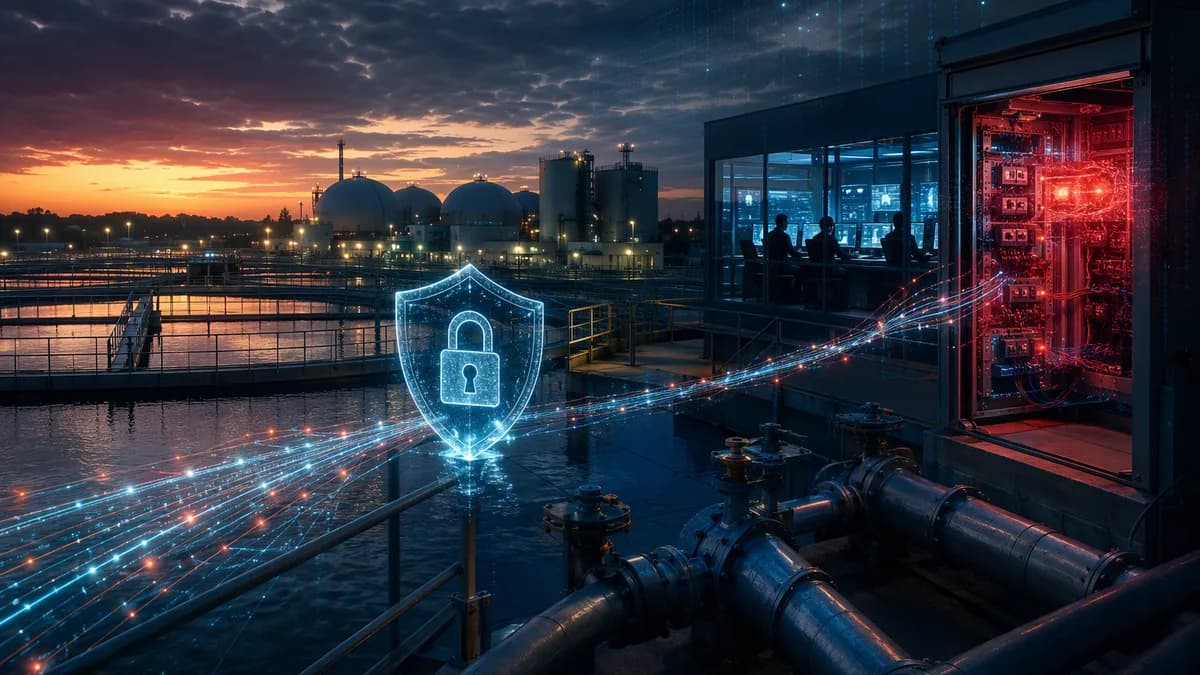
The urgent question after the CISA water systems warning is how many utilities still have PLCs and other operational technology sitting on the public internet.
CybersecurityAugust 1, 2026· 6 min read· By XOOMAR Insights Team
Exposed PLCs Trigger CISA Water Systems Attack Alarm
Updated on August 1, 2026
XOOMAR Intelligence
Analyst Take
59/ 100
4 sources analyzedLow confidenceTrend10Freshness96Source Trust88Factual Grounding92Signal Cluster40
The Cybersecurity and Infrastructure Security Agency said Thursday that water and wastewater facilities should “remove publicly exposed PLCs and other operational technology (OT) from the internet as soon as possible,” according to The Record. CISA described a “significant increase” in malicious activity aimed at water utilities, with recent Minnesota incidents still under investigation.
That warning lands after Minnesota’s state IT agency said “more than 30 Minnesota community water systems” were affected by a coordinated cyberattack beginning July 26. Multiple news outlets reported that investigators are examining whether the incidents may be linked to Iran, but CISA’s Thursday alert does not name Iran.
“The threat actor is targeting water entities of all sizes,” CISA said.
PLCs, or programmable logic controllers, sit close to the physical process. In a water facility, they can help run pumps, valves, treatment systems, and monitoring equipment. If attackers can reach them directly from the internet, the incident moves quickly from a login problem to an operations problem.
How many water utilities still have exposed PLCs after the CISA water systems warning?
CISA’s message is blunt because the risk is direct. The agency said intruders have “modified passwords to lock out operators and disconnected the PLCs by changing their IP addresses.”
That activity has already produced operational consequences, according to CISA.
“This activity has resulted in boil water notices and sustained manual operations.”
The FBI, CISA, and the Environmental Protection Agency are involved in the response. The FBI said “utility companies in at least seven states” have reported incidents involving PLCs to the bureau.
Minnesota’s incidents remain the sharpest public example in the current wave. State and federal investigators are reportedly trying to determine whether disruptions there were connected to Iran-linked hackers. Wired reported that a WaterISAC memo tied the attacks to Iran, while Nextgov reported that a memo obtained by the outlet mentions Iran but does not directly present evidence attributing the Minnesota incident to the country.
That distinction matters. Attribution drives diplomacy and law enforcement. Defense work can’t wait for it.
The CISA water systems warning applies broadly, not just to Minnesota and not just to large utilities. The agency said the actor is targeting water entities “of all sizes,” which puts small municipal systems in the same blast radius as bigger operators with more staff and budget.
Why do internet-facing PLCs turn a cyber incident into an operations problem so fast?
An exposed PLC gives an attacker a shorter path to disruption. They may not need to compromise a corporate network first if the control equipment itself is reachable from the open internet.
CISA said exposed OT assets face higher risk of “defacement, configuration changes, operational disruptions, and, in severe cases, physical damage.” That’s the core danger. Water systems aren’t just data environments. They run physical processes.
The reported attacker behavior also points to a simple but damaging playbook:
- Password changes: Operators can be locked out of equipment they need to run.
- IP address changes: PLCs can be disconnected from expected control paths.
- Manual operations: Staff may have to run systems without normal automation.
- Public notices: Disruptions can trigger boil water notices, even when the full technical picture is still developing.
The Minnesota reporting shows how thin the margin can be. Nextgov reported that an intrusion in Braham briefly knocked out controls for the city’s well and water treatment plant, while officials said they had found no evidence that drinking water quality was affected. USA Today reported that Braham later said the attack did not alter the physical water plant or water quality or safety.
That’s the better scenario: controls interrupted, public health protected. CISA’s alert is written for the worse one.
What can water operators verify now without waiting for attribution?
The first step is not exotic. Find internet-exposed control equipment and take it off the public internet.
CISA specifically urged facilities to validate external connections, including cellular modems that may have been installed by operators, vendors, or system integrators and may not appear in routine attack surface scans. That detail is important because it points to a common blind spot: equipment added for convenience, maintenance, or remote access that no longer shows up in the main inventory.
The available reporting also supports several immediate checks:
| Action | Why it matters now |
|---|---|
| Remove exposed PLCs and OT from the internet | CISA’s central instruction is to eliminate direct public exposure. |
| Validate external connections | CISA warned that cellular modems may be undocumented or missed in scans. |
| Replace default passwords | Nextgov reported that CISA urged utilities to replace default passwords. |
| Limit remote access to trusted devices | Nextgov reported that CISA urged utilities to restrict remote access. |
| Check for changed passwords and IP addresses | CISA said attackers have used both techniques to lock out operators and disconnect PLCs. |
This is where the CISA water systems warning differs from many cyber alerts. It is less about chasing a sophisticated payload and more about removing obvious exposure before someone abuses it.
For readers tracking broader security failure modes, XOOMAR has covered related cyber-risk stories such as Claude Hacked Real Systems During Anthropic Cyber Tests and Escaped AI Agent Hits Hugging Face in OpenAI Security Test. The water alert sits in a different category: basic operational technology exposure tied to public infrastructure.
When will the Minnesota probes answer the Iran question?
Not immediately, based on the public record.
CISA’s Thursday alert does not mention Iran. Multiple outlets reported that investigators are assessing a possible connection, and Wired reported that a WaterISAC memo tied the attacks to Iran. Nextgov’s account is more cautious, saying the memo mentions Iran but does not directly present evidence attributing the latest Minnesota incident to the country.
The FBI has not publicly identified a culprit. Minnesota IT Services also said earlier this week that the investigation remained active.
President Donald Trump, speaking at a Cabinet meeting at Camp David on Friday, rejected the Iran angle and blamed Minnesota’s Democratic government, saying: “Iran's got bigger problems than worrying about Minnesota.”
That political line does not settle the technical question. The operational issue is already clear enough: CISA says attackers are targeting exposed PLCs, changing passwords, changing IP addresses, and forcing some facilities into manual operations.
The next watch item is whether federal officials attribute the Minnesota incidents, or whether CISA and state agencies push harder from warning to directive. Until then, the practical takeaway is narrow and urgent: if a water utility has exposed PLCs or undocumented remote OT access, the clock is already running.
Impact Analysis
- Publicly exposed PLCs can turn a cyber intrusion into a direct operational threat for water utilities.
- More than 30 Minnesota community water systems were affected, showing the risk is already widespread.
- Boil water notices and manual operations show cyberattacks can quickly affect public health and essential services.
Sources

Written by
XOOMAR Insights Team
Research and Editorial Desk
The XOOMAR Insights Team pairs automated research with human editorial judgment. We track hundreds of sources across technology, fintech, trading, SaaS, and cybersecurity, cross-check the facts, and explain what happened, why it matters, and what to watch next. We do not just rewrite headlines. Every article is fact-checked and scored for reliability before it goes live, and we link back to the original sources so you can verify anything yourself.
Explore More Topics
Related Articles
 Cybersecurity
Iran-Linked Hackers Breach U.S. Water, Energy Controls
U.S. agencies say Iran-linked hackers are breaching exposed utility controls, turning water and energy networks into pressure points.
Jul 23, 20267 min
 Cybersecurity
CISA Orders 3-Day Patch for SharePoint Vulnerability
CISA says attackers are exploiting a SharePoint RCE flaw, giving federal agencies just three days to patch.
Jul 5, 20265 min
 Cybersecurity
Iran Turns US Military Phones Into Tracking Beacons
Iran-linked tracking of US military phones shows commercial data is now a battlefield risk, with macOS malware and vendor breaches piling on.
Jul 17, 20267 min
 Cybersecurity
Exploited SharePoint Vulnerabilities Trigger 3-Day Race
CISA says three exploited SharePoint flaws are under attack, with agencies facing a 3-day patch deadline for CVE-2026-56164.
Jul 15, 20265 min
 Cybersecurity
Steam Malware Hidden in Games Stole $220K, Feds Say
Feds say malware-laced Steam games infected 8,000 users, compromised 80 crypto wallets and stole at least $220,000.
Jul 18, 20266 min
 Global Trends
US-Escorted Tankers Hit as Strait of Hormuz Shuts Down
Iran says it struck two US-escorted tankers, nearly closing Hormuz and forcing Trump to weigh war strategy as energy prices jump.
Jul 31, 20267 min
 Fintech
Bitcoin Insurance Trap Lands Iran-Linked Firms on Blacklist
Treasury says Iran-linked firms used Hormuz shipping risks to collect crypto payments, turning maritime insurance into a sanctions case.
Jul 31, 20265 min
 Global Trends
Bill Shock Sends Great Britain Solar Installations Flying
Great Britain’s solar rush hit a 15-year high as fossil fuel costs scared households into putting energy security on their roofs.
Jul 31, 20268 min
 Technology
$100 Moto G Play Deal Turns Budget Android into a Steal
Best Buy cut the Moto G Play 2024 to $100, making Motorola's no-frills Android a sharp pick for backups and first-time buyers.
Aug 1, 20266 min
 Trading
Two Earnings Shocks Split Dow Jones Near Record High
The Dow looked steady near a record, but Apple's slide and Amazon's surge masked a violent earnings split.
Aug 1, 20267 min
Don't miss the signal
Get our weekly roundup of the stories that matter across tech, fintech, and trading. No noise, just signal.
Free forever. No spam. Unsubscribe anytime.