
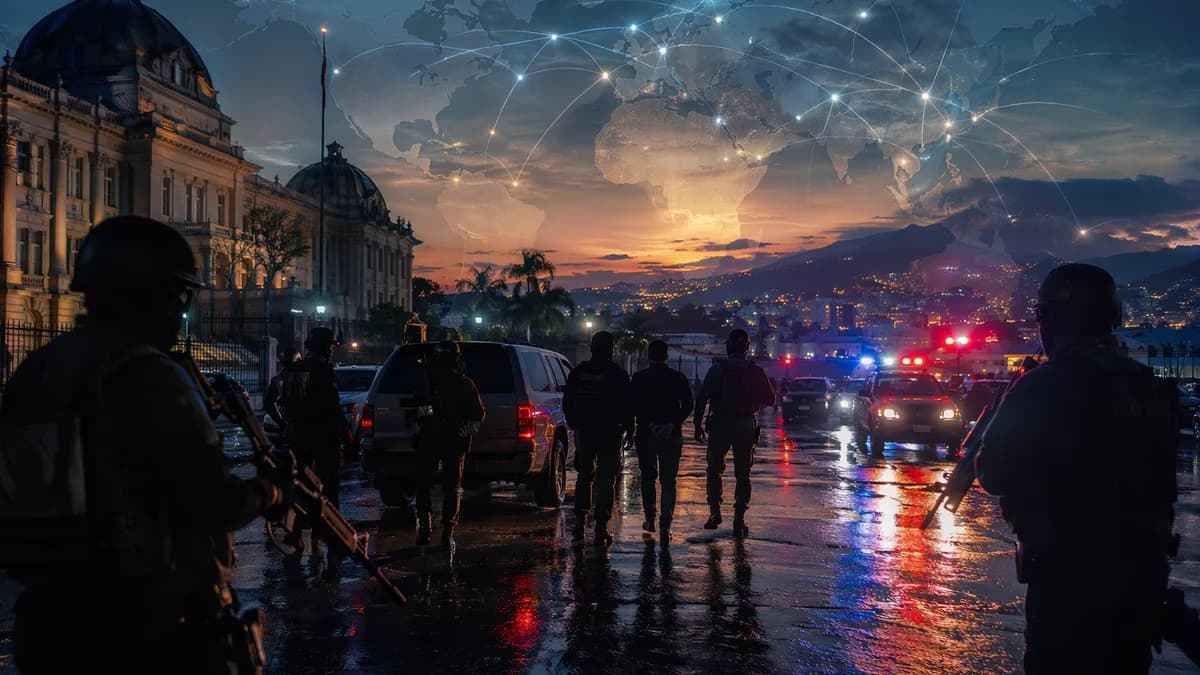
On Thursday, armed men seized James Boyard, one of Haiti’s most senior security officials, turning the country’s kidnapping crisis into a direct strike on the command layer of the state.
Global TrendsJune 14, 2026· 7 min read· By XOOMAR Insights Team
Haiti Kidnapping Seizes State Security Insider and Family
Updated on June 14, 2026
XOOMAR Intelligence
Analyst Take
57/ 100
4 sources analyzedLow confidenceTrend10Freshness94Source Trust92Factual Grounding86Signal Cluster20
Boyard, the defence minister’s chief of staff and inspector general of Haiti’s police, was abducted in Port-au-Prince, according to BBC World. Reports cited by the BBC described it as the highest-ranking abduction in Haiti in recent years. The New York Times, cited by the BBC, reported that Boyard’s wife and six-year-old daughter were also taken and that a ransom had been requested.
That is the immediate shock. The deeper signal is harsher: Haiti’s armed groups are no longer just preying on civilians or peripheral officials. They can now reach into the security establishment itself, targeting a figure involved in rebuilding the armed forces and assessing police reform.
This follows our breaking coverage of Brazen Haiti Kidnapping Takes Top Security Official, but the abduction deserves a broader reading. It is not only a criminal event. It is a test of who controls movement, protection, intelligence, and fear in Haiti’s capital.
Thursday's seizure of James Boyard put Haiti's security hierarchy on notice
Boyard’s role made him a symbolic and operational target. He is chief of staff to Mario Andrésol, who was appointed in March, and was tasked with helping rebuild Haiti’s armed forces. He is also described in the reporting as a highly respected security expert.
That combination matters. A kidnapping of a wealthy business figure pressures families and networks. A kidnapping of a senior security official pressures the state.
For ordinary Haitians, the message is brutal: if a figure with status, access, and presumed protection can be seized, then the shrinking idea of “safe” space in Port-au-Prince looks even weaker. For police and defence officials, the message is personal. The people responsible for managing threats are now publicly exposed to them.
The Associated Press account cited by regional outlets reported that Boyard was seized in Bourdon, an area described as one of the few parts of Port-au-Prince still considered relatively safe. That detail changes the tone of the case. It suggests the threat is not contained to known gang strongholds or clearly avoided routes. It is pushing into places where state officials, professionals, and families may have assumed they still had room to move.
Diego Da Rin, an analyst with the International Crisis Group, told AP that kidnappings are increasingly occurring in areas of Port-au-Prince once considered safe. He also said gangs have targeted people with double nationalities and public officials, potentially to seek higher ransoms or discourage operations in gang-controlled areas where hostages are held.
“A person of this rank clearly has a fairly important security detail,” Da Rin said, according to the AP account.
XOOMAR analysis: that line is the core of the story. If Boyard had meaningful protection and was still taken, the issue is not only manpower. It raises questions about planning, surveillance, informants, route security, and possible penetration of official protective routines.
UN figures show why this abduction landed in an already broken system
The kidnapping landed inside a crisis already measured in mass casualties, displacement, and collapsing public confidence.
According to the United Nations figures cited by the BBC, gang-related violence in Haiti has caused at least 2,310 deaths, 1,106 injuries, and 99 kidnappings so far this year. The latest figures from the UN migration agency put displacement at nearly 1.5 million people without a place to live.
AP reporting carried by the Los Angeles Times and Jamaica Gleaner added another layer: an estimated 70% of Port-au-Prince is controlled by Viv Ansanm, a powerful gang coalition that the U.S. designated as a foreign terrorist organization in May 2025.
Those numbers explain why Boyard’s abduction matters beyond one case:
- Casualties: The death toll cited by the UN shows violence is already operating at a national emergency scale.
- Displacement: Nearly 1.5 million people without stable shelter means violence has remade daily life, not just security policy.
- Kidnappings: The BBC cites 99 kidnappings so far this year, showing that abductions remain a central part of the wider security collapse.
- Territorial control: The estimated 70% gang control of the capital points to a state that does not fully govern its own administrative center.
There is also a trend complication. Reported kidnapping counts can move differently from public fear and political impact. A lower reported total, where it occurs, can still coexist with more politically consequential abductions, more territorial control, and worse public fear.
Data in Haiti is also hard to treat as complete. Fear, weak institutions, disrupted access, and the practical danger of reporting crimes can distort the record. The verified figures are already severe. The unreported reality may be worse, but the supplied sources do not allow a precise estimate.
A senior security abduction creates leverage beyond ransom
The New York Times, cited by the BBC, reported that a ransom had been requested. AP-related reporting said it was not clear who kidnapped Boyard or whether a ransom had been requested. That discrepancy matters. It shows how little confirmed information is available in the immediate aftermath, even when the victim is a top official.
Still, the tactical value of such a kidnapping is clear.
| Pressure point | How Boyard's abduction could matter |
|---|---|
| Ransom | A high-ranking official and family members may be seen as higher-value hostages. |
| Intelligence | A security official may know personnel, routes, priorities, reform plans, or operational weaknesses. |
| Humiliation | The state is forced to respond to a public demonstration of its own vulnerability. |
| Deterrence | Gangs may seek to discourage attacks on areas where hostages are held, as Da Rin suggested. |
| Internal suspicion | Officials may question whether routes, schedules, or protection details were compromised. |
The internal damage may be as important as the external message. If a kidnapping appears carefully planned, security agencies can start looking inward. Who knew the route? Who knew the tim
The Stakes
- The abduction of James Boyard shows Haiti’s armed groups can target the upper ranks of the security state.
- The kidnapping raises doubts about the government’s ability to protect officials tasked with restoring order.
- For residents of Port-au-Prince, the attack signals that even high-status figures with presumed protection are vulnerable.
Sources

Written by
XOOMAR Insights Team
Research and Editorial Desk
The XOOMAR Insights Team pairs automated research with human editorial judgment. We track hundreds of sources across technology, fintech, trading, SaaS, and cybersecurity, cross-check the facts, and explain what happened, why it matters, and what to watch next. We do not just rewrite headlines. Every article is fact-checked and scored for reliability before it goes live, and we link back to the original sources so you can verify anything yourself.
Explore More Topics
Related Articles
 Global Trends
Nigerian Army Frees 33 Hostages in Gunfight Rescue
Nigerian troops rescued all 33 people abducted just one day earlier in a firefight, forcing the kidnappers to flee into the bush.
Aug 9, 20264 min
 Global Trends
Nigeria Rescues 308 Hostages in Historic Militant Raid
Nigerian security forces rescued 308 hostages from militants, marking the largest single recovery in the country's history, yet it highlights a kidnapping epide
Aug 6, 20268 min
 Global Trends
Nigeria Frees 308 Hostages in Single Raid, Breaking Kidnap Cycle
A coordinated military operation freed 308 abducted civilians in a single Nigerian national park, marking a rare, large-scale tactical win against criminal gang
Aug 6, 20265 min
 Trading
Strait of Hormuz Shutdown Lifts Oil Prices 6%
WTI crude oil jumped over 6% after Iran confirmed talks on shipping routes don't mean the Strait of Hormuz will reopen, setting the stage for a prolonged geopol
Aug 10, 20268 min
 Fintech
Erebor Quadruples Deposits In 100 Days For $8B Valuation
Startup-focused Erebor Bank has quadrupled deposits in three months and is now raising $1.5 billion at an $8 billion valuation, a giant bet on its post-SVB nich
Aug 10, 20265 min
 Trading
Stocks Ignore Record Job Losses as Fed Pledge Trumps Payrolls
The Dow Jones Industrial Average showed no fear after July's shocking job losses, as investors bet weak labor data will keep the Federal Reserve from raising ra
Aug 10, 20266 min
 Fintech
DOJ Charges 455 Providers for $6.5B in Healthcare Fraud
The Department of Justice has replaced traditional fraud investigations with AI-driven analytics, charging 455 defendants in a $6.5 billion scheme and forcing p
Aug 10, 20267 min
 Fintech
Poland Launch Tests Paysafe's Legacy Card Pivot
Paysafe's launch in Poland is a strategic test of whether it can upgrade its existing prepaid card users into full digital wallet customers, following a wave of
Aug 10, 20266 min
 Technology
Microsoft's PC Tax Hike Ignites Sticker Shock on New Windows
Microsoft is implementing a 7-10% price hike for Windows 11 licenses to PC makers, a significant increase that will add further cost pressure to new computers a
Aug 10, 20267 min
 Technology
Pentagon Bets $1.4B on China-Free Battery Breakthrough
The Pentagon issued a $1.4 billion loan to Sila Nanotechnologies to build next-generation batteries in the U.S., a direct move to break China's grip on critical
Aug 10, 20265 min
Don't miss the signal
Get our weekly roundup of the stories that matter across tech, fintech, and trading. No noise, just signal.
Free forever. No spam. Unsubscribe anytime.