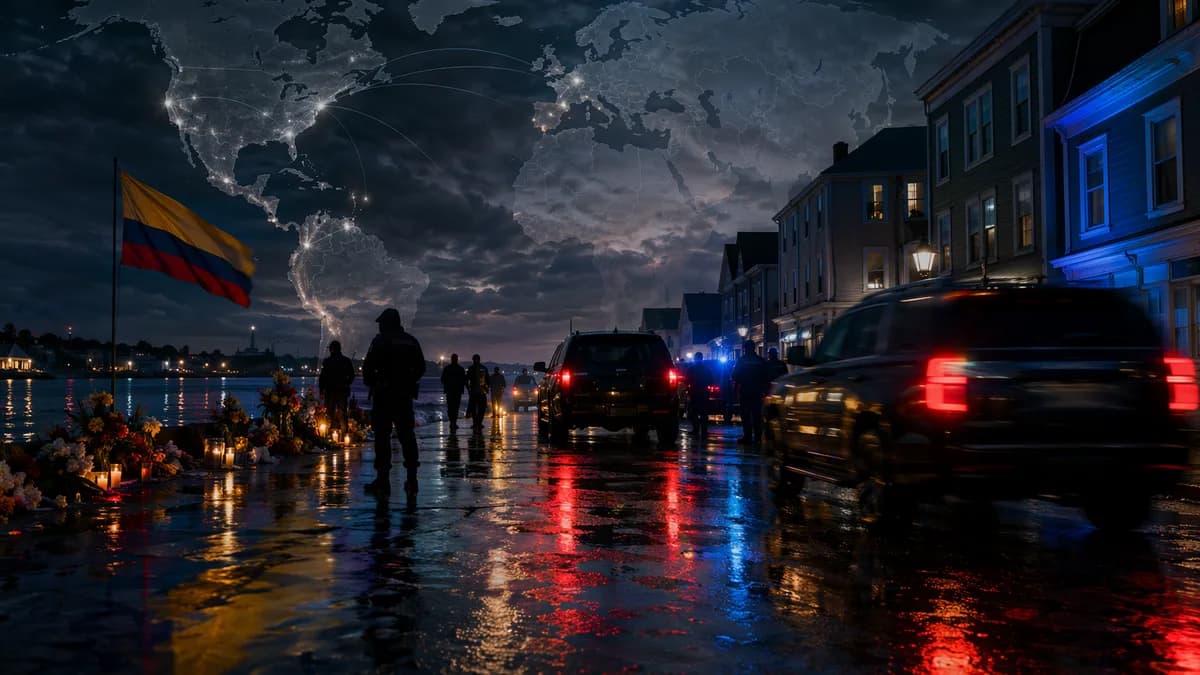
After a second fatal immigration operation in less than a week, is ICE facing isolated split-second threats or a deeper operational failure? That is the question raised by the ICE shooting in Maine, where an immigration agent fatally shot a Colombian national during an enforcement operation in Biddeford, according to BBC World.
XOOMAR Intelligence
Analyst Take
The case is already bigger than a local shooting. Immigration and Customs Enforcement said agents were watching an address at around 07:00 EDT on Monday for a person with a final order of removal. When agents tried to stop someone driving from that address, ICE said "the vehicle attempted to flee the scene and, fearing for public safety, an officer discharged his weapon", striking the driver.
Did the Biddeford operation collapse because of one moment, or because of the setup?
The official account starts with surveillance, a stop attempt, a vehicle, and a shot. That sequence leaves the most important part underdeveloped: the seconds between the stop and the gunfire.
Maine Attorney General Aaron Frey said initial statements indicate "the subject attempted to flee in a vehicle in the direction of the officer and was fatally shot". ICE has not shared details on why the officer feared for safety. The agent, from ICE's Enforcement Removal Operations department, has been placed on leave pending an investigation.
The dead man has not been publicly named because authorities said he must be formally identified and his family notified. The Embassy of Colombia confirmed he was a Colombian national and said it has "requested information and clarification" from DHS "regarding the circumstances surrounding this lamentable death and will continue to follow the case closely as the investigation progresses".
Advocates filled in part of the human picture. The Maine Immigrants' Rights Coalition said the man was 26 years old and authorised to work in the US.
"He was a member of our community, a neighbor, and a human being whose life was cut tragically short," the organisation said.
XOOMAR analysis: the operational question is not only whether the agent felt threatened. It is whether the stop was designed in a way that made a panicked vehicle movement more likely, and whether agents had less lethal or lower-risk options before the confrontation reached a fatal point.
Why does the Houston case make the Maine shooting harder to treat as isolated?
The ICE shooting in Maine came less than a week after an ICE officer fatally shot 52-year-old builder Lorenzo Salgado Araujo in Houston on 7 July. Federal officials later acknowledged Salgado Araujo was not the intended target of that operation, while saying he had tried to run over an ICE agent.
That does not prove the Maine and Houston cases are the same. It does make the burden on federal explanations heavier.
| Case | Source-supported facts | Accountability pressure |
|---|---|---|
| Biddeford, Maine | Colombian national killed during an ICE operation tied to an address under surveillance for a person with a final order of removal | ICE has not detailed why the officer feared for safety. Senator Angus King later said he was told the man was not the target of a warrant |
| Houston, Texas | Lorenzo Salgado Araujo killed on 7 July while driving to a construction site | Federal officials said he was not the intended target but claimed he tried to run over an ICE agent |
Senator Angus King said DHS chief Markwayne Mullin initially told him the person killed in Maine was the target of an arrest warrant. Hours later, King said Mullin called back to say the man was actually not the target of a warrant, his office told the BBC.
That revision matters. In lethal-force cases, early official framing often hardens public perception. If the target status changes within hours, investigators need to reconstruct not just the shooting, but the intelligence and identification process that put agents in front of that car.
How much evidence exists if the ICE agents had no body cameras?
King said the officers involved did not wear body cameras. That creates the central evidentiary problem.
Witnesses offered fragments. One Biddeford resident, Lucas Scott, told the Biddeford Gazette he saw lights flashing from an unmarked white SUV and "at least two officers wearing green ICE vests". He said agents were shouting as they surrounded a white sedan, then he heard at least four gunshots.
Another witness, Mary Hayes, told the Associated Press she saw the aftermath in personal terms that no agency statement can neutralize.
"I watched a wife fall to her knees looking at her husband's dead body on the ground," Hayes said. "I watched a little girl crying with a little pink backpack on because she's never going to see her father again."
Senator Susan Collins said the DHS inspector general's office is taking over the investigation. She also called for a "full and impartial investigation of what happened".
XOOMAR analysis: without body-camera footage, investigators will lean harder on radio traffic, vehicle positioning, witness statements, forensic evidence, dispatch records, warrants or administrative paperwork, and any private video. That slows public clarity. It also gives both supporters and critics of ICE more room to fill the gap with their own assumptions.
Which numbers matter before anyone calls this a trend?
The available numbers are sharp but incomplete.
Two migrants were fatally shot by immigration agents in less than a week, one in Houston and one in Biddeford. The Maine shooting happened about 18 miles (30km) south of Portland. The man killed there was reportedly 26. Salgado Araujo was 52.
Those facts are enough to justify scrutiny. They are not enough to calculate a reliable rate of fatal force during immigration operations.
The missing denominators matter:
- Arrests: How many field arrests occurred during the relevant period?
- Stops: How many operations involved vehicle stops?
- Force reports: How often did ICE agents report pointing weapons, firing weapons, or using less lethal tools?
- Targeting errors: How often were people stopped who were not the named target of the operation?
- Camera coverage: How many ICE field teams had body cameras or vehicle cameras active?
XOOMAR analysis: fatal shootings may be statistically rare and still politically explosive. A single death can trigger protests, diplomatic pressure, litigation, congressional questions, and local demands to know whether police helped federal agents.
Who has the most to lose if the official account stays thin?
Immigrant communities will read the Maine killing through fear and proximity. The person killed was described by advocates as authorised to work in the US. Witnesses said he lived nearby with his wife and daughter. Dozens of demonstrators gathered in Biddeford after the shooting, and others protested outside Collins' office over her vote to fund ICE.
Law enforcement will read the same event differently. Agents may argue that a vehicle moving toward officers can become a lethal threat in seconds. King said Mullin used the term "weaponised" to describe the vehicle.
"He was in a vehicle - pulled out in the vehicle, and the term the secretary used was 'weaponised' the vehicle and was shot by an ICE agent," King said.
Local politics will absorb the fallout too. Maine is not usually the center of national immigration enforcement fights, but this shooting puts state officials, local police, and federal partners under pressure to explain their roles. For separate coverage of Maine's political volatility, XOOMAR has covered Sanders Breaks With Platner, Upends Maine Senate Race and Democrats Pressure Graham Platner Toward Maine Senate Exit.
The important distinction: those electoral fights do not explain this shooting. They do show why any federal enforcement controversy in Maine can quickly become a wider test of political accountability.
Which unanswered question will decide whether this becomes a policy fight?
The decisive question is whether the evidence supports the claim that deadly force was necessary.
If investigators produce a detailed timeline, physical evidence, and a clear explanation of the threat, pressure may narrow toward this specific operation. If the public gets only short agency statements, the ICE shooting in Maine and the Houston death will be treated together as a warning sign about armed immigration enforcement.
Expect advocates and attorneys to focus first on evidence preservation: witness interviews, radio logs, vehicle movement, administrative targets, and any video from nearby homes or businesses. Expect lawmakers to press on body cameras, targeting errors, and whether people not named in warrants are being pulled into high-risk encounters.
The next evidence to watch is simple: who was the operation actually meant to arrest, what did agents know before the stop, and what proof shows the vehicle posed an immediate threat. Those answers will either narrow the Biddeford shooting to a tragic split-second decision, or widen it into a broader indictment of how ICE is conducting field operations.
Impact Analysis
- The shooting raises scrutiny over ICE use-of-force decisions during immigration enforcement operations.
- Colombia’s embassy has requested clarification from DHS, adding diplomatic pressure to the investigation.
- The case may intensify concerns from immigrant-rights advocates after a second fatal operation in less than a week.
Primary Sources & Disclosures

Written by
XOOMAR Insights Team
Research and Editorial Desk
The XOOMAR Insights Team pairs automated research with human editorial judgment. We track hundreds of sources across technology, fintech, trading, SaaS, and cybersecurity, cross-check the facts, and explain what happened, why it matters, and what to watch next. We do not just rewrite headlines. Every article is fact-checked and scored for reliability before it goes live, and we link back to the original sources so you can verify anything yourself.