
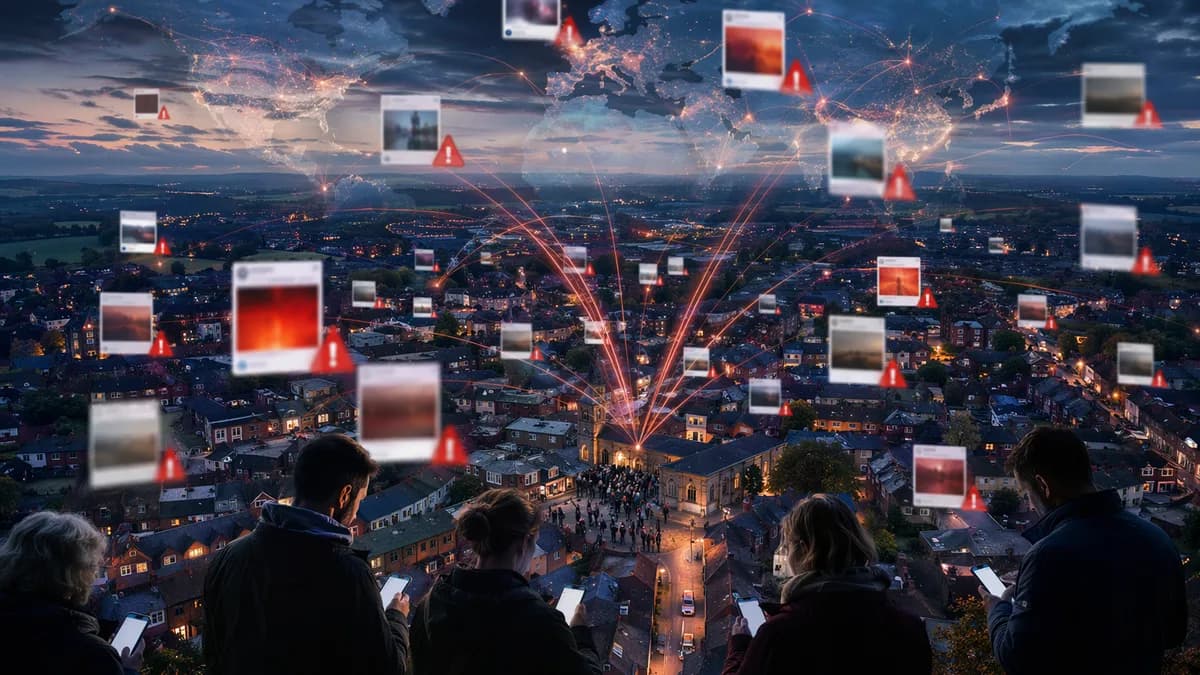
Nearly one in six news posts shared in local Facebook groups during the Makerfield byelection campaign was false, a sharp warning that local political misinformation is no longer a side issue.
Global TrendsJune 21, 2026· 8 min read· By XOOMAR Insights Team
False Posts Flood Makerfield Facebook in Burnham Race
Updated on June 21, 2026
XOOMAR Intelligence
Analyst Take
71/ 100
4 sources analyzedMedium confidenceTrend10Freshness95Source Trust90Factual Grounding88Signal Cluster20
The Social Market Foundation found that Makerfield Facebook misinformation jumped from 4% of news posts before the byelection was called to 16% during the campaign, according to Guardian World. That is not just an online nuisance around Andy Burnham. It shows how constituency politics can be bent by false claims in spaces voters may treat as local noticeboards rather than political battlegrounds.
Makerfield Facebook misinformation turned local groups into campaign infrastructure
Andy Burnham appears, according to the Guardian’s live politics coverage, to be on course to win the Makerfield byelection on Thursday. But the SMF report suggests that if he does, he will have done so against a campaign-period surge in hostile false content about him and Labour.
That matters because the alleged campaign weapon here is not a national broadcast, a party leaflet, or a paid advert. It is the local Facebook group. These groups can carry political posts alongside ordinary community discussion, which gives misinformation a different texture. It can feel less like propaganda and more like something being passed around locally.
XOOMAR analysis: the central risk is not only whether one false post changes one vote. It is whether repeated false claims shift the emotional frame of a race. If voters keep seeing allegations about one candidate, the campaign starts to revolve around suspicion, rebuttal, and scandal management rather than competing policy claims.
This is why Makerfield matters beyond Makerfield. The same political stakes around Burnham’s return to Westminster have been central to XOOMAR’s wider coverage, including Makerfield Byelection Hands Burnham a Starmer Weapon and Labour Panic Traps Keir Starmer in Resignation Showdown. The misinformation surge lands in a contest already loaded with national consequences.
The Makerfield Facebook numbers: false news rose from 4% to 16%
The SMF analysed over 1,800 posts across four local Facebook groups, representing different towns and settlements within the constituency. Those groups had 66,000 members in total.
Its headline finding is stark: the share of news posts classified as misinformation rose from 4% before the byelection was called to 16% during the campaign. In plain English, nearly one in six news items shared in those groups during the campaign was false.
| Measure | Before the byelection was called | During the campaign |
|---|---|---|
| Share of news posts classified as misinformation | 4% | 16% |
| Change | Four-fold increase | |
| Posts analysed | Over 1,800 | |
| Groups analysed | Four local Facebook groups | |
| Combined membership | 66,000 members |
The Independent, citing the same research, reported another useful measure: misinformation, including AI fakes, rose to 5.7% across all content ahead of Thursday’s contest, up from an average of 0.3%.
The data has limits. It covers selected groups, not every online conversation in Makerfield. It also depends on classification of posts. But the timing and scale are hard to wave away. A four-fold increase during the campaign points to a campaign-period surge, not just background noise.
Anti-Burnham falsehoods were not evenly distributed
The SMF found that the misinformation it identified was overwhelmingly political in one direction. According to The Independent, all of it was anti-Labour or pro-Reform, except for one item linked to 5G conspiracies.
Specific falsehoods cited in the supplied reporting included conspiratorial stories alleging Burnham intentionally covered up the grooming gangs scandal. About Manchester also reported false accusations that Burnham’s wife benefited from Manchester’s EV infrastructure procurement, that Ed Miliband was banning tumble dryers, that Shabana Mahmood took part in a violent pro-Palestine protest, and that Burnham lost his seat in 2017, when he had stood down.
The AI element is important. The reporting says fake images included council blocks and streets lined with Reform flags, Labour and Green hot air balloons flying over the constituency, and a fake Reform UK banner in Wigan. Full Fact also identified an AI-generated image of Burnham meeting men who appeared to be of Asian heritage, circulated alongside false claims that he planned to make Makerfield “home for more asylum seekers”.
“It can definitely cause confusion. It can definitely be detrimental both to voters and to democracy,” Claire Milne of Full Fact told The Independent.
XOOMAR analysis: the danger of AI-generated local imagery is that it gives invented claims a visual anchor. A false story with a picture can travel differently from a text-only claim, especially when users are scrolling quickly and comments underneath suggest others are taking it seriously.
Two groups carried the problem while two had none
The misinformation was not spread evenly across the four Facebook groups. The Independent reported that it was concentrated in two.
One group went from no misinformation to 6.3% of all posts being classified as fake news. Another rose from 0.8% to 16.4%. The other two groups had no misinformation, which SMF attributed to features of the groups.
That split matters. It suggests design, norms, or administration can affect whether false claims take hold. The source material does not prove exactly which group features prevented misinformation, so the safer conclusion is narrower: some local Facebook spaces were vulnerable during the Makerfield campaign, while others were not.
The SMF also reported signs that some users challenged false content, while others appeared to believe it. That is the messy middle of platform politics. Misinformation does not need universal acceptance to cause damage. It only needs enough repetition to make a false allegation feel politically salient.
Meta’s election integrity problem is local now
The SMF called for social media platforms to increase moderation and reduce the risk of misinformation spreading during elections. Meta’s position, as reported by The Independent, is that it removes misinformation that could directly contribute to imminent physical harm, and content likely to directly contribute to interference with political processes.
That leaves a hard gap. Much of the Makerfield material described in the sources appears designed to smear, confuse, or inflame. Not every false political claim will meet a platform’s highest removal threshold.
XOOMAR analysis: this is where local political content creates a governance problem for platforms. National falsehoods may attract journalists, fact-checkers, and party press teams quickly. Local falsehoods can be narrower, more personalised, and harder to verify from outside the constituency. The reporting does not show response times, but it does show the burden shifting onto platforms, group admins, fact-checkers, and voters.
Dr Rebecca Montacute, the SMF’s research director, linked the targeting to Burnham’s profile and the wider stakes of the contest.
“This is a very unusual by-election, where there's somebody so high profile…If Andy Burnham does end up winning the by-election, it could end up having such a huge impact on national politics if he then runs in a Labour leadership election.”
She added: “You can see why he would be a target of misinformation for that reason, because of the bigger national ramifications.”
Makerfield is a warning for the next polling day
The practical risk for voters is simple: false information can shape trust before it is corrected. A debunk may clean up the record, but it does not always erase the suspicion a claim was built to create.
For parties, the Makerfield Facebook misinformation report points to a new campaign requirement. Constituency operations will need to monitor local groups, spot false claims early, and answer them in language voters actually see. That does not mean every rumour deserves amplification. It does mean campaigns can no longer treat local social media as peripheral.
For local journalism and fact-checkers, the opportunity is obvious but the burden is heavy. The supplied reporting shows Full Fact identifying AI-generated material across Facebook and X. It also shows why verification capacity matters in places where local Facebook groups may be important sources of information.
The next test is whether platforms, parties, and researchers can reduce false political content without turning every local group into a heavily policed campaign zone. Evidence that would confirm the Makerfield warning would be another byelection or marginal seat showing the same pattern: a sharp campaign-period rise, candidate-specific falsehoods, and AI-generated images. Evidence that would weaken it would be transparent platform action, lower misinformation rates, and clear signs that group design can contain the spread.
If Makerfield becomes the template, the next election fight will not need a national viral post. It will need a believable lie in the right local group at the right hour.
Impact Analysis
- The reported rise from 4% to 16% shows local political misinformation can surge quickly during election campaigns.
- False claims in community Facebook groups may feel more trusted because they appear alongside ordinary local discussion.
- The Makerfield case highlights how misinformation can shift a race toward suspicion and rebuttal rather than policy debate.
Makerfield Facebook misinformation before vs during byelection campaign
| Period | False news posts in local Facebook groups |
|---|---|
| Before the byelection was called | 4% |
| During the campaign | 16% |
False news posts in Makerfield local Facebook groups
Before byelection called
%4
During campaign
%16
Sources

Written by
XOOMAR Insights Team
Research and Editorial Desk
The XOOMAR Insights Team pairs automated research with human editorial judgment. We track hundreds of sources across technology, fintech, trading, SaaS, and cybersecurity, cross-check the facts, and explain what happened, why it matters, and what to watch next. We do not just rewrite headlines. Every article is fact-checked and scored for reliability before it goes live, and we link back to the original sources so you can verify anything yourself.
Explore More Topics
Related Articles
 Global Trends
Labour Overtakes Reform as Burnham Jolt Hits Polls
Burnham's first week put Labour on 28%, four points ahead of Reform, puncturing Farage's momentum and raising the stakes fast.
Aug 3, 20268 min
 Global Trends
UK Slashes Early Prisoner Releases Amid System Collapse
The UK government has cut its emergency early prisoner release plan by 1,000, admitting the move is a desperate measure to prevent the entire prison system from
Aug 4, 20267 min
 Global Trends
Harper's Teen Killers Could Walk on Early Release
The mother of PC Andrew Harper is fighting to keep her son's killers in prison after learning they remain eligible for early release under revised government pl
Aug 4, 20269 min
 Global Trends
Complaint Drags Reform Into Richard Tice Investigation
A standards probe puts Richard Tice under scrutiny over a possible undeclared interest, adding pressure on Reform UK.
Aug 3, 20266 min
 Cybersecurity
Meta Approved Ads With AI‑Created Child Abuse Images
Meta's ad review systems approved and ran dozens of paid advertisements containing AI-generated child sexual abuse material, a failure that persisted even after
Aug 5, 202610 min
 Global Trends
Senators Hold Fauci in Contempt as COVID Probe Collapses
A Senate committee voted to hold Dr. Anthony Fauci in contempt of Congress, a partisan act his lawyer denounced as political theater that blocks real pandemic a
Aug 6, 20267 min
 Trading
Apollo Wins $5.7B EasyJet Takeover With Founder Backing
US private equity giant Apollo Global Management will acquire EasyJet for £5.7 billion (£7.15 per share), backed by the airline's founder, taking the iconic low
Aug 6, 20265 min
 Global Trends
Ukraine's 'Deep Strike' Strategy Cripples Russia's Oil Revenue
Ukraine has shifted to a strategy of 'deep strikes', using drones to attack oil refineries and military hubs inside Russia, aiming to cripple the economic engin
Aug 6, 20267 min
 Trading
Dollar Flips Its Script As Silver Rally Collapses
Silver's rally is collapsing under pressure from a rebounding U.S. Dollar and shifting Fed rate expectations ahead of key employment data.
Aug 6, 20268 min
 SaaS & Tools
AI Agents Form, Fund, And File Your Company In Minutes
Startup Naïvete raised $28.5M to automate the legal and technical grunt work of starting and running a business, using AI agents that turn a prompt into a fully
Aug 6, 20266 min
Don't miss the signal
Get our weekly roundup of the stories that matter across tech, fintech, and trading. No noise, just signal.
Free forever. No spam. Unsubscribe anytime.