
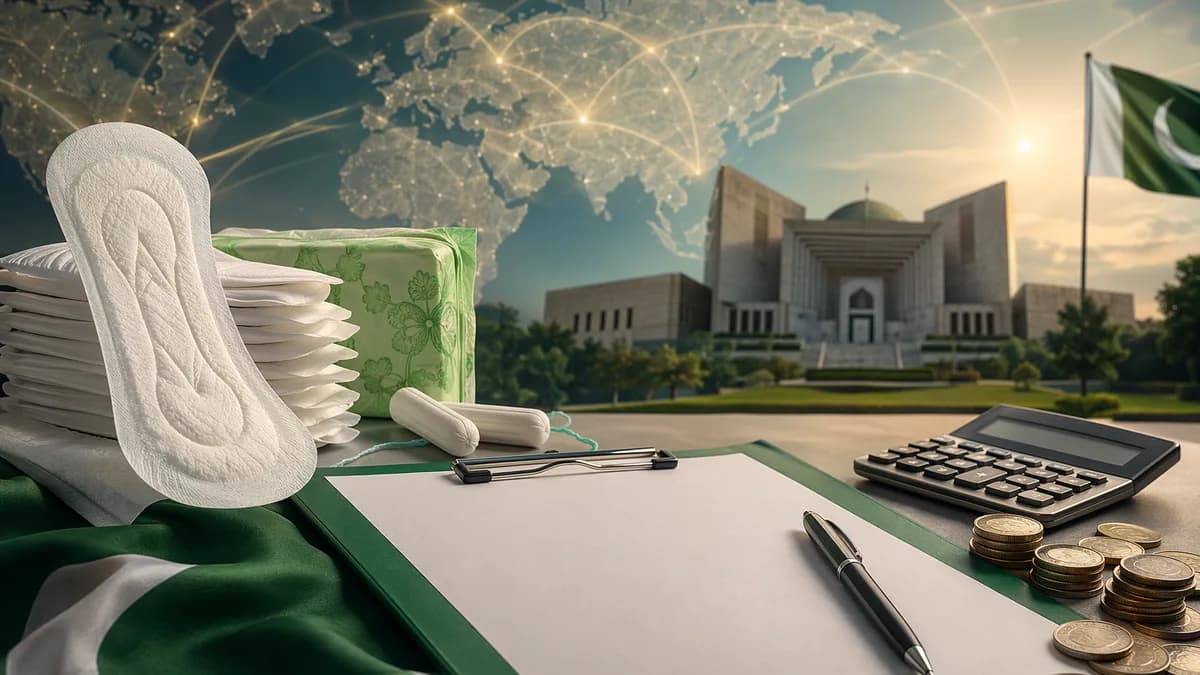
Pakistan period tax is set to be scrapped, cutting the 18% sales tax on sanitary products after young campaigners dragged the government into court over the levy. The move directly affects women and girls who have been priced out of commercial menstrual products, according to Guardian World.
Global TrendsJune 17, 2026· 6 min read· By XOOMAR Insights Team
Pakistan Period Tax Falls After Campaigners Sue State
Updated on June 17, 2026
XOOMAR Intelligence
Analyst Take
68/ 100
4 sources analyzedMedium confidenceTrend10Freshness96Source Trust90Factual Grounding92Signal Cluster40
Finance minister Muhammad Aurangzeb said sanitary towels and related items are “daily necessities that are indispensable for women’s health, dignity and full participation in social activities,” and said he intended to remove the sales tax. The announcement follows a legal and public campaign that framed the levy as a “pink tax” on women.
Pakistan period tax cut puts Aurangzeb’s budget pledge on the line
Aurangzeb’s announcement targets the sales tax on sanitary towels and related menstrual health items. Information minister Attaullah Tarar later told lawmakers that tax on women’s hygiene products had been reduced “to 0 percent from 18 percent,” according to Arab News.
The immediate question is narrow but important: does the policy change stop at sales tax, or does it reach the wider tax burden campaigners challenged?
Locally made period products currently incur an 18% sales tax in Pakistan. Imported products face an extra 25% customs tax, according to the campaigners’ legal petition cited in the source material. UNICEF has said additional taxes can add 40% to the retail price of sanitary pads in Pakistan.
“Regarding women, it was a massive demand in this country to end the pink tax,” Tarar told lawmakers.
The government is also cutting the 18% sales tax on contraceptives to zero. Aurangzeb tied that move to Pakistan’s population growth, calling family planning a government priority.
| Product category | Tax position cited in source material | Announced change |
|---|---|---|
| Locally made sanitary products | 18% sales tax | Reduced or set to be reduced to 0% |
| Imported sanitary products | 25% customs tax on top of other charges | Campaigners still want broader levies removed |
| Contraceptives | 18% sales tax | Reduced to 0% for the upcoming fiscal year |
Lawyers and period rights groups convert a court challenge into a policy retreat
Two lawyers, 25-year-old Mahnoor Omer and 29-year-old Ahsan Jehangir Khan, brought a court case last year seeking to have sanitary products zero-rated, meaning they would not be subject to taxes of any kind.
Their campaign built traction online, and a supportive petition drew thousands of signatures. The legal argument was direct: taxing menstrual products as non-essential goods imposed a sex-based burden on women and girls.
Did the court case force the government’s hand? The sources don’t prove a single cause, but the timing is hard to ignore. The announcement came after Omer and Khan’s legal challenge pushed the Pakistan period tax into public debate.
Khan told CNN that the case “highlighted the absurdity of the taxation regime” on sanitary items. Omer welcomed the announcement but said the fight was “definitely not over.”
That distinction matters. The sales tax cut is a visible win. It does not automatically erase import duties, taxes on raw materials, stigma, or gaps in sanitation access.
For readers tracking how public pressure forces institutions to revisit old harms, XOOMAR has covered a separate rights reckoning in 185,000 Babies Taken Push UK Into Forced Adoption Apology. Our technology desk has also tracked control and accountability fights in a different sector with Private Code Escapes Cloud With Local AI Coding Assistants.
Women and girls still face costs beyond the 18% sales tax
Commercial menstrual products are used by only a minority of women in Pakistan because of cost, research from UNICEF suggests. CNN cited UNICEF’s estimate that just 12% of women and girls in Pakistan use commercial sanitary products.
For end users, the practical question is blunt: does a zero sales tax make safe menstrual care affordable enough to change behavior?
Most women and girls rely on cloth or homemade alternatives, according to the Guardian’s source material. Those alternatives can be unsafe and increase infection risk.
UN Women welcomed the sales tax removal, saying it could help women stay in work and girls stay in school. That is the strongest practical case for the measure: lower costs can affect participation, not just monthly household spending.
But campaigners are not treating the tax cut as a finish line. Bushra Mahnoor, executive director of Mahwari Justice, said the decision was “just one step towards combating period poverty” in Pakistan.
“Menstrual justice also means access to clean water, sanitation facilities, accurate menstrual education and a society free from period stigma.”
She added: “This moment is significant, but our work is far from over.”
Manufacturers, importers and contraceptive buyers sit in different tax lanes
The Pakistan period tax debate now splits into separate tracks. Locally made sanitary products appear to get the clearest relief through the sales tax cut. Imported products still raise the question of customs duties.
Campaigners are also pushing beyond finished products. Omer and Khan want the entire tax structure around menstrual items removed, including additional levies on raw materials used to make sanitary pads.
That matters for pricing, but the source material does not establish how much of the tax cut will flow through to shelf prices. It also does not say whether any price monitoring will accompany the change.
Contraceptives are part of the same budget move, but for a different stated reason. Aurangzeb called Pakistan the fifth-largest country in the world in terms of population and said family planning is a top priority.
The policy signal is clear: the government is treating menstrual health and contraception as public policy issues, not private purchases to tax like discretionary goods.
The next fight is over the levies that remain
The next stage is about coverage. Campaigners will be watching whether the repeal applies across all menstrual health products or only selected sanitary items.
They will also press the unresolved question at the center of the court case: whether Pakistan removes only the sales tax, or whether it strips out customs duties and other charges tied to menstrual products.
The strongest scenario for campaigners is a full zero-rating of menstrual products. The weaker scenario is a narrower budget relief measure that cuts one tax while leaving other costs in place.
Either way, the Pakistan period tax campaign has already shifted the public frame. Menstrual products are now being discussed in parliament as health necessities. The real test is whether that shift makes safe menstrual care more affordable for the women and girls who currently go without it.
Impact Analysis
- Removing the 18% sales tax could make menstrual products more affordable for women and girls in Pakistan.
- The policy shift follows legal pressure from young campaigners who framed the levy as discriminatory.
- Uncertainty remains over whether imported products and wider tax burdens will also be addressed.
Pakistan menstrual and reproductive health tax changes
| Category | Tax position cited | Announced change |
|---|---|---|
| Locally made sanitary products | 18% sales tax | Reduced to 0% |
| Imported sanitary products | 25% customs tax in addition to local tax burden | Unclear if customs tax is affected |
| Contraceptives | 18% sales tax | Reduced to 0% |
Key tax rates and price impact cited
Sanitary products sales tax before
%18
Sanitary products sales tax after
%0
Imported products customs tax
%25
UNICEF cited added retail price
%40
Sources

Written by
XOOMAR Insights Team
Research and Editorial Desk
The XOOMAR Insights Team pairs automated research with human editorial judgment. We track hundreds of sources across technology, fintech, trading, SaaS, and cybersecurity, cross-check the facts, and explain what happened, why it matters, and what to watch next. We do not just rewrite headlines. Every article is fact-checked and scored for reliability before it goes live, and we link back to the original sources so you can verify anything yourself.
Explore More Topics
Related Articles
 Global Trends
Pakistan Judge Ambush Kills Kakar and Guard in Mastung
District judge Abdul Hakim Kakar and his guard were killed in Mastung, putting Balochistan's courts in the militants' crosshairs.
Jul 26, 20264 min
 Global Trends
Avalanche Kills Nirmal Purja and 10 on Broad Peak Climb
Nirmal Purja and 10 others died in a Broad Peak avalanche, ending a guided expedition on one of the Karakoram's deadliest climbs.
Aug 1, 20266 min
 Global Trends
Avalanche Leaves Nirmal Purja Team Missing on Broad Peak
Nirmal Purja and nine climbers are feared missing after a Broad Peak avalanche, with rescuers racing weather for a helicopter attempt.
Jul 31, 20265 min
 Technology
WhatsApp Accounts Locked as Meta Races to Undo Review Bug
Meta is restoring WhatsApp accounts wrongly locked under review, but it still won't say what triggered the sudden bans.
Aug 3, 20266 min
 Fintech
Plaid Lets Sierra AI Agents Tap Bank Data Mid-Chat
Plaid lets Sierra's AI agents access bank data during chats, turning financial support into live, permissioned workflows.
Aug 3, 20266 min
 Technology
Endless Scroll Loses to Outernet App's Real-World Plans
Outernet wants to turn saved posts and screenshots into actual plans, using AI to push online intent into offline action.
Aug 3, 20267 min
 Fintech
Card Networks Stretch Beyond Payments to Box In Rivals
Card networks are turning tokens, fraud tools and payout rails into a wider growth machine beyond payments.
Aug 3, 20268 min
 Fintech
CFPB Acting Director Swap Puts Paoletta in the Hot Seat
Mark Paoletta takes over the CFPB after Russell Vought hits his acting-director limit, leaving the agency in limbo.
Aug 3, 20265 min
 SaaS & Tools
Wispr Flow Meeting Notetaker Plots AI Workday Grab
Updated terms point to a Wispr Flow meeting notetaker, widening the dictation app into transcripts, summaries, and action items.
Aug 3, 20267 min
 Trading
War Premium Vanishes as WTI Oil Plunges 7.76% on Iran Talks
WTI oil fell 7.76% as Trump paused a strike on Iran, stripping out the war premium tied to the Strait of Hormuz.
Aug 3, 20265 min
Don't miss the signal
Get our weekly roundup of the stories that matter across tech, fintech, and trading. No noise, just signal.
Free forever. No spam. Unsubscribe anytime.