
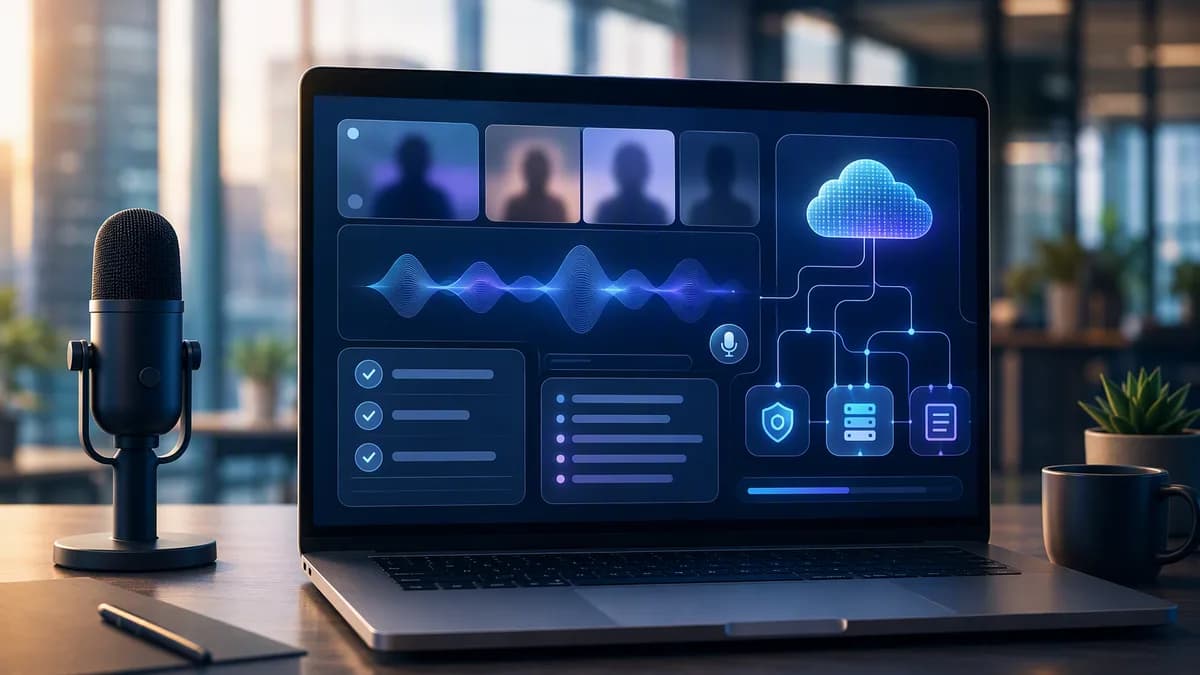
Wispr Flow’s next move appears to be less about better dictation and more about owning the spoken workday. Updated terms of service suggest Wispr Flow meeting notetaker features are on the way, with the product moving from cleaned-up voice input into meeting transcripts, summaries, action items, and speaker-aware outputs, according to TechCrunch.
SaaS & ToolsAugust 3, 2026· 7 min read· By XOOMAR Insights Team
Wispr Flow Meeting Notetaker Plots AI Workday Grab
Updated on August 3, 2026
XOOMAR Intelligence
Analyst Take
59/ 100
4 sources analyzedLow confidenceTrend10Freshness100Source Trust90Factual Grounding91Signal Cluster20
That matters because Wispr Flow has been positioned as a dictation app: speak naturally, get polished writing across apps. A meeting notetaker would widen its data surface. Instead of only helping users compose emails, messages, code prompts, or notes after they speak, Wispr could capture the conversations that generate those tasks in the first place.
The evidence is not a launch announcement. It’s product intent visible through legal language. That distinction matters. Wispr Flow hasn’t publicly detailed the feature, and TechCrunch said the company didn’t respond to a request for comment. Still, terms of service updates often appear before AI features that need new permissioning and data-processing coverage. This one is unusually direct.
Wispr Flow meeting notetaker language points to a bigger data footprint
The updated terms describe a Notetaker that handles meeting data and turns it into AI-generated work artifacts. TechCrunch cites the new language as saying:
“For Notetaker, Input may also include Meeting Data, including meeting audio, participant information, meeting metadata, speaker labels, meeting transcripts, and other information processed in connection with a meeting. Output may include AI-generated meeting transcripts, summaries, action items, meeting insights, speaker attribution, and other meeting-related content.”
That is a meaningful expansion. Meeting audio, participant information, metadata, speaker labels, and transcripts are richer than a dictated sentence. They can reveal who was involved, what was decided, what was deferred, and who owns the next step.
XOOMAR analysis: this is the core strategic shift. Dictation improves input. Meeting intelligence captures context. If Wispr Flow can connect a meeting transcript to a follow-up email, a sales note, a project update, or a task list, it becomes harder to treat the product as a disposable utility.
The strongest counterpoint is product sprawl. A dictation app that does one thing well can lose clarity when it chases crowded categories. Meeting notetakers already include Granola, Fireflies, Read AI, Otter, and Fathom, all named in the TechCrunch report. Wispr will need more than competent summaries.
The real numbers are Wispr’s valuation jump, not market-size theater
The source material does not provide meeting volume, pricing comparisons, or adoption statistics, so those should not be invented. The numbers that do matter here are Wispr’s own financing markers.
Wispr Flow has raised more than $81 million, TechCrunch reported. The company was valued at $700 million at its last round. In May, Bloomberg reported that Wispr was in talks for a new round valuing it at $2 billion.
| Data point | Source-supported detail | Why it matters |
|---|---|---|
| Capital raised | More than $81 million | Gives Wispr room to expand beyond dictation |
| Last valuation | $700 million | Sets a high bar for a voice-input company |
| Reported new round talks | $2 billion valuation | Suggests investors may expect a larger platform story |
| Current product positioning | Voice-to-text AI for polished writing | Meeting notes would broaden the workflow |
That valuation context makes the Wispr Flow meeting notetaker more than a feature leak. A $700 million company, potentially discussing a $2 billion valuation, needs a bigger narrative than “better speech-to-text.” Meeting capture offers one: the product becomes a layer across calls, writing, memory, and follow-up.
Wispr’s own site says Flow is available on Mac, Windows, iPhone, and Android, and markets the product as “4x faster than typing.” It also lists use cases for teams, developers, sales, customer support, lawyers, leaders, creators, students, and accessibility. Those categories map naturally to meetings, but the move also raises the bar on trust.
Meeting notes push Wispr into privacy-sensitive workplace AI
A meeting notetaker is not just a better recorder. It changes who is affected by the product. Dictation primarily involves the user who chooses to speak. Meeting capture can involve other participants who did not choose Wispr Flow and may not know how their comments are being processed.
XOOMAR analysis: this is where the product will be judged as much on policy design as AI quality. Buyers will look for clarity around:
- Consent: How are participants notified that meeting content is being processed?
- Retention: How long are audio, transcripts, summaries, and metadata kept?
- Training: Does meeting data improve models, and under what account settings?
- Controls: Can organizations restrict recording, exports, sharing, and deletion?
- Correction: Can users fix speaker attribution, action items, or summaries when the AI gets them wrong?
TechCrunch says it’s unclear whether Wispr plans a Granola-style notetaker that relies on system audio and transcribes without keeping a recording, or a fuller meeting recording tool. That distinction will matter. A lightweight transcript-first design may feel less intrusive. A recording-centric product may offer richer recall, but it can also create more compliance and workplace trust questions.
The thesis still holds either way. Wispr does not need to become a full meeting archive company to expand its value. Even without stored recordings, meeting summaries and action items could feed the writing workflows Wispr already serves.
Wispr’s best angle is connecting meetings to written follow-up
The crowded field is obvious. TechCrunch names Granola, Fireflies, Read AI, Otter, and Fathom as existing meeting notetakers Wispr would be taking on. A related post from Ivan Mehta’s Week in Voice AI also mentions Quill and says Wispr is building a meeting notetaker, though TechCrunch frames the evidence around the terms update.
The differentiation is not likely to come from summaries alone. Summaries are expected. Action items are expected. Speaker attribution is expected. Wispr’s potential advantage is that it already sits in the moment after thought becomes text.
If a sales lead says something important in a call, the useful output is not merely a transcript. It’s a follow-up draft, a CRM-ready note, or a clean internal update. If a developer talks through a technical decision, the useful output might be a ticket, a pull request note, or a concise prompt for another tool. Wispr’s current pitch, voice-to-polished-writing in every app, gives it a natural bridge from meeting memory to execution.
That does not guarantee success. Users may prefer dedicated tools that do meeting notes extremely well. Employers may block tools that don’t meet their requirements. Participants may resist being summarized by software they didn’t install. The feature has to feel useful without feeling sneaky.
The next test is trust, not transcript quality
For current Wispr users, the practical shift could be significant. Wispr Flow meeting notetaker features would move the app from a personal dictation layer into something closer to an ambient work assistant, one that listens during calls and helps turn conversations into written outputs.
Buyers should judge the product on workflow quality, not demo polish. A tidy summary is easy to admire and hard to rely on if action items are vague, owners are wrong, or technical details get flattened. The real test is whether Wispr can move from meeting content to usable next steps without creating more cleanup work.
The watch item is the launch shape. Evidence that would strengthen the thesis: clear consent flows, precise retention settings, strong admin controls, and tight links from meeting notes into follow-up writing. Evidence that would weaken it: broad data language, unclear recording behavior, weak speaker attribution, or summaries that look good but don’t drive action.
Wispr’s notetaker could be a smart expansion. But in this category, another neat meeting summary won’t be enough. Trust and execution will decide whether Wispr becomes a broader voice AI platform or just another tab in an already crowded notetaking stack.
The Bottom Line
- Wispr Flow may be expanding from dictation into the larger AI meeting assistant market.
- The updated terms suggest the product could process much more sensitive workplace data.
- Meeting summaries and action items would make Wispr more central to users’ daily workflows.
Wispr Flow: Current Dictation Focus vs. Possible Notetaker Expansion
| Current Wispr Flow | Potential Meeting Notetaker |
|---|---|
| Turns spoken input into polished writing across apps | Captures meeting conversations and turns them into work artifacts |
| Uses user dictation as the main input | May process meeting audio, participant information, metadata, speaker labels, and transcripts |
| Outputs emails, messages, prompts, or notes | Could output transcripts, summaries, action items, insights, and speaker attribution |
Sources

Written by
XOOMAR Insights Team
Research and Editorial Desk
The XOOMAR Insights Team pairs automated research with human editorial judgment. We track hundreds of sources across technology, fintech, trading, SaaS, and cybersecurity, cross-check the facts, and explain what happened, why it matters, and what to watch next. We do not just rewrite headlines. Every article is fact-checked and scored for reliability before it goes live, and we link back to the original sources so you can verify anything yourself.
Explore More Topics
Related Articles
 SaaS & Tools
App Store Hidden Gems Defy AI Agent Hype With Real Jobs
New app launches are up 60% in 2026, and focused App Store hidden gems show useful software isn't yielding to AI agents.
Aug 1, 20268 min
 SaaS & Tools
$85M DeductiveAI Deal Pulls Elastic Beyond Dashboards
Elastic is buying DeductiveAI for up to $85M, pushing observability from alerting toward automated diagnosis and repair.
Jun 19, 20267 min
 SaaS & Tools
Best AI Meeting Assistants Rescue Remote Teams in 2026
Remote teams need AI meeting assistants that fit their calls, privacy rules, and handoffs, not just the flashiest bot.
Jun 18, 202624 min
 SaaS & Tools
AI Task Management Tools Cut Busywork, If Teams Adapt
AI task managers can trim busywork, but teams only win when the tools connect to where work already happens.
Jun 18, 202620 min
 SaaS & Tools
Asana vs Motion Forces a Workload Planning Tradeoff
Asana wins on structure and reporting. Motion wins when AI needs to schedule work around real calendar capacity.
Jun 17, 202623 min
 Cybersecurity
Samsung Smart TV Apps Caught Renting Out Your Home IP
Samsung is banning smart TV apps with proxy code that could quietly route strangers through users' home internet connections.
Aug 3, 20269 min
 Fintech
Plaid Lets Sierra AI Agents Tap Bank Data Mid-Chat
Plaid lets Sierra's AI agents access bank data during chats, turning financial support into live, permissioned workflows.
Aug 3, 20266 min
 Technology
Endless Scroll Loses to Outernet App's Real-World Plans
Outernet wants to turn saved posts and screenshots into actual plans, using AI to push online intent into offline action.
Aug 3, 20267 min
 Fintech
Card Networks Stretch Beyond Payments to Box In Rivals
Card networks are turning tokens, fraud tools and payout rails into a wider growth machine beyond payments.
Aug 3, 20268 min
 Fintech
CFPB Acting Director Swap Puts Paoletta in the Hot Seat
Mark Paoletta takes over the CFPB after Russell Vought hits his acting-director limit, leaving the agency in limbo.
Aug 3, 20265 min
Don't miss the signal
Get our weekly roundup of the stories that matter across tech, fintech, and trading. No noise, just signal.
Free forever. No spam. Unsubscribe anytime.