
The Singapore straw licking fine is small on paper, but it turns one Instagram stunt into a public-order warning: shared food and retail spaces are not props for viral content.
Global TrendsJuly 30, 2026· 7 min read· By XOOMAR Insights Team
Singapore Straw Licking Fine Makes Teen Pay for Prank
Updated on July 30, 2026
XOOMAR Intelligence
Analyst Take
58/ 100
4 sources analyzedLow confidenceTrend10Freshness96Source Trust92Factual Grounding91Signal Cluster20
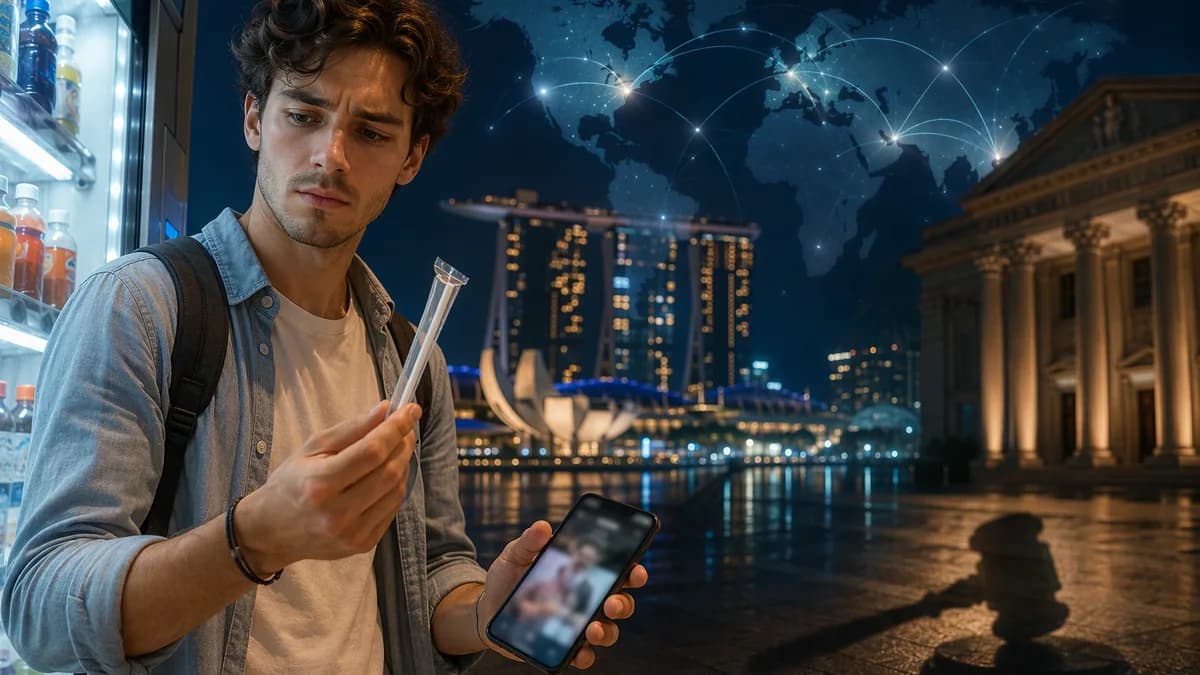
A Singapore court fined Didier Gaspard Owen Maximilien, a 19-year-old French student, S$600 ($465; £348) after he pleaded guilty to one count of public nuisance, according to BBC World. The case began with a short video: Maximilien licked a straw from an iJooz orange juice vending machine, put it back into the dispenser, then posted the clip on Instagram with the caption "city is not safe".
That caption did the damage. It converted a dumb private act into a public contamination scare, then into a court matter. The defence said Maximilien was sorry. The company still replaced all 500 straws in the dispenser.
Maximilien is "truly sorry for having caused all this trouble and he realises that what appeared to him at that time as something perhaps playful has turned out to be something very consequential," a defence lawyer was quoted as saying by The Straits Times.
Singapore turns an Instagram straw stunt into a public nuisance warning
The useful reading of the Singapore straw licking fine is not that Singapore crushed a teenager over one straw. The sharper point is that the court treated a filmed hygiene stunt in a shared retail setting as a public nuisance, even though both prosecution and defence sought a fine rather than jail.
The facts are narrow. Maximilien was studying in Singapore. The machine belonged to iJooz, whose vending machines sell freshly squeezed orange juice at S$2 per cup and are common in shopping districts, train stations and housing blocks. The incident took place at Goldhill Centre on 12 March, after a boxing workout, according to Channel News Asia as cited in the source material.
The case also shows how little separation now exists between juvenile online behavior and formal legal exposure. A clip posted to Instagram was reposted on a community page, picked up by local news outlets, and met with online disgust. From there, the issue was no longer just whether one teenager made a bad joke. It became a question of whether a public-facing food machine had been contaminated.
That is the hinge of the case. The act was brief. The response was institutional.
The S$600 fine was below the maximum, but the cleanup reached 500 straws
The court imposed S$600, while Singapore’s public nuisance offence carries a possible penalty of up to S$2,000, three months in jail, or both. That makes the sentence modest compared with the legal ceiling, but still costly enough to turn the prank into international news.
The more concrete operational cost sat with iJooz. The company said it replaced all 500 straws in the dispenser after the stunt. That number matters because it shows why the case moved beyond personal embarrassment. A single contaminated item forced a full reset of the dispenser.
| Reported fact | Why it matters |
|---|---|
| S$600 fine | The court imposed a financial penalty rather than jail. |
| S$2,000 maximum fine | The offence carried a higher ceiling than the sentence used. |
| 500 straws replaced | The prank created a practical hygiene response for the operator. |
| S$2 orange juice cups | The machine was a low-cost public retail service, not a private setting. |
| Instagram post | The offender himself helped turn the act into a public event. |
XOOMAR analysis: the punishment looks calibrated. It did not treat the case as severe criminality, but it also did not let the defendant hide behind the idea that a prank is harmless because it was meant to be funny. In public hygiene cases, the perceived risk can trigger real cleanup even when reported physical harm is limited.
How a Goldhill Centre clip became a courtroom apology
The sequence is simple and revealing.
First, Maximilien took a straw from an iJooz vending machine at Goldhill Centre. Second, he licked it and returned it to the dispenser while filming. Third, he uploaded the footage to Instagram. Fourth, the video spread beyond his own audience. Fifth, public disgust and media attention followed. Sixth, the case ended in a guilty plea and a fine.
Additional reporting from the supplied material says he later took the contaminated straw for his own use, meaning no member of the public used it. That detail limits the actual contamination outcome. It does not erase the public nuisance issue, because the act still made the dispenser appear unsafe and pushed the operator to replace the straws.
Intent also has limited power here. A prank can be unserious in motive and still serious in effect. The legal system did not need to prove that Maximilien planned a public health incident. The conduct itself created disruption in a shared retail space.
That’s the lesson for creators and students abroad. Filming does not make an act less real. It often makes it more consequential.
Singapore’s public nuisance law did the work, not online outrage alone
The online reaction mattered because it amplified the incident. But the court case rested on a specific offence: public nuisance. Maximilien pleaded guilty to one count. Public nuisance offenders in Singapore can face a fine, jail, or both.
The supplied reporting also says a second charge of mischief was taken into consideration. That is important because it shows prosecutors had more than one legal lens available, even though the final sentence centered on the public nuisance plea.
XOOMAR analysis: this case fits Singapore’s reputation for taking public order seriously, but the source material does not support a broad tour through unrelated civic rules. The safer conclusion is narrower and stronger. In this case, a public-facing hygiene stunt crossed from social media content into enforceable misconduct because it touched a shared consumer product.
For XOOMAR readers tracking how local incidents become wider public stories, the media mechanic is familiar from other global-trends coverage, including 16-Year-Old Lifeguard Saves Boy in Santa Cruz Ocean Rescue and Nolan Wells Autopsy Throws Teen’s Death Into Doubt. The facts are completely different, but the pattern is recognizable: a local event becomes larger once digital circulation gives it a second life.
International students, retailers, and platforms will read the straw-licking case differently
The same Singapore straw licking fine sends different messages depending on who is reading it.
- Students and travelers: Local law beats online norms. A joke posted from a phone can become a court file in the country where it happens.
- Retail operators: The iJooz response shows the practical burden. Once contamination is filmed, replacement becomes the safer course.
- Families and educators: The case is a blunt example of digital consequences. The clip did not stay inside a private Instagram circle.
- Platforms and community pages: The reposting chain helped turn the act into public knowledge. The source material does not say platforms removed or promoted the clip, but the spread itself was central.
The most important distinction is between actual harm and institutional response. Reporting indicates the same straw was later used by Maximilien. Still, iJooz replaced 500 straws. That gap explains the legal and commercial sensitivity. Public trust in a shared dispenser depends on what customers believe could have happened, not only what eventually did.
The next test is whether the case stays isolated or becomes a reference point
The fine will not end viral stupidity. It does give courts, retailers, schools and families a concrete case to point to when someone treats a public retail machine as a content prop.
The evidence to watch is specific. If similar food, hygiene or vending-machine stunts appear, Singapore authorities and retailers now have a recent example showing that even a short clip can end in a guilty plea, a fine, and product replacement. If no copycats follow, the case may remain a one-off embarrassment for a student who apologized in court.
Either way, the Singapore straw licking fine has already done one thing: it made the offline cost of online attention visible.
Impact Analysis
- The case shows Singapore treating viral hygiene stunts in public retail spaces as public nuisance issues.
- iJooz replaced all 500 straws, showing how one prank can create real operational costs for businesses.
- The fine signals that social media posts can turn reckless behavior into a legal and public-order matter.
Singapore Straw-Licking Case: Fine vs Juice Price
Court fine
S$600
iJooz orange juice price
S$2
Sources

Written by
XOOMAR Insights Team
Research and Editorial Desk
The XOOMAR Insights Team pairs automated research with human editorial judgment. We track hundreds of sources across technology, fintech, trading, SaaS, and cybersecurity, cross-check the facts, and explain what happened, why it matters, and what to watch next. We do not just rewrite headlines. Every article is fact-checked and scored for reliability before it goes live, and we link back to the original sources so you can verify anything yourself.
Explore More Topics
Related Articles
 Global Trends
Epstein Files Scout Daniel Siad Dies Before Questioning
Daniel Siad died before French investigators could question him, leaving a key Epstein files thread unresolved.
Jul 27, 20267 min
 Global Trends
Bordeaux Airport Fire Turns Deadly, Kills 2 Firefighters
Two firefighters died as a reported brush fire near Bordeaux airport parking lots spread to a building and delayed flights.
Jul 22, 20266 min
 Global Trends
40C Heat Pushes Bordeaux Mega-Fire Back to the Brink
A 40C heat wave and winds could undo firefighting gains near Bordeaux after 220,000 evacuations.
Jul 29, 20268 min
 Global Trends
16-Year-Old Lifeguard Saves Boy in Santa Cruz Ocean Rescue
A 16-year-old rookie lifeguard saved a boy swept offshore, then a viral video pushed the rescue into the national spotlight.
Jul 29, 20265 min
 Global Trends
Ghana’s Tallest Man Dies at 33 After Leg Infection
Sulemana Abdul Samed, Ghana’s tallest man, died at 33 after hospitalization for infected leg sores, sparking grief in Gambaga.
Jul 28, 20266 min
 Technology
Kremlin Targets Telegram Founder Durov in Terror Case
Russia accused Telegram founder Pavel Durov of facilitating terrorism, turning a moderation fight into a Kremlin pressure campaign.
Jul 29, 20266 min
 Fintech
Spot Trading Slump Ambushes Coinbase Earnings Hopes
Wall Street cut Coinbase earnings hopes as spot trading cooled, making Q2 a referendum on its diversification push.
Jul 30, 20268 min
 Trading
Oil Shock Pins British Pound Below $1.33 After Iran Threat
WTI ripped higher on Iran war risk, but GBP/USD stayed stuck below $1.33. The calm in sterling looks fragile.
Jul 30, 20265 min
 Technology
Australia Hauls Telegram to Court Over Terror Videos
Australia seeks up to A$54.6m from Telegram over alleged extremist content failures. Telegram denies the claims.
Jul 30, 20266 min
 Trading
EUR/USD Options Flash Euro Pain Before Fed Decision
EUR/USD is calm near 1.13, but options traders are paying up for euro downside protection before the FOMC decision.
Jul 30, 20267 min
Don't miss the signal
Get our weekly roundup of the stories that matter across tech, fintech, and trading. No noise, just signal.
Free forever. No spam. Unsubscribe anytime.