
751 priests, 264 seminarians, and six bishops explain why the Vatican’s Society of St. Pius X schism decree is bigger than a fight over the Latin Mass: Rome is trying to stop a rival Catholic authority structure from hardening outside papal control.
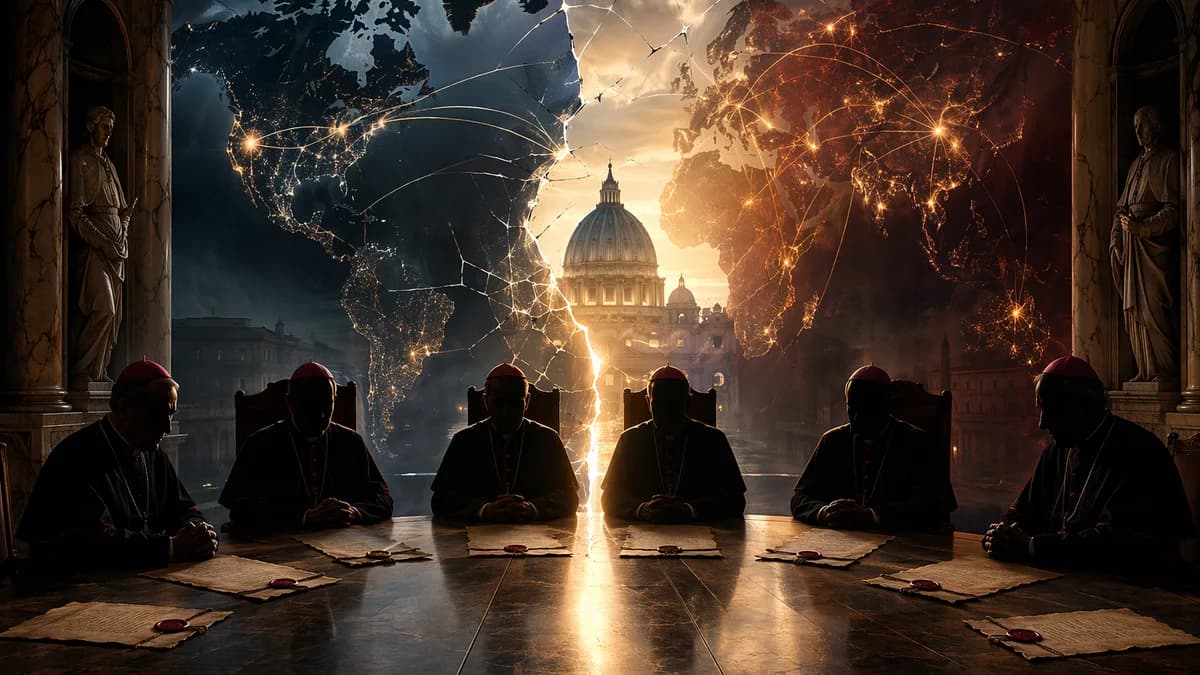
Global TrendsJuly 5, 2026· 8 min read· By XOOMAR Insights Team
Rome Escalates Society of St. Pius X Schism in Bishop Clash
Updated on July 5, 2026
XOOMAR Intelligence
Analyst Take
60/ 100
4 sources analyzedLow confidenceTrend10Freshness98Source Trust85Factual Grounding93Signal Cluster40
The Vatican declared the Society of St. Pius X, known as SSPX, in schism on July 2, 2026, after the traditionalist group consecrated four new bishops at its seminary in Econe, Switzerland, without Pope Leo XIV’s consent, according to ABC International. The ceremony drew about 15,500 people and lasted five hours. That scale matters. This was not a private act of defiance. It was a public claim to Catholic continuity against Rome’s command.
751 SSPX priests turn a liturgy dispute into an authority test
The Vatican’s response treated the consecrations as more than unauthorized ritual. The doctrine office declared the act “schismatic,” excommunicated the four newly consecrated bishops and the two bishops who took part, and warned that SSPX priests and faithful who formally adhere to the group face the same sanction.
The primary keyword here is Society of St. Pius X schism, but the real issue is governance. Bishops are not symbolic accessories in Catholic life. They are the spine of church authority. When a group consecrates bishops against the pope’s will, it is not just preserving a preferred form of worship. It is building the leadership layer that can keep ordaining, teaching, and administering apart from Rome.
That is why the Vatican went beyond the minimum sanctions foreseen by canon law. It also declared SSPX priests schismatic and excommunicated, and said the sacrament of penance administered by them and marriages assisted by them are invalid.
The Vatican said the consecrations were an “episcopal consecration of four presbyters, without pontifical mandate and against the will of the Supreme Pontiff,” according to Vatican News.
XOOMAR has followed the stakes around this rupture in Vatican Cuts Off Society of St. Pius X in Full Schism and SSPX Ordinations Defy Pope Leo as Schism Threat Grows. The new decree turns that threat into a formal break.
Four new bishops, one forbidden ceremony, and a repeat of 1988
The Vatican’s decree names a familiar pattern. Archbishop Marcel Lefebvre founded SSPX in 1970 in opposition to the reforms of the Second Vatican Council. In 1988, Lefebvre consecrated four bishops without papal consent. The Vatican promptly excommunicated him and the four bishops, calling the act schismatic.
This week’s confrontation closely echoes that earlier rupture. The new consecrations involved Alfonso de Galarreta and Bernard Fellay as consecrating bishops, and Pascal Schreiber, Michael Goldade, Michel Poinsinet de Sivry, and Marc Hanappier as the newly consecrated bishops, according to Vatican News.
In canon-law terms, latae sententiae excommunication means a person incurs the penalty by committing the act itself, rather than only after a later judicial process. The Vatican’s decree made that penalty explicit and attached it to a broader institutional judgment: SSPX itself is now declared to be in schism.
| Issue | Vatican position | SSPX position in the source material |
|---|---|---|
| Bishops | Consecrations without papal mandate are a schismatic act | SSPX says consecrations were needed because only two of the original four 1988 bishops are alive and too old to serve all faithful |
| Priests | SSPX priests are schismatic and excommunicated | SSPX presents itself as preserving the true faith |
| Faithful | Those who “adhere formally” are considered schismatic and excommunicated | SSPX draws supporters to its Masses and institutions |
| Sacraments | Penance and marriages administered by SSPX priests are invalid | SSPX continues to operate outside Rome’s legal standing |
The scale is not trivial. SSPX says it has 751 priests, 264 seminarians in five seminaries, 145 religious brothers, 88 oblates, and 250 religious sisters across 50 nationalities. For a group described as a fringe of the Catholic right, that is still enough infrastructure to sustain itself for years.
Vatican II remains the unresolved wound under the Latin Mass
SSPX celebrates the ancient Latin Mass, but the dispute runs deeper than language or ceremony. The group opposes the modernizing reforms of Vatican II, which changed the Catholic Church’s relations with other Christians, Jews, and people of other faiths, and allowed Mass to be celebrated in the vernacular rather than Latin.
For SSPX, those reforms are not merely pastoral updates. The society has accused the church of being rife with errors, including modernism and liberalism, and claims it is upholding the true faith of Christ.
That makes the Society of St. Pius X schism a fight over legitimacy. Rome says communion with the pope is not optional. SSPX says fidelity to tradition can require resistance to Rome’s current direction. Both cannot fully win at the same time.
Rev. Davide Pagliarani, the SSPX superior, framed the consecrations as loyalty rather than rebellion.
“We are accused of not respecting the pope,” Pagliarani said. “But it is precisely because we love the pope as the vicar of Christ, as the head of the church, that we don’t want to see the pope humiliated anymore, on the side of false shepherds representing false religions.”
That sentence captures the collision. SSPX uses Catholic language to justify defiance of Catholic authority. The Vatican’s decree rejects that logic.
Pope Leo XIV chose force after outreach failed
The consecrations created a direct crisis for Pope Leo XIV, who has stressed church unity and reached out to conservative and traditionalist Catholics who were alienated during the Pope Francis pontificate.
ABC reports that Leo urged SSPX to hold off for the sake of unity. Vatican News says the act went against the will “repeatedly expressed” by the pope. The doctrine office’s explanatory note says attempts from the time of Saint Paul VI through recent talks to bring Lefebvre’s movement into full communion had failed.
The Vatican had also softened its stance before. Pope Benedict XVI lifted the 1988 excommunications in 2009 as part of outreach to the group. Thursday’s decree reverses that trajectory. It signals that Rome now sees continued negotiation without obedience as a dead end.
XOOMAR analysis: Leo’s decision is a high-risk assertion of papal authority. A softer response could have allowed SSPX to expand its bishops while still claiming a semi-Catholic ambiguity. A harder response protects institutional clarity, but it may also deepen SSPX’s appeal to supporters who already believe Rome has abandoned tradition.
Traditionalist Catholics now face a sharper line
The Vatican did not only target bishops. It warned ordinary faithful to stop attending SSPX Masses, saying those who formally adhere to the society are schismatic and excommunicated.
That creates pressure well beyond SSPX leadership. Many Catholics who prefer the Latin Mass remain in communion with Rome. They are not SSPX. The decree forces a distinction between attachment to older worship and submission to a group now formally declared schismatic.
Luigi Casalini of the blog Messa in Latino told The Associated Press that the excommunication of the bishops was correct under canon law, but that extending the penalties to priests and faithful was “an act of unusual severity.” He also questioned why the Vatican had not created a specific body to receive those who want to leave SSPX.
The Vatican did say it would welcome returnees “like a caring mother,” but it assigned procedures to apostolic nuncios and local bishops rather than creating a dedicated Vatican entity.
That administrative choice may matter. If Rome wants SSPX faithful to come back, it needs more than penalties. It needs a practical route.
The next scale test is whether punishment creates returnees or a permanent rival
The legal question is now clearer than it was before July 2, 2026. The Vatican says SSPX is in schism. Its bishops and priests are excommunicated. Its penance and marriage ministry is invalid. Faithful who formally adhere are at risk of the church’s harshest sanctions.
The harder question is whether the decree changes behavior.
Evidence that Rome’s strategy is working would include SSPX clergy or faithful seeking reconciliation through local bishops, traditionalist Catholics in communion with Rome distancing themselves from SSPX, and no further unauthorized moves by the society’s leadership. Evidence that the decree is backfiring would be SSPX using the sanctions to rally supporters, expand its institutions, or present itself as the persecuted guardian of pre-Vatican II Catholicism.
The Society of St. Pius X schism decree settles authority on paper. It does not settle the argument over tradition, obedience, and trust that produced the rupture. Rome can excommunicate unauthorized bishops in a day. Rebuilding confidence among Catholics drawn to SSPX will take much longer.
Impact Analysis
- The decree escalates the conflict from a liturgy dispute to a direct challenge over Catholic authority.
- By consecrating bishops without papal consent, SSPX strengthened its ability to operate independently from Rome.
- The Vatican’s penalties could affect priests, sacraments, marriages, and faithful formally tied to the group.
Vatican vs. SSPX: Core Conflict
| Side | Action | Significance |
|---|---|---|
| Vatican | Declared SSPX in schism and excommunicated six bishops | Asserted papal authority over bishop consecrations and Catholic governance |
| SSPX | Consecrated four new bishops without Pope Leo XIV’s consent | Created a leadership structure capable of operating outside Rome’s control |
SSPX Reported Personnel
Priests
people751
Seminarians
people264
Bishops
people6
Sources

Written by
XOOMAR Insights Team
Research and Editorial Desk
The XOOMAR Insights Team pairs automated research with human editorial judgment. We track hundreds of sources across technology, fintech, trading, SaaS, and cybersecurity, cross-check the facts, and explain what happened, why it matters, and what to watch next. We do not just rewrite headlines. Every article is fact-checked and scored for reliability before it goes live, and we link back to the original sources so you can verify anything yourself.
Explore More Topics
Related Articles
 Global Trends
Vatican Cuts Off Society of St. Pius X in Full Schism
Rome declared the SSPX in schism, excommunicating six bishops and warning ordinary faithful could be next.
Jul 3, 20266 min
 Global Trends
SSPX Ordinations Defy Pope Leo as Schism Threat Grows
SSPX ordained four bishops despite Pope Leo XIV's warning, turning Écône into a public test of Rome's authority.
Jul 2, 20267 min
 Global Trends
600,000 SSPX Followers Risk Vatican Excommunication
Rome’s SSPX crackdown puts up to 600,000 worshippers in limbo and tests Pope Leo XIV’s grip on Catholic authority.
Jul 2, 20268 min
 Technology
277 Americans Put AI Collective Intelligence on Trial
A 277-person birthday debate tested whether AI can structure civic judgment at scale without drowning out human voices.
Jul 5, 20267 min
 Fintech
BNY USDC Custody Pulls Stablecoins Into Wall Street
BNY is turning USDC into bank-grade infrastructure, letting institutions mint, hold and redeem stablecoins inside its custody platform.
Jul 5, 20267 min
 Global Trends
Six Killed as Stade Shooting Shatters Welfare Shelter
Six shelter workers were killed in the Stade shooting. Police arrested two people, including the suspected gunman.
Jul 5, 20266 min
 Cybersecurity
US Slaps $10M Bounty on Russian Signal, WhatsApp Hackers
$10M is on the table for tips on Russia-linked groups accused of hijacking Signal and WhatsApp accounts used by officials and journalists.
Jul 5, 20266 min
 Fintech
8-Currency Kinexys Puts Cross-Border Payments on Notice
J.P. Morgan’s Kinexys now supports eight currencies, pushing 24/7 blockchain settlement deeper into institutional payments.
Jul 5, 20268 min
 Global Trends
Burnham Hands No 10 North to Manchester Power Broker
Burnham wants Caroline Simpson to run No 10 North, turning devolution into an early power test with Whitehall.
Jul 5, 20269 min
 Future Fiction
5 Mystery Movies Like Enola Holmes That Crack the Fun Case
Five playful whodunits keep Enola Holmes' spark alive, from Nancy Drew's teen sleuthing to Knives Out's sharper puzzle box.
Jul 5, 20268 min
Don't miss the signal
Get our weekly roundup of the stories that matter across tech, fintech, and trading. No noise, just signal.
Free forever. No spam. Unsubscribe anytime.