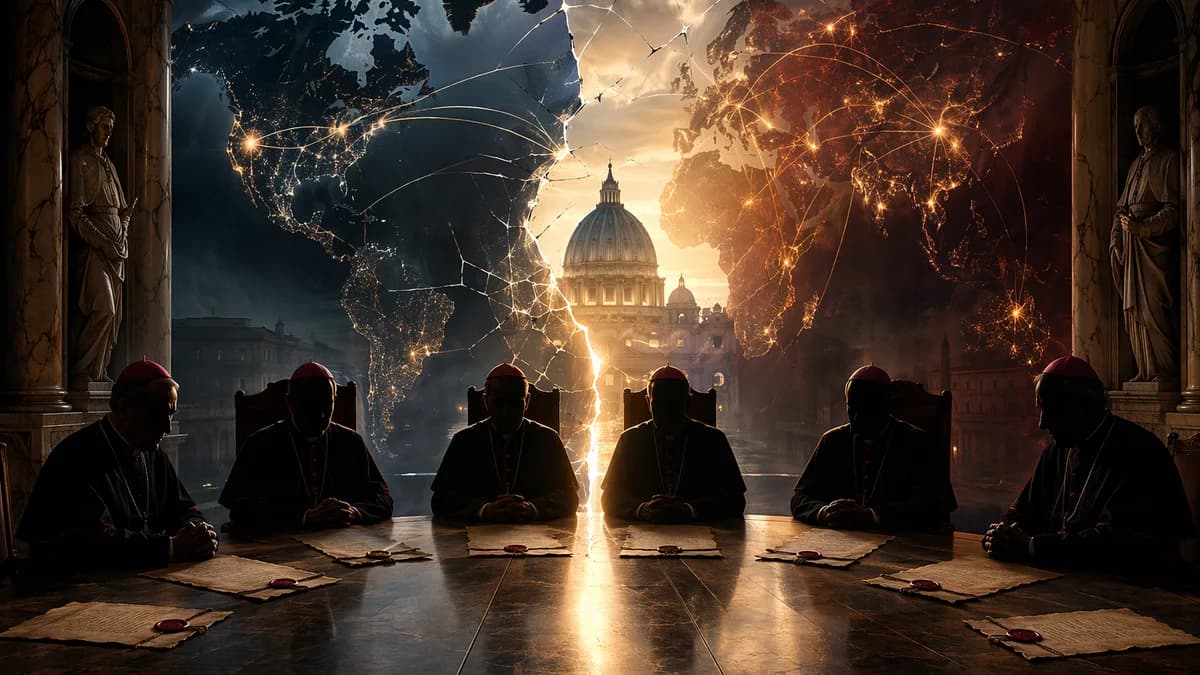
Rome was expected to punish bishops. It instead drew a line around an entire movement, declaring the Society of St. Pius X schism formal and warning ordinary faithful that they may also face excommunication.
XOOMAR Intelligence
Analyst Take
The Vatican’s doctrine office responded Thursday after the SSPX consecrated four new bishops without papal approval at its seminary in Econe, Switzerland, according to Independent World. The decree excommunicated the four new bishops and the two bishops who took part in the ceremony, called the consecrations a “schismatic act,” and said the society itself had created a schism.
That is the rupture. Not a liturgy dispute. Not a Vatican scolding. A public declaration that a traditionalist Catholic group with six bishops, 751 priests, 264 seminarians, and supporters across 50 nationalities, according to SSPX statistics cited in the source, now stands outside communion with Rome.
Why the Society of St. Pius X schism is more than a fight over Latin Mass
The SSPX is best known for celebrating the ancient Latin Mass and rejecting the modernizing reforms of the Second Vatican Council. But the Vatican’s action shows the core issue is authority.
The group was founded in 1970 by French Archbishop Marcel Lefebvre, who opposed Vatican II reforms that changed the Church’s relationship with other Christians, Jews, and people of other faiths, and allowed Mass to be celebrated in the vernacular rather than Latin. The SSPX argues the Church has embraced errors such as modernism and liberalism. Rome sees something else: a group claiming Catholic identity while defying the pope on bishops.
That distinction matters. Plenty of Catholics attached to traditional liturgy remain in communion with the Holy See. The Vatican’s decree does not treat every Latin Mass Catholic as SSPX. It targets a society that, in Rome’s view, crossed from resistance into rupture.
For context on how the confrontation escalated, see XOOMAR’s related explainer, SSPX Ordinations Defy Pope Leo as Schism Threat Grows.
Pope Leo asked them to stop. The SSPX consecrated bishops anyway
The immediate trigger was Wednesday’s five-hour Mass in Econe, where the SSPX consecrated Marc Hanappier, Michel Poinsinet de Sivry, Michael Goldade, and Pascal Schreiber as bishops.
An estimated 15,500 people attended. That number gave the Vatican a visible problem: this was not a private disciplinary breach. It was a public act of defiance, watched by supporters who came from around the world despite Pope Leo XIV urging the group to hold off for the sake of Church unity.
The Vatican had tried one more route before the decree. Its doctrine chief, Cardinal Víctor Manuel Fernández, met in February with SSPX superior the Rev. Davide Pagliarani and proposed dialogue. Pagliarani sought a meeting with Leo instead. Leo declined, but wrote a letter Tuesday begging the SSPX to cancel the consecrations.
They proceeded.
That is why the Vatican response landed so hard. In XOOMAR analysis, the decree reads as a message that negotiations cannot continue if the SSPX creates its own episcopal future without Rome.
The decree did not stop with the bishops
The Vatican could have focused only on those who performed and received the consecrations. It went wider.
The decree:
- Bishops: Excommunicated the four newly consecrated bishops and the two bishops who participated in the ceremony.
- SSPX priests: Declared priests of the society schismatic and therefore excommunicated.
- Sacraments: Invalidated confessions and marriages administered by SSPX priests.
- Faithful: Warned Catholics to stop attending SSPX Masses, saying “those who adhere formally” to the society are themselves schismatic and excommunicated.
That last line is the most explosive part. The Vatican has previously described adherence to the SSPX as including Catholics who put loyalty to the society above the pope, and those who participate exclusively in SSPX Masses. The result could involve sanctions against thousands of rank-and-file faithful.
“For us, this excommunication extended to the faithful is brutal. It’s not what we expect from a father to whom we refer every day,” SSPX media manager Marc-André Mabillard told The Associated Press.
Mabillard called the sanctions “unjust” and said the society’s “main flaw today is having a leader who doesn’t want to communicate with us.”
Schism, excommunication, and the practical Catholic problem
In this dispute, schism means an intentional rupture with the Catholic Church. The Vatican used that language directly.
Excommunication is among the Church’s harshest sanctions. Here, it signals that Rome believes the SSPX has moved beyond protest into a competing structure of authority. Bishops matter because they ordain priests, govern communities, and carry institutional continuity. Consecrating bishops without papal consent is not just symbolism. It lets a group keep reproducing its own hierarchy.
The Vatican’s before-and-after shift is stark:
- Before: Rome had made concessions while trying to bring the SSPX back under its wing.
- After: The Vatican revoked that softer posture, declared SSPX priests schismatic, and invalidated confessions and marriages they administer.
- Before: The conflict could still be framed by some supporters as unresolved tension.
- After: Rome has stated that formal adherence to the SSPX carries excommunication.
That creates immediate pastoral confusion for Catholics drawn to SSPX worship but unsure whether they share its defiance of Rome. A family attending SSPX Mass for the Latin liturgy now has to ask sharper questions: Are they merely attending for spiritual reasons, or are they formally adhering to the society’s rejection of Rome’s authority? Can they receive confession or marry through SSPX priests after the decree? Should they seek guidance from a local bishop?
Those are no longer theoretical questions. For more on the scale of the risk to ordinary followers, see 600,000 SSPX Followers Risk Vatican Excommunication.
Rome left a door open, but not a rival hierarchy
The Vatican did not only issue penalties. In a note accompanying the decree, it said it was willing, “like a caring mother,” to welcome SSPX faithful back into the fold. But it did not create a dedicated Vatican body to receive them. Instead, Vatican ambassadors around the world are to establish procedures for local bishops.
That leaves a gap. Luigi Casalini, of the blog Messa in Latino, said excommunicating the bishops was correct under canon law, but called the extension to SSPX priests and faithful “an act of unusual severity.” He also questioned why no Vatican body had been set up to manage possible defectors, as happened after the 1988 excommunications.
The path back, if it exists, runs through authority. The SSPX would have to accept papal oversight and Rome’s interpretation of Vatican II. The Vatican may continue to make space for traditionalist Catholics who remain loyal to the pope. What it cannot allow, without weakening its own governance, is a society consecrating bishops as if papal approval were optional.
The next test is local and practical: how bishops handle SSPX faithful who want to return, and how many SSPX supporters decide that loyalty to tradition still requires communion with Rome.
Impact Analysis
- The Vatican’s decree escalates the conflict from a disciplinary dispute to a formal schism.
- Ordinary SSPX supporters may now face serious canonical consequences, including possible excommunication.
- The move clarifies that Rome sees the central issue as papal authority, not simply attachment to the Latin Mass.
SSPX Position vs. Vatican Response
| Issue | SSPX | Vatican |
|---|---|---|
| Core dispute | Frames its stance as defense of tradition and rejection of modernist errors | Frames the issue as defiance of papal authority |
| Bishops | Consecrated four new bishops without papal approval | Declared the consecrations a schismatic act |
| Catholic identity | Claims to preserve authentic Catholic teaching and liturgy | Says the society has placed itself outside communion with Rome |
Reported SSPX Scale
Primary Sources & Disclosures

Written by
XOOMAR Insights Team
Research and Editorial Desk
The XOOMAR Insights Team pairs automated research with human editorial judgment. We track hundreds of sources across technology, fintech, trading, SaaS, and cybersecurity, cross-check the facts, and explain what happened, why it matters, and what to watch next. We do not just rewrite headlines. Every article is fact-checked and scored for reliability before it goes live, and we link back to the original sources so you can verify anything yourself.