Five confirmed H5 bird flu cases in migratory sub-Antarctic birds are already on Australia’s books, and one sick giant petrel near Hawks Nest may now move the threat onto the NSW coast. That is the real signal beneath the headline: H5 bird flu in NSW is still only suspected, but Australia’s east coast risk has shifted from a planning scenario to a live biosecurity test.
XOOMAR Intelligence
Analyst Take
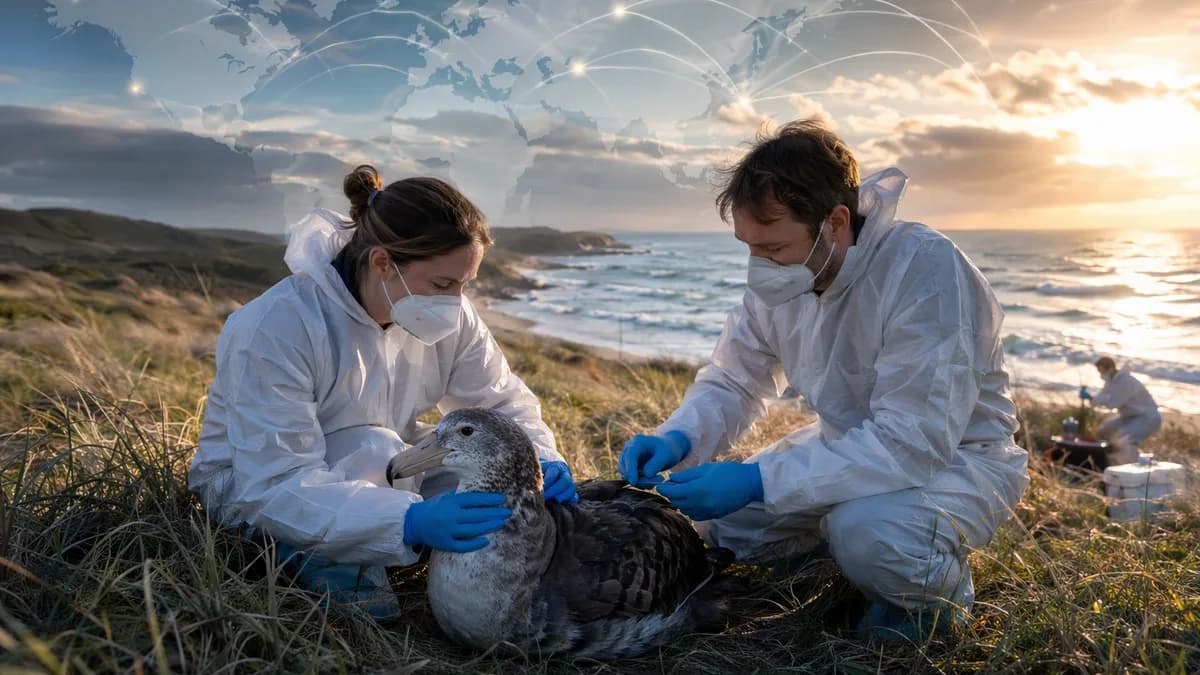
New South Wales has recorded its first suspected case of the deadly H5 bird flu in a giant petrel found unwell near Hawks Nest, north of Newcastle, according to Guardian World. Initial NSW laboratory testing confirmed the bird was positive for H5 influenza. Samples have been sent for confirmatory testing by CSIRO’s Australian Centre for Disease Preparedness to determine whether it is the highly pathogenic H5N1 strain.
If confirmed, this would be the first detection of the deadly disease on Australia’s east coast. That matters because the country had been one of the last places to avoid the worst phase of the global H5N1 wave until recent detections in Western Australia and South Australia.
NSW H5 bird flu would turn a single beach discovery into an east coast biosecurity event
The case is still provisional. That should not be confused with harmless.
Biosecurity systems do not wait for perfect certainty when the suspected pathogen has devastated wild birds, poultry and mammals elsewhere. The NSW government is treating the Hawks Nest case as serious because the first test has already found H5 influenza in a migratory seabird, and because the confirmatory question is the one that decides the stakes: is this the highly pathogenic H5N1 strain?
Tara Moriarty, the NSW agriculture minister, made that tension clear.
“This latest development is incredibly concerning for both agriculture and for wildlife,” Moriarty said. “The impact of H5 worldwide on wild birds and poultry has been devastating. But NSW and the rest of the country have been preparing for this moment for many years.”
The known facts are narrow but consequential:
- Location: near Hawks Nest, north of Newcastle, on the NSW coast.
- Species: a giant petrel, a migratory seabird.
- Status: initial NSW lab testing positive for H5 influenza.
- Confirmation pending: CSIRO testing is needed to identify whether it is highly pathogenic H5N1.
- Current poultry status: NSW says the disease has not been detected in commercial poultry flocks, captive birds, or other birds in the state.
That last point is critical. A wild bird detection is not a poultry outbreak. It does not carry the same immediate production, containment, or trade consequences. But it can be the first signal that infected migratory birds are now reaching coastlines where people, poultry, wildlife carers, councils, and domestic animals all overlap.
The Hawks Nest giant petrel puts migratory seabirds at the centre of the risk map
The species matters. A giant petrel is not a backyard chicken, and that is exactly why the case is worrying. Migratory seabirds can travel across vast southern ocean routes, making them potential sentinels for viral movement between regions.
The bird was found unwell by a member of the public, who contacted authorities. That detail shows how early detection may work in practice: not through a single agency sweep, but through a chain of ordinary sightings, reporting hotlines, veterinary testing, and national lab confirmation.
Hawks Nest also changes the geography of the story. Previous confirmed detections since late June were in Western Australia and South Australia, all in migratory sub-Antarctic birds. A suspected case on the NSW coast raises immediate questions about beaches, islands, wetlands, seabird colonies, and the route by which the bird arrived.
Authorities will now need to answer several practical questions:
- Travel history: where the bird may have been before it reached Hawks Nest.
- Local spread: whether any other sick or dead birds are found nearby.
- Surveillance radius: how far along the mid-north coast and other high-risk coastal areas monitoring should extend.
- Species exposure: whether other seabirds, shorebirds, or marine mammals show signs of illness.
Moriarty said NSW is increasing surveillance. A state coordination centre at the Department of Primary Industry and Regional Development in Orange is managing operations, and more than 500 people in government and private veterinary services have been trained in disease surveillance.
“There are no other birds that have been found to be positive for H5 at the moment, but we are now increasing our surveillance,” Moriarty said.
XOOMAR analysis: this is the right posture for an uncertain case. The state cannot assume spread. It also cannot assume isolation. The only way to separate those two paths is fast field surveillance and clean lab confirmation.
5 confirmed detections, 500 trained responders, and the scale problem behind H5N1
The raw Australian case count still looks small: five confirmed cases since late June, with four in Western Australia and one in South Australia, all in migratory sub-Antarctic birds. The NSW case would sit outside that confirmed tally until CSIRO testing is complete.
The global context is much larger. Supplied reports state that H5N1 2.3.4.4b, a clade of the H5N1 virus, has spread quickly through wild bird movement and caused mass mortality in poultry and sea mammals globally. The strain caused mass deaths in birds in the northern hemisphere in 2021 and was confirmed in Antarctica in mid-2025. Australia had been the only continent without the H5 strain before the first confirmed detection in Western Australia.
One figure shows why wildlife agencies are alarmed before any poultry case appears. On Heard Island, an Australian external territory about 4000km south-west of Perth, bird flu devastated the local seal population. Supplied reporting says it wiped out 13,000 out of 17,000 seal pups.
That number should shape how NSW reads the Hawks Nest case. The first exposed groups may not be farms. They may be seabirds and marine mammals.
| Scenario | Current NSW status | Consequence if it changes |
|---|---|---|
| Single suspected wild bird | One giant petrel near Hawks Nest, H5 positive on preliminary testing | Expanded surveillance and public reporting focus |
| Confirmed H5N1 wild bird case | Pending CSIRO confirmation | First deadly H5N1 detection on Australia’s east coast |
| Multiple wild bird detections | No evidence reported in NSW yet | Stronger concern over coastal spread |
| Commercial poultry detection | No detection reported | A different response category, with far higher farm and supply chain stakes |
The most important metrics now are not just headline case counts. Authorities and producers need to watch:
- Detections in wild birds: whether the Hawks Nest case stays isolated.
- Species mix: whether cases appear only in migratory seabirds or broader bird populations.
- Distance to poultry operations: not publicly detailed in the supplied material, but central to farm risk assessment.
- Testing turnaround: how quickly CSIRO can confirm or rule out highly pathogenic H5N1.
- Carcass reports: whether councils and wildlife groups see unusual mortality.
XOOMAR analysis: a single suspected wild bird case can trigger a serious response because it changes the prior assumption. Before detection, the east coast risk was modelled. After detection, even a provisional one, surveillance has a target.
Farmers, wildlife carers, scientists, and beach communities will read the NSW case differently
For poultry producers, the key sentence from the NSW government is the one that says bird flu has not been detected in poultry flocks, captive birds, or other wild birds in NSW. That keeps this out of the farm-outbreak category for now.
Still, the industry will read the case as a warning to tighten basic controls. The supplied reports do not say movement controls, culling orders, or export measures have been triggered in NSW. They do support a simpler point: once H5 is suspected in a wild bird on the coast, farms have a strong reason to reduce any pathway between wild birds and poultry.
For wildlife carers and councils, the risk is more immediate. Sick or dead birds become potential infection points. Staff and volunteers may be the first to encounter carcasses, especially on beaches and in coastal reserves.
Dr Jo Coombe, the NSW chief veterinary officer, said the case remains isolated at this stage.
“It doesn’t mean it’s going to be the last case, but at this point there is no evidence of spread to any wild birds,” Coombe said.
Coombe said symptoms of deadly H5 bird flu include lethargy, respiratory signs such as watery eyes or difficulty breathing, and paralysis or difficulty walking. She warned people not to touch sick or dead birds and asked them to record the location and report it to authorities.
The public health message is measured, not alarmist. The NSW government said the risk to human health remains low, and supplied reporting states H5 bird flu rarely affects humans. But “low” is not a licence to handle sick wildlife. The practical advice is blunt: keep your distance, document the location, and report it.
The Invasive Species Council is pushing for a broader conservation response, renewing its call for $200m in federal funding for conservation measures to support the bird flu response by reducing other threats to wild species.
“The best defence we have is to make Australia’s wildlife as resilient as possible before widespread outbreaks occur. That means rebuilding healthy populations that are better able to withstand disease and recover afterwards,” the council’s policy director, Carol Booth, said.
That is a different frame from farm containment. It treats H5N1 not only as an agricultural biosecurity issue, but as a wildlife shock that hits hardest where populations are already under pressure.
Australia prepared for years, but the east coast would compress the risk
Australia’s recent H5 story moved quickly. The first confirmed H5 detection in Australia was reported in a brown skua in remote Western Australia in June. Since then, confirmed detections have appeared in WA and South Australia. Now NSW has a suspected case.
The relevant history in the supplied material is not a long list of past domestic outbreaks. It is the global route of the current strain. H5 spread through wild birds, caused severe disease in poultry and wild populations overseas, reached Antarctica in mid-2025, and then appeared in Australian-linked southern territories before mainland detections.
Federal agriculture minister Julie Collins had already framed the arrival as expected rather than shocking.
“Whilst disappointing, this is not unexpected, given the global spread of the H5 bird flu,” Collins said after the first Australian detection.
She also said:
“We all knew we couldn’t be bird flu-free forever.”
That line now reads less like reassurance and more like the operating manual. The job is no longer to preserve a perfect border against H5. The job is to detect quickly, contain where possible, and prevent complacency among poultry owners, councils, and the public.
The east coast adds complexity because it concentrates people, beaches, domestic animals, wildlife interfaces, and food production networks in tighter spaces than remote detection sites. The supplied material does not map NSW poultry operations near Hawks Nest, so that risk cannot be quantified from the available facts. But the operational challenge is plain: an east coast detection would force agencies to communicate with many more people, faster.
For readers tracking Australia’s wider resilience tests, this is a different kind of pressure from the military and regional security issues XOOMAR has covered in US and Japanese Troops Drill for War in Australia’s Bush and Australia Vanuatu Military Deal Boxes Out China in Pacific. Those stories involve strategic positioning. This one tests whether local reporting, labs, veterinary networks, and public behaviour can move at the speed of migratory wildlife.
For NSW households, poultry producers, and coastal councils, confirmation would change the rules fast
If CSIRO confirms highly pathogenic H5N1 at Hawks Nest, the first practical change will be behavioural. People on beaches and near waterways will need to treat sick or dead birds as reportable biosecurity events, not curiosities.
The advice from authorities is already clear:
- Do not touch sick or dead birds.
- Keep pets away from carcasses or visibly unwell wildlife.
- Record the location of the bird or animal.
- Report it through official emergency animal disease channels.
- Watch for symptoms including lethargy, breathing problems, watery eyes, paralysis, or trouble walking.
For poultry producers, likely near-term action is less dramatic but more disciplined: tighter shed controls, stronger separation between wild birds and feed or water, closer checks on flock health, and limits on unnecessary visitors. The supplied reports do not say these measures have been ordered statewide, but they are the kind of farm-level steps that follow directly from a wild bird risk.
For coastal councils, the issue becomes operational. Beach signage, carcass response protocols, staff protective equipment, and coordination with wildlife authorities can move from “plan” to “do” very quickly if more birds appear.
Food supply should not be hyped. A suspected wild bird case does not equal a poultry outbreak. NSW says there is no detection in commercial poultry flocks. If that changes, the consequences would be different, but the current facts do not support claims of a poultry production event in NSW.
If CSIRO confirms H5N1 at Hawks Nest, the next phase starts with speed and trust
The best-case path is simple: CSIRO testing rules out the highly pathogenic strain, or confirms H5N1 in a single migratory bird with no evidence of spread. That would still be serious, but contained in scope.
The worse path is a sequence: more coastal detections, unusual seabird deaths, signs in marine mammals, or any movement toward captive birds and poultry. Each step would force a broader response and sharper public messaging.
Expect the next phase to focus on three things:
- Surveillance: more checks around Hawks Nest, the mid-north coast, and other high-risk areas.
- Reporting speed: clearer instructions for the public, councils, wildlife carers, and poultry owners.
- Policy pressure: stronger scrutiny of whether wildlife surveillance and conservation funding are adequate. The Invasive Species Council’s $200m call shows that debate has already started.
XOOMAR analysis: the confirmation result matters, but so does what authorities find immediately after it. One sick giant petrel is not a catastrophe. It is a warning flare. If H5 bird flu in NSW is confirmed as highly pathogenic H5N1, Australia’s east coast will have to prove that years of preparation can survive contact with the virus itself.
Impact Analysis
- A confirmed NSW case would mark the first detection of deadly H5 bird flu on Australia’s east coast.
- The suspected case shifts the risk from a planning scenario to an active biosecurity response.
- The virus poses serious concerns for wildlife and agriculture if it spreads further.
Australia H5 Bird Flu Detection Status
| Area | Status | Birds involved | Count |
|---|---|---|---|
| Western Australia and South Australia | Confirmed H5 cases | Migratory sub-Antarctic birds | 5 |
| NSW coast near Hawks Nest | Suspected H5 case; H5N1 confirmation pending | Giant petrel | 1 |
Reported H5 Bird Flu Cases Mentioned
Primary Sources & Disclosures

Written by
XOOMAR Insights Team
Research and Editorial Desk
The XOOMAR Insights Team pairs automated research with human editorial judgment. We track hundreds of sources across technology, fintech, trading, SaaS, and cybersecurity, cross-check the facts, and explain what happened, why it matters, and what to watch next. We do not just rewrite headlines. Every article is fact-checked and scored for reliability before it goes live, and we link back to the original sources so you can verify anything yourself.