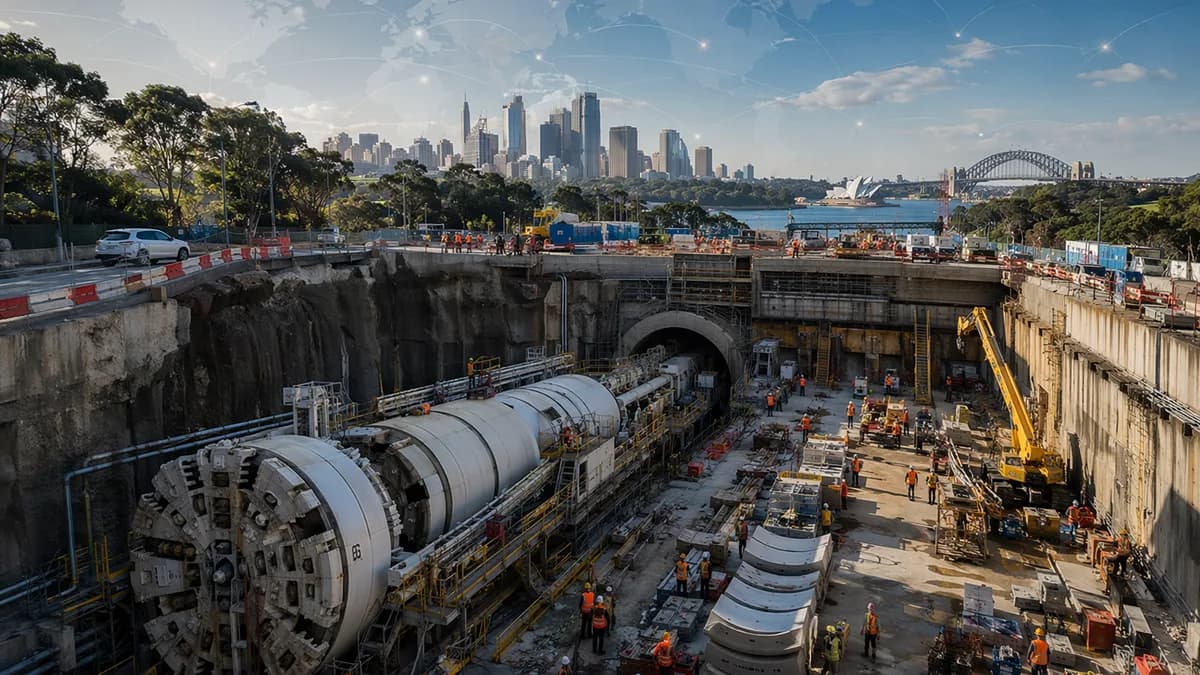
Sydney’s M6 motorway is restarting because the NSW government and the CPB Contractors-led CGU consortium have agreed to finish the compromised twin tunnels, shifting the fight from “can it be built?” to “who pays when the ground breaks the contract model?”
XOOMAR Intelligence
Analyst Take
The deal ends a two-year stalemate over the $3.1bn M6 project, according to Guardian World, after sinkholes and a high-angle reverse fault stopped tunnelling under Rockdale. For NSW taxpayers, drivers, builders and residents near the works, the minister’s line matters most: there will be “no extra cost to NSW taxpayers.”
Sydney M6 motorway deal turns an engineering crisis into a contract test
The revived Sydney M6 motorway is being sold as a construction restart. It is really a stress test for how NSW handles risk on megaprojects after the ground refuses to behave.
The project covers twin 4km tunnels connecting Kogarah and Arncliffe, linking Sydney’s south to the wider road network. It was approved in 2019 under the former Coalition government, with an original completion date of 2024. That slipped to 2025. The latest schedule now points to 2028 at the earliest.
The core question: if a fixed contract meets unexpected geology, does the private builder absorb the shock or does the public budget quietly do it later?
NSW roads minister Jenny Aitchison framed the deal as a taxpayer win.
“Our priority has always been to complete this project under the existing contract,” she said. “Unlike the Liberals, we will not hand out blank cheques when contractors try to take NSW taxpayers for a ride.”
XOOMAR analysis: That is a sharp political line, but it also raises the bar. The government now has to prove the restart is not just cheaper on paper, but clean in execution.
Builders face the hardest 250 metres of the M6 tunnel
The M6 was already 90% complete when the dispute escalated. The problem is the remaining section is not routine finishing work. About 250 metres of excavation remains on the main tunnel, after two large sinkholes opened in March 2024 above the tunnel and below an industrial estate in Rockdale.
The consortium, a joint venture of CPB, Ghella and UGL, known as CGU, had said it would down tools after discovering a “high-angle reverse fault” in bedrock near the sinkholes. A reverse fault is where one layer of rock is pushed upward and over another. In tunnelling, that matters because the ground can move, fracture or behave differently from the design assumptions.
The question for builders: can CGU complete the final stretch under the original contract terms without another technical or legal rupture?
NSW Motorways chief executive Camilla Drover said the contractor would restart immediately.
“CGU will resume work on the project immediately, and we will provide an updated timeline for expected completion once we have it,” she said.
That last clause matters. The restart is agreed. The final delivery timetable is not yet nailed down.
Taxpayers get a cost promise, but delay still carries a price
The government says CGU has agreed not to pursue contractual claims against the state for costs related to the 2024 sinkholes. It also says the consortium will absorb the costs of finishing the tunnels.
That is the strongest taxpayer protection claim in the story. It is also the one that will get tested hardest as work resumes.
| Stakeholder | Immediate win | Remaining risk |
|---|---|---|
| NSW government | Can say the M6 resumes under the existing contract | Must defend the “no extra cost” claim if delays continue |
| CGU consortium | Keeps the project alive and avoids an unresolved standoff | Must finish difficult tunnelling work after sinkholes |
| Drivers | Project still has a path to opening | Earliest opening is now 2028 |
| Residents and nearby businesses | A stalled site may move toward completion | Ground stability, disruption and communication remain live concerns |
The question for taxpayers: does “no extra cost” cover only direct tunnelling claims, or will the public still absorb costs through delay, oversight and longer disruption?
XOOMAR analysis: The source material supports the direct claim that CGU will absorb completion costs tied to the tunnel dispute. It does not establish the full public cost of the delay. That distinction is crucial. A contract can protect against one bill while the broader project still loses time, confidence and operating value.
Sinkholes exposed the weakest link in Sydney’s tunnel buildout
The sinkholes did not just interrupt the M6. They exposed the part of tunnel delivery that press releases tend to flatten: underground risk is physical before it is financial.
A tunnel can be politically announced as a fixed deliverable. It can be packaged into a design and construct contract. It can have a date, a budget and a ribbon-cutting script. Then water, fractured rock, voids or settlement can force everyone back into engineering reality.
Engineer Grahame Campbell, who project-managed the M4, told Guardian World the delay showed governments should do more geological work before signing major infrastructure contracts.
“They should have done more investigation into the geology under the road system,” he said. “That’s the main reason it went over budget.”
The question for NSW infrastructure planners: how much ground risk can really be transferred to contractors before it returns as delay?
Campbell said jet grouting was the only viable option. The method uses high-speed fluid to erode soil, then fills the cavity with grout to form a stronger composite material.
Drivers get a future road link, not a congestion cure-all
For motorists, the M6 Stage 1 promise is simple: better north-south road connectivity between Sydney’s south and the wider motorway network. The project is designed to link into the broader road system at Arncliffe, with the tunnels running from Kogarah.
But drivers are not getting immediate relief. The M6 is now scheduled to open in 2028 at the earliest, after missing the original 2024 target and then the pushed-back 2025 timeline.
The question for users: will the finished M6 justify the wait if the first stage does not solve every pinch point around it?
XOOMAR analysis: The restart improves the odds that the sunk public effort becomes an operating asset rather than an unfinished liability. But tunnel completion alone does not prove network performance. The practical test will come only when traffic is using the road, and when NSW can show the link works as part of the wider system.
For readers tracking other Australia stories involving public risk, safety and political accountability, XOOMAR has also covered the Cabramatta pram crash after school pickup and the Pauline Hanson and Sarah Martin media row.
Future bidders will read the M6 as a warning on geotechnical risk
The M6 deal sends a clear signal to infrastructure builders: NSW still wants major projects delivered, but it also wants contractors held to their design and construct obligations when problems emerge.
That may shape future bids. If builders believe governments will push hard on fixed-cost promises after unexpected ground conditions, they may price tunnelling risk more aggressively or demand clearer geotechnical assumptions upfront.
The question for the construction industry: will the next tunnel tender be cheaper because risk is disciplined, or more expensive because bidders price in the M6 lesson?
Transport for NSW secretary Josh Murray said CGU would be responsible for fixing the “subsidence issue that originally paused the contract.” CPB executive project director Terry Sleiman told the Sydney Morning Herald the agreement provided the “opportunity to continue tunnelling works.”
Those are cautious words. Nobody close to the project is declaring the ground easy.
The next M6 fight is over deadlines, blame and proof
The “unbuildable motorway” label will not disappear because tunnelling restarts. It will fade only if the final excavation is completed safely, the timetable firms up and the taxpayer-cost claim survives scrutiny.
The evidence to watch is specific:
- Timeline: NSW Motorways has not yet provided the updated completion schedule.
- Engineering: The remaining 250 metres must be finished through the difficult ground zone.
- Claims: The government says CGU will not pursue costs tied to the 2024 sinkholes.
- Public confidence: The project’s credibility now depends on visible progress, not ministerial phrasing.
The M6 restart is a win only under strict conditions. The tunnels need to be completed safely. The costs need to stay where the government says they will stay. And if hidden public costs emerge later, the deal will look less like disciplined contract management and more like a delayed reckoning.
Impact Analysis
- The $3.1bn motorway restart tests whether NSW can finish a troubled megaproject without extra taxpayer costs.
- Drivers and residents face a much longer timeline, with completion now expected in 2028 at the earliest.
- The deal sets a precedent for how governments and contractors handle unexpected geology in fixed-price infrastructure contracts.
Sydney M6 completion timetable
| Schedule point | Completion target |
|---|---|
| Original approval schedule | 2024 |
| Previous revised schedule | 2025 |
| Latest restart schedule | 2028 at the earliest |
Sydney M6 completion target shifts
Primary Sources & Disclosures

Written by
XOOMAR
Data desk
XOOMAR is a capital markets software and data company. Every brief on this site starts from a dataset the company collects itself from primary sources (CFTC, SEC EDGAR, FINRA, the Federal Reserve, exchange APIs) and names the numbers it is built on, with a link to the data page so you can check them. Briefs are reviewed before they go out and corrected in place when the data is revised.