
If Pauline Hanson Sarah Martin becomes the phrase people remember from the National Press Club, the harder question is whether a politician can chill scrutiny without formally shutting a journalist out of the room.
Global TrendsJune 18, 2026· 12 min read· By XOOMAR Insights Team
Pauline Hanson Attack on Sarah Martin Ignites Media Row
Updated on June 18, 2026
XOOMAR Intelligence
Analyst Take
71/ 100
4 sources analyzedMedium confidenceTrend10Freshness94Source Trust90Factual Grounding92Signal Cluster20
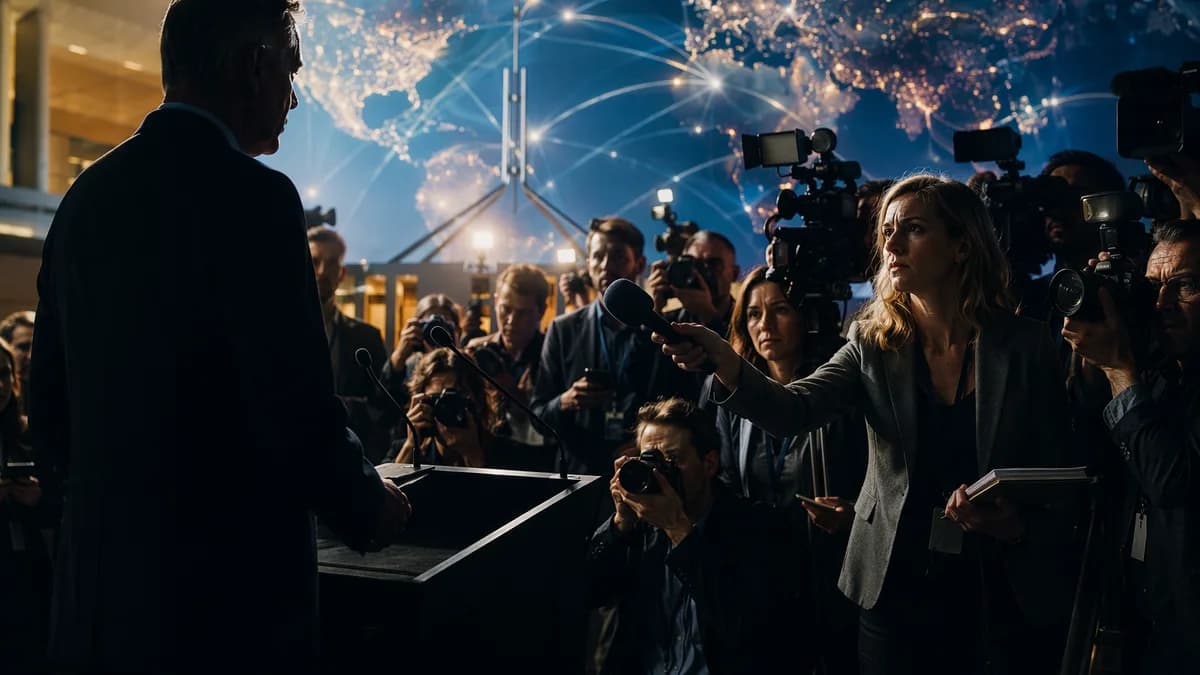
Hanson’s clash with Guardian Australia senior correspondent Sarah Martin followed a direct question about her daughter Lee Hanson’s employment by a NSW One Nation senator while living and working in Tasmania, according to Guardian World. Hanson answered by calling Martin “trashy” and saying she would be banned from future events.
That response did more than insult a reporter. It converted a question about taxpayer-funded political employment into a loyalty test: are journalists scrutinising public money, or are they enemies of One Nation?
XOOMAR analysis: that is the real signal beneath the outburst. Politicians don’t need to ban every question to weaken accountability. They can punish the questioner, frame scrutiny as malice, rally supporters against the reporter, and make the next journalist calculate the personal cost before asking the same thing.
Why did the Pauline Hanson Sarah Martin exchange cut deeper than one insult?
Because the question was predictable, and the answer was revealing.
Martin asked Hanson about Lee Hanson’s employment by a NSW One Nation senator despite living and working in Tasmania. The Guardian reported in February that Lee Hanson had been spearheading the party’s expansion in Tasmania while receiving a taxpayer-funded salary of about $150,000 a year.
Hanson’s response attacked Martin personally.
“Honestly, you never give up. I have never seen a person that is such a trashy journalist, and what you put out all the time, you've got this obsession with constantly trying to pull down myself, my party or Mrs [Gina] Rinehart,” Hanson said, according to the supplied ABC material.
She also said:
“You will be banned from my answering. I'll answer you this question today, but I am telling you now, don't come near me for an interview in the future.”
The substance of the question matters. A political party employing family members is not automatically improper. The issue is whether public money, party-building work, family ties, and parliamentary staffing arrangements are being handled transparently.
Hanson defended her daughter’s appointment, saying Lee Hanson was appointed “on her own merits.” Mediaweek’s supplied account also says Hanson cited her daughter’s HR experience and work at Tasmania University.
But the exchange did not settle the accountability question. It amplified it.
When a politician answers a staffing question by attacking the reporter, the story shifts from one employment arrangement to a larger issue: whether journalists can ask about political money without being punished for asking.
That matters beyond Hanson. As we wrote in Monocultural Australia Exposes One Nation’s Power Pitch, One Nation’s current pitch is not only about policy positions. It is also about who gets to define national legitimacy, institutional trust, and acceptable scrutiny.
Why did the MEAA treat Hanson’s comments as a press freedom issue?
The Media, Entertainment and Arts Alliance did not frame Hanson’s remarks as rough political theatre. It called them “bitter, personal and unprofessional” and said One Nation’s attempts to ban Guardian Australia and the ABC from press conferences were an assault on press freedom.
The union’s statement went directly at the contradiction in Hanson’s position.
“Hanson’s actions stand in stark contrast with her remarks that she welcomes the scrutiny of the media on her party, its people and its politics,” the MEAA said.
It added:
“[Martin] is an experienced and professional journalist who was attending her place of work to do her job of holding the powerful to account. Journalists must be provided with safe workplaces, free from abuse, so we can uphold the public’s right to know.”
That “safe workplaces” line is not decorative. It shifts the incident from free speech rhetoric into workplace risk.
XOOMAR analysis: public attacks on named reporters can travel far beyond the room. They can become clips, campaign content, online abuse triggers, and signals to supporters that a journalist is fair game. The source material does not quantify any abuse directed at Martin after the exchange, so that cannot be asserted here. But the MEAA’s warning is clear: the risk is not confined to a single press conference.
The union also called for journalists to stand with colleagues when they are targeted by politicians. That is a strategic demand. If one newsroom’s reporter can be isolated, other outlets may be tempted to stay quiet. If the industry responds collectively, banning or shaming one journalist becomes harder to normalise.
This is where the Pauline Hanson Sarah Martin clash becomes a test for the press gallery, not just One Nation.
What makes the Lee Hanson employment question legitimate rather than personal?
The legitimacy comes from the money, the role, and the public interest.
The supplied Guardian material says Lee Hanson was employed by a NSW One Nation senator while living and working in Tasmania, and that Martin had reported she was spearheading One Nation’s Tasmanian expansion while receiving a taxpayer-funded salary of about $150,000 a year.
The supplied ABC material gives a different figure, saying Lee Hanson was employed as a senior adviser to NSW senator Sean Bell, with a salary of up to $180,000. The source package does not reconcile those two figures, so the safest reading is this: reporting has placed the publicly funded salary in the broad range of about $150,000 to up to $180,000, depending on the account.
That is enough to justify scrutiny.
The source material also notes that Lee Hanson is not the first political family member to work in politics. ABC’s supplied account cites Chris Bowen’s son working as an electorate officer for state Labor MP Anoulack Chanthivong, and former prime minister Kevin Rudd’s sons being appointed to work on his 2013 re-election campaign as advisers.
So the issue is not “relative works in politics.” The issue is disclosure, role clarity, taxpayer funding, and whether a parliamentary position is being used in a way voters can properly assess.
The supplied material does not provide:
- Staffing rules: The precise parliamentary employment conditions governing this role.
- Allowance structure: The relevant staffing budget available to the senator.
- Work breakdown: How much of Lee Hanson’s work related to NSW Senate duties versus Tasmania party expansion.
- Formal approvals: Whether any internal or parliamentary review occurred.
That absence is not a reason to drop the story. It is the reason reporters ask.
A straight answer from Hanson could have narrowed the issue. A personal attack widened it.
Why did Albanese’s ABC and SBS warning land in the same fight?
Because Hanson’s clash with Martin came alongside a broader attack on publicly funded media.
Hanson used her National Press Club speech to call for SBS to be shut down and for the ABC to move to a subscription model in metropolitan Australia, with only some regional services continuing to receive taxpayer funding.
Prime minister Anthony Albanese responded by saying parties seeking to exclude media organisations or cut public broadcasting were misguided.
“I would hope that all media organisations come out and oppose that, because they should, because they’re vital roles in our democracy,” he said.
That sentence matters because it ties two issues together: access for journalists and the future of public broadcasters.
The ABC told Guardian Australia that universal access was increasingly important “in a world where the majority of content is only available behind a paywall.” It added:
“Australians should be able to continue to rely on the ABC as the most trusted source of news and information.”
The ABC also said Australian music and other creative industries would be “substantially negatively impacted” without a freely available ABC and its varied services.
SBS declined to comment on One Nation’s plans, citing its obligations around impartiality.
XOOMAR analysis: Albanese’s defence of media institutions is strongest when the target is a political opponent. The harder test for any government is whether it protects press freedom when journalists are examining its own spending, secrecy, or mistakes. That is not a claim about this specific government’s conduct in this incident. It is the standard the principle demands.
Public-interest journalism is not only comfortable when it points elsewhere.
How does the National Press Club setting change the meaning of Hanson’s response?
The National Press Club is built for direct questioning. That is the point of the forum.
Hanson’s address was described in the supplied material as a landmark appearance, and Mediaweek’s supplied account says it was her first ever National Press Club address despite being in politics for more than 30 years.
That setting made the attack sharper. This was not a shouted exchange on a campaign rope line. It was a formal political forum where leaders expect national attention and journalists are expected to press them on accountability.
The federal parliamentary press gallery committee president Jane Norman issued a statement on behalf of journalists working in Parliament House.
“The ability to scrutinise and question politicians is one of the fundamental functions of our work as journalists,” it said.
The statement continued:
“Against this backdrop, the gallery strongly objects to threats made by One Nation, or by any political party, to ban certain journalists and organisations from doing their jobs as important observers and interpreters of federal politics.”
And then the key warning:
“Journalists have an essential role to play in a free and open democracy, and such restrictions will weaken the country’s political system.”
That is the institutional rebuke. It says the issue is not whether Hanson likes Martin’s reporting. Politicians do not get to convert dislike into access control without damaging the forum itself.
This follows a wider public debate over One Nation’s political framing, including our analysis of One Nation’s power pitch around monocultural Australia. The through-line is control: who defines the country, who gets heard, and who is dismissed as illegitimate.
Who sees danger in the Hanson Martin exchange, and who sees opportunity?
Different players are reading the same moment in completely different ways.
| Stakeholder | Likely reading of the exchange | Practical consequence |
|---|---|---|
| Journalists and unions | A workplace safety and press freedom problem | Pressure for collective defence when reporters are targeted |
| One Nation and supporters | A confrontation with hostile media | The attack can be used to reinforce distrust of mainstream outlets |
| Voters | A question about public money got buried under a personal attack | Less clarity on staffing arrangements and political accountability |
| ABC and SBS | A warning shot against public broadcasters | More pressure to defend universal access and editorial independence |
| Commercial newsrooms | A competitor’s reporter was targeted today | Silence may make similar treatment easier later |
Hanson and her supporters may cast Martin’s question as a biased ambush. The supplied ABC material says Hanson has repeatedly criticised journalists reporting on her and One Nation, portraying the media as trying to discredit her party.
That position has obvious political utility. If scrutiny can be branded as persecution, the actual question becomes secondary.
For voters, that is the loss. The public does not need journalists to be liked by politicians. It needs them to ask about money, jobs, influence, and conflicts before those issues disappear into campaign noise.
There is also a strategic question for newsrooms. Defending a competitor’s journalist can feel uncomfortable. But if media outlets only object when their own staff are targeted, politicians learn to isolate reporters one at a time.
The same accountability logic applies outside media politics. XOOMAR’s coverage of Pakistan Period Tax Falls After Campaigners Sue State showed a different kind of public-interest pressure, but the principle rhymes: institutions change only when questions keep being asked, documented, and defended.
Will Hanson’s attack make newsrooms harder to intimidate, or more cautious?
That is the question that won’t be answered for months.
In the near term, Hanson may gain attention from supporters who already distrust the Guardian, the ABC, or mainstream media. The exchange gives them a clean clip and a simple story: the senator hits back.
But the backlash also keeps the staffing issue alive. A direct answer about Lee Hanson’s role might have contained the story. Calling Martin “trashy,” threatening future access, and linking the exchange to proposed cuts or changes to the ABC and SBS turned it into a broader fight over accountability.
For editors, the practical lessons are immediate:
- Protocols: Newsrooms need clear plans for responding when politicians target individual reporters.
- Documentation: Abuse, access threats, and bans should be recorded, not treated as routine campaign friction.
- Public backing: Editors should defend legitimate questions quickly, before the politician’s framing hardens.
- Cross-newsroom solidarity: A ban on one outlet should concern every outlet that may ask the next uncomfortable question.
XOOMAR analysis: the evidence that would confirm the darker reading is not one insult. It would be repeated exclusion of specific reporters, more party events where access depends on favourable treatment, and other politicians copying the tactic. The evidence that would weaken it would be One Nation allowing critical outlets back into press events and answering detailed questions about staffing arrangements without personal attacks.
For now, the Pauline Hanson Sarah Martin episode has done what sharp press scrutiny often does. It exposed more than the answer on offer. It showed how quickly a question about public money can become a fight over who is allowed to ask questions at all.
Impact Analysis
- The clash raises concerns about politicians using personal attacks to deter scrutiny from journalists.
- The question involved taxpayer-funded political employment, making it a public accountability issue.
- Threatening to ban a reporter from future events can chill press freedom even without formal censorship.
Reported taxpayer-funded salary for Lee Hanson
Lee Hanson
$150,000
Sources

Written by
XOOMAR Insights Team
Research and Editorial Desk
The XOOMAR Insights Team pairs automated research with human editorial judgment. We track hundreds of sources across technology, fintech, trading, SaaS, and cybersecurity, cross-check the facts, and explain what happened, why it matters, and what to watch next. We do not just rewrite headlines. Every article is fact-checked and scored for reliability before it goes live, and we link back to the original sources so you can verify anything yourself.
Explore More Topics
Related Articles
 Global Trends
Arrest After Man Threatens To Hunt NSW MP
Police arrested a man for allegedly threatening to find and harm NSW MP Liesl Tesch, marking the second serious online threat against a female politician in rec
Aug 6, 20264 min
 Global Trends
Andrews Throws Ben Carroll a Victoria Election Lifeline
Daniel Andrews backed Ben Carroll as Labor tries to prove its leadership reset can survive November.
Jul 29, 20269 min
 Global Trends
Gillard Turns Jacinta Allan Ouster into Sexism Fight
Gillard says Allan faced vile sexism, complicating Carroll's reset and Victorian Labor's construction crackdown.
Jul 29, 20267 min
 Global Trends
Australia's Trade Surplus Collapses Below $1.1 Billion
Australia's trade surplus plummeted to $1.1 billion, a nine-year low, as booming EV imports and strategic fuel purchases expose the economic cost of green and d
Aug 6, 20266 min
 Global Trends
Jetstar Eats Carry-Ons As Free Overhead Bags Vanish
Jetstar is ending free overhead carry-on, forcing passengers to pay up to $108 for a small suitcase that once fit for nothing. It's a radical money grab.
Aug 5, 20266 min
 Global Trends
Trump Slaps 15% Tariff on China's Chip Silicon
A new US policy levies a 15% tariff and minimum price on imported polysilicon, directly targeting Chinese control over the foundational material for chips and s
Aug 7, 20268 min
 Technology
Streamer’s Death Earns Convictions, But No Prison
Two men received suspended sentences for violence and incitement tied to the live-streamed death of Kick streamer Raphaël Graven, but no one was held legally re
Aug 7, 20266 min
 Technology
Tiny AI Model Outperforms Giants on a Raspberry Pi
Liquid AI's 2.6B parameter LFM2.5 model, small enough to run on a Raspberry Pi, outperforms far larger models, threatening the economic core of cloud-dependent
Aug 7, 20269 min
 Global Trends
Court Declares Walking a Human Right After Boy's Death
India's Supreme Court declared safe walking a fundamental right, directly challenging cities to fix deadly footpaths after a tragedy exposed the risks for 45 mi
Aug 7, 20266 min
 SaaS & Tools
AI Overhaul Uncorks The RealReal's Buried 22% Growth
The RealReal's 22% GMV growth proves its AI-driven operational overhaul is working, shifting the business from being crippled by manual processes to being power
Aug 7, 20267 min
Don't miss the signal
Get our weekly roundup of the stories that matter across tech, fintech, and trading. No noise, just signal.
Free forever. No spam. Unsubscribe anytime.