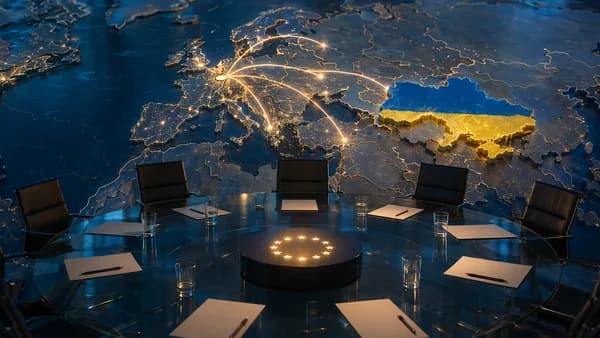
Can Ukraine EU membership talks survive the contradiction at their core: Brussels wants slow institutional proof while Kyiv is fighting a war that rewards speed, secrecy and centralized power?
XOOMAR Intelligence
Analyst Take
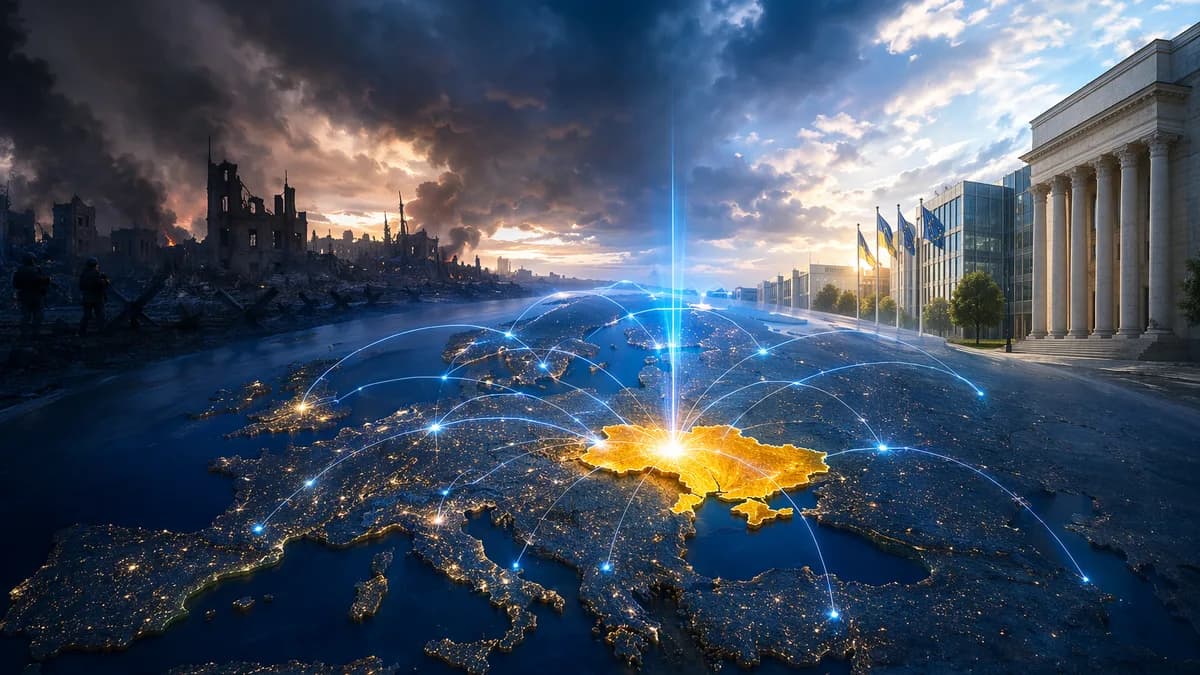
That is the real test behind Monday’s ceremony in Luxembourg, where Ukraine officially opened European Union membership negotiations while still under Russian invasion, according to ABC International. The talks won’t end the war. They do something more structural: they tie Ukraine’s postwar future to Europe’s legal, political and economic order, one chapter at a time.
“Aggression against Ukraine and threats against Europe is a permanent policy of Russia, so that’s why we need to be united," Ukrainian Deputy Prime Minister Taras Kachka told journalists. "That’s why we need faster and very comprehensive accession to the European Union.”
Can Ukraine EU membership talks turn wartime survival into a reform clock?
Ukraine EU membership talks are not a reward ceremony. They are a deadline machine.
Kachka joined an intergovernmental conference in Luxembourg to begin the work of aligning Ukraine with the 27-member bloc’s laws, standards and values. That phrase sounds bureaucratic. It isn’t. For Kyiv, it means the EU will now scrutinize how courts function, how procurement is run, how public money is controlled and whether anti-corruption institutions can act without political protection.
XOOMAR analysis: the political bet is blunt. Ukraine must prove that a state under attack can still behave like a candidate for membership in a rules-heavy union. Russia is trying to break Ukrainian state capacity. Brussels is asking that same state to document, reform and submit itself to review.
Moldova also officially launched membership talks, giving the move a wider regional frame. Russia has long tried to keep Moldova in its orbit, and Moscow was accused last year of running an artificial intelligence-driven disinformation campaign during elections there.
How many gates does Kyiv have to pass before membership is real?
The scale is the story. Candidate countries must complete negotiations across 35 policy areas, or chapters, covering fields from agriculture and taxation to energy and trade.
Monday’s meeting opened five key chapters, grouped into a first cluster centered on the EU’s founding values. The chapters are:
| Opened chapter | Why it matters for Ukraine’s accession |
|---|---|
| Judiciary and fundamental rights | Tests court independence and rights protections |
| Justice, freedom and security | Covers legal cooperation and internal security rules |
| Public procurement | Puts state contracting under EU-style scrutiny |
| Statistics | Requires credible data systems for policy and funding |
| Financial control | Focuses on oversight of public money |
The process is not just long. It is veto-prone. All 27 EU countries must agree before each chapter opens, and again before it closes.
The Guardian reported that Ukraine and Moldova were accepted as EU candidate countries in 2022, after applications filed days after Russia’s full-scale invasion. A symbolic decision to open talks came in June 2024, but substantive negotiations were blocked by Hungary until a new Hungarian government changed the equation. EU officials cited by The Guardian also believe Ukraine has completed only 15% of reforms in a 10-point plan agreed last December, though they think technical talks could finish in around four years with sufficient political will.
That four-year technical window is not a membership promise. It is a stress test.
Can wartime government meet rule-of-law tests built for peacetime?
This is Kyiv’s hardest contradiction. War pushes power inward. EU accession pushes it outward, toward institutions, procedures and external review.
The first cluster makes that tension explicit. Some EU countries worry about Ukraine’s ability and willingness to fight corruption. ABC International reported that last month, two national anti-corruption agencies named President Volodymyr Zelenskyy’s former chief of staff as an official suspect in a major graft investigation, while saying Zelenskyy was not under suspicion.
That cuts both ways. It shows corruption concerns remain alive at the highest levels of politics. It also shows investigative bodies are active enough to name a figure close to the presidency.
XOOMAR analysis: Brussels will judge Ukraine less by whether scandals appear and more by what happens after they appear. Are investigators protected? Are courts credible? Are procurement rules followed under pressure? Does emergency wartime governance become a permanent excuse?
Those questions will define the substance of Ukraine EU membership talks more than speeches in Luxembourg.
Why did Brussels move now after Hungary had stalled the file?
Hungary is the cautionary tale inside the Ukraine file.
Ukraine’s accession path had been stymied by Hungary under former Prime Minister Viktor Orbán, described in the source material as Russia’s strongest ally in Europe and a possible threat to the EU project. Orbán lost an election this year. Under EU rules, one government can slow or block decisions that require unanimity.
That veto problem is the same one XOOMAR examined in Ukraine EU Membership Bid Forces Europe Into a Veto Fight. It hasn’t disappeared. It has merely shifted.
EU officials and other candidate countries insist the process should remain merits-based and lead to full membership, not a symbolic halfway house. Still, some capitals are searching for faster routes. German Chancellor Friedrich Merz urged partners last month to consider “associate membership” for Ukraine. France and the Netherlands have also suggested work-arounds that would bring Ukraine closer without granting full membership rights.
Finland’s Foreign Minister Elina Valtonen pushed back against the idea that accession is just a status upgrade.
What Ukrainians “truly are after is freedom, democracy and a transparent market economy without any corruption,” she told journalists in Luxembourg.
Swedish Foreign Minister Maria Malmer Stenergard framed the lesson from Hungary more sharply:
“We need to be very cautious in the future and make sure that these are countries that really want to be a part of Europe, and a part of the European Union, and are willing to work with us.”
Why do Moscow, Washington and EU capitals read the same talks differently?
For Kyiv, EU membership is a security guarantee for after the war. Not the strongest one. The source material says Ukraine’s best guarantee would be NATO membership, but the Trump administration insists that cannot happen, and others are wary of Ukraine joining while the war continues.
For Brussels, accession talks give the EU a structured way to shape Ukraine’s reforms. That is power, but it also creates expectations Brussels may struggle to satisfy quickly.
For Moscow, the strategic signal is obvious even if EU accession is not NATO membership: Ukraine is moving deeper into Europe’s institutional orbit. Kachka’s language leaves no ambiguity. Kyiv sees Russian aggression as permanent policy and EU accession as part of the answer.
For business, the immediate issue is not membership date. It is regulatory direction. XOOMAR analysis: banks, infrastructure firms, defense suppliers, energy companies and agribusinesses will watch whether Ukraine’s judiciary, procurement and financial-control chapters reduce legal and corruption risk before full accession happens.
The military backdrop remains inseparable from the political one. XOOMAR has separately tracked related Ukraine war pressure points, including Bulgaria’s Ukraine Weapons Halt Hands Putin a NATO Win.
What evidence will show by 2030 whether this is integration or theater?
The best evidence will be procedural, not rhetorical.
Watch whether Ukraine closes the gap on the 10 priority reforms cited by EU officials. Watch whether the first cluster produces measurable movement on courts, procurement and financial control. Watch whether anti-corruption agencies retain room to act when investigations touch politically sensitive figures.
On the EU side, watch whether member states keep opening chapters without returning to veto theater. The Hungarian experience showed how one capital can jam the machine. Swedish concerns show that the lesson has not been forgotten.
The staged-integration debate will also matter. If “associate membership” or similar arrangements advance, Ukraine may enter parts of EU decision-making, policy programs or regulatory systems before full membership. If those ideas stall, the process may remain formally alive but politically thin.
The thesis is simple: Ukraine EU membership talks are now one of Europe’s hardest institutional tests. If Kyiv keeps reforming under fire and the EU keeps its own members aligned, accession can turn wartime solidarity into a durable political order. If either side drifts, Monday’s opening will look less like the start of membership and more like another European promise waiting for proof.
Impact Analysis
- Ukraine’s EU talks formally anchor its postwar future to Europe’s institutions.
- The process will test whether a country at war can still deliver deep democratic and anti-corruption reforms.
- Moldova’s parallel launch gives the talks broader significance in Europe’s contest with Russian influence.
EU Accession Demands vs. Wartime Pressures
| EU Membership Process | Ukraine’s Wartime Reality |
|---|---|
| Requires slow, documented institutional reform | War rewards speed, secrecy and centralized decision-making |
| Scrutinizes courts, procurement, public finance and anti-corruption bodies | State capacity is under constant pressure from Russia’s invasion |
| Ties Ukraine to the EU’s legal, political and economic order | Kyiv must maintain survival efforts while proving democratic readiness |
Primary Sources & Disclosures

Written by
XOOMAR
Data desk
XOOMAR is a capital markets software and data company. Every brief on this site starts from a dataset the company collects itself from primary sources (CFTC, SEC EDGAR, FINRA, the Federal Reserve, exchange APIs) and names the numbers it is built on, with a link to the data page so you can check them. Briefs are reviewed before they go out and corrected in place when the data is revised.