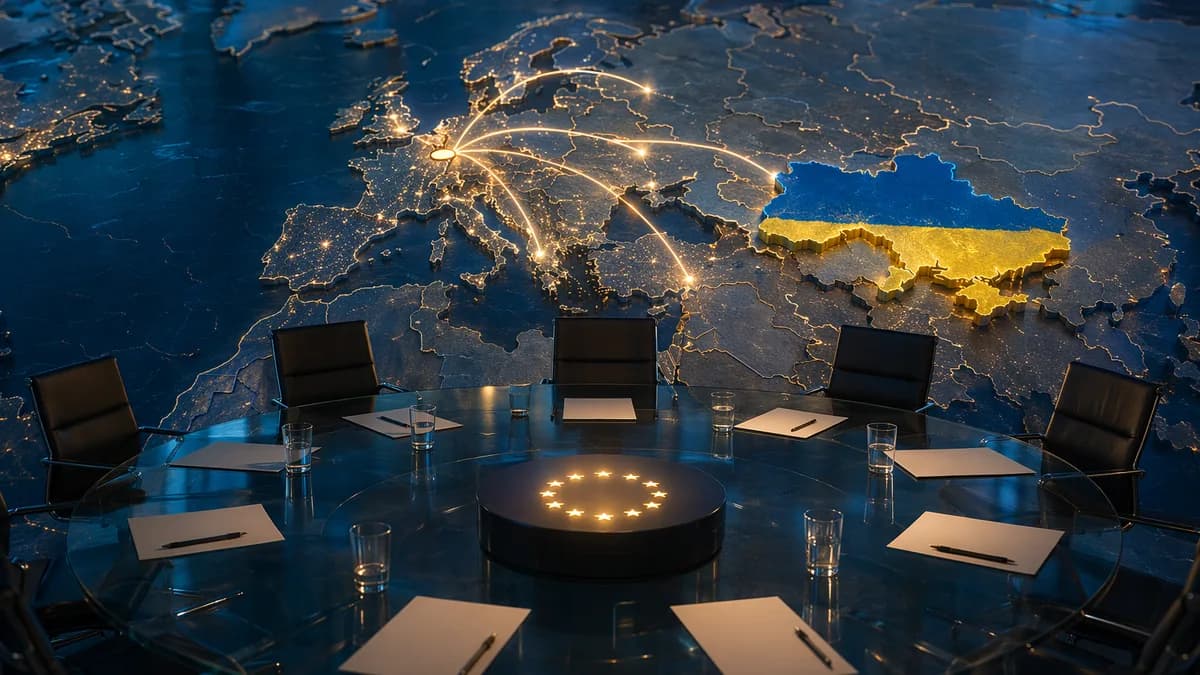
Ukraine EU membership has crossed from wartime symbolism into the hard machinery of enlargement, where Brussels can support Kyiv politically but still force it through the bloc’s slowest and most veto-prone process.
XOOMAR Intelligence
Analyst Take
European officials launched accession talks with Ukraine and Moldova on Monday after all 27 E.U. member states agreed last week to open the first negotiating cluster, according to Time. That sounds procedural. It isn’t. The first cluster covers the “fundamentals”: democracy, rule of law, governance, and judicial reform. Without progress there, the rest of Ukraine’s accession bid cannot really move.
“On the day Ukraine opens its first negotiation cluster with the E.U., Moscow shows again what it fears most. A democratic Ukraine, firmly anchored in Europe,” Marta Kos, the European Commissioner for Enlargement, said after Russia launched another deadly attack on Ukraine the night before talks began.
Brussels Is Treating Ukraine EU Membership as a Security Instrument
Kaja Kallas, the E.U.’s chief diplomat, said in March that it was her wish that “Ukraine is going to join [the] European Union soon,” while declining to give a timeline. That contrast captures the whole story.
Politically, Brussels wants to anchor Ukraine inside Europe. Technically, it has no shortcut that avoids the accession rulebook. Every cluster must be opened and closed unanimously. Every member state has veto power. Every reform claim can be tested by the European Commission.
XOOMAR analysis: Ukraine’s bid is now part of Europe’s response to Russia’s war, not just a democratic aspiration filed in Brussels. Ursula von der Leyen and António Costa framed the move as a way to “strengthen peace, security, and prosperity” across Europe amid global uncertainty. Zelensky called it “political and moral support.” Those phrases are diplomatic, but the stakes are concrete: the E.U. is trying to make Ukraine’s westward alignment harder to reverse.
That does not make membership imminent. It makes the process more consequential.
Ukraine’s Accession Path Has Moved From Symbolism to Leverage
Ukraine formally applied for European Union membership in February 2022, shortly after Russia’s full-scale invasion. It received candidate status in June 2022. E.U. leaders agreed in December 2023 to open accession negotiations. The first accession conference was held in June 2024. Ukraine then completed the Commission’s screening process in September 2025, a review of how its laws match the E.U. acquis, the bloc’s body of common law.
Frank Schimmelfennig, a professor of European politics at ETH Zurich, told Time that the original candidate decision was not driven mainly by Ukraine’s reform progress.
“The original decision was not driven by progress in democratic and rule of law reform. It was driven by the Russian invasion, and the desire to support Ukraine, and to send a signal that Ukraine is part of the family and a future member state,” he said.
That signal now becomes leverage. Kyiv gets a structured path toward the E.U., but Brussels gets constant pressure points over courts, procurement, minority rights, public administration, and anti-corruption agencies.
The Hungary factor shows why this matters. Time reports that Viktor Orbán, a Putin ally, had blocked the opening of the first cluster. After Orbán’s 16-year rule ended in March and Péter Magyar took power, that obstacle was removed. But the broader lesson remains: Ukraine EU membership can be slowed by one capital, even when most of Brussels wants momentum.
The Hard Numbers Show Why This Process Is Built to Be Slow
The supplied record gives enough numbers to make one point clear: this is not a single political vote. It is a staged legal conversion.
| Accession marker | Status for Ukraine |
|---|---|
| Formal application | February 2022 |
| Candidate status | June 2022 |
| Decision to open talks | December 2023 |
| First accession conference | June 2024 |
| Screening process completed | September 2025 |
| Association Agreement reform implementation | Roughly 84% since 2014 |
| Negotiating clusters | Six |
| Member-state approval | Unanimity among 27 states |
The 84% figure comes from Ukraine’s latest Association Agreement implementation report released in 2026, covering required reforms across sectors since 2014. It is a strong headline number, but it does not settle accession. The first cluster now sets benchmarks that affect every other chapter.
Schimmelfennig described the fundamentals cluster as “basically horizontal.” His point is blunt: if Ukraine cannot satisfy Brussels on rule of law and governance, progress in other areas will hit a ceiling.
“You cannot close any of the other chapters and clusters unless you meet certain benchmarks for this first cluster,” Schimmelfennig said.
The remaining clusters include areas such as agriculture, sustainability, trade, and economic policy. The source material does not provide current figures for Ukraine’s population, GDP, agricultural output, reconstruction needs, or budget impact on the E.U., so those claims should not be overstated. What is supported is enough: Ukraine would have to keep aligning domestic law with E.U. standards across a wide policy range, while at war.
Kyiv’s Reform Test Runs Through Anti-Corruption Institutions
Ukraine has made real progress toward E.U. requirements. A European Commission report published in November 2025 said Ukraine had “adopted roadmaps on rule of law, public administration reform and on the functioning of democratic institutions, as well as an action plan on national minorities.”
The same report flagged work still needed, especially around strong and independent anti-corruption institutions. That is the core vulnerability.
Zelensky’s top aide Andriy Yermak resigned late last year after Ukraine’s anti-corruption agencies searched his home. Separately, Zelensky signed a bill last year that critics said limited anti-corruption agencies. After protests and pushback from E.U. officials, he reversed course and restored the independence of Ukraine’s two main anti-corruption bodies.
XOOMAR analysis: Brussels cannot treat this as a box-checking exercise. If it lowers standards because Ukraine is fighting Russia, it weakens the credibility of enlargement. If it demands peacetime perfection from a country under attack, it risks turning accession into a permanent waiting room.
That is the tightrope. Ukraine EU membership depends on reforms that are hardest to execute during war: independent institutions, transparent administration, credible courts, and anti-corruption enforcement that reaches politically sensitive targets.
For related XOOMAR coverage on the wider war pressure around Ukraine, see Bulgaria’s Ukraine Weapons Halt Hands Putin a NATO Win and Ukrainian Drone Strike Sets Russia Export Hub Ablaze.
Member States Still Hold the Real Power Over Ukraine’s Bid
The Commission evaluates progress. The member states decide.
Every cluster must be opened and closed unanimously. Once negotiations are complete, the Commission drafts an accession treaty. That treaty must be approved by the European Commission, the European Council, and the European Parliament, then ratified by all member states and the candidate country.
Schimmelfennig warned that the structure “creates a lot of veto points in the process and a lot of opportunities for individual countries to block the progress in the negotiations.”
France could require a national referendum before approving Ukraine’s accession, according to Time’s account of Schimmelfennig’s view. Hungary, even under new leadership, has signaled opposition to fast-tracking Ukraine into the bloc. Germany and France reportedly support faster “symbolic” membership, but the source record also shows skepticism around Kyiv’s hope for a fast-tracked decision by 2027.
Brussels often views 2030 as the “magic date” for potential membership, Schimmelfennig said. He cautioned that there is no guaranteed timeline and pointed to Serbia, which began formal accession negotiations in 2014 before talks stalled.
Ukraine Would Join a Stricter, More Cautious E.U.
The last country to join the E.U. was Croatia in 2013. That matters because enlargement today runs through a bloc more alert to rule-of-law backsliding and institutional gridlock.
Ukraine’s case is even harder. It is trying to meet E.U. standards while defending itself from Russia. The accession process will test courts, ministries, regulators, border systems, and public procurement under wartime pressure. It will also test whether the E.U. can act geopolitically without gutting its own standards.
Marta Kos told Time that Brussels has already done “a large portion of the work” with Ukraine and Moldova in advance through a “frontloading” approach.
“We all took the frontloading very seriously and it will work to speed up their entry into the E.U.,” Kos said.
That is the best-case mechanism: do more reform work earlier, then move faster when political windows open. The risk is that veto politics, corruption setbacks, or war damage slow the process anyway.
The Membership Clock Is Running, but Not on Kyiv’s Preferred Schedule
For investors, contractors, logistics firms, agribusinesses, and energy companies, the practical signal is regulatory convergence before membership. Ukraine will keep adapting laws to E.U. standards, and Brussels will keep using accession benchmarks to shape institutions.
The next evidence to watch is not a grand declaration. It is narrower and more revealing:
- Fundamentals benchmarks: Does Ukraine keep anti-corruption bodies independent and functioning?
- Cluster progress: Do member states agree to move beyond the first cluster without new veto fights?
- Political discipline: Does Kyiv avoid reforms that trigger E.U. backlash?
- Timeline realism: Does the 2027 ambition fade into a longer 2030-style track?
Ukraine is closer to the European Union than it was before Monday. But the real story is not distance. It is durability. Ukraine EU membership will test whether Europe can reward a country resisting Russia while still enforcing the rules that make the E.U. worth joining.
Impact Analysis
- Ukraine’s EU accession talks turn wartime political support into a formal, rules-heavy enlargement process.
- Progress depends on reforms in democracy, rule of law, governance, and judicial independence before other areas can advance.
- Any of the 27 EU member states can slow or block the process, making membership politically significant but far from guaranteed.
Primary Sources & Disclosures

Written by
XOOMAR
Data desk
XOOMAR is a capital markets software and data company. Every brief on this site starts from a dataset the company collects itself from primary sources (CFTC, SEC EDGAR, FINRA, the Federal Reserve, exchange APIs) and names the numbers it is built on, with a link to the data page so you can check them. Briefs are reviewed before they go out and corrected in place when the data is revised.