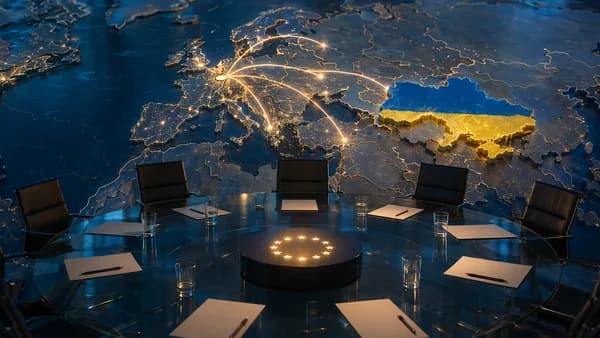
European leaders are trying to turn Donald Trump from a Ukraine war bystander into the host of direct Zelenskyy-Putin talks, a move that would affect Kyiv most because it could open a diplomatic channel while also raising pressure on Ukraine to define what it can accept.
XOOMAR Intelligence
Analyst Take
The push came at the G7 summit in Évian-les-Bains, France, where leaders urged Trump to take up a proposal to host Volodymyr Zelenskyy and Vladimir Putin in the US, according to Guardian World. The thesis is plain: Europe wants Trump’s access to Putin, but it also wants guardrails around any diplomacy that could move faster than Ukraine or Europe can absorb.
Trump gets pulled toward the one Ukraine gamble he can’t fully control
Trump described “the great antipathy” between Zelenskyy and Putin as a barrier to a settlement and said Moscow “should make a deal”, noting that Russia had “lost a great many people, just like Ukraine”. That language fits his preferred frame: a brutal conflict that only direct bargaining can stop.
But a US-hosted meeting would not be a normal diplomatic venue. It would make Trump the visible broker between the Ukrainian president and the Russian president, before the source material shows any agreed framework for territory, security guarantees, sanctions relief, or enforcement.
“The right negotiation is one in which Ukraine and Russia are at the table, but with Europeans and Americans present as well,” Emmanuel Macron said on Monday.
That line captures Europe’s central concern. Leaders want Trump engaged enough to pressure Moscow, but not so detached from allied coordination that Washington becomes a messenger between Kyiv and Moscow rather than a mediator backing Ukraine.
Can Trump host Zelenskyy-Putin talks without making the summit itself the prize? That is the risk. A meeting in the US would carry symbolic weight even if the hard issues remain unresolved.
Zelenskyy’s battlefield message changes the politics of peace talks
Zelenskyy’s message to Trump was sharper than a generic appeal for support. He tried to convince the US president that Ukraine was no longer losing on the battlefield, and that Washington should act as a mediator supportive of Ukraine rather than a neutral courier between the two sides.
That matters because diplomacy from weakness looks very different from diplomacy from durability. If Trump believes Ukraine is sliding toward defeat, the logic of a quick bargain grows stronger. If he accepts Zelenskyy’s case that Kyiv is holding stronger ground, the argument for pressuring Moscow becomes harder to dismiss.
Zelenskyy also told G7 leaders he was making changes to army pay to make frontline recruitment levels sustainable. That point directly answers a recurring criticism inside the US administration. The Guardian reports that JD Vance, the US vice-president, has repeatedly claimed Ukraine is bound to lose because Russia can recruit more soldiers.
Kyiv’s aim is clear from the supplied facts: remain open to talks, but resist a settlement that treats Russia’s battlefield presence as a settled outcome. How does Zelenskyy do that without appearing to reject peace? By arguing that Ukraine’s military position gives diplomacy a better chance, not a reason to rush.
For readers tracking how the war pressures European decision-making, XOOMAR’s earlier coverage of War Forces Ukraine EU Membership Talks Into a Trap is relevant context on the political constraints around Kyiv’s longer-term alignment.
The hard numbers Trump is being asked to turn into a deal
The source material does not provide verified casualty estimates. It does, however, show how numbers are shaping the diplomacy around Zelenskyy-Putin talks.
| Data point | Why it matters |
|---|---|
| 60-day ceasefire in Iran | Zelenskyy hopes the US administration is less distracted after agreeing it |
| First face-to-face Trump-Zelenskyy meeting in four months | The channel needed reactivation at the G7 |
| 21st EU sanctions package | Europe is preparing more pressure on Russia, including restrictions on LNG tanker sales |
| 9 miles / 15km from the Kremlin | Location of Moscow’s largest oil refinery, which Zelenskyy said Ukrainian drones set on fire |
| 300 miles / 500km from Ukraine | Shows the reach of Ukraine’s long-range strike campaign, based on the source |
Zelenskyy framed Ukraine’s long-range weapons as pressure, not symbolism.
“Russia must be forced to end its war against our people. And Ukraine’s long-range weapons are one of the important components of such pressure,” he said. “This is a just response to Russian strikes, and to the dragging out of a war that must be ended.”
Trump’s language about both sides losing “a great many people” lets him argue that direct bargaining is morally urgent. Europe’s sanctions push suggests a different theory: talks need pressure behind them, or Moscow has little reason to alter course.
Europe wants Trump at the table, but fears the deal he might accept
The European position is tactical, not sentimental. Leaders want US weight in the room because Trump speaks to both Zelenskyy and Putin. The source says Trump spoke to both men on Sunday before traveling to the G7 and claimed both were open to a meeting.
But Europe also wants representation. The E3, the UK, Germany and France, want to be directly involved because they are providing almost all the financial and military support to Ukraine, according to the Guardian’s account. German government sources said the most realistic format would pair Ukraine and Russia with the US and Europe, while the hardest question is who speaks for Europe.
That unresolved question is not procedural trivia. If Europe cannot decide who represents it, Washington may set the pace by default.
The format problem
Alexander Stubb, Finland’s president, rejected the idea that he should become Europe’s special representative.
“Personally, I do not see myself as a representative in this matter,” he said. “I believe this should be led by the major players, namely France, Germany and the UK.”
He still backed talks, saying Ukraine holds “strong positions militarily, politically and economically” and that Europe should establish contact with Putin to conduct diplomatic negotiations.
Putin’s side is already attacking the European role. Kirill Dmitriev, Putin’s special representative, accused the EU and UK of inserting “poison pills” into peace discussions.
“EU/UK warmongering ‘poison pills’ to derail peace discussions are too obvious and delay peace by pushing tired, unrealistic solutions,” he wrote. “Hypocrisy does not work well when exposed.”
XOOMAR analysis: Dmitriev’s language supports the view that Moscow would prefer a narrower channel where European governments have less influence. That does not prove Russia would accept a Trump-hosted summit, but it shows why Europe is pushing to be in the room.
For a related pressure point on European military support, see Bulgaria’s Ukraine Weapons Halt Hands Putin a NATO Win.
A US-hosted summit could redraw Kyiv’s choices before terms are settled
A Trump-hosted meeting would give Ukraine more diplomatic attention, but attention has costs. Kyiv would need to sharpen its position on the difference between compromise and capitulation before sitting across from Putin in a US-backed format.
The Guardian reports that Trump still appears to regard the US as neutral in the conflict and eager to see sanctions on Russia lifted so projects such as an Alaska-Siberia tunnel can be considered. That detail is important because it shows a possible gap between Washington’s economic instincts and Europe’s pressure strategy.
Europe, meanwhile, is moving in the other direction on sanctions. G7 leaders agreed to step up sanctions on Russian energy, and the EU is preparing its 21st sanctions package. The package includes restrictions on the sale of LNG tankers to Russia.
So the diplomatic map has two tracks:
- Trump’s track: direct leader-level bargaining, with the US as host and mediator.
- Europe’s track: sanctions, military and financial support, plus direct European representation in talks.
- Ukraine’s track: prove battlefield resilience, strengthen recruitment, and demand that the US role support Kyiv rather than simply transmit messages.
Can those tracks merge before autumn, when Zelenskyy and his main European partners hope Trump’s engagement could make talks possible? That is the practical test.
The evidence that would confirm or weaken the summit thesis
The strongest evidence for a real diplomatic opening would be a defined format: Ukraine and Russia at the table, with the US and Europe present, and an agreed European representative or delegation. A Trump announcement alone would not be enough.
The thesis weakens if Europe remains unable to settle who speaks for it, if Trump keeps framing Washington as neutral, or if Moscow continues treating European involvement as an obstacle rather than part of the negotiating structure.
For now, Zelenskyy-Putin talks remain a proposal, not a process. The next signal to watch is whether Trump moves from saying he will “do what he could” to naming conditions, participants, and sequencing. Without that, a summit risks becoming a photo opportunity before the actual peace architecture exists.
The Stakes
- A US-hosted Zelenskyy-Putin meeting could open a rare direct diplomatic channel in the Ukraine war.
- European leaders want Trump’s access to Putin but fear an uncoordinated process could weaken allied leverage.
- Ukraine could face new pressure to clarify its negotiating limits before security guarantees or enforcement terms are defined.
Stakeholder Positions on Proposed US-Hosted Zelenskyy-Putin Talks
| Stakeholder | What They Want | Main Risk or Constraint |
|---|---|---|
| European leaders | Trump engaged as host while Europeans and Americans remain present in negotiations | Diplomacy could move faster than Ukraine or Europe can absorb |
| Donald Trump | Direct bargaining to stop a brutal conflict | A US-hosted summit could make the meeting itself the prize without an agreed framework |
| Ukraine | A diplomatic channel that includes Kyiv at the table | Increased pressure to define what it can accept |
| Russia | Potential direct talks with Ukraine in the US | No agreed framework cited for territory, sanctions relief, security guarantees, or enforcement |
Primary Sources & Disclosures

Written by
XOOMAR
Data desk
XOOMAR is a capital markets software and data company. Every brief on this site starts from a dataset the company collects itself from primary sources (CFTC, SEC EDGAR, FINRA, the Federal Reserve, exchange APIs) and names the numbers it is built on, with a link to the data page so you can check them. Briefs are reviewed before they go out and corrected in place when the data is revised.