
One death in Russia’s Krasnodar region is the human headline, but the larger signal is strategic: Ukraine is pushing the war deeper into Russia’s export, fuel, and military-support infrastructure.
Global TrendsJune 13, 2026· 7 min read· By XOOMAR Insights Team
Ukrainian Drone Strike Sets Russia Export Hub Ablaze
Updated on June 13, 2026
XOOMAR Intelligence
Analyst Take
57/ 100
4 sources analyzedLow confidenceTrend10Freshness99Source Trust85Factual Grounding90Signal Cluster20
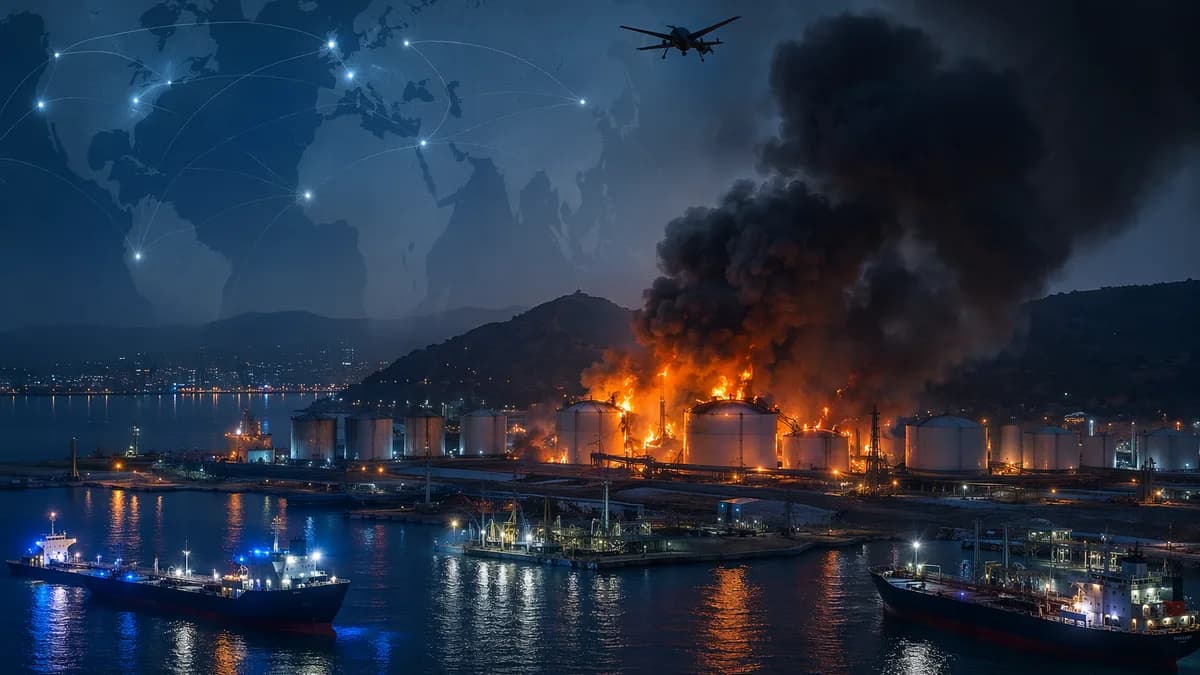
A Ukrainian drone attack killed one person and injured three in the southern Russian region, while drone debris sparked a fire at a sea terminal, local officials said Saturday, according to ABC International. Russian news outlets reported damage at a Black Sea export terminal in the village of Volna that transports crude oil, petroleum products, and liquefied gas.
That combination matters. A casualty event gives Moscow a political weapon. A terminal fire gives Kyiv a pressure point. The war’s center of gravity is no longer only the trench line across eastern and southern Ukraine. It is also ports, refineries, pumping stations, military factories, and the air-defense systems Russia must now spread across a much wider map.
One death, three injuries, and a Black Sea terminal fire change the Krasnodar equation
The reported Krasnodar strike fits a widening Ukrainian campaign against targets inside Russia, especially military and energy infrastructure. Ukraine’s General Staff did not comment on the Krasnodar attack Saturday, but said Ukrainian forces hit an oil preparation and pumping station overnight in Russia’s Volgograd region, as well as Russian-occupied areas in Ukraine’s Donetsk and Zaporizhzhia regions.
That distinction is important. Kyiv did not claim this specific Krasnodar strike in the source material. But the broader pattern is clear from the same reporting: Ukraine is reaching beyond battlefield positions and into systems that help Russia fund, fuel, and sustain the war.
Krasnodar is not an abstract rear area. It sits in southern Russia, close to the Black Sea and near maritime routes and energy infrastructure linked to Russia’s war economy. A fire at a sea terminal may be physically limited, or it may create wider disruption. The available facts don’t yet show which.
The confirmed core facts are narrower than the strategic implications: one killed, three injured, drone debris sparked a fire, and Russian outlets reported damage at a Black Sea export terminal in Volna.
That gap between confirmed damage and possible consequence is where the analysis sits.
More than 1,000 kilometers of static front line pushed both sides toward long-range strikes
The AP report gives the scale that explains the shift: more than four years after Russia’s full-scale invasion, the front line has remained largely static across more than 1,000 kilometers. Drones have made advances harder. Long-range strikes have become the workaround.
Ukrainian President Volodymyr Zelenskyy said Wednesday that Ukrainian FP-5 Flamingo long-range missiles hit a military factory in Cheboksary, in Russia’s Chuvashiya region, more than 900 kilometers from the front line. He said the facility supplied components for Russian drones and missiles.
That claim, paired with the Krasnodar incident and Ukraine’s stated Volgograd strike, shows how Kyiv is trying to turn distance into a weaker shield for Russia.
| Reported strike area | Target or reported effect | Source-grounded significance |
|---|---|---|
| Krasnodar region | 1 killed, 3 injured, sea terminal fire | Brings casualties and port infrastructure into the same event |
| Volgograd region | Oil preparation and pumping station hit, per Ukraine’s General Staff | Points to continued focus on energy infrastructure |
| Cheboksary, Chuvashiya | Zelenskyy said FP-5 Flamingo missiles hit a military factory | Shows claimed reach of more than 900 kilometers from the front |
| St. Petersburg area | Putin vowed stronger air defenses after Ukrainian attacks set ablaze an oil terminal and hit a nearby naval base | Suggests Russian concern over attacks far from Ukraine |
| Dnipropetrovsk region, Ukraine | Russian attacks injured nine people and set fire to a local marketplace | Shows long-range pressure is not one-sided |
The economics are blunt. XOOMAR analysis: relatively cheap unmanned systems and long-range strike weapons can force the defender to spend more on air defense, repairs, dispersal, and emergency response than the attacker spends on each strike. The source does not quantify those costs, so the point should be read as strategic logic, not a confirmed financial impact.
A sea terminal fire can matter even before the damage count is known
Sea terminals are not just waterfront real estate. In wartime, they can move fuel, commodities, equipment, and revenue-generating exports. The reported Volna terminal handled crude oil, petroleum products, and liquefied gas, according to Russian news outlets cited in the AP report.
That makes the location more consequential than a generic infrastructure fire.
Still, the limits matter. The source does not confirm:
- Damage scale: how much of the terminal was hit or burned.
- Operational status: whether the facility paused, slowed, or continued operations.
- Duration: whether disruption lasted hours, days, or longer.
- Military role: whether the terminal directly supported Russian forces, beyond its reported energy-export function.
XOOMAR analysis: Kyiv’s logic, if the terminal was the intended target, would be to make Russia defend more assets across a broader zone. That stretches air-defense coverage and increases the burden on regional authorities. But the civilian death complicates the picture. Long-range war carries strategic upside and political risk in the same flight path.
For readers tracking security beyond the battlefield, this pattern rhymes with other forms of infrastructure exposure. XOOMAR has covered sensitive-system risk in Void Blizzard Suspect Lands in Boston. Secrets Are at Risk and institutional fallout from large-scale data compromise in Coupang Data Breach Triggers a $400M Boardroom Crisis. Different domain, same lesson: critical systems become pressure points when adversaries can reach them.
Krasnodar residents, Kyiv planners, and market watchers see different wars in the same fire
Local Russian officials are emphasizing the immediate consequences: a death, injuries, and emergency response after drone debris started a fire. That is the part residents feel first. For people living near ports, refineries, and logistics nodes in southern Russia, the war is less distant than it once appeared.
Kyiv’s strategic view is different. Ukraine has repeatedly framed strikes on Russian military and energy infrastructure as a way to reduce Moscow’s ability to wage war. The AP report says this Krasnodar attack came as part of Kyiv’s campaign against military and energy targets deep inside Russia, though Ukraine did not claim this specific strike.
For shipping and energy-market readers, the practical question is narrower than the politics: does this remain a contained incident, or does it become part of a recurring disruption pattern around Black Sea and southern Russian terminals? The source does not report insurer, trader, shipper, or buyer reactions. No market impact is confirmed.
That restraint matters. A terminal fire near export infrastructure is a signal. It is not, by itself, proof of a sustained supply shock.
Putin’s air-defense pledge shows the pressure is reaching Moscow’s planning table
The Krasnodar attack followed another sensitive episode for Russia. Last week, Russian President Vladimir Putin vowed to strengthen air defenses after Ukrainian attacks set ablaze an oil terminal in St. Petersburg and hit a nearby naval base, according to the AP report. Those attacks cast a cloud over a showcase economic forum in his hometown.
That detail sharpens the Krasnodar story. Russia is facing strikes in places with different symbolic and operational value: southern export zones, oil infrastructure, naval facilities, and sites far from the front line. The reported Cheboksary strike, more than 900 kilometers from the front, reinforces the same point.
XOOMAR analysis: if Ukrainian reach keeps expanding, Russia has three hard choices. It can concentrate defenses around the most valuable sites and leave others exposed. It can spread defenses thinner across more territory. Or it can accept recurring fires and disruptions as a cost of war. None is attractive.
The watch item now is evidence, not rhetoric. Confirmation of terminal downtime, visible repair work, repeated strikes on the same corridor, or new Russian air-defense deployments would strengthen the thesis that Krasnodar is becoming part of a sustained pressure campaign. If the fire proves minor, operations continue normally, and follow-up strikes do not materialize, the incident may register more as a warning shot than a structural change.
The Stakes
- The strike shows Ukraine is extending pressure beyond the front line into Russia’s energy and export infrastructure.
- Damage at a Black Sea terminal could disrupt systems tied to Russia’s fuel supply and war financing.
- Civilian casualties give Moscow a political tool while forcing Russia to defend a wider range of strategic sites.
Reported Casualties in Krasnodar Drone Strike
Killed
people1
Injured
people3
Sources

Written by
XOOMAR Insights Team
Research and Editorial Desk
The XOOMAR Insights Team pairs automated research with human editorial judgment. We track hundreds of sources across technology, fintech, trading, SaaS, and cybersecurity, cross-check the facts, and explain what happened, why it matters, and what to watch next. We do not just rewrite headlines. Every article is fact-checked and scored for reliability before it goes live, and we link back to the original sources so you can verify anything yourself.
Explore More Topics
Related Articles
 Global Trends
3 Romania Drone Shootdowns Drag NATO Into Airspace Fight
Romania shot down three drones in three days, turning Black Sea spillover into a direct NATO airspace test.
Jul 26, 20268 min
 Global Trends
Wildberries Drone Strikes Expose Russia's Soft Underbelly
Four strikes on Wildberries sites turn Russia's e-commerce backbone into a wartime liability and shake sellers who rely on it.
Jul 22, 202612 min
 Global Trends
Ukraine Installs Mykhailo Drapatyi to Shake Up War Command
Mykhailo Drapatyi takes Ukraine's top command with reform hype and a brutal winter test ahead.
Jul 22, 20268 min
 Global Trends
Arkady Dvorkovich Sanctions Drag FIDE Into Governance Crisis
EU sanctions sidelined Arkady Dvorkovich but didn't force him out, leaving FIDE trapped in a governance crisis over Russia and Ukraine.
Jul 25, 20267 min
 Global Trends
Zelensky Ousts Ukraine Commander After Street Fury
Zelensky fired Oleksandr Syrskyi after protests, putting Mykhailo Drapatyi atop Ukraine's army while doubts over command deepen.
Jul 21, 20267 min
 Technology
Kremlin Targets Telegram Founder Durov in Terror Case
Russia accused Telegram founder Pavel Durov of facilitating terrorism, turning a moderation fight into a Kremlin pressure campaign.
Jul 29, 20266 min
 Trading
Oil Shock Trips Indian Rupee as USD/INR Snaps Back
The Rupee's three-day run stalled as crude jumped, reviving India's import pressure and putting USD/INR back near a key line.
Jul 29, 20267 min
 Technology
Fast Metals Mines Toxic Red Mud for Critical Minerals
Fast Metals raised $4.3M to mine critical minerals from red mud. Now it has to prove the leftover waste is safer.
Jul 29, 202612 min
 SaaS & Tools
Nearly 60 Webinar Tools Expose the Best Webinar Software
Webinar platforms are now judged by pipeline, not polish. Zapier’s 2026 picks show marketers which tools turn attendance into action.
Jul 29, 20268 min
 Trading
$83 Oil Traps USD/CAD Before Pivotal Fed Rate Call
USD/CAD is boxed near 1.4093 as oil supports the loonie, but Fed risk keeps traders from calling a breakout.
Jul 29, 20265 min
Don't miss the signal
Get our weekly roundup of the stories that matter across tech, fintech, and trading. No noise, just signal.
Free forever. No spam. Unsubscribe anytime.