
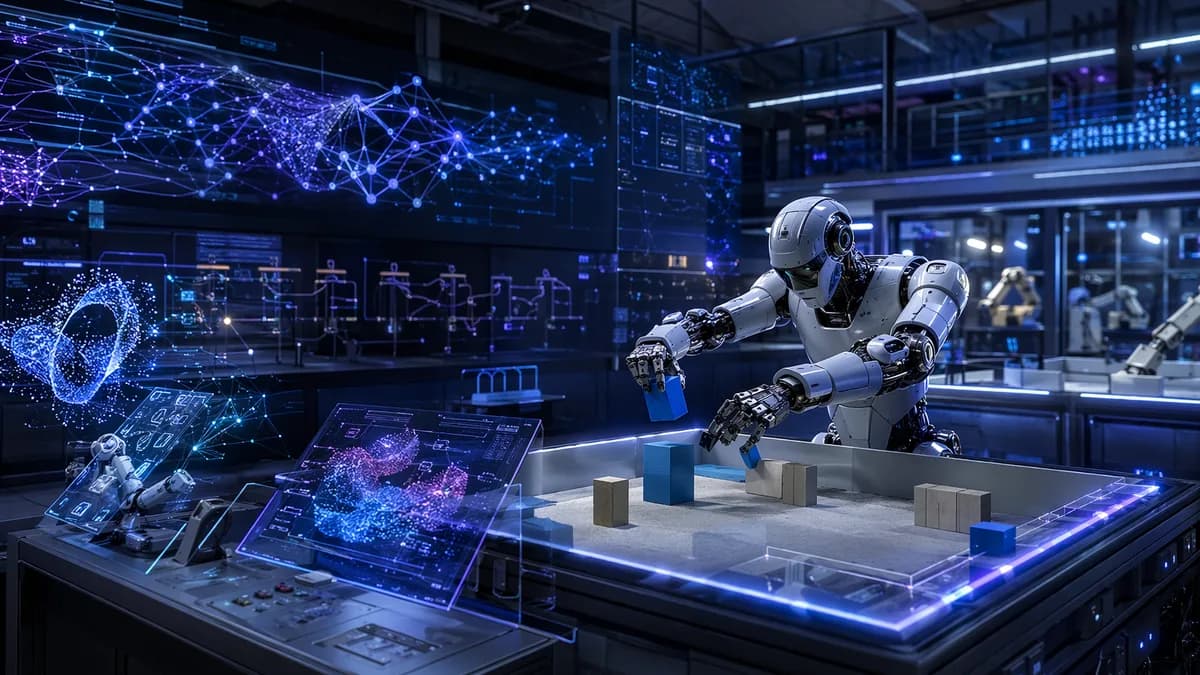
AI coding agents for robot training just moved from software-only tinkering into the robot lab, where NVIDIA researchers say agent teams helped physical arms reach 99 percent success on manipulation tasks including Push-T, zip-tie cutting, pin organization, and GPU insertion.
TechnologyJune 17, 2026· 7 min read· By XOOMAR Insights Team
AI Coding Agents Push Robot Training to 99% Success
Updated on June 17, 2026
XOOMAR Intelligence
Analyst Take
72/ 100
4 sources analyzedMedium confidenceTrend10Freshness99Source Trust90Factual Grounding88Signal Cluster20
The work centers on ENPIRE, an agent harness built by researchers at NVIDIA GEAR, Carnegie Mellon University, and UC Berkeley, according to Ars Technica. The important part is not that a robot completed a flashy demo. It is that AI coding agents were allowed to plan, edit, test, read logs, ingest papers, and improve the training pipeline with limited human involvement.
“A part of our NVIDIA GEAR lab now self-improves tirelessly overnight,” wrote Jim Fan, director of AI at NVIDIA, in a LinkedIn post. “We just read the reports in the morning.”
Why NVIDIA’s AI coding agents for robot training matter to automation teams
Robot training still has a blunt bottleneck: humans. Engineers collect data, reset scenes, tune policies, debug brittle code, inspect failures, then do it again. ENPIRE points at a different operating model, where AI coding agents for robot training take over more of that loop.
That matters because the slow part of robotics is often not buying the arm. It is getting the arm to behave reliably across messy edge cases. In NVIDIA’s tests, agent teams worked on tasks that require real manipulation, not just scripted motion: organizing pins, tying and cutting zip-ties, and placing a GPU into a motherboard socket before unplugging it to reset the next trial.
The economic read is straightforward, as analysis: if agents can compress the iteration cycle, robotics teams may spend less time waiting for manual tuning and more time validating whether a policy is safe, repeatable, and worth deploying. That doesn’t prove lower costs in production. The source does not show deployment economics. But it does show a credible attack on the labor-heavy training loop.
This also fits a wider robotics data problem. XOOMAR has covered adjacent pressure points in robot training data collection and the push to keep sensitive engineering work closer to the developer in local AI coding assistants. ENPIRE sits at the intersection: agents are not just writing code, they are steering experiments on machines.
What ENPIRE actually gives the agents
ENPIRE is not a robot brain by itself. It is a harness around AI models that gives coding agents access to tools, memory, context, constraints, and feedback loops. That wrapper is what lets an agent do more than suggest code in a chat window.
The framework has four modules. They handle automatic reset and verification, refine policies that guide robot behavior, evaluate policies across multiple physical robots running in parallel, and address failures by analyzing logs, ingesting research papers, and improving training infrastructure and algorithm code.
NVIDIA’s team tested ENPIRE with three coding-agent stacks:
| Coding agent setup | Model named in source | Role in ENPIRE tests |
|---|---|---|
| OpenAI Codex | GPT-5.5 | Developed and tested robot-training approaches |
| Anthropic Claude Code | Opus 4.7 | Developed and tested robot-training approaches |
| Moonshot AI Kimi Code | Kimi K2.6 | Developed and tested robot-training approaches |
The agents independently tried different algorithmic approaches, ran real-world experiments, and kept changes that improved success rates over repeated cycles. That is the core shift. The robot is not “thinking” its way into competence from nothing. The system still depends on models, policies, evaluation logic, compute, tests, and human-designed boundaries.
Fan also said the team would open-source everything so others could host a “self-running robot lab at home.” Treat that as a research ambition until the release details are visible.
How can AI coding agents autonomously direct robot training?
The loop is simple enough to describe and hard to execute.
Task: Define what success looks like, such as sliding a T-shaped block into position or inserting pins.
Code: Let agents modify training code, evaluation logic, or infrastructure.
Test: Run the candidate policy in simulation or on real hardware.
Score: Verify whether the robot actually improved.
Revise: Read logs, diagnose failures, change the approach, and repeat.
In the research described by Ars and related reporting, ENPIRE did both simulation and real-world work. The Decoder reported that all three agents solved Push-T in simulation, but two out of three failed in the real environment, with researchers pointing to variable conditions such as robot dynamics, friction, and object movement. That gap is the hard part. Simulation can accelerate iteration, but it can also reward behavior that collapses when a real object slips, sticks, or rotates differently than expected.
The clearest numeric example is Push-T. An eight-agent team reached 99 percent success in two hours of research time. A four-agent team needed three hours. A single agent needed nearly five hours. More agents helped, but not for free.
There were costs. The robots often sat idle while agents read logs, wrote code, debugged, or waited for the language-model backbone. Larger teams also spent more time summarizing each other’s ideas and sometimes failed to use available compute fully when launching parallel training sessions.
That is the practical lesson for engineering leaders: agentic automation needs orchestration. Version control, sandboxes, test suites, approval gates, and traceable experiment logs are not optional extras. They are the difference between autonomous research and uncontrolled code churn.
What would this look like in a warehouse robot picking case study?
Consider a hypothetical warehouse picking robot learning to handle irregular items from bins without dropping them or applying too much force. This example is analysis, not a reported NVIDIA deployment.
One agent could adjust the grasping policy. Another could generate difficult simulated cases, such as awkward object poses or confusing visual conditions. A third could inspect failure logs. A fourth could rewrite training code to make experiments run faster. The team would then compare results, keep improvements, and discard dead ends.
The first version might fail on glossy packaging or objects partly hidden by other items. The agents could add new test conditions, rerun the policy, and flag whether the failure rate drops before anyone risks hardware time. If the policy clears internal checks, engineers could move it to a physical robot for controlled validation.
That is where ENPIRE’s reported structure becomes relevant. Its modules are designed to reset scenes, verify outcomes, evaluate policies across multiple robots, and repair failures by using logs and research material. In a production-facing setting, that same structure would need stronger safety gates and human sign-off.
The business case remains a scenario, not a proven result. Fewer failed picks, faster onboarding of new item categories, and less engineer downtime are plausible targets. The source does not show those outcomes. It shows the training loop becoming more automated.
Where autonomous robot training still breaks
ENPIRE’s strongest result may be the pin insertion and organization task, where AI coding agents reached nearly 100 percent success faster than a “frontier human-in-the-loop method” developed by many of the same researchers. That is a serious signal. It also does not erase the weak spots.
Simulation-to-real transfer remains fragile. A policy that wins in a virtual benchmark can fail on a physical table.
Reward design can mislead agents if success checks miss the real objective.
Generated code can introduce unsafe behavior or hidden regressions.
Compute and token use can climb quickly as agent teams grow.
Robot utilization can fall if agents spend too much time coordinating instead of running experiments.
Accountability is the harder enterprise question. If an AI coding agent changes a robot policy and a machine damages equipment, the buyer will need to know which code changed, which tests passed, who approved the deployment, and whether the behavior matched the validated policy. Git-style records help, but they are not enough by themselves.
The near-term prescription is clear: use autonomous coding agents to speed research, not to remove robotics engineers. Engineers shift toward supervision, validation, safety design, and experiment governance. The watch item is whether ENPIRE’s promised open-source release gives outside teams enough visibility to reproduce the results, inspect the guardrails, and test whether AI coding agents for robot training can survive outside NVIDIA’s lab conditions.
Impact Analysis
- AI coding agents could reduce the manual bottleneck in robot training workflows.
- The work shows agent teams improving real physical manipulation tasks, not just software simulations.
- Faster training loops may help automation teams focus more on safety, reliability, and deployment validation.
Robot Training Models Compared
| Traditional robot training | ENPIRE agent-assisted training |
|---|---|
| Engineers collect data, reset scenes, tune policies, debug code, and inspect failures manually. | AI coding agents plan, edit, test, read logs, ingest papers, and improve the training pipeline with limited human involvement. |
| Iteration is slowed by human bottlenecks. | Agent teams can self-improve overnight and report results in the morning. |
| Reliability across messy edge cases remains difficult and labor-intensive. | NVIDIA researchers reported up to 99 percent success on physical manipulation tasks. |
Reported Robot Manipulation Task Success
ENPIRE agent-assisted training
%99
Sources

Written by
XOOMAR Insights Team
Research and Editorial Desk
The XOOMAR Insights Team pairs automated research with human editorial judgment. We track hundreds of sources across technology, fintech, trading, SaaS, and cybersecurity, cross-check the facts, and explain what happened, why it matters, and what to watch next. We do not just rewrite headlines. Every article is fact-checked and scored for reliability before it goes live, and we link back to the original sources so you can verify anything yourself.
Explore More Topics
Related Articles
 Technology
XDOF Wrings $70M From Dirty Robot Training Data Race
XDOF has $70M, 20 customers, and a bet that robotics' real bottleneck is messy physical-world data, not model architecture.
Jun 17, 202610 min
 Technology
Same Accuracy Forces PyTorch Lightning vs Accelerate Choice
Lightning and Accelerate matched accuracy in a 2-GPU test, so the choice comes down to structure versus control.
Jun 17, 202619 min
 Technology
KServe vs BentoML Exposes the Real Model Serving Gap
KServe fits Kubernetes-heavy teams. BentoML favors Python workflows. Ray Serve needs separate proof before it belongs in your stack.
Jun 17, 202624 min
 Technology
No-Code RAG Chatbot Turns Internal Docs Into Answers
No-code RAG chatbot tools let teams query internal docs without building a Python pipeline, but setup and testing decide success.
Jun 16, 202623 min
 Fintech
FinCEN Lets Banks Trade Fraud Data Before Cash Vanishes
FinCEN says banks can share suspected fraud data in real time under Section 314(b), even before tracing laundered proceeds.
Jun 17, 20268 min
 Technology
AI Sellers Get Squeezed in Chi-Hua Chien AI Winners Bet
Chi-Hua Chien says the AI boom’s biggest winners may hide the tech inside cheaper care, entertainment and personalization.
Jun 17, 20269 min
 Trading
Warsh Fed Rips Up Rate Map After Federal Reserve Rate Hold
Warsh held rates but tore up the Fed's guidance map, putting 2026 hike risk back on the table as inflation forecasts rose.
Jun 17, 20268 min
 Technology
Near-$2,200 Snap AR Glasses Sink Stock in Price Shock
Snap shares fell over 5% after its nearly $2,200 Specs reveal, putting the AR hardware pitch under investor pressure.
Jun 17, 20265 min
 Global Trends
Trump's US-Iran Agreement Masks a Nuclear Deadline
Trump sells a US-Iran breakthrough, but the text only buys 60 days, reopens Hormuz, and leaves the nuclear fight unresolved.
Jun 17, 20268 min
 Trading
Copy Trading vs Algorithmic Trading Exposes Hidden Risks
Copy trading hands control to a trader. Algorithmic trading hands it to rules, data, and execution systems. Your risk profile decides.
Jun 17, 202620 min
Don't miss the signal
Get our weekly roundup of the stories that matter across tech, fintech, and trading. No noise, just signal.
Free forever. No spam. Unsubscribe anytime.