
On June 22, 2026, Android 17 landed on Jack Wallen’s Pixel 9 Pro, and the signal is clear: Google’s most useful work here is not cosmetic. It’s about making the phone feel less like a stack of apps you manage manually and more like a workspace that stays ready.
TechnologyJune 22, 2026· 9 min read· By XOOMAR Insights Team
Quiet Android 17 Pixel 9 Pro Test Rewires Daily Work
Updated on June 22, 2026
XOOMAR Intelligence
Analyst Take
57/ 100
4 sources analyzedLow confidenceTrend10Freshness98Source Trust85Factual Grounding89Signal Cluster20
That matters because this is not framed as a dramatic leap from Android 16. Wallen says as much in his hands-on for ZDNet, noting that Android 17 “isn’t comparable to the jump from Android 15 to Android 16.” The interesting part is that the best new pieces still change daily use, especially if you bounce between apps, record tutorials, or want your phone to act more like a lightweight computer.
Primary keyword: Android 17 Pixel 9 Pro. And on the Android 17 Pixel 9 Pro test, the standout theme is friction removal.
June 22 on Pixel 9 Pro: Android 17 trades visual shock for quieter control
The Android 17 Pixel 9 Pro experience described by ZDNet starts with a mundane but useful data point: the upgrade took “roughly 30 minutes to download and install.” After that, the biggest changes were not a redesigned home screen or a dramatic new visual layer. They were workflow features.
That distinction matters. A flashy OS update is easy to market. A calmer OS update has to prove itself in repeated use.
Wallen’s six highlighted features point in the same direction:
- Desktop mode: phone-to-monitor computing
- App bubbles: faster multitasking
- Selfie camera in screen recordings: better built-in creator tools
- Recent apps improvements: more direct task control
- Early GUI Linux support: promising but unfinished power-user tooling
- Enhanced HDR brightness: more control over HDR playback
“So far, this is my favorite new Android 17 feature.”
That line was about app bubbles, and it’s the right place to start.
The six Android 17 Pixel 9 Pro features that changed the feel of daily use
App bubbles are the feature with the clearest everyday value. Android has had message bubbles before, but Android 17 expands the idea to apps. Long-press an app launcher, tap Bubble or the small square in the pop-up menu, and the app becomes a floating access point on the home screen.
Wallen describes it as “as close to desktop-like multitasking as has ever been applied to Android.” That’s strong, but supported by the behavior he tested: multiple bubbled apps can sit inside one bubble collection, and users can switch between them quickly. One limit matters: “You can only have one collection of bubbles on the homescreen at a time.”
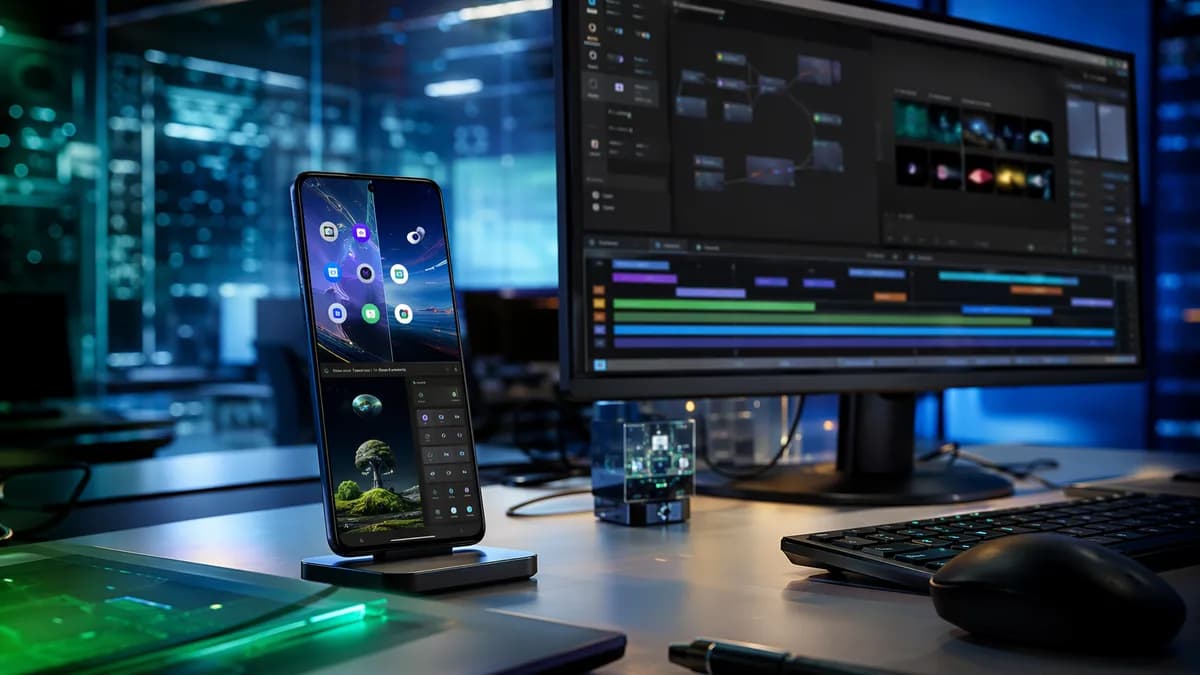
Desktop mode pushes the same thesis further. Plug the Android phone into an external monitor, add a Bluetooth mouse and keyboard, and Android turns into a desktop-style environment. Wallen calls it Google’s version of Samsung DeX and says it “works to perfection,” based on his earlier beta testing.
Selfie camera in screen recordings is more targeted but immediately useful. From Quick Tiles, users can tap Screen recording and enable the Selfie cam, putting their face on-screen while recording the phone. That helps tutorials, remote troubleshooting, and how-to content without needing a separate app or post-production step.
Recent apps also gets more practical. The Android 17 recent apps page now shows the full app name and a drop-down with options to pin, split screen, take a screenshot, select the app, or clear recent apps. That is not glamorous. It is exactly the kind of tap-saving change that makes a phone feel faster without changing the processor.
Early GUI Linux support is the caution flag. Wallen found a GUI icon in the Linux terminal, but his attempt to install LibreOffice failed, and the Linux terminal “totally flaked out” until he reset the terminal app. He later reached a login prompt and created a new user, but he had not tested further. This is promising, not ready.
Enhanced HDR brightness is the media-control upgrade. It lets users adjust how HDR content appears, including pushing brightness higher for more vivid videos and images. ZDNet says it makes “a big difference” in how HDR content looks.
| Feature | Practical value | Readiness based on ZDNet test |
|---|---|---|
| App bubbles | Faster multitasking | Strong |
| Desktop mode | Phone as desktop-style setup | Strong in tested experience |
| Selfie cam screen recording | Easier tutorials and reactions | Strong |
| Recent apps drop-down | Fewer taps for common actions | Strong |
| GUI Linux support | Future power-user workflows | Early and unstable |
| Enhanced HDR brightness | Better HDR viewing control | Strong |
For readers tracking how mobile OS features are creeping into everyday workflows, this sits beside Apple’s own app-level push in iOS 27 AI Features Invade Your Everyday iPhone Apps. Different platform, same pressure: phones are being asked to do more without making users dig.
The numbers from the Pixel 9 Pro test are thin, and that matters
The Android 17 Pixel 9 Pro hands-on includes one hard installation metric: roughly 30 minutes to download and install.
It does not provide measured battery drain, charging speed, app launch timings, thermals, screen-on time, notification volume, or crash frequency. That absence matters because those are the figures that decide whether an OS update feels good after a week, not just after a morning.
The only stability issue described in detail involved early GUI Linux support. The terminal failed after an attempted LibreOffice install, forcing a reset of the terminal app, not the phone. That suggests the experimental Linux path is still fragile, while the mainstream phone features Wallen highlighted were stable enough to recommend trying.
XOOMAR analysis: Android 17 should not be judged as a performance upgrade from this source alone. The available evidence supports a usability argument, not a speed or battery argument.
Pixel owners get the cleanest first cut, while other Android users wait
ZDNet’s test is specific to Pixel 9 Pro, and Wallen says Android 17 has arrived for Pixel devices. He also writes that Pixel owners can expect the upgrade “any time now,” while other Android handset owners need to wait until the OS arrives for their device.
That matters for interpretation. Android 17 may be an Android release, but the first clear experience is a Pixel experience. If Desktop mode, app bubbles, screen recording, and HDR controls feel polished first on Google hardware, Pixel gets the cleanest version of Google’s direction before other Android skins adapt it.
XOOMAR analysis: this gives Google a strategic advantage without needing a headline feature. If the Pixel version simply feels more coherent, the phone becomes easier to recommend to users who care about Android features arriving early and behaving predictably.
For a hardware-side comparison of how phone makers try to keep loyal users engaged without overhauling everything, see our coverage of how Sony Xperia 1 VIII Dumps Zoom Trick to Keep Fans Hooked.
Android 17 continues Google’s move from customization toward managed workflows
Android’s old appeal was control: launchers, widgets, settings, and endless personal setup. Android 17, at least in this Pixel 9 Pro test, points toward something more managed.
App bubbles reduce switching. Recent apps controls reduce digging. Desktop mode reduces the gap between phone and computer. Selfie cam screen recording removes the need for extra creator tooling. Enhanced HDR brightness gives a direct control for a specific viewing problem.
This is not customization chaos. It is controlled convenience.
That does not mean everyone will like it. Some users want fewer overlays, fewer system-managed behaviors, and fewer Google-shaped defaults. Android 17’s success will depend on whether these tools feel optional and helpful rather than intrusive.
The same tension shows up across platforms. Apple is also trying to reduce clutter and make older devices feel more manageable, as we covered in 5 iOS 27 Features Rescue Older iPhones From Clutter. Android’s version is more workflow-heavy. Apple’s tends to be more tightly staged. Both approaches ask the same question: can the OS do more without getting in the way?
Who should install Android 17 early on a Pixel 9 Pro
Based on ZDNet’s hands-on, Android 17 Pixel 9 Pro is most compelling for users who multitask heavily, record screen tutorials, consume HDR content, or want to experiment with desktop-style phone computing.
Install early if you care about:
- Multitasking: App bubbles are the headline workflow change.
- Productivity: Desktop mode could turn the phone into a more flexible work device.
- Content creation: Selfie cam screen recording removes a common editing step.
- Media control: Enhanced HDR brightness gives visible payoff.
- Power-user experiments: GUI Linux support is interesting, but clearly unfinished.
Wait if your daily phone depends on absolute stability. ZDNet’s Linux terminal problem was contained, but it is still a reminder that new OS features can break in narrow but annoying ways. Users who rely on work profiles, banking apps, medical apps, smart-home controls, or mission-critical battery reliability should be more conservative until broader stable feedback accumulates.
The next Android 17 decision point is whether these workflow features stay quiet and reliable
The features most likely to define Android 17 are not the experimental ones. App bubbles, Recent apps controls, screen recording with selfie cam, and Enhanced HDR brightness already sound useful because they solve ordinary problems.
GUI Linux support is the outlier. It could become a serious differentiator for technical users, but the ZDNet test shows it is not ready to carry the release narrative.
The evidence that would confirm Android 17’s promise is simple: after weeks of use, Pixel owners should feel they are switching less, tapping less, and reaching for fewer third-party tools. The evidence that would weaken it is just as clear: bubble clutter, inconsistent app behavior, battery complaints, or half-finished advanced features that distract from the polished basics.
Android 17’s real test won’t be feature count. It’ll be whether the Pixel 9 Pro feels quieter, faster to operate, and more trustworthy after the novelty fades.
Key Takeaways
- Android 17 appears focused on reducing daily friction rather than delivering a dramatic visual redesign.
- Features like app bubbles, desktop mode, and improved recent apps could make Pixel phones better for multitasking.
- Built-in creator and power-user tools suggest Google is pushing Android closer to lightweight computer territory.
Sources

Written by
XOOMAR Insights Team
Research and Editorial Desk
The XOOMAR Insights Team pairs automated research with human editorial judgment. We track hundreds of sources across technology, fintech, trading, SaaS, and cybersecurity, cross-check the facts, and explain what happened, why it matters, and what to watch next. We do not just rewrite headlines. Every article is fact-checked and scored for reliability before it goes live, and we link back to the original sources so you can verify anything yourself.
Explore More Topics
Related Articles
 Technology
Pixel 11 Fails to Justify Ditching a Perfect Pixel 9 Pro
A journalist explains why the upcoming Pixel 11 isn't worth the upgrade from a still-excellent Pixel 9 Pro, arguing that the era of mandatory two-year phone upg
Aug 9, 20267 min
 Technology
Google Blogger Seizes Hundreds of Legitimate User Websites
Google's automated malware scanner wrongly locked hundreds of Blogger sites, threatening permanent deletion and exposing creators' total dependence on unchecked
Aug 9, 20266 min
 Technology
Google Ends DeepMind's Moonshot Era in CEO Shakeup
Google DeepMind founder Demis Hassabis is stepping down as CEO, a move central to a restructuring that absorbs the AI lab into Google's corporate machine and en
Aug 8, 20266 min
 Technology
Google Shakes Top AI Leadership as OpenAI Rivalry Intensifies
Google's leadership shakeup removes key AI research leaders, signaling a chaotic corporate pivot towards aggressive product shipping to rival OpenAI and Anthrop
Aug 6, 20267 min
 Technology
Stripping the Moonshot Mystique from AI Leadership
Google's leadership reshuffle sidelines its premier AI researchers, ending the era of open-ended moonshots to enforce a stricter focus on product integration an
Aug 6, 20266 min
 Global Trends
Nigerian Army Frees 33 Hostages in Gunfight Rescue
Nigerian troops rescued all 33 people abducted just one day earlier in a firefight, forcing the kidnappers to flee into the bush.
Aug 9, 20264 min
 Global Trends
Zelenskyy Demands Patriots as Kyiv Missile Toll Rises
Ukraine lacks the specific Patriot systems needed to intercept ballistic missiles, a critical weakness laid bare by a deadly Russian attack on Kyiv.
Aug 9, 20266 min
 Trading
US Hiring Slows to 44,000 Jobs, Fed Faces Wage Sticker Shock
Private hiring slowed sharply to 44,000 jobs in July, a cooling demand signal for the Fed, but strong pay gains for job-switchers mean wage-driven inflation pre
Aug 9, 20267 min
 Fintech
US Services Index Plunges Into Survival Test
A strong surge in new business orders masks a deep contraction in service sector jobs and a fierce reacceleration in costs, revealing an economy stuck in inflat
Aug 9, 20267 min
 Global Trends
Zuckerberg's Superyacht Shunned Rescue Duty in Alaska
Mark Zuckerberg's superyacht was the vessel nearest to a stranded family but did not respond to a US Coast Guard assistance request, forcing a small cruise ship
Aug 9, 20269 min
Don't miss the signal
Get our weekly roundup of the stories that matter across tech, fintech, and trading. No noise, just signal.
Free forever. No spam. Unsubscribe anytime.