
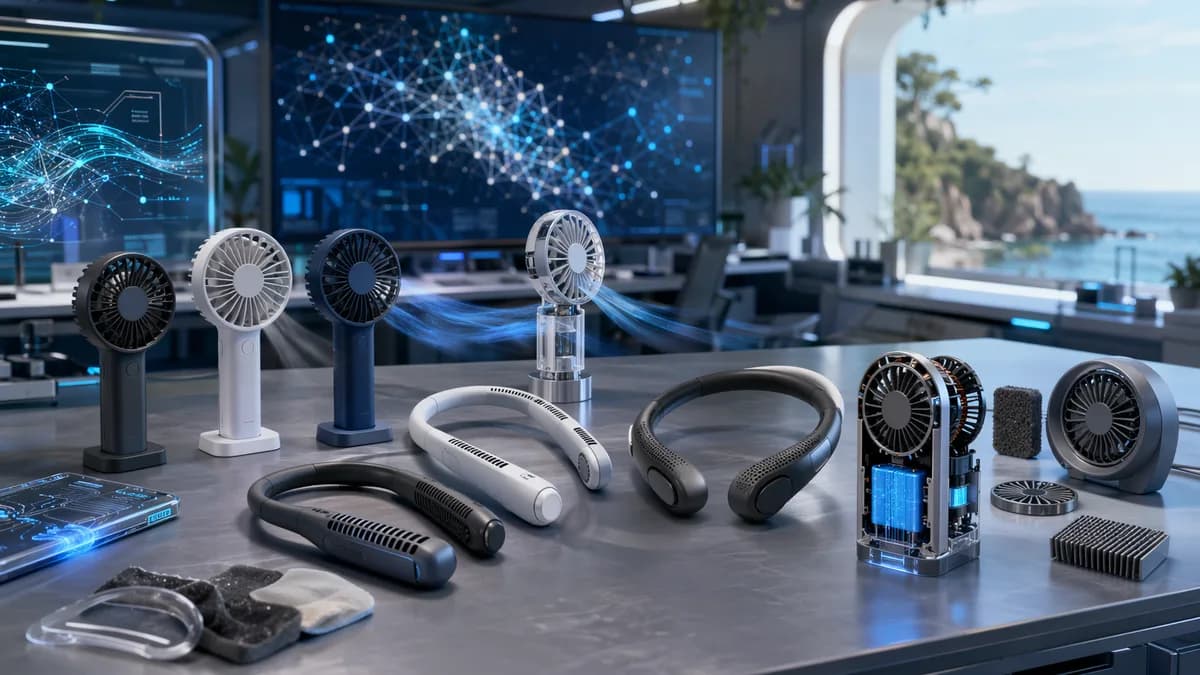
100 speeds on a handheld misting fan sounds absurd until you compare it with the real problem: the best handheld fans now have to cool people through outdoor concerts, weddings, festivals, hikes, pickleball, and crowded summer events without becoming loud, bulky, dead-weight gadgets.
TechnologyJune 17, 2026· 8 min read· By XOOMAR Insights Team
100 Speeds Expose the Best Handheld Fans Worth Buying
Updated on June 17, 2026
XOOMAR Intelligence
Analyst Take
58/ 100
4 sources analyzedLow confidenceTrend10Freshness97Source Trust88Factual Grounding92Signal Cluster20
That’s the useful signal inside Wired’s updated portable fan guide. The category has moved past novelty. The winners aren’t the flashiest models. They’re the ones that balance airflow, battery life, noise, weight, and whether anyone can tolerate wearing or holding them for hours.
“It kept my face from melting off on the 100-degree day I used it,” Wired’s Kristin Canning wrote of the PlayHot Handheld Turbo Fan.
Best handheld fans are now judged by 5 numbers, not vibes
The most revealing specs in Wired’s guide are not the marketing labels. They’re the measurable constraints.
The PlayHot Handheld Turbo Fan, Wired’s best overall handheld pick, has five speed levels, a 5,000-mAh battery, a claimed runtime of three to 12 hours, and a three-hour full charge time. It costs $20, or $18 in the listed Amazon deal. That’s the sweet spot this category keeps circling: enough airflow to matter, cheap enough to toss into a festival bag, but not small enough for a pocket.
The Aecooly Portable Waist Fan pushes a different trade-off. It delivers five speeds, a top wind speed of 866 feet per minute, and runs at 53 decibels, according to Wired. It can clip to a belt or waistband, hang from a neck strap, or sit on a desk. But it weighs nearly three-quarters of a pound, enough that lighter shorts or pants may sag.
Noise is the hidden tax. The Jisulife Portable Neck Fan is around 40 decibels on low, while the Jisulife Portable Handheld Fan Ultra2 hits 60 decibels on its lowest setting. That Ultra2 also produces 1,614 feet per minute of airflow and carries a 9,000-mAh battery, but Wired describes its sound as “not unlike a jet engine.”
That’s the portable fan market in one sentence: power costs you silence.
Handheld, waist, neck, and jacket cooling solve different heat problems
A handheld fan gives the most control. You aim it at your face, neck, makeup, shirt collar, or wherever heat is winning. That’s why the best handheld fans still matter even as wearable options spread.
Neck fans solve a different problem: they keep both hands free. Wired’s Jisulife Portable Neck Fan looks somewhat like headphones, has a 5,000 mAh battery, and is comfortable enough that Kat Merck wore it during a day-long hike around New Orleans’ Garden District and Audubon Park. The drawback is directionality. Its ends don’t adjust or angle, so the airflow goes where the hardware sends it.
Waist fans are stronger than they look, but less discreet. The Aecooly Portable Waist Fan can cool under or over clothing, yet its weight and 53-decibel noise level make it better for movement than ceremony.
The Ororo ZenFlow Power Cooling Jacket goes furthest. At $150, it uses two circular fans on the lower back and offers three levels of airflow. The battery lasts 5.5 hours on high and 9.5 hours on low. Wired preferred it over waist and belt fans for upper-body cooling, while flagging the obvious aesthetic problem: the back and sides puff up when the fans run.
| Form factor | Best use case | Main advantage | Main compromise |
|---|---|---|---|
| Handheld fan | Festivals, lines, outdoor seating | Direct airflow | Occupies one hand |
| Neck fan | Walking, light activity, multitasking | Hands-free comfort | Airflow angle may be fixed |
| Waist fan | Work, standing, moving around | Strong body airflow | Weight and noise |
| Cooling jacket | Upper-body cooling | More coverage | Bulk and shorter high-power runtime |
This mirrors a broader gadget-buying rule we’ve seen in other categories: specs only matter when they survive real use. That’s true for personal cooling, and it’s also why XOOMAR’s testing lens in Shark Grabs Best Robot Vacuum 2026, Eufy Barges In focuses on what machines actually do after the showroom pitch fades.
The cheap fan problem: tiny size can mean tiny relief
Small fans can work. Wired’s Gaiatop Portable Handheld Fan costs $12, or $10 in the listed deal, weighs four ounces, folds into a purse or clutch, and has soft blades that stop automatically if they hit something. It lasts 10 to 17 hours, depending on which of its two speeds is used.
But Wired’s review is clear about the limit: the higher speed wasn’t strong enough to prevent sweating the way the PlayHot did. That’s the buying tension. The fan you’ll carry everywhere may not be the fan that saves you in direct heat.
The Jisulife Handheld Mini Fan shows the upside of a small multiuse device. It weighs 4 ounces, produces 472 feet per minute of airflow in Wired’s measurement, runs at 44 dB on low, includes a flashlight, and can act as a power bank through a USB-C port. The trade-off is a 2,000-mAh battery, which Wired says lasts about one phone charge.
This is where buyers should be ruthless:
- Airflow: Look for measured wind speed when available, not just “turbo” language.
- Battery: Treat max runtime as a low-speed number unless testing says otherwise.
- Noise: Anything around 50 decibels or higher may annoy people in quiet settings.
- Weight: Neck and waist fans become clothing decisions, not just gadget decisions.
- Safety: Soft blades, covered blades, or bladeless designs matter around kids, hair, and bags.
The same practical mindset applies to other portable tech. If a device has to work away from a wall outlet, real battery behavior beats brochure claims, a point that also runs through XOOMAR’s guide to Best Tablets for Sheet Music That Won't Fail Mid-Gig.
Misting, bladeless designs, and cooling plates are where the category is stretching
Wired’s updated guide, listed as updated in June 2026, added new fans from Dyson, Shark, and Aecooly. That matters because the most interesting products now blur the line between fan, cooling accessory, and power gadget.
The Aecooly Cold Air Ultra Personal Cooling System is the clearest example. It costs $80, has 100 speeds, uses a digital touchscreen, produces a fine mist that Wired says does not wet fabric or surfaces, and doubles as a phone charger, duster, or pool-toy inflator with magnetic attachments. Its weakness is sound. Wired describes a “high-pitched jet-engine whine” and says ears began to ring after using it on high for more than 20 minutes.
The Aecooly Aero Pro Hand Fan takes the bladeless route. It has six speeds, a digital display, no exposed rotors or blades, and airflow measured by Wired at 807 feet per minute on high. It also exceeded 50 decibels on low, which limits where it makes sense.
Premium entries have to justify themselves. The Shark ChillPill 3-in-1 Personal Cooling System costs $150 and can work as a regular fan, refillable misting fan, or metal cryo-inspired cold plate. Wired liked the cold-plate idea but criticized the need to swap and carry separate attachments. The Dyson HushJet Mini Cool, at $100, avoided the high-pitched whine of the Ultra2 but was described as only marginally better than cheaper fans in windspeed and overall performance.
That’s the high-end warning. Novel cooling features are useful only if the whole object is easy to carry, hold, charge, and tolerate.
The smartest buy is the fan matched to the event
For outdoor concerts and festivals, the PlayHot Handheld Turbo Fan is the cleanest value signal in Wired’s testing: strong airflow, five speeds, lanyard carry, bendable neck, table use, and a price near $20.
For hands-free cooling, the Jisulife Portable Neck Fan looks better for long wear than for precision airflow. For stronger wearable cooling, the Aecooly Portable Waist Fan moves more air but asks you to accept weight and noise. For upper-body coverage, the Ororo ZenFlow Power Cooling Jacket is the serious option, if you can live with the puffed-up silhouette and 5.5-hour high-setting battery life.
Parents or anyone buying for kids should look at blade design first. Wired singled out the Gaiatop Portable Handheld Fan and Jisulife Handheld Mini Fan for blades that stop when they contact an object. That’s more useful than another speed setting.
The weakest purchase is the one made on size alone. A tiny purse fan can be perfect for a parade or short walk. It can also underperform when heat, crowds, and direct sun stack up.
Personal cooling gear gets smarter only if it stays honest about physics
The next wave is already visible in Wired’s list: misting systems, power-bank fans, bladeless tubes, cold plates, and fan-cooled clothing. The category will likely keep mixing functions because shoppers want one object that cools, charges, stands, clips, and travels.
The constraint won’t disappear. Stronger airflow needs more power or a bigger design. Better comfort requires lower weight. Lower noise usually means accepting less force. A 9,000-mAh battery can stretch runtime, but it won’t make a loud, bulky fan discreet.
The practical watch item is simple: premium portable fans need to prove they outperform the $20 class in real conditions, not just in feature lists. Evidence that would confirm the category is maturing would include quieter high-airflow designs, better attachment systems, clearer runtime claims by speed level, and more washable or durable wearable parts. Evidence against it would be more expensive gadgets that still whine, sag, or end up abandoned after one hot weekend.
Key Takeaways
- Portable fans are becoming practical gear for concerts, festivals, hikes, sports, and extreme summer heat.
- The best models balance airflow, battery life, noise, weight, and comfort rather than chasing gimmicky features.
- Specs like decibels, runtime, and wind speed help buyers avoid fans that are too loud, heavy, or weak.
Portable fan trade-offs from Wired’s guide
| Fan | Category | Key numbers | Main trade-off |
|---|---|---|---|
| PlayHot Handheld Turbo Fan | Best overall handheld pick | 5 speeds; 5,000-mAh battery; 3-12 hours runtime; 3-hour charge; $20 or $18 deal | Strong value, but not small enough for a pocket |
| Aecooly Portable Waist Fan | Wearable waist fan | 5 speeds; 866 ft/min top wind speed; 53 dB; nearly 0.75 lb | Flexible clip, neck, or desk use, but heavy enough to sag light clothing |
| Jisulife Portable Neck Fan | Wearable neck fan | Around 40 dB on low | Quieter low setting than some handheld options |
| Jisulife Portable Handheld Fan Ultra2 | High-airflow handheld fan | 1,614 ft/min airflow; 60 dB on lowest setting | Powerful airflow comes with higher noise |
Airflow speeds cited for portable fans
Aecooly Portable Waist Fan
ft/min866
Jisulife Portable Handheld Fan Ultra2
ft/min1,614
Sources

Written by
XOOMAR Insights Team
Research and Editorial Desk
The XOOMAR Insights Team pairs automated research with human editorial judgment. We track hundreds of sources across technology, fintech, trading, SaaS, and cybersecurity, cross-check the facts, and explain what happened, why it matters, and what to watch next. We do not just rewrite headlines. Every article is fact-checked and scored for reliability before it goes live, and we link back to the original sources so you can verify anything yourself.
Explore More Topics
Related Articles
 Technology
Shark Grabs Best Robot Vacuum 2026, Eufy Barges In
Shark takes the top robot vacuum spot, while Eufy wins on value. The real test is how little babysitting each bot needs.
Jun 16, 20268 min
 Technology
Prime Day Smart Device Deals Ditch Amazon for 49% Off
Rival smart home gear beats the obvious Amazon picks, with Prime Day discounts reaching 49% on Arlo, Google, Roku and more.
Jun 16, 20267 min
 Technology
$110 Samsung Essential S3 Deal Drops Before Prime Day
Samsung's 27-inch Essential S3 is back to $110 before Prime Day. It's a cheap WFH upgrade, if Full HD is enough.
Jun 16, 20266 min
 Technology
20-Metre Remote Screen Sells Insta360 Luna Ultra to Creators
Insta360 Luna Ultra’s detachable OLED remote screen is the creator hook, but DJI’s legal fight adds launch drama.
Jun 16, 20266 min
 Technology
Tiny TCL A65K Soundbar Throws 460 Watts at Small Rooms
The TCL A65K makes 460 watts and Dolby Atmos feel apartment-friendly, but weak surround keeps it from punching above its size.
Jun 15, 20267 min
 Fintech
Messy Wallets Expose the Best Crypto Tax Software for DeFi
DeFi taxes get messy fast. The best crypto tax software classifies wallets, staking, LPs, and NFTs with less cleanup.
Jun 16, 202626 min
 SaaS & Tools
AI Meeting Notes Tools That Rescue PMs From Meeting Chaos
Project managers need AI notes that capture decisions, owners, deadlines, and scope changes, not generic meeting recaps.
Jun 17, 202626 min
 SaaS & Tools
Hidden Fees Bite Backblaze B2 vs Wasabi vs R2 Buyers
Backblaze B2, Wasabi, and R2 look cheap until egress, churn, minimums, and regions decide the real winner.
Jun 17, 202623 min
 SaaS & Tools
Best VPN for Remote Teams Locks Down Work Anywhere
Remote teams need more than encryption: the right VPN balances access controls, speed, admin visibility, logging, and price.
Jun 17, 202624 min
 SaaS & Tools
Cheap Cloud VPS Fight Hits Hetzner, DigitalOcean, Vultr
Hetzner wins on price, DigitalOcean on managed services, Vultr on global reach. SaaS teams need to pick their real constraint.
Jun 17, 202621 min
Don't miss the signal
Get our weekly roundup of the stories that matter across tech, fintech, and trading. No noise, just signal.
Free forever. No spam. Unsubscribe anytime.