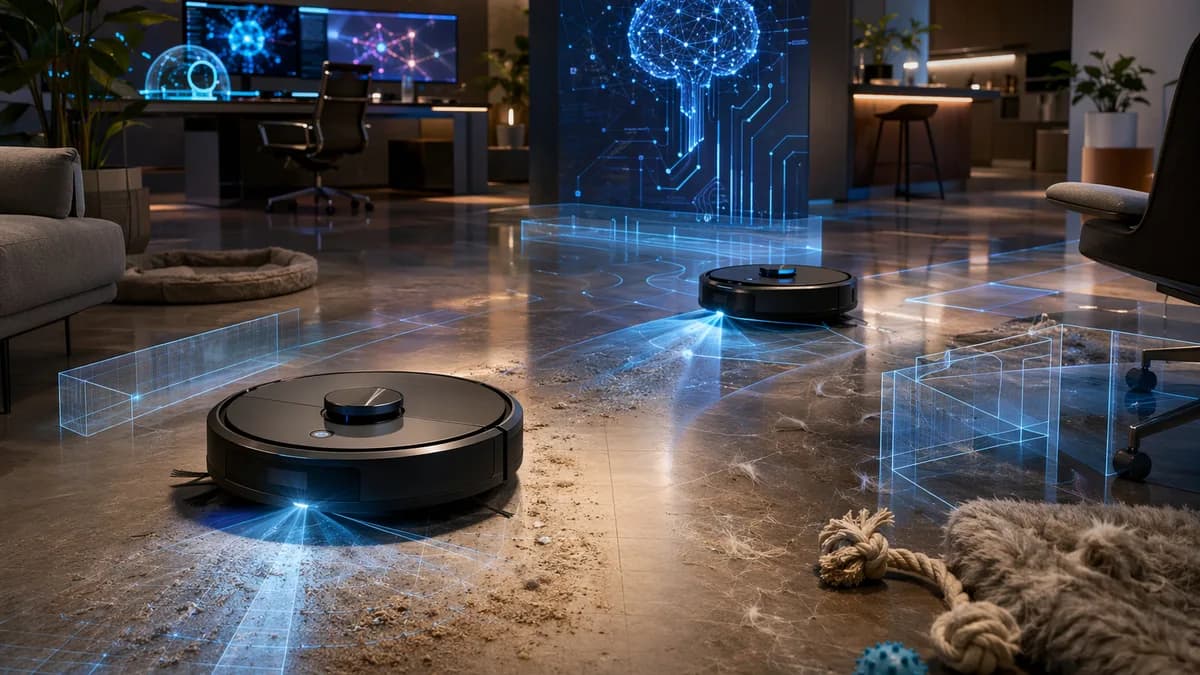
The best robot vacuum 2026 race is really a fight over trust: which machine can clean a lived-in home without turning into another chore. Shark and Eufy sit at the center of that question in Wired’s latest testing, where the Shark PowerDetect UV Reveal takes the overall pick and the Eufy Omni C28 lands as the budget choice.
XOOMAR Intelligence
Analyst Take
That says more than a simple product ranking. The category has moved past novelty. Buyers aren’t just paying for suction, mapping, or a dock that looks expensive. They’re paying to reduce friction after week three, when the thrill is gone and the robot either fits into the house or gets stranded under furniture.
Robot vacuums in 2026 are selling freedom, but buyers are really paying to avoid disappointment
The strongest robot vacuum is the one that needs the least human rescue. That’s the real signal from Wired’s 2026 picks. The Shark PowerDetect UV Reveal impressed because it handled hard floors, rugs, carpet, corners, spills, and obstacles with fewer compromises than most models. The Eufy Omni C28 stood out because it brought vacuuming, mopping, self-cleaning, and multi-floor mapping into a lower price band.
“The best robot vacuums these days aren't just vacuuming your floors, nor are they blindly bumping around your house like they used to.”
That line captures the market’s new baseline. The machines now mop, scrub, detect stains, lift themselves off obstacles, and return to docks that handle part of the cleanup. But XOOMAR’s read is that the spec sheet can mislead. A robot vacuum that advertises AI but misses corners, drags residue, or needs constant bin care is still household labor with extra steps.
The counterpoint is simple: price still matters. A $1,300 robot, even discounted to $800, has to clear a high bar. A $800 robot discounted to $500 has more room to be imperfect. That’s why the best robot vacuum 2026 decision is less about “best” in the abstract and more about matching mess tolerance, floor type, and patience level.
The best robot vacuum 2026 scorecard starts with stains, corners, docks, and maps
The useful numbers in Wired’s testing aren’t just suction claims. They’re the scores that show whether a robot can handle actual messes.
| Model | Wired role | Price shown | Corner test | Spill test | Mapping | Debris system |
|---|---|---|---|---|---|---|
| Shark PowerDetect UV Reveal | Best overall | $1,300, $800 sale | 2 out of 3 Cheerios | 1.5 out of 2 spills | No multi-floor mapping | Bagless debris |
| Eufy Omni C28 | Best budget | $800, $500 sale | 2 out of 3 Cheerios | 1.5 out of 2 spills | Multi-floor mapping | 3-liter dust bag |
The Shark’s standout feature is its UV light and built-in AI, which found spots on the floor and sent the robot back to deep-clean them. Wired reports it cleaned the main floor in about 60 minutes, then spent another 30 minutes scrubbing detected spots, for a 93-minute total across four rooms plus extra scrub work. That’s not instant, but it’s meaningful if the robot is doing work a person would otherwise skip.
The Eufy’s value case is different. It has 15,000 Pa suction, a self-cleaning roller mop, retractable detangling brushes, and multi-floor mapping. But Wired’s test also exposed the tradeoff: after cleaning a four-room main floor, it had 37 percent battery left. It recharged to 57 percent after 20 minutes, enough to keep going, but not enough to make multi-floor coverage feel effortless.
Shark and Eufy are fighting over usable premium features, not the trophy shelf
Shark wins Wired’s overall pick because it made advanced cleaning behavior visible. The PowerDetect UV Reveal didn’t just pass over floors. It spotted stains, returned to dirty areas, handled LVP and tile, and made a large rug feel as fluffy and well-vacuumed as if a stick vacuum had been used. It also used “NeverStuck Technology” to lift itself off obstacles, including the flat, long legs of a side table.
Its weakness is practical. It can learn only a single map. For a multi-story home, that means remapping and moving the base station if you want it to clean another level. Shark also declined to state the exact suction level, which leaves buyers judging by results rather than a comparable spec.
Eufy’s Omni C28 makes the budget argument more convincingly. It packs mopping, vacuuming, multi-floor maps, and a dock at a lower tested price point. Its miss in the corner test was the hardest fridge-corner Cheerio, and its second cherry juice spill left some sticky residue after drying longer. That’s not fatal. It just tells buyers where the savings show up.
For readers tracking other useful tech buys, the lesson resembles our view in Best Laptop Power Banks That Rescue Dying MacBooks: advertised capacity matters less than whether the device solves the failure point you actually face every week.
From bump-and-run cleaners to self-emptying floor systems, the dock became the appliance
Older robot vacuums were judged by whether they could stop crashing into chair legs. The 2026 standard is much harsher. A serious robot vacuum now needs app control, mapping, obstacle avoidance, mopping, and a dock that cuts down on dirty work.
Wired’s maintenance guidance shows why the dock matters. A charger-only robot usually needs its onboard debris emptied after each use. A self-emptying dock typically needs emptying every 30 to 60 days, depending on design and use. Dirty-water tanks should be cleaned after each mopping run, while clean water can stay filled in the station.
That changes the buying calculus. A cheap robot with a small bin may cost less upfront, but it demands more touchpoints. A self-emptying or mop-cleaning station costs more, takes more space, and may require bags or replacement parts, yet it can turn the robot from gadget into appliance. The Shark’s bagless debris system lowers one recurring purchase concern. The Eufy’s 3-liter dust bag is more conventional, but it adds a consumable to track.
Pet owners, renters, parents, and privacy hawks need different answers
There is no single best robot vacuum for every household. Wired’s test home included three adults, a preschooler, and a cat spreading litter around the house. That matters. Pet debris, small obstacles, rugs, and multiple floor types are where robot vacuums stop being spec-sheet products and start revealing their design choices.
Pet owners should care about brushes, bin capacity, and how often the dock clogs or needs emptying. Parents should care about obstacle avoidance and whether the robot can avoid creating a bigger mess. Renters may prefer smaller docks and robots that don’t require elaborate setup. Multi-story households should look closely at mapping limits, because Shark’s single-map constraint is a real drawback if you expect one robot to cover every floor.
Privacy-conscious buyers have a separate issue. Wired identifies navigation hardware including NeuroNav AI with RGB sensors, lasers, and an UltraRange camera on the Shark, while the Eufy uses a laser distance sensor and laser line. XOOMAR analysis: any robot that maps your home, uses cameras, or depends on app accounts deserves a careful look at settings and data policies. The source does not provide those policies, so buyers should not assume all “AI” cleaning systems handle data the same way.
That same discipline applies across consumer tech. As with choosing Best Phones With MicroSD Card Slots That Beat the Cloud, the right feature is the one that reduces your dependence on systems you don’t want to manage.
Choosing between Shark and Eufy comes down to your floors, messes, and patience
Pick Shark PowerDetect UV Reveal if your biggest frustration is dirty hard flooring, visible spills, pet litter, mixed rugs, and obstacles that usually trap cheaper robots. Wired’s testing supports its strength on LVP, tile, builder-grade carpet, and a large living-room rug. Its UV stain detection and return-to-scrub behavior are the clearest reasons to pay more.
Pick Eufy Omni C28 if value matters more and you want mopping, vacuuming, multi-floor mapping, and a dock without paying close to or beyond a four-figure sum. Its weaker battery showing matters, but Wired still found it could clean all three floors in one day with a recharge pause. For many buyers, that’s a fair compromise at $500 on sale.
Don’t overbuy. A premium dock makes sense for busy households, pet homes, and people who will actually run the robot daily. A simpler machine can still work in apartments, single-floor homes, or places where crumbs and dust are the main problem.
The next winner in the best robot vacuum 2026 fight will be the model that cleans edges better, handles wet messes more reliably, discloses how its smart features work, and keeps maintenance costs predictable. Evidence that would weaken Shark’s case: real homes finding the single-map limit too annoying. Evidence that would weaken Eufy’s case: battery life making multi-floor mapping feel more like a promise than a convenience. For now, Wired’s testing points to a clear split: Shark is the better cleaner, Eufy is the sharper value.
Key Takeaways
- Robot vacuums are now judged by how much human intervention they eliminate, not just suction or smart features.
- Shark’s overall win suggests premium models must justify high prices with fewer real-world compromises.
- Eufy’s budget pick shows buyers can get advanced cleaning and mapping features without paying top-tier prices.
Wired’s 2026 Robot Vacuum Picks
| Model | Positioning | Strength | Price Signal |
|---|---|---|---|
| Shark PowerDetect UV Reveal | Overall pick | Handles hard floors, rugs, carpet, corners, spills, and obstacles with fewer compromises | $1,300 robot, discounted to $800 |
| Eufy Omni C28 | Budget choice | Offers vacuuming, mopping, self-cleaning, and multi-floor mapping at a lower price | $800 robot, discounted to $500 |
Discounted Robot Vacuum Prices Mentioned
Primary Sources & Disclosures

Written by
XOOMAR
Data desk
XOOMAR is a capital markets software and data company. Every brief on this site starts from a dataset the company collects itself from primary sources (CFTC, SEC EDGAR, FINRA, the Federal Reserve, exchange APIs) and names the numbers it is built on, with a link to the data page so you can check them. Briefs are reviewed before they go out and corrected in place when the data is revised.