While nuclear startups chase commercial deployments in the early 2030s, Critical Energy geothermal is pitching a faster route: $22 million to build modular power-plant hardware inspired by rocket-engine turbomachinery.
XOOMAR Intelligence
Analyst Take
The startup, co-founded and led by former SpaceX engineer Spencer Jackson, raised $19 million in seed funding and another $3 million in venture debt from Silicon Valley Bank, according to TechCrunch. The seed financing was led by Susa Ventures and Upfront Ventures, with participation from MaC Venture Capital, Susquehanna Sustainable Investments, Humba Ventures, Scribble Ventures, and Underground Ventures.
The money is going toward Critical Energy’s first 2.5 megawatt geothermal project. The company says that plant is scheduled for completion by 2027 at an existing geothermal site similar to those found in Iceland or at The Geysers in Northern California.
Critical Energy geothermal is selling speed against nuclear’s slower clock
Critical Energy’s bet is not that geothermal needs a new sales pitch. It’s that geothermal needs a manufacturing base for the machinery that turns underground heat into grid power.
Jackson told TechCrunch that many geothermal developers are specifying large turbines that can take “months to years” to assemble on site. Critical Energy wants to replace that with factory-built, modular turbines that can be shipped and repeated.
“It’s still way faster and cheaper to make it the other direction, to built it in a factory,” Jackson told TechCrunch.
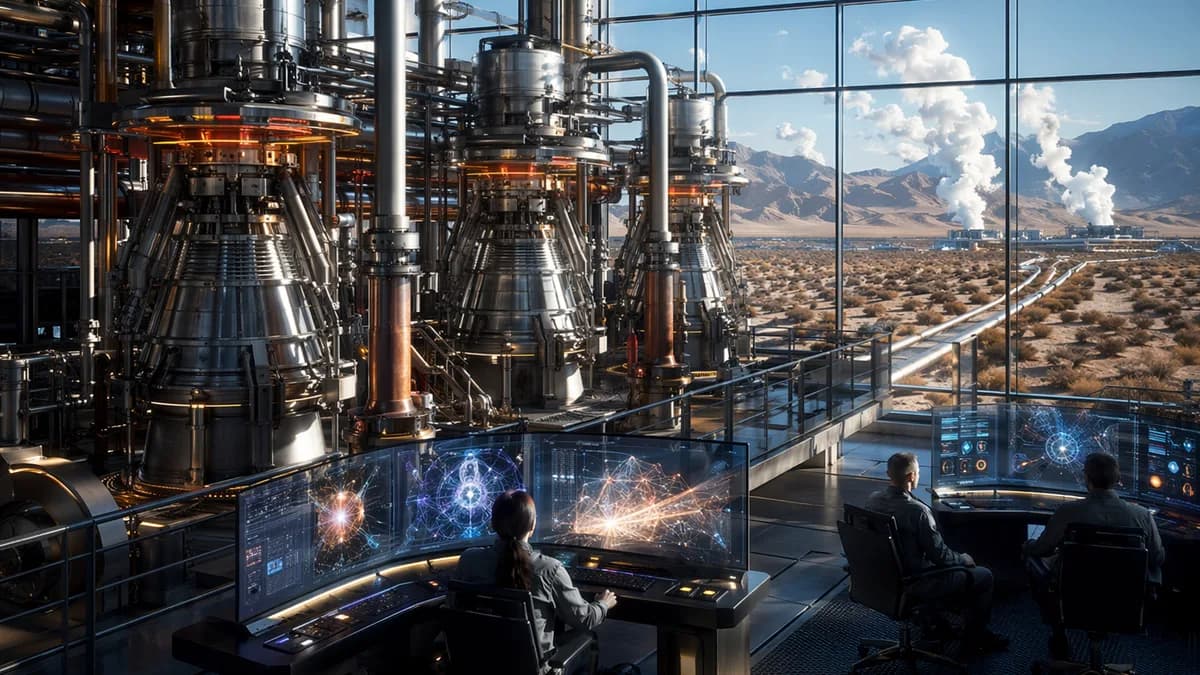
That factory logic comes straight from Jackson’s resume. At SpaceX, he worked on Falcon Heavy, Starship, and the Raptor rocket engine. Critical Energy is now working with machine shops to build turbomachinery and turbine components that TechCrunch says resemble rocket engines, while buying other parts off the shelf for now.
The company’s ambition is much larger than one pilot. Jackson said the long-term target is 300 gigawatts a year in 2045.
“We are looking for the fastest path to gigawatts of scalable power on the grid,” he said. “Long term goal is 300 gigawatts a year in 2045.”
That number is the story. It would move Critical Energy geothermal from startup experiment to core power-supply infrastructure, if the company can actually execute.
Rocket-engine hardware targets geothermal’s turbine bottleneck, not the drill bit
The easy headline is “rocket engines for geothermal.” The more precise version is more interesting: Critical Energy is applying rocket-engine manufacturing and turbomachinery know-how to geothermal turbines.
That distinction matters. The source material does not say Critical Energy is building a new drilling system. It says the startup is designing modular turbines for geothermal plants, including a larger 5 megawatt module aimed at enhanced geothermal companies such as Fervo Energy, which drill deeper to pull up more heat.
The physics overlap is still real. Rocket engines and geothermal turbines both live in punishing worlds of heat, pressure, fluid flow, and materials stress. SpaceX’s propulsion culture also prizes rapid iteration and vertical integration, two habits Jackson suggested Critical Energy may adopt over time.
Here’s the before-and-after Critical Energy is trying to force:
- Before: Large geothermal turbines are specified project by project and assembled on site over long timelines.
- After: Smaller modular turbines are made in factories, shipped to projects, and repeated as geothermal developers scale.
- Before: Geothermal remains constrained by project-specific hardware and slow buildouts.
- After: Turbine supply becomes less of a bottleneck, if the modules perform and costs hold.
That “if” is doing heavy work. Underground heat is abundant, but turning it into bankable power requires equipment that survives, repeats, and clears utility-grade reliability tests.
The prize is large enough to justify the attempt. TechCrunch cites the IEA as saying at least 42 terawatts of geothermal capacity is available worldwide, more than twice the world’s energy use last year.
Investors are funding steel, factories, and megawatts, not another software layer
Critical Energy’s raise stands out because geothermal has not attracted the same investor spotlight as advanced nuclear fission and fusion. TechCrunch frames those nuclear startups as the investment darlings, even as their first commercial deployments are targeted for the early 2030s.
Jackson’s counter-position is blunt.
“Geothermal is going to beat them to it. By a lot,” he told TechCrunch. “In four or five years, I hope that we’re doing many gigawatts a year.”
This is a different type of startup risk than the software-heavy markets XOOMAR often tracks, from no-code algo trading tools turning prompts into live bots to embedded payments turning SaaS into a revenue battleground. Critical Energy has to make physical machines, place them into power plants, and prove they work under heat and pressure.
That makes the investor test harsher. A slick demo is not enough. The company will be judged on output, uptime, manufacturing pace, and whether geothermal developers can actually get turbines when they need them.
The demand signal is also coming from the tech sector. TechCrunch cites a recent report saying advanced geothermal could power nearly two-thirds of new data centers by 2030. That gives Critical Energy geothermal a clear customer problem to aim at: around-the-clock clean power for loads that can’t wait for intermittent supply.
Oil and gas drillers could accelerate the market, if turbines don’t run short
Jackson expects oil and gas companies to become a force in geothermal once the technology matures. His reasoning is practical: they already know how to repeat drilling campaigns at industrial scale.
“Geothermal is great because the oil and gas industry has the replicability to do hundreds and then thousand of wells. They’re very, very good at drilling wells,” Jackson said. “But they need turbines and there’s going to be a massive shortage of those.”
That quote explains Critical Energy’s positioning. The company is not trying to own every part of the geothermal stack on day one. It is targeting the component Jackson sees as the coming choke point.
| Piece of the geothermal buildout | Critical Energy’s apparent role |
|---|---|
| Drilling wells | Oil and gas expertise could help scale this, according to Jackson |
| Heat extraction | Enhanced geothermal companies such as Fervo Energy are drilling deeper |
| Power conversion | Critical Energy is building modular turbines |
| Project scale-up | The company wants gigawatts per year by the early 2030s |
The first real checkpoint is the 2.5 megawatt project due in 2027. After that, the larger question is whether the 5 megawatt module can serve enhanced geothermal developers and repeat across enough sites to support gigawatt-scale manufacturing.
The next failure point is execution, not ambition
Critical Energy now has capital, a strong founder-market story, and a massive target. None of that proves the machines will scale.
The next milestones are concrete: plant completion, turbine performance, project uptime, manufacturing repeatability, and commercial agreements with geothermal developers or power buyers. If the first plant slips, underperforms, or requires too much custom engineering, the modular thesis weakens fast.
The risks are also physical. Geothermal hardware faces punishing heat, pressure, corrosion, and maintenance demands. Projects can also run into permitting, interconnection, financing, and site-specific engineering problems.
The clean read is this: Critical Energy geothermal has found a sharp wedge in a market with huge theoretical capacity and a plausible near-term power need. The watch item now is whether rocket-engine discipline can turn into repeatable geothermal manufacturing, or whether the company runs into the same brutal scaling wall that has slowed many hard-energy startups before it.
The Bottom Line
- Critical Energy is positioning geothermal as a faster clean-power alternative to nuclear startups chasing early-2030s deployments.
- The company’s modular turbine approach could reduce reliance on large, slow-to-assemble geothermal equipment.
- Its $22 million raise will fund a 2.5 MW project that could test whether rocket-inspired hardware can scale geothermal power.
Critical Energy’s Geothermal Push vs. Nuclear Startup Timelines
| Approach | Timeline | Key Strategy |
|---|---|---|
| Critical Energy geothermal | First 2.5 MW project scheduled for completion by 2027 | Factory-built modular turbines inspired by rocket-engine turbomachinery |
| Nuclear startups | Commercial deployments targeted for the early 2030s | Longer path to grid-scale deployment |
Critical Energy Funding Breakdown
Primary Sources & Disclosures

Written by
XOOMAR
Data desk
XOOMAR is a capital markets software and data company. Every brief on this site starts from a dataset the company collects itself from primary sources (CFTC, SEC EDGAR, FINRA, the Federal Reserve, exchange APIs) and names the numbers it is built on, with a link to the data page so you can check them. Briefs are reviewed before they go out and corrected in place when the data is revised.