
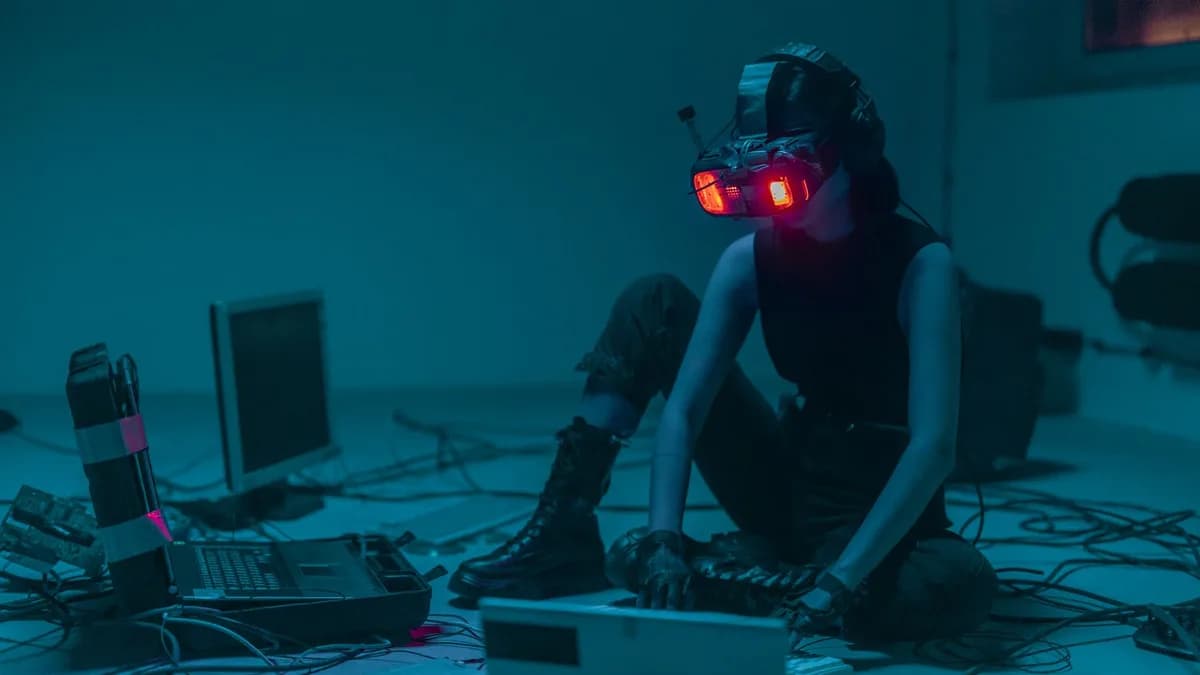
An alleged fraudster in Spain tried to use real-time deepfake software to create legally binding digital identities. He was caught because his face-swap video blinked.
TechnologyAugust 13, 2026· 7 min read· By XOOMAR Insights Team
Deepfake Blink Exposes Spain's Digital Certificate Heist
Updated on August 13, 2026
XOOMAR Intelligence
Analyst Take
71/ 100
4 sources analyzedMedium confidenceTrend10Freshness99Source Trust85Factual Grounding88Signal Cluster20
The glitch, lasting barely a second, exposed his real face to a verification camera, providing Spanish police the break they needed. According to The Register Security, the unnamed suspect made 38 attempts to impersonate 30 people to obtain their digital certificates, succeeding on "multiple" occasions. This isn't just another deepfake scam, it's a direct assault on the foundational systems of digital trust used for everything from signing contracts to government services. The target audience wasn't the public, but the security infrastructure itself.
The One-Second Flaw in a Perfect Digital Heist
The suspect's operation was sophisticated. Police allege he used a combination of forged documents, manipulated photographs, deepfake tools, and a custom lighting setup to bypass a security company's live video identity checks. The verification process required matching the applicant's live face to the photo on their identity document.
To beat it, he allegedly used deepfake technology to alter his face in real time. His lighting rig was particularly advanced. "The alleged perpetrator used household spotlights with strategically placed colored bulbs to simulate the flashes and security features found on physical identity documents under real light," police explained. He balanced the counterfeit documents in front of the webcam to perfectly recreate official holograms.
For 38 attempts, this digital masquerade worked well enough. The entire enterprise, however, hinged on the flawless, real-time processing of the face-swapping algorithm.
The failure was microscopic and abrupt. The software processing his fake face suffered a momentary delay. The digital disguise dropped for less than the length of a heartbeat, exposing his real visage. That single artifact was the thread investigators pulled. It led to an arrest, a search of a home, and the seizure of a high-grade encrypted laptop, multiple phones, storage devices, and documents. The investigation was complicated by the use of more than 320 phone lines across 24 devices, most registered under stolen identities. This all collapsed because of a blink.
Digital Certificates: The Keys to the Digital Kingdom Are Identity Cards
This story's gravity is in its target. The suspect wasn't making fake celebrity porn or political disinformation, he was trying to forge digital certificates. In the EU and elsewhere, these are the digital equivalent of a notarized ID and signature stamp combined. They use public key infrastructure to bind a cryptographic key to a verified identity.
Possession of a certificate allows the holder to authenticate themselves for logging into critical systems, sign contracts with legal force, authorize financial transactions, and interact with government bodies, all online. A certificate obtained fraudulently is a master key for impersonation. Police allege the suspect planned to use them for further cybercrimes. It's identity theft operating at the level of cryptographic proof.
The verification process to get a certificate is supposed to be the robust gatekeeper. It’s a process similar to the one financial institutions rely on. This case proves that gate can now be attacked not just with fake papers, but with a convincingly animated fake face.
The Criminal Toolkit Evolves from Static Forgeries to Live Synthesis
This fraud represents a predictable but dangerous evolution in a long-running criminal enterprise. Identity fraud has historically progressed in step with consumer technology.
| Era | Primary Method | Weakness |
|---|---|---|
| Pre-Digital | Forged physical documents | Expert inspection, tactile features |
| Digital 1.0 | Scanned & Photoshopped IDs | Low resolution, poor realism under scrutiny |
| Digital 2.0 | High-res 3D masks, static deepfakes | Inability to perform in real-time, unnatural movement |
| Present | Real-time generative AI video (Deepfakes) | Processing glitches, temporal artifacts |
The paradigm shift is from manipulating static images to performing under the dynamic, interactive scrutiny of a live video call. Earlier methods could be defeated by simply asking the person to turn their head or blink. Modern deepfake tools, in theory, can generate those movements in real time. The Spanish case shows this capability is now in the hands of individual criminals, not just state actors. As we explored in iPhone Arms Users With Weapon Against AI Deepfakes, the counter-technology is also evolving, but it's a frantic race.
Verification Providers: The Lucky Break That Signals a Systemic Crisis
For the security company issuing the certificates and its peers, this incident is a five-alarm fire disguised as a success story. A criminal almost perfectly automated the bypass of their core verification service. He failed due to a transient software hiccup, not because their systems detected the fraud.
This exposes a glaring vulnerability at the heart of remote Know Your Customer (KYC) and notarization platforms globally. Their entire business model is based on the ability to verify "liveness" and match identity documents via video. That model is now fundamentally challenged by accessible, real-time generative AI. The question every provider must answer overnight is: how many fraud attempts succeed without the telltale blink?
The response will likely be a rapid, costly arms race. Expect a surge in demand for multi-modal verification that layers voice analysis, behavioral biometrics (like micro-movements and interaction patterns), and advanced liveness detection that probes the AI's rendering capabilities. The investment required for fraud prevention is about to spike, a cost that will inevitably be passed down to businesses and consumers. This technological pivot mirrors the kind of foundational efficiency shift we've analyzed in other sectors, such as the move in WEX AI Shift Exposes Big Tech's Costly Blunder.
For Everyone Else: The End of "Seeing Is Believing" Online
The broader implication is a profound erosion of digital trust. For everyday users, the message is clear: a simple video selfie or passport scan is no longer definitive proof of identity for high-stakes services.
The psychological contract of online verification, "we saw it was you on video, so it must be you", is broken. This will lead to more friction, more invasive checks, and a baseline of distrust even in seemingly secure digital interactions. Why would a bank trust a video call if a criminal can simulate one with spotlights and a $50 app?
"The alleged perpetrator used household spotlights with strategically placed colored bulbs to simulate the flashes and security features found on physical identity documents under real light."
This quote from the police report is the most damning detail. It shows that defeating security is becoming a matter of creative engineering with consumer-grade tools, not just sophisticated code.
The immediate user impact will be:
- More Steps: Verification will move from one-step video to multi-step, multi-factor processes.
- New Demands: Users may be asked to perform specific, randomized actions to prove liveness or use dedicated hardware tokens.
- Privacy Trade-offs: In the name of security, companies may demand access to more biometric data, creating new privacy risks.
The Horizon: Moving Beyond the Visual Layer to Cryptographic Proof
So, what comes after the blink? This case is a forcing function. The long-term solution is not to build better deepfake detectors for video, but to sidestep the visual impersonation layer entirely.
Short-term (1-2 years): A messy scramble. We'll see a surge in "AI forensic" services and a rush to patch verification systems, but more successful frauds are inevitable as the technology stabilizes. The glitch that caught this suspect will become rarer.
Medium-term (3-5 years): The rise of cryptographically verifiable digital identities. Think government-issued digital wallets or decentralized identifiers (DIDs) where your credential is a signed piece of code, not a photograph. The verification shifts from "Does this face match the photo?" to "Is this cryptographic signature valid and unrevoked?" The EU's digital identity wallet framework is a step in this direction.
Long-term: A fundamental re-architecture of online trust. Reliance on mimicking human verification (a video of a face, a copy of a document) will be seen as a legacy weakness. The future belongs to machine-readable, cryptographically secured credentials that are presented and verified automatically, making the deepfake, no matter how flawless, irrelevant to the transaction.
The Spanish police got their man because, for one second, the machine failed. The real warning is for the day it doesn't.
Impact Analysis
- This incident proves that foundational digital trust systems like digital certificates, used for signing contracts and accessing government services, are now a primary target for complex AI-powered fraud.
- The attacker’s use of real-time deepfakes and sophisticated physical rigs (like colored lighting to mimic document holograms) shows how traditional live video verification is becoming obsolete against current AI tools.
- It demonstrates that security failures can be shockingly brief—a one-second software glitch led to exposure—highlighting the need for continuous, multi-layered verification rather than single-point checks.
Sources

Written by
XOOMAR Insights Team
Research and Editorial Desk
The XOOMAR Insights Team pairs automated research with human editorial judgment. We track hundreds of sources across technology, fintech, trading, SaaS, and cybersecurity, cross-check the facts, and explain what happened, why it matters, and what to watch next. We do not just rewrite headlines. Every article is fact-checked and scored for reliability before it goes live, and we link back to the original sources so you can verify anything yourself.
Explore More Topics
Related Articles
 Technology
iPhone Arms Users With Weapon Against AI Deepfakes
Apple is building a cryptographic feature called Apple Reference Image to let iPhone users prove their photos are original camera shots, not AI-generated deepfa
Aug 13, 20268 min
 Trading
Standard Backtesters Fail Options Strategies, Demand Specialized Tools
You can't backtest complex options strategies like an iron condor with a generic stock simulator. You need specialized software that models implied volatility,
Aug 13, 202614 min
 Trading
Copy Trading Experts Reveal Hidden Fees and Traps
In 2026, selecting a copy trading platform requires parsing hidden fees and minimums, not just leaderboards. Our review details how to protect your capital.
Aug 13, 202612 min
 Trading
Stock Scanner Finds Shots Screener Misses
Screeners filter based on your questions; scanners find trades in real-time you didn't know to look for.
Aug 13, 202615 min
 Trading
Top Free Stock Charting Software for Beginners in 2026
The best free stock charting software for beginners balances powerful features with an intuitive, educational interface, letting you learn technical analysis wi
Aug 13, 202613 min
 Trading
Connect Expert Charting Tools to Your Broker in Minutes
A clear roadmap for fusing the advanced analytics of tools like TradingView with the execution power of your existing broker, creating a seamless hybrid trading
Aug 13, 202615 min
 Fintech
Digital Bank Transfer Fees Slash 80% Off Traditional Wires
Specialized online transfer services routinely charge 50-80% less for international payments than traditional banks, which profit from hidden exchange rate mark
Aug 13, 202614 min
 Fintech
BNPL Surge Strains Households With Hidden Debt Traps
In a tight budget economy, BNPL and bank overdraft protection compete as instant credit options, yet they carry vastly different costs, approval models, and lon
Aug 13, 202612 min
 Fintech
IRS Hunts DeFi Stakers Who Mishandle Taxable Rewards
Global tax authorities now classify staking and yield farming rewards as ordinary income the instant you control them. A robust crypto tax tracker is your defen
Aug 13, 202610 min
 Fintech
Joint Digital Accounts Prevent Couples' Financial Fights
The best digital joint accounts for couples reduce financial conflict through features like sub-accounts and real-time notifications, aligning money management
Aug 13, 202610 min
Don't miss the signal
Get our weekly roundup of the stories that matter across tech, fintech, and trading. No noise, just signal.
Free forever. No spam. Unsubscribe anytime.