
Can Foundation Alloy turn a $22 million Series A and a no-melt alloying process into real supply for defense drones, luxury watches, and chef’s knives?
TechnologyJune 16, 2026· 7 min read· By XOOMAR Insights Team
$22M Bet Forces Foundation Alloy Super Metals to Scale
Updated on June 16, 2026
XOOMAR Intelligence
Analyst Take
61/ 100
2 sources analyzedLow confidenceTrend10Freshness98Source Trust90Factual Grounding93Signal Cluster40
The startup has raised the new round to scale production of its high-performance alloys, according to TechCrunch, betting that customers want metals made by force rather than by furnaces.
Can Foundation Alloy’s $22 million round turn smashed powders into super metals?
Foundation Alloy says its core advantage starts with a blunt technical break from conventional metallurgy: it combines metal powders by repeatedly smashing them together instead of melting different metals in a pot.
“We’re actually smashing metal powder particles together instead of melting them,” Jake Guglin, co-founder and CEO of Foundation Alloy, told TechCrunch. “We can create properties that other people can’t.”
That matters because most commercial alloys are still produced through melting. Foundation Alloy’s process is solid-state metallurgy, meaning the material is formed without taking the ingredients through a liquid phase.
The company has already been selling bespoke metals in small batches. Guglin told TechCrunch the bottleneck is not interest from buyers.
Foundation Alloy is “constrained by our ability to make stuff, not by the people that want to take it.”
The new $22 million Series A was led by Voyager Ventures. Participants included Trust Ventures, Yamaha Motors, America’s Frontier Fund, Overlap Holdings, Material Impact, Engine Ventures, El Cap, and Kanematsu Corporation. Kanematsu will also distribute Foundation Alloy’s metals in Japan and Southeast Asia.
The target is clear: increase production to several tons per week by 2027. That is the real headline. Small-batch specialty metals can impress early customers, but defense, automotive, aerospace, semiconductor, watch, and knife makers need repeatable material in predictable quantities.
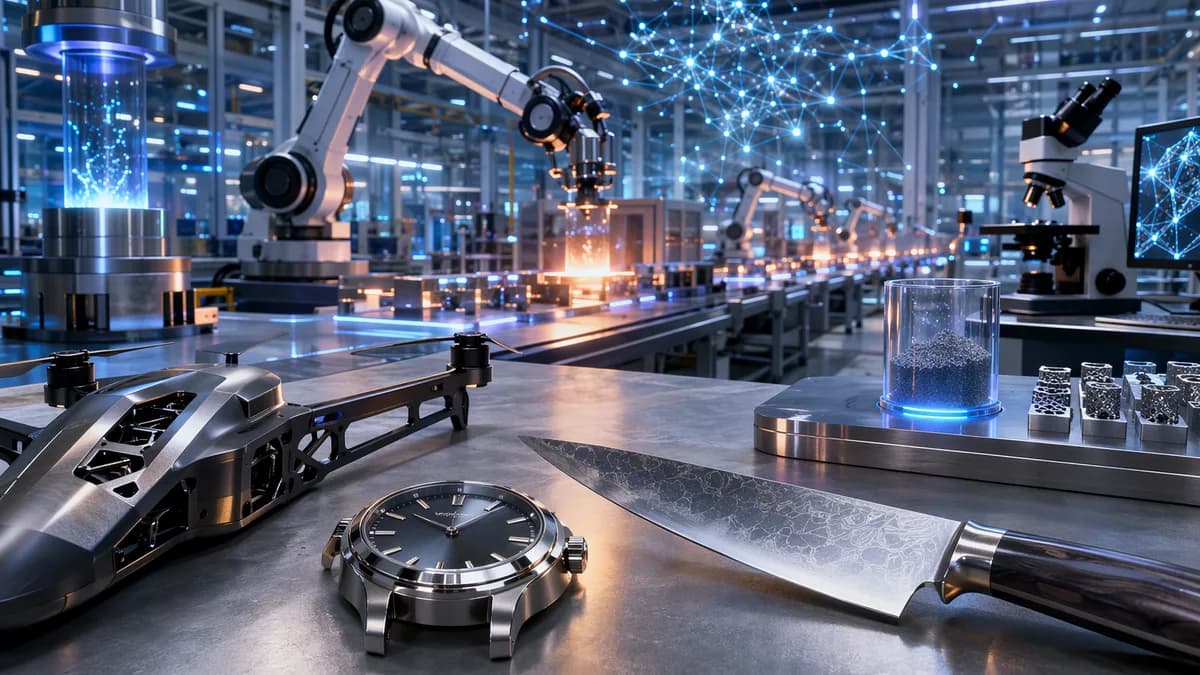
Foundation Alloy says it is already running pilots with companies in the automotive, aerospace, semiconductor, and defense industries, plus companies that make chef’s knives and luxury watches. That spread is unusual. One process is being pitched at both drone parts and premium consumer hardware.
For founders tracking the capital side of the story, this is the kind of raise where customer pipeline and investor process collide, a theme XOOMAR covered in Investor CRM Tools Can Make or Break Your Startup Raise. Foundation Alloy now has to convert investor confidence into qualified supply.
Does cold-processing give Foundation Alloy a real edge in drones, watches, and knives?
The harder question is whether avoiding heat creates enough performance gain to justify new customer qualification work.
Traditional alloying can blend metals well, but not perfectly. TechCrunch notes that conventional processes can leave voids that reduce performance, making an alloy more brittle or more vulnerable to heat. They also struggle when metals have vastly different melting points.
Foundation Alloy’s pitch is that mechanical alloying unlocks combinations that furnaces can’t easily make. Guglin said the company’s solid-state process uses around an order of magnitude less energy by avoiding melting.
| Question | Conventional melting | Foundation Alloy’s process |
|---|---|---|
| How metals combine | Metals are melted and mixed | Metal powders are repeatedly smashed together |
| Temperature profile | High-heat process | Solid-state process |
| Material limits | Harder with metals that have very different melting points | Designed to combine materials that are difficult to melt together |
| Commercial risk | Established supply chains and known qualification paths | Must prove repeatability, cost, and scale |
The performance claim goes to an old tradeoff in metals. Materials that tolerate heat often become brittle. Stronger tooling metals can degrade faster when exposed to heat. Foundation Alloy says it can make metals that handle both heat and mechanical stress.
That combination explains the early customer mix. In defense drones, stronger or more heat-tolerant parts could matter if a component has to be produced at higher volumes than legacy aerospace supply chains were built for. Guglin told TechCrunch some drone supply chains were originally designed for F-35 fighter jets.
“They think about making 100 perfect parts per year,” Guglin said, whereas drones need more like 10,000 per month.
That line is the clearest commercial clue in the story. Foundation Alloy is not only selling better materials. It is selling a way around manufacturing assumptions built for lower-volume, higher-cost aerospace programs.
The defense angle lands at a moment when drone hardware is already central to geopolitical coverage, including XOOMAR’s report on a Ukrainian Drone Strike Sets Russia Export Hub Ablaze. Foundation Alloy’s relevance will depend less on headlines and more on whether its parts can pass customer testing at volume.
The consumer use cases are different but still materials-driven. In watches, customers may care about wear resistance, finish, strength, and durability. In chef’s knives, the pitch would likely center on edge retention and toughness, though TechCrunch did not report specific performance data for knife steels.
Analysis: Foundation Alloy’s strongest near-term case appears to be tooling and high-stress industrial parts, where TechCrunch says some of its first products have gone to automakers as well as aerospace and defense companies. Premium watches and knives broaden the brand story, but industrial customers will be the more demanding proof point.
MIT News has also reported that Foundation Alloy’s alloys can be twice as strong as traditional metals, with 10 times faster product development, letting companies test and deploy new metals in months instead of years, according to MIT News. That is a bold claim, and the next stage is making it boringly repeatable.
Can factory-scale production survive defense and premium manufacturing qualification?
The $22 million will be judged by three things: capacity, qualification, and repeat orders.
Scaling to several tons per week by 2027 is not just a manufacturing target. It is a credibility test. If Foundation Alloy can’t produce consistent batches, the claimed material properties will not matter to defense, aerospace, semiconductor, or automotive customers.
Qualification is the slow part. Buyers in these markets need data on durability, heat tolerance, failure behavior, and batch-to-batch performance. A better alloy still has to earn its way into a bill of materials.
Foundation Alloy’s technical roots help explain why investors are taking the bet. The company’s technology grew out of roughly 20 years of research into metals at the nanometer scale, led by Tim Rupert and Chris Schuh. Schuh previously co-founded Desktop Metal and Xtalic, giving the company a founder with prior materials-startup experience.
Guglin’s own framing is simpler.
“The quality of the output of a dish is not just based on the ingredients, it’s how you cook it,” he said. “We have a new way to cook.”
That cooking line is useful because it captures both the promise and the risk. A new recipe can create a better material, but customers still need the same result every time.
Foundation Alloy will also be measured against the buying habits of customers that already source specialty metals, powder-based materials, and qualified industrial components. The company does not need to replace every incumbent process. It needs to win where conventional alloys hit a hard limit.
The next signal will be specific commercial traction: qualified drone components, repeat tooling orders, watch or knife materials moving beyond pilots, or distribution in Japan and Southeast Asia through Kanematsu. Until then, the funding proves investor appetite. The factory will have to prove the metal.
The Bottom Line
- Foundation Alloy’s $22 million Series A is aimed at turning small-batch specialty metals into scalable production.
- If the process works at industrial scale, it could supply higher-performance materials for defense drones, luxury watches, and chef’s knives.
- The company’s key challenge is production capacity, not customer demand, according to its CEO.
Foundation Alloy’s Approach vs. Conventional Alloy Making
| Approach | How It Works | Claimed Advantage |
|---|---|---|
| Foundation Alloy solid-state metallurgy | Combines metal powders by repeatedly smashing particles together without melting them | Can create alloy properties the company says conventional methods cannot |
| Conventional metallurgy | Melts different metals together in a liquid phase | Dominant commercial process, but potentially more limited for certain advanced properties |

Written by
XOOMAR Insights Team
Research and Editorial Desk
The XOOMAR Insights Team pairs automated research with human editorial judgment. We track hundreds of sources across technology, fintech, trading, SaaS, and cybersecurity, cross-check the facts, and explain what happened, why it matters, and what to watch next. We do not just rewrite headlines. Every article is fact-checked and scored for reliability before it goes live, and we link back to the original sources so you can verify anything yourself.
Explore More Topics
Related Articles
 Technology
Netflix Mobile App Turns Asia Into Its Short-Clip Lab
Netflix is making Asia-Pacific its mobile lab, using Clips and kids' games to pull families deeper into the app.
Jun 10, 20267 min
 Trading
Bitcoin Defies Japan Rate Hike as Shorts Get Crushed
Bitcoin shrugged off Japan's rate hike, topping $66,500 as shorts were squeezed and XLM, INJ and UNI led a sharper altcoin rally.
Jun 16, 20268 min
 Global Trends
Bank of Japan Jolts Markets as Rates Hit 31-Year High
The BoJ lifted rates to 1%, the highest since 1995, signaling Japan is done treating deflation as the only threat.
Jun 16, 20268 min
 SaaS & Tools
Cut Client Chaos With Client Portal Project Management
Client portal project management tools give agencies one controlled place for updates, files, feedback, and approvals.
Jun 16, 202624 min
 SaaS & Tools
AI Search Changes the Knowledge Base Software Race
AI search turns messy knowledge bases into faster answers, fewer support tickets, and a sharper shortlist for growing teams.
Jun 16, 202625 min
 SaaS & Tools
Speed or Control, Asana AI vs Monday AI Splits Teams
Monday AI helps teams create work faster. Asana AI gives leaders stronger forecasting, governance, and portfolio control.
Jun 16, 202622 min
 SaaS & Tools
Shared Hosting to Cloud Hosting, Cut Over Without Downtime
Zero-downtime migration takes staging, backups, DNS prep, testing, and post-launch checks, not a blind host switch.
Jun 16, 202622 min
 SaaS & Tools
VPS vs Cloud Hosting Cost Traps That Drain Budgets
VPS looks cheaper upfront, but cloud hosting costs can win or spiral depending on traffic, scaling, uptime needs, and billing discipline.
Jun 16, 202620 min
 SaaS & Tools
Small Apps Force a Lightsail vs DigitalOcean vs Vultr Call
Lightsail, DigitalOcean and Vultr all work for small apps, but pricing, bandwidth and scaling paths make the real choice.
Jun 16, 202620 min
 Trading
Tiny Portfolios Pit Micro-Investing Apps Against Brokers
Micro-investing apps lower the entry bar, but brokers give small portfolios more choice and room to grow.
Jun 16, 202620 min
Don't miss the signal
Get our weekly roundup of the stories that matter across tech, fintech, and trading. No noise, just signal.
Free forever. No spam. Unsubscribe anytime.