
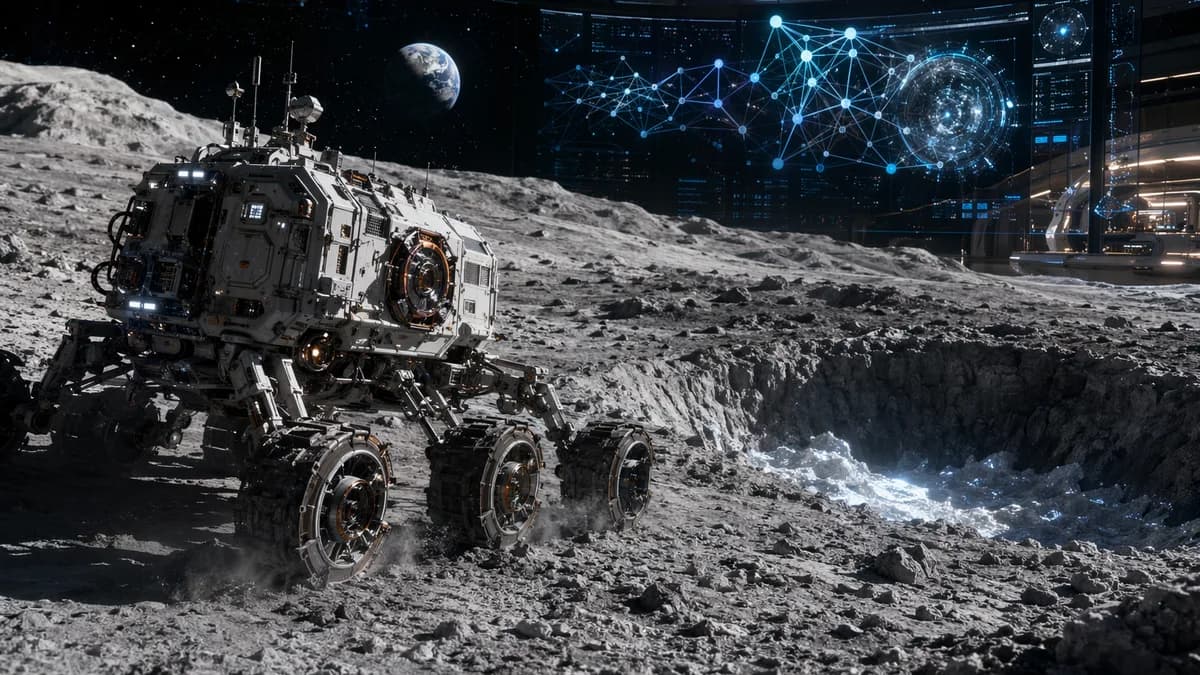
On Tuesday, NASA officials said they are seriously considering sending a nuclear-powered Mars rover test vehicle to the Moon, a shortcut that could give the agency a long-range robot for the lunar south pole without starting from a blank sheet. The rover is Promise, the full-scale engineering model for Perseverance, currently housed at the Jet Propulsion Laboratory in California, according to Ars Technica.
TechnologyJuly 1, 2026· 8 min read· By XOOMAR Insights Team
NASA May Turn Nuclear Mars Rover Into Moon Base Shortcut
Updated on July 1, 2026
XOOMAR Intelligence
Analyst Take
70/ 100
4 sources analyzedMedium confidenceTrend10Freshness97Source Trust90Factual Grounding96Signal Cluster20
The timing matters because NASA is trying to accelerate work around a future Moon base while focusing on the south pole, where darkness, rough terrain, and survival through the lunar night make solar-powered surface missions harder. A multi-mission radioisotope thermoelectric generator, or MMRTG, would let Promise keep operating without depending on sunlight.
“We are thinking very hard right now about sending Promise to the Moon,” NASA Administrator Jared Isaacman said Tuesday.
That sentence carries the story. NASA has a 1-ton Mars rover testbed, an available MMRTG, and a supply of Plutonium-238 that continues to decay over time, according to Ars. The question now is whether that existing hardware can become a lunar asset fast enough to matter.
On Tuesday, Promise moved from Mars testbed to Moon-base candidate
Promise was built to support Perseverance, not to fly. At JPL, engineers have used it in the “Mars yard” to test commands before sending similar instructions to the rover on Mars. It has also helped NASA check how Perseverance might handle different terrain.
That role made sense when Perseverance was newer. Perseverance launched in July 2020. Curiosity, its similarly sized predecessor, launched in November 2011. The argument now is that NASA has years of operating experience with both rovers on Mars, which changes the value calculation for keeping Promise on Earth.
In practical terms, NASA appears to be weighing whether the rover’s remaining usefulness as a ground testbed is greater than its possible value as a mobile lunar platform. That is a different kind of question from the one Promise was originally built to answer.
That’s the core trade. NASA would lose a ground testbed for Mars operations, but might gain a mobile lunar platform that can work where sunlight is unreliable or absent.
For XOOMAR readers, the management logic should sound familiar: scarce hardware gets redirected toward the highest-priority constraint. We’ve seen similar pressure in other domains, from compute demand in AI Data Centers Send RAM Prices Into a 4X Shock for PCs to operational bottlenecks in Real-Time Payment Liquidity Traps Banks at the Send Button. Different industries, same pattern: capacity matters most where delay is most expensive.
Why a nuclear-powered Mars rover would solve a specific lunar problem
The primary search keyword here is nuclear-powered Mars rover, but the nuclear part is not a branding flourish. It’s the operational difference.
NASA’s other rovers primarily operate on solar power, Ars reports. Promise would instead land with an MMRTG, the same broad class of power system used to produce electricity from the heat of radioactive decay. That matters on the Moon because the south pole includes terrain where illumination is uneven, and lunar night survival is a major constraint.
NASA officials have framed the appeal in practical terms: a rover with a nuclear power source would not have to plan every move around available sunlight. It could also make lunar-night survival less central to mission design, which is one reason the Promise idea is attracting attention.
That explains why Promise is attractive. A solar rover has to plan around light. A nuclear-powered rover can treat darkness as a navigation problem, not an existential threat.
| Rover approach | Power constraint | Practical implication |
|---|---|---|
| Solar-powered lunar rover | Depends on illumination | Operations are limited by darkness and lunar-night survival |
| Promise with MMRTG | Not dependent on sunlight | Could attempt longer traverses into harder-to-reach terrain |
| Purpose-built lunar rover | Depends on design choice | Could be optimized for the Moon, but would require a new development path |
The safety and approval side is not detailed in the supplied source material, so it should not be hand-waved. NASA has not presented this as a final mission. The current public signal is narrower: the agency is assessing whether an existing nuclear-powered Mars rover test article can be adapted for lunar use.
The south pole is the obvious target because darkness shapes the mission
NASA is considering Promise specifically to speed exploration of the lunar south pole region. That region is central to the agency’s Moon-base planning, and Ars reports that Isaacman’s team is scouring NASA for existing hardware and tools to advance the mandate to return to the Moon and build a surface base.
This is where a nuclear-powered Mars rover could shift mission design. The south pole is attractive because NASA wants to understand the environment where it plans a long-term human presence. It is also difficult because access, lighting, and terrain complicate rover operations.
A useful comparison is NASA’s history of studying ambitious long-range lunar rover ideas. The supplied source material does not verify a specific route, distance, or payload plan for those concepts, so the safer takeaway is broader: NASA has long been interested in robotic mobility that can cover scientifically valuable terrain beyond a lander’s immediate vicinity.
Promise would not automatically become that kind of mission. The route, instruments, landing site, and operational goals are not final. But the broader history shows the kind of lunar field science NASA has already imagined: long-distance robotic exploration across scientifically valuable terrain. Promise offers a different path toward that ambition, using hardware that already exists.
Analysis: the strategic value is not that Promise is perfectly lunar from day one. It isn’t. The value is that it combines proven Mars-rover heritage with a power source that removes one of the Moon’s hardest operating limits. If NASA wants durable surface mobility before a custom rover program can mature, Promise is the kind of asset that forces a serious look.
The immediate hurdle is turning Mars hardware into Moon hardware
NASA officials are not pretending Promise can be rolled out of JPL and bolted to a rocket tomorrow. The rover was designed around Mars operations, and NASA would need to determine how much modification is required for the Moon. The scientific instruments aboard the vehicle would also likely need to match lunar objectives rather than Mars priorities.
The launch system is another constraint. Because Promise has a mass of about 1 ton, NASA would need a lunar delivery system with enough payload capacity to put it safely on the surface. The supplied source material does not verify a specific delivery provider or vehicle, so the point is simpler: rover readiness and lander readiness would have to line up.
The adaptation question has three layers:
- Vehicle fit: Promise was designed around Mars operations, so NASA must prove it can survive and move effectively on the Moon.
- Science fit: The instruments need to match lunar objectives, not simply mirror Mars priorities.
- Delivery fit: The rover needs a lander large enough to put a 1-ton vehicle on the surface.
There is also a budget logic embedded in the discussion. NASA has taxpayer-funded hardware that was not otherwise planned for launch. Reusing it could create a visible lunar win. But reuse only works if modification, testing, delivery, and operations are cheaper or faster than building a purpose-made lunar rover.
The next decision is whether Promise becomes a lunar workhorse or stays a Mars insurance policy
The decision is not final. NASA is still assessing feasibility, and the source material does not provide a launch date, mission duration, cost estimate, landing site, or final instrument package.
Still, the direction is clear. Mars is not NASA’s near-term priority in this discussion. Ars reports that the agency is seeking to accelerate plans to land humans on the Moon’s south pole before China and explore the most interesting terrain there first.
That symbolism is hard to miss. Promise is valuable because it was built for Mars. Sending it to the Moon would mean NASA believes its lunar urgency outweighs the remaining value of keeping the rover as an Earth-based Mars testbed.
The practical watch item is simple: NASA has to show that this nuclear-powered Mars rover can be adapted, delivered, and operated on the Moon without turning a shortcut into a custom program by another name. If it can, Promise could give the lunar south pole something NASA badly wants: a rover that doesn’t fear the dark.
Impact Analysis
- Repurposing Promise could speed up NASA’s ability to explore the lunar south pole.
- Nuclear power would help a rover survive darkness and the lunar night where solar missions struggle.
- Using existing hardware and Plutonium-238 could reduce waste as the fuel continues to decay.
Rovers Mentioned in NASA’s Moon Plan
| Rover | Current Role | Key Detail |
|---|---|---|
| Promise | Full-scale engineering model for Perseverance at JPL | NASA is considering sending it to the Moon with an MMRTG |
| Perseverance | Active Mars rover | Launched in July 2020 |
| Curiosity | Earlier similarly sized Mars rover | Launched in November 2011 |
Sources

Written by
XOOMAR Insights Team
Research and Editorial Desk
The XOOMAR Insights Team pairs automated research with human editorial judgment. We track hundreds of sources across technology, fintech, trading, SaaS, and cybersecurity, cross-check the facts, and explain what happened, why it matters, and what to watch next. We do not just rewrite headlines. Every article is fact-checked and scored for reliability before it goes live, and we link back to the original sources so you can verify anything yourself.
Explore More Topics
Related Articles
 Technology
Anti-Vaccine Myths Cluster Around AI Chatbot Users
Frequent AI health users were more likely to believe vaccine myths, though the poll doesn't prove chatbots caused those beliefs.
Jul 1, 20268 min
 Technology
AI Jobs Panic Cracks as Ramp Study Finds Faster Hiring
Ramp's study found the heaviest AI spenders grew headcount 10% and entry-level hiring 12%, challenging the layoff panic.
Jul 1, 20267 min
 Technology
Billions Ride on AWS Public Sector AI's Cloud Grab
AWS is spending billions to make its cloud the default home for government AI, from classified workloads to spy agency migrations.
Jul 1, 20268 min
 Global Trends
55% Still Stay After Article 8 Asylum Reforms Clamp Down
The Home Office expects 11,700 extra refusals a year, but 55% of rejected asylum seekers may still remain in the UK.
Jul 1, 202611 min
 Global Trends
LeBron James Free Agency Turns Lakers Goodbye Into Leverage
LeBron James' polite Lakers goodbye makes his free agency feel less like drama and more like a controlled exit.
Jul 1, 20268 min
 Cybersecurity
FTC Hits Amazon With $2.25M Identity Theft Fine Over Records
Amazon will pay $2.25M after the FTC said identity theft victims were denied records needed to prove fraud on fake accounts.
Jul 1, 20268 min
 Technology
Meta Smart Glasses Paywall Puts Your AI on a Timer
Meta is capping Conversation Focus at three free hours a month, turning a useful smart glasses feature into a $20 subscription fight.
Jul 1, 20268 min
 Technology
$2 Token Price Throws Claude Sonnet 5 Into AI Agent War
Claude Sonnet 5 brings stronger AI agent features to cheaper default plans, turning token pricing into the new battleground.
Jul 1, 20268 min
 Fintech
$1B Trump Crypto Windfall Puts Presidency on Trial
Trump reported more than $1bn from crypto in 2025, turning a disclosure filing into a test of presidential conflicts.
Jul 1, 20268 min
 Technology
Sling Stays on Air as $2B Dish Bankruptcy Hits Court
Dish's Chapter 11 filing isn't a shutdown. Dish TV and Sling stay live while a $2B debt deadline shapes the reset.
Jul 1, 20266 min
Don't miss the signal
Get our weekly roundup of the stories that matter across tech, fintech, and trading. No noise, just signal.
Free forever. No spam. Unsubscribe anytime.