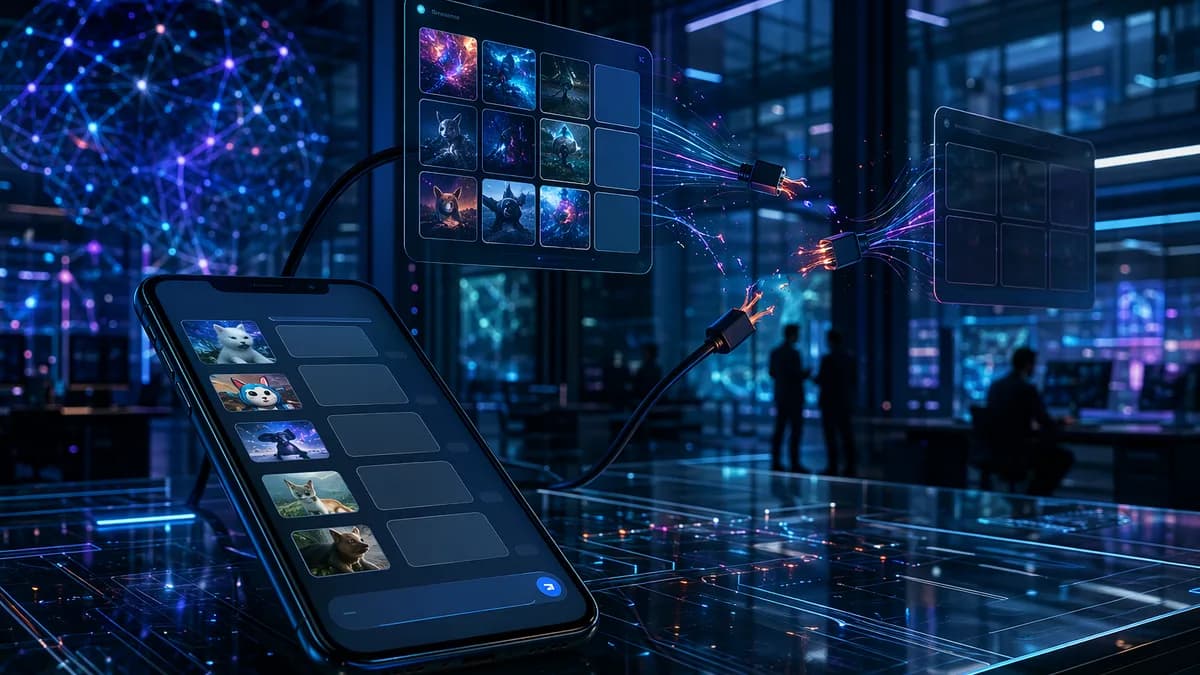
The important detail is what Google is not killing. Tenor.com stays live. Tenor's searchable GIF library stays live. Google will also keep using Tenor in its own services, including Google Messages and Gboard.
That split says more than the shutdown notice. Google is not abandoning GIF search. It is withdrawing the outside access layer that let other apps use Tenor as shared infrastructure.
Google's stated rationale is narrower:
“As part of an ongoing effort to focus resources on enhancing our core products, we’ve made the decision to sunset the Tenor API on June 30, 2026.”
XOOMAR analysis: that phrasing matters. “Core products” is the tell. The Tenor API had value when broad distribution helped Google own a slice of internet expression. Now, Google is keeping that value closer to home.
For users, the Tenor API shutdown may show up as a smaller GIF catalog, different search results, missing favorites, or a redesigned picker. For app makers, it is a forced migration of a social habit that people barely think about until it breaks.
The Verge reports that affected platforms include X, Discord, Bluesky, and WhatsApp. X Product head Nikita Bier said on June 21st that the platform was “forced to migrate,” though he did not identify the replacement provider. Discord started testing Giphy and Klipy as Tenor alternatives in January. WhatsApp was working on replacing Tenor with Klipy in May.
That range of responses shows the problem. There is no universal replacement that preserves the exact same experience. GIF libraries vary by provider, and The Verge notes the most visible user change may be losing access to favorite Tenor GIFs.
| Platform |
Reported Tenor API response |
| X |
Nikita Bier said it was “forced to migrate” |
| Discord |
Tested Giphy and Klipy alternatives in January |
| WhatsApp |
Worked on replacing Tenor with Klipy in May |
| Bluesky |
Listed among platforms that previously integrated the API |
This is the quiet weakness in many social products. A lightweight feature can become emotional infrastructure. GIFs carry jokes, fandom references, sarcasm, and fast reactions. If the picker changes, the conversation changes with it.
For a related XOOMAR lens on fragile consumer tech dependencies, see Old Android Phone Rescues Your Home Router From Outages. The connection is simple: users often discover hidden infrastructure only after it disappears.
Google acquired Tenor in 2018. The service lets users search for GIFs by keyword, similar to Giphy and Klipy. That made Tenor useful as embedded media plumbing across messaging apps and social platforms.
Then Google started closing the door.
January 13th: Google stopped accepting requests for new Tenor API sign-ups and integrations, according to its Tenor FAQ page cited by The Verge.
June 30th, 2026: Google says API agreements and current integrations will be “fully decommissioned.”
After the deadline, Google says any API request will fail and return an error message.
That sequence gave developers some runway, but it also turned migration from a product choice into a deadline. Apps either switch providers, build alternatives, or let a visible feature degrade.
XOOMAR analysis: the data point that matters most is not a traffic number. The supplied reporting does not provide current Tenor usage volume. The more important signal is distribution. The affected apps named in the reporting span social feeds, messaging, and chat. Tenor was not just a website people visited. It was an invisible layer inside other products.
This fits a broader Google product focus question, though the source material here gives only Google's stated API rationale. XOOMAR readers tracking Google's consumer product tradeoffs may also want our coverage of Free Gemini AI Image Generation Mines Your Google Data, but the Tenor story stands on its own: outside access is ending while Google-owned integrations remain.
The regulatory history around Giphy helps explain why this small product change has larger platform stakes. After Meta announced plans to acquire Giphy in 2020, the UK's Competition and Markets Authority described Tenor as the only equivalent “large provider of GIFs,” according to The Verge. The CMA also said the Giphy acquisition would “negatively impact competition between social media platforms.”
Meta was later made to divest the GIF library in 2023.
That history matters because it shows GIF databases are not just novelty archives. They are searchable media layers embedded into communication products. The company that controls the index can influence which reactions are easy to find, which references travel fastest, and which platforms get reliable access.
Here is the strategic contrast:
| GIF service |
Path described in supplied reporting |
| Tenor |
Acquired by Google in 2018. Website remains live. Third-party API access is being shut down. Google products keep integrations. |
| Giphy |
Meta announced an acquisition in 2020. UK regulators challenged the deal. Meta was made to divest it in 2023. |
| Klipy |
Named as an alternative tested or adopted by affected apps, including Discord testing and WhatsApp replacement work. |
XOOMAR analysis: ownership is the core issue. If a GIF library is embedded everywhere, it becomes part of the social interface. If it is owned by a major platform, access can change when strategic priorities change.
Google wants focus. That is the only incentive explicitly stated in the supplied reporting. The company says the API is being shuttered to focus resources on core products, while Tenor remains available inside Google services.
App makers want continuity. X, Discord, Bluesky, and WhatsApp do not benefit from users suddenly wondering why their GIF picker feels worse. Even if the replacement works, altered results can make a familiar search feel broken.
Creators and rights holders sit in a murkier position. The supplied sources do not detail licensing terms, creator payouts, or attribution mechanics for Tenor. So the safer point is this: visibility inside a major GIF library can shape cultural reach, and shifting providers can change which media appears in front of users.
Users want the least strategic thing of all. They want the GIF they had yesterday.
That is why the Tenor API shutdown is likely to irritate people out of proportion to the feature's apparent size. A GIF picker is a tiny button until it fails in the middle of a fast-moving conversation.
Google's move will not kill GIFs. It will make GIF infrastructure more fragmented.
The next evidence to watch is practical, not theoretical:
- Provider choices: Which apps settle on Giphy, Klipy, or something else?
- User behavior: Do complaints center on missing favorites, weaker search matches, or broken recents?
- Google's own products: Does Tenor become more visibly tied to Gboard, Google Messages, and other Google-controlled surfaces?
- Developer resilience: Do apps add fallback providers so one API change cannot break a familiar feature again?
XOOMAR analysis: the Tenor API shutdown is a warning about product dependence disguised as a GIF story. The apps affected did not lose the concept of GIF search. They lost guaranteed access to one major provider's index.
If replacement services preserve search quality and favorites, this fades into a minor interface change. If users keep noticing missing reactions and thinner results, the lesson gets sharper: even the playful parts of the internet need infrastructure planning.
- Major apps will need to replace or rebuild GIF search flows that users rely on in everyday conversations.
- Google is keeping Tenor for its own products while ending the shared access layer for competitors and partners.
- The move highlights how small media tools like GIF pickers can become points of platform control.