
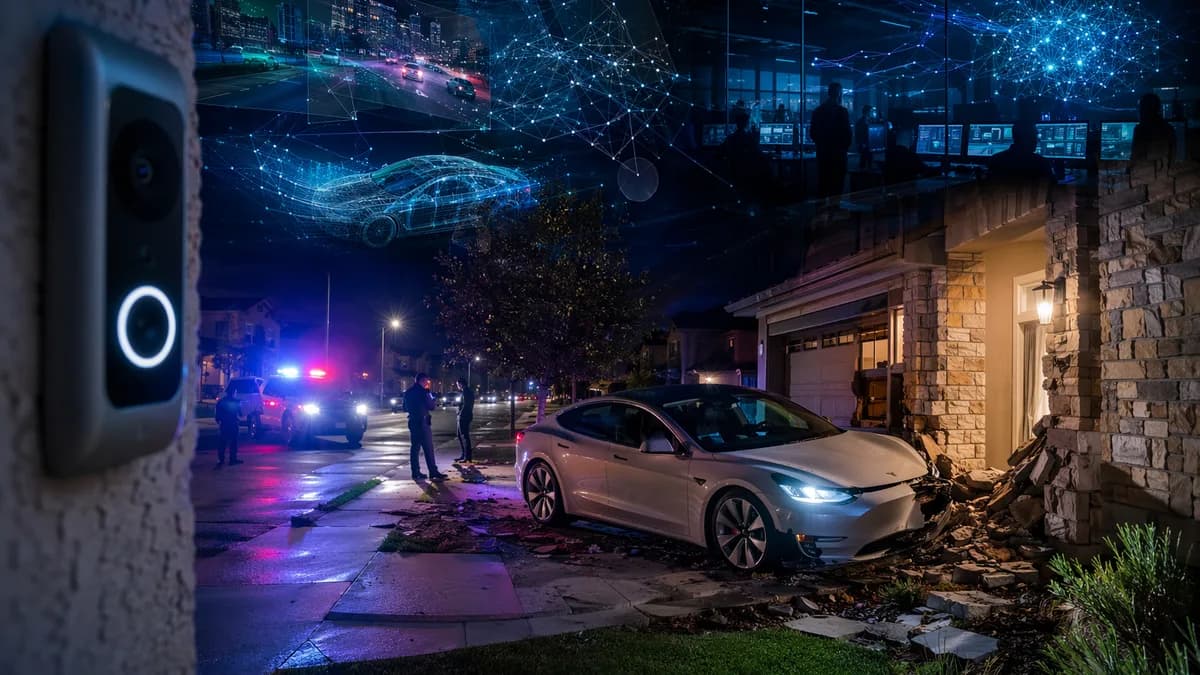
On Friday night, a Tesla Autopilot crash moved the debate over driver-assistance software from highways and court filings into a family’s front room.
TechnologyJune 23, 2026· 8 min read· By XOOMAR Insights Team
Doorbell Cam Catches Tesla Autopilot Crash Killing Woman
Updated on June 23, 2026
XOOMAR Intelligence
Analyst Take
70/ 100
4 sources analyzedMedium confidenceTrend10Freshness94Source Trust90Factual Grounding90Signal Cluster40
Martha Avila, 76, died after a Tesla Model 3 crashed into her home in Katy, Texas, while the driver told police an automated driver-assistance system was engaged, according to Ars Technica. The next day, Tesla’s X account reposted praise calling the company’s technology “both magical and life changing, relaxing and maybe even lifesaving!”
That timing is the story. Not because investigators have determined Autopilot caused the crash. They haven’t. The Harris County Sheriff’s Office is still investigating, and the National Highway Traffic Safety Administration told Ars it is launching a special crash investigation. But the contrast is brutal: a grandmother killed inside a home, and a company still selling the public on automation as a safety breakthrough.
Friday’s Tesla Autopilot crash turned a private home into the crash scene
The Harris County Sheriff’s Office said Michael Butler was operating a Tesla Model 3 when he “failed to drive in a single lane, left the roadway, and struck the residence” at a “high rate of speed.” Butler told police “he was operating with an automated driving-assistance system engaged at the time of the crash.”
Police said Butler was not intoxicated and is cooperating. That matters. It keeps the early focus on two questions investigators now have to separate cleanly: what the driver did, and what the system did.
Avila was standing in the front room of the house, where she lived with her daughter, son-in-law, and three young grandchildren. Her daughter, Jennifer Barbour, told a local outlet that no one else was hurt. The family is now mourning while living in a hotel and waiting for answers.
“I don’t know if it’s his fault or the car’s fault or what really happened,” Barbour said. “I’ve never seen a car go that fast.”
XOOMAR analysis: that uncertainty is exactly why the Tesla Autopilot crash will become more than a local fatality. It sits at the fault line between software branding, driver responsibility, and the public’s tolerance for rare but catastrophic failures.
Doorbell footage will shape the first public version of the crash
The doorbell camera footage matters because it gives the public something official statements rarely provide: a visual record of speed, trajectory, and impact. Ars reported that The New York Times shared video showing the Tesla plowing through the brick front of the home. Other local reporting described Ring doorbell footage capturing the vehicle crashing into the house at high speed.
Video won’t answer everything. It won’t, by itself, prove whether Autopilot steered, accelerated, failed to brake, or simply remained engaged while the driver lost control. But it can anchor the timeline.
Investigators and litigators will likely focus on:
- Autopilot status: whether the driver-assistance system was active, when it engaged, and whether it disengaged before impact.
- Driver inputs: steering, braking, accelerator use, and any manual override attempts.
- Warnings: whether the vehicle issued driver-attention alerts before the crash.
- Vehicle behavior: speed, lane position, braking records, and steering data.
- Scene reconstruction: curb strikes, roadway departure, home impact angle, and damage pattern.
XOOMAR analysis: the legal distinction is narrow but decisive. A crash involving Autopilot is not automatically a crash caused by Autopilot. The first draws scrutiny. The second changes liability.
This is consumer technology as evidence, not convenience. XOOMAR often covers connected devices in lighter contexts, from AirTags Prime Day Deal Cuts Trackers to $22.50 Each to Apple Watch SE 3 Crashes to $199 in Prime Day Steal. Here, the device that matters is a doorbell camera recording the moment software claims meet physical consequences.
Tesla’s safety pitch now runs into the crash people can see
Tesla’s public position has long been that automation can reduce crashes by cutting human error. Ars notes that automated-vehicle makers often cite a 2019 NHTSA study finding that 94 percent of crashes were linked to human error.
But Advocates for Highway and Auto Safety told NHTSA that such claims are “misleading” because the agency described human error as a “critical reason” linked to crashes, not a formal assignment of cause or fault to the driver, vehicle, or environment.
That distinction matters here. Tesla can argue that driver-assistance systems improve safety when used correctly. Critics can answer that branding and design shape how drivers actually behave.
Tesla’s own materials also contain the tension. Fox News cited Tesla’s website saying:
“Autopilot and Full Self-Driving Capability are intended for use with a fully attentive driver, who has their hands on the wheel and is prepared to take over at any moment,” the website says. “While these features are designed to become more capable over time, the currently enabled features do not make the vehicle autonomous.”
Yet Ars reported that as recently as May, Tesla’s X account posted an ad showing drivers with their hands off the wheel while goofing off or drinking coffee with both hands.
XOOMAR analysis: charts and claims can help Tesla in policy debates. They won’t neutralize a fatal Tesla Autopilot crash caught on home video. The public remembers the house.
Four audiences now see four different Autopilot stories
The same crash produces different readings depending on who has to live with the consequences.
| Audience | The story they see |
|---|---|
| Tesla owners | Autopilot remains a driver-assistance feature, not permission to disengage. The manual and website warnings are not fine print after a fatal crash. |
| Avila’s family | A loved one died in a place that should have been safe. Technical distinctions between driver fault and system fault may feel secondary until evidence answers them. |
| Regulators | NHTSA must decide whether existing rules and enforcement tools match how companies market and deploy automation. |
| Tesla supporters and investors | Automation is central to Tesla’s future narrative, but every fatal incident raises the cost of public trust. |
The family’s position is the hardest to argue with emotionally. Avila was not a road user. She was inside her home. That shifts the moral weight of the crash.
It also complicates Tesla’s usual safety framing. A driver accepts some road risk by getting behind the wheel. A grandmother putting away groceries or standing in a front room does not.
Prior Autopilot scrutiny makes this crash harder for Tesla to compartmentalize
This crash does not arrive in a vacuum. In 2023, Tesla recalled more than 2 million vehicles, every car with Autopilot, after regulators found the company had not deployed the feature in a way that required drivers to remain attentive. Ars reported that recall followed a 2021 NHTSA investigation into crashes and fatalities involving the technology.
The regulatory backdrop is now moving fast. Ars reported that NHTSA Administrator Jonathan Morrison described 2026 as a “big” year for automated-vehicle rulemaking. He said the agency wants to remove “unnecessary regulatory barriers” and allow commercial deployment of purpose-built AVs without traditional controls such as steering wheels or brake pedals.
Morrison also said:
“I’m talking about vehicles that would never require human intervention, vehicles you can take a nap in,” Morrison said.
That quote lands differently after Katy. Tesla’s current Autopilot is not that system. Tesla says drivers must remain attentive and ready to take over. But the branding gap remains: Autopilot and Full Self-Driving sound more capable than the legal and operational limits described in the warnings.
XOOMAR analysis: this is the core accountability problem. If a feature name sells confidence, but the disclaimer assigns responsibility back to the driver, regulators will keep asking whether the product is being understood as designed.
The next fight will center on video, telemetry, and rules Tesla can’t market around
The immediate decision point is evidentiary. NHTSA’s special crash investigation, local police findings, vehicle data, and video analysis will determine whether this remains a fatal crash with Autopilot engaged or becomes a case where the system’s behavior is directly implicated.
For Tesla, the communications risk is already clear. Reposting praise about Autopilot being “maybe even lifesaving” the day after a fatal crash involving alleged driver-assistance use may fit the company’s broader confidence in automation, but it looks tone-deaf against the facts now public.
For regulators, the Katy crash sharpens the policy question. If automation is advancing toward vehicles with fewer human controls, then driver-assistance systems on today’s roads need naming, monitoring, and disclosure standards that ordinary drivers can’t misunderstand.
The watch item now is simple: if the vehicle data shows clear driver misuse with adequate warnings and intervention opportunities, Tesla’s defense strengthens. If it shows weak attention checks, confusing system behavior, or limited response before a high-speed roadway departure, the Tesla Autopilot crash becomes a much larger test of the company’s safety claims.
Autonomy won’t be derailed by one crash. But the era of treating software safety claims as self-validating is ending.
Impact Analysis
- The crash puts renewed scrutiny on how Tesla’s driver-assistance systems behave in real-world conditions.
- Federal investigators are now examining a fatal incident where the driver said automation was engaged.
- The case highlights the gap between marketing claims about safety technology and unresolved questions after deadly crashes.
Sources
- [1] Ars Technica
- [2] Tesla in autopilot mode left roadway and crashed into home, killing 76-year-old woman inside, officials say
- [3] Disturbing video shows Tesla crash into Texas home, killing grandma, 76, in latest Autopilot controversy
- [4] Driver says Tesla was in autopilot mode when it plowed into Texas home, killing 76-year-old woman

Written by
XOOMAR Insights Team
Research and Editorial Desk
The XOOMAR Insights Team pairs automated research with human editorial judgment. We track hundreds of sources across technology, fintech, trading, SaaS, and cybersecurity, cross-check the facts, and explain what happened, why it matters, and what to watch next. We do not just rewrite headlines. Every article is fact-checked and scored for reliability before it goes live, and we link back to the original sources so you can verify anything yourself.
Explore More Topics
Related Articles
 Technology
49ers Coach Blames Tesla Autopilot for Bone-Breaking Crash
San Francisco 49ers head coach Kyle Shanahan suffered broken bones in a crash where his Tesla was on Autopilot, revealing deep confusion over whether the system
Aug 9, 202610 min
 Technology
Amazon's Gas Plant Permits 33 Million Tons of CO2
Amazon's planned Texas data center, powered by a dedicated natural gas plant, has a permit to emit 33 million tons of CO2 annually, potentially making it the la
Aug 8, 20267 min
 Technology
Amazon's Texas Gas Power Plant Betrays Climate Pledge
Amazon's investment in a private gas-fired power plant to run its Texas AI data centers makes a mockery of the company's Climate Pledge, prioritizing power reli
Aug 8, 20267 min
 Technology
Ford's Fathom EV Model T Claim Masks Deep Sales Crisis
Ford CEO Jim Farley's pitch of the Fathom EV as a 'Model T moment' reveals a desperate company struggling for relevance as its sales sit at less than half their
Aug 8, 20266 min
 Global Trends
Court Cancels Russia's Only Anti-War Party on 'Extremism'
A Moscow court disqualified Russia's only registered anti-war political party from parliamentary elections, using allegations of extremism and copyright infring
Aug 10, 20266 min
 Fintech
Banks Invade Earned Wage Access, Force Fintechs Out
Major banks and credit unions are launching earned wage access to retain customers and gather data, forcing original fintech providers into a defensive scramble
Aug 10, 20264 min
 Fintech
Brazil Aims Pix Payments at Global Payment Giants
Brazil's central bank is pushing its dominant Pix instant payment system onto the global stage, aiming to reshape cross-border payments and challenge establishe
Aug 10, 20267 min
 Technology
Zuckerberg's Personal AI Pitch Betrays Meta's True Motive
Mark Zuckerberg's new AI manifesto, promising universal 'personal superintelligence,' inadvertently exposes the commercial engagement and data-harvesting logic
Aug 10, 20265 min
 Technology
Tech Giants Lose Major Ruling, Face 2,400 Addiction Suits
A federal appeals court refused to let Meta, Google, TikTok, and Snapchat use Section 230 to quickly dismiss thousands of lawsuits accusing them of intentionall
Aug 10, 20266 min
 Fintech
CFPB Opens Gate for Banks to Charge Open Banking Fees
The CFPB may scrap its ban on data-access fees, allowing banks to charge third-party apps for your transaction history and potentially crippling the free flow o
Aug 10, 202610 min
Don't miss the signal
Get our weekly roundup of the stories that matter across tech, fintech, and trading. No noise, just signal.
Free forever. No spam. Unsubscribe anytime.