
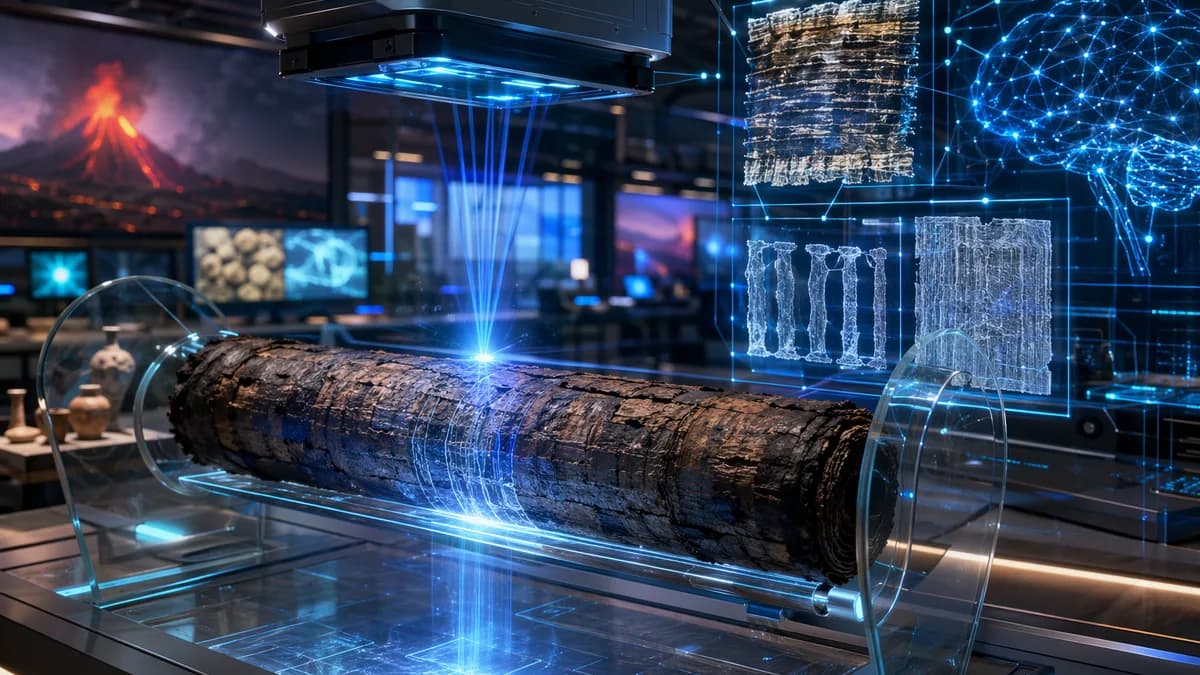
A Vesuvius-burned papyrus scroll that looked more like a lump of carbon than a book has now yielded 20 columns of hidden text without being opened by hand.
TechnologyJune 28, 2026· 7 min read· By XOOMAR Insights Team
AI Cracks Vesuvius Papyrus Scroll Sealed in Carbon
Updated on June 28, 2026
XOOMAR Intelligence
Analyst Take
69/ 100
4 sources analyzedMedium confidenceTrend10Freshness96Source Trust90Factual Grounding91Signal Cluster20
Researchers virtually unwrapped the surviving part of PHerc 1667, a scroll recovered from Herculaneum, and read more than a metre of charred papyrus with help from artificial intelligence, according to Guardian World. The text discusses Stoic philosophy on ethics, art and human behaviour, and dates to the second or late-third century BC.
Why does an AI-read Vesuvius papyrus scroll matter for ancient philosophy?
The phrase AI read Vesuvius papyrus scroll sounds like a tech stunt. It isn’t. The real achievement is access: a text that could not be safely opened has become readable without destroying the object.
That matters because Herculaneum’s carbonized scrolls have long posed a brutal conservation problem. They survived the eruption of Mount Vesuvius in AD79, but the same heat that preserved them also made them nearly impossible to handle. Earlier efforts to unwrap PHerc 1667 damaged it. The Guardian reports that the scroll was broken in half at some point, while previous unwrapping attempts caused outer layers to flake off or disintegrate.
The newly revealed text is not a sensational “lost secret.” Its value is quieter and more serious. It gives scholars direct evidence from an ancient philosophical work that appears to belong to the Stoic tradition, rather than forcing them to infer from scraps.
XOOMAR analysis: The breakthrough is not that AI “understands” ancient philosophy. It doesn’t. The breakthrough is that machine learning can help make invisible ink signals visible enough for papyrologists to do their work. The machine opens the door. Scholars still have to walk through it.
How did Mount Vesuvius turn papyrus scrolls into unreadable carbon blocks?
The scroll came from the library of a luxury Roman villa in Herculaneum, near Naples. The villa was blasted by heat and buried under ash when Vesuvius erupted and destroyed nearby Pompeii in AD79.
That disaster created a paradox. The papyri were preserved, but in a form that made them almost unusable. Their layers were carbonized, crushed, warped and fused. The result was a three-dimensional object whose writing sits inside a blackened roll.
The physical challenge is severe:
| Problem | Why it matters |
|---|---|
| Carbonized papyrus | The writing surface is fragile and can crumble if handled. |
| Carbon-based ink | Ink can be hard to distinguish from the burned papyrus around it. |
| Warped layers | Pages no longer lie flat, so text must be reconstructed in 3D. |
| Past handling damage | PHerc 1667 is now only 8cm tall and 2cm wide, about half the original size. |
The wider Herculaneum collection is among the most important surviving ancient libraries. The National Endowment for the Humanities describes the cache as more than 1,800 charred and carbonized papyri discovered in 1752 at a villa thought to have belonged to Julius Caesar’s father-in-law.
Traditional conservation tools hit a wall because the scrolls are not just brittle books. They are compressed archives. Open them carelessly and the text can turn to dust.
How can artificial intelligence read a scroll without unrolling it?
Virtual unwrapping starts with scanning. Researchers capture high-resolution images of the scroll’s internal structure, then trace the curved layers inside the roll. Those layers are digitally separated and flattened so that the writing surface can be examined without moving the papyrus.
Then AI enters the process. Machine-learning models are trained to spot subtle patterns in the scan data that may correspond to ink. In the Herculaneum scrolls, that is especially hard because the ink and papyrus were both carbonized.
One useful comparison: imagine trying to read a crushed, blackened book by reconstructing every page from a medical-style scan, then enhancing hidden writing pixel by pixel.
But AI does not translate a scroll in one click. It helps identify likely ink signals. Human experts still have to verify letters, assemble words, follow column order and interpret the text.
Prof Brent Seales, a computer scientist at the University of Kentucky, laid the foundation for this work. The Vesuvius Challenge, launched in 2023, built on his research and invited teams to use AI and other software to read the carbonized scrolls from high-resolution X-ray images.
“People now know that this can be done and now we’re exploring what [the texts] actually mean,” Seales said. “For me that’s the World Cup. I just won the World Cup: that’s my victory.”
What did researchers find in the newly revealed Stoic philosophy text?
The headline result is specific: researchers recovered 20 columns of previously hidden writing across more than one metre of charred papyrus from PHerc 1667.
The title and author are still unknown. But Federica Nicolardi, a papyrologist at the University of Naples Federico II, and colleagues argue that the text appears to be a Stoic treatise. The work may have been authored by Chrysippus, the third head of the Stoic school, though that remains an attribution based on analysis rather than a settled identification.
The text refers to Aristocreon, Chrysippus’s nephew and pupil. It also discusses hormē, a Stoic term often translated as impulse, and warns that failing to regulate behaviour with reason can lead to harmful passions and a diversion from one’s goals. Another concept is phronēsis, or practical wisdom, treated in Stoic philosophy as the highest virtue.
“We will inquire into something, but we will not grasp it, if in some way we depart from ourselves and from our own nature.”
Nicolardi described the result as a proof point for the whole method:
“We don’t have the full scroll, but the surviving object was unwrapped and that’s a very important result because it shows that we are able to unwrap these objects completely.”
For readers following AI’s shift from general-purpose demos into specialist research, XOOMAR’s coverage of Elite Researchers Bolt Google AI for OpenAI, Anthropic offers a separate lens on why technical talent and model capability now matter far outside consumer chatbots. And in a different corner of technology constraints, GTA 6 Console Prices Slam Late Buyers Before Launch shows how hardware access can shape what users actually experience.
What does this Vesuvius scroll reveal about AI's limits in reading ancient texts?
PHerc 1667 is a strong mini case study because the result is substantial but still bounded. The researchers recovered continuous text, not just stray letters. Yet the process depended on scanning, layer mapping, model training and expert review.
The risks are obvious. AI can surface patterns that look like ink but may not be reliable. Letters can be incomplete. Word breaks can be uncertain. Column order matters. A fragment can tempt readers into a stronger claim than the evidence supports.
Scholars build confidence by checking letter shapes, comparing Greek vocabulary, reading across columns and testing whether a passage makes philosophical sense. In this case, the Stoic interpretation rests on content, dating, internal references and conceptual vocabulary.
XOOMAR analysis: AI changes the scale of what scholars can inspect. It does not remove the burden of proof. The strongest claims will still be the ones that survive slow philological review.
Could AI help recover more lost books from Herculaneum's buried library?
The next phase is larger than one scroll. If the same virtual unwrapping techniques scale, more unopened or unreadable Herculaneum texts could become legible without destructive handling.
There is already another result from the same effort. Researchers virtually unwrapped another scroll and found the words “Philodemus, On Gods, Book 8”, showing for the first time that On Gods was a multi-book work. Previously, only the first had been identified.
Nicolardi put the shift plainly:
“These unopened Herculaneum Scrolls look like dead books, but they’re not. They’re starting to speak again.”
The watch item now is not whether AI can help read a Vesuvius papyrus scroll. That question has been answered. The harder test is whether researchers can turn more scans into reliable editions, with enough collaboration between computer scientists and papyrologists to separate signal from wishful reading.
Why It Matters
- AI helped reveal 20 columns of hidden text from a Vesuvius-burned scroll without physically opening it.
- The discovery gives scholars new direct evidence from an ancient Stoic philosophical work.
- The method could help recover more texts from fragile Herculaneum scrolls that were previously unreadable.
Reading Herculaneum Scrolls: Old vs New Approach
| Approach | What It Does | Risk to Scroll |
|---|---|---|
| Physical unwrapping | Attempts to open the carbonized papyrus by hand | Can cause layers to flake off or disintegrate |
| AI-assisted virtual unwrapping | Uses scans and machine learning to reveal hidden ink without opening the scroll | Preserves the object while making text readable |
Sources

Written by
XOOMAR Insights Team
Research and Editorial Desk
The XOOMAR Insights Team pairs automated research with human editorial judgment. We track hundreds of sources across technology, fintech, trading, SaaS, and cybersecurity, cross-check the facts, and explain what happened, why it matters, and what to watch next. We do not just rewrite headlines. Every article is fact-checked and scored for reliability before it goes live, and we link back to the original sources so you can verify anything yourself.
Explore More Topics
Related Articles
 Technology
Meta Releases Glimmer AI to Spark Personal Superintelligence Race
Meta released its open Glimmer AI model to run powerful agents locally on a consumer GPU, directly challenging the cloud-based models of rivals like OpenAI and
Aug 14, 20269 min
 Technology
AI's Founders Declare Open Models Unstoppable
Three AI pioneers argue that open-weight models are an irreversible reality, and the US must compete within that open world or risk ceding control to a closed e
Aug 12, 20266 min
 Technology
AI Tools Automate Half Your Startup Fundraising Grind
Artificial intelligence can now automate nearly half the manual labor of startup fundraising, freeing founders to focus on investor relationships and storytelli
Aug 13, 202613 min
 Technology
AI Tools Turn Meeting Notes Into Trackable Tasks
Modern AI tools now extract action items and assign tasks directly from meeting talk, solving a major productivity drain for teams.
Aug 13, 202614 min
 Technology
Slash Support Time Instantly With No-Code Chatbots
You can build a powerful AI support chatbot in minutes without any coding, dramatically cutting costs and saving valuable agent time while improving customer se
Aug 13, 202612 min
 Technology
Servers Go Dark, Your Purchased Games Vanish Forever
Publishers treat games as disposable services you rent, not products you own, erasing them permanently when they're no longer profitable.
Aug 14, 20268 min
 Technology
French Court Torpedoes Macron's Social Media Ban for Minors
France's Constitutional Council struck down a landmark law that would have banned children under 15 from social media, ruling the blanket restriction violated c
Aug 14, 20264 min
 Technology
This $20 App Stalks Your To-Do List Until You Do It
Developer Marco Arment just launched Unforgetful, a $20/year app that sends persistent, repeating notifications that don't stop until you complete your task.
Aug 14, 20267 min
 Fintech
Women Inherit $100 Trillion, Trashing Old Wealth Management Playbooks
Women will inherit over $100 trillion by 2048, but most have never met a financial advisor. To win their business, advisors must redesign their practice around
Aug 14, 20265 min
 Technology
Vendor Mortality Scars Businesses Left Without Data
The primary risk in enterprise cloud computing is no longer downtime, but the permanent loss of critical data when a storage vendor goes out of business, a cost
Aug 14, 20269 min
Don't miss the signal
Get our weekly roundup of the stories that matter across tech, fintech, and trading. No noise, just signal.
Free forever. No spam. Unsubscribe anytime.