
Walmart’s global ad business reached nearly $6.4 billion in fiscal 2026, while Amazon’s advertising business exceeded $70 billion over the latest 12 months. That gap explains why Walmart connected TV advertising is no side project. It’s Walmart’s attempt to move the purchase funnel onto the biggest screen in the home.
TechnologyJune 26, 2026· 7 min read· By XOOMAR Insights Team
Walmart Connected TV Advertising Ignites Prime Day Data War
Updated on June 27, 2026
XOOMAR Intelligence
Analyst Take
72/ 100
4 sources analyzedMedium confidenceTrend10Freshness100Source Trust88Factual Grounding90Signal Cluster20
The trigger is sale week. Amazon Prime Day runs June 23 through June 26, while Walmart Deals started one day earlier and ends two days later, according to PYMNTS. U.S. online spending across retailers hit $8.3 billion on Prime Day’s first day, up 5.3% from a year earlier, Adobe Analytics said.
That number shows shoppers are still spending. It doesn’t show that discounts are the real prize.
Walmart connected TV advertising is the real Prime Day counterattack
The sale events are the visible fight. The deeper contest is over who controls the ad, the screen, and the data trail before a purchase happens, a fight now extending into the smart glasses platform war.
Walmart’s agreement to buy Vibe.co, a French advertising startup, was reported by The Wall Street Journal at $1.4 billion. That deal matters because it slots into Walmart’s earlier $2.3 billion Vizio acquisition in 2024. Vizio gives Walmart a living-room screen. Vibe brings self-service software for smaller advertisers. Walmart Connect brings shopper data and measurement across online and in-store purchases.
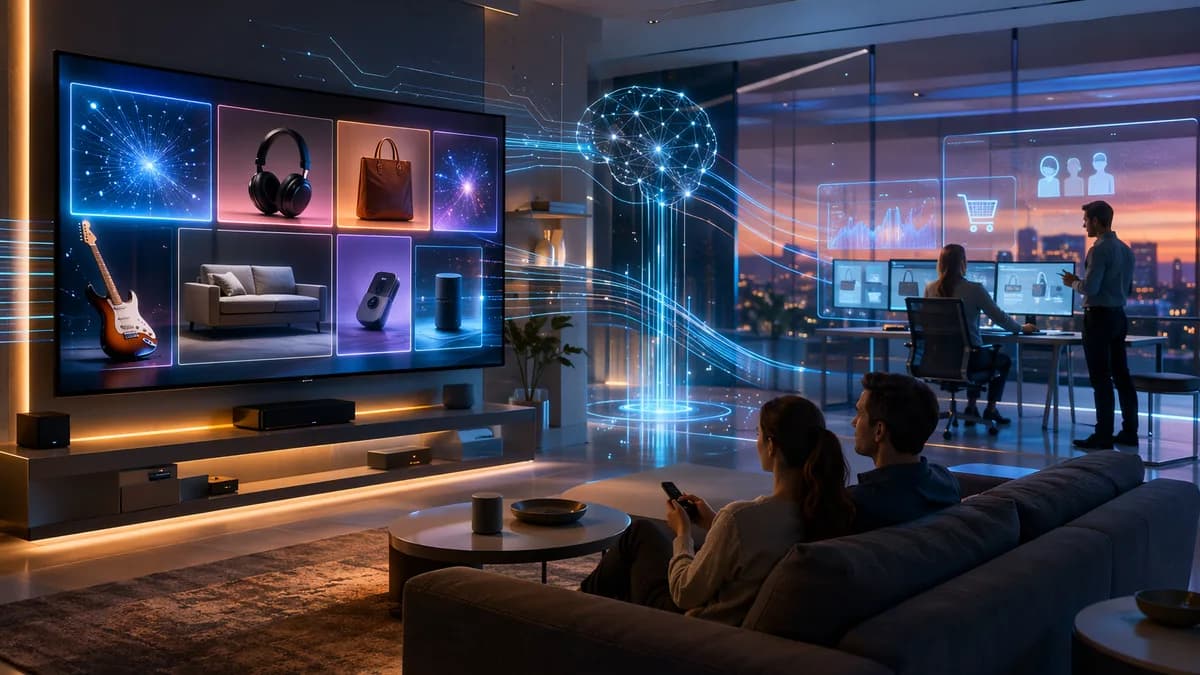
Put together, Walmart is trying to make the TV screen behave less like passive media and more like a retail surface. A brand can show an ad, push a viewer toward a product, then ask whether that exposure turned into a sale.
That is the strategic point behind Walmart connected TV advertising. Walmart doesn’t have to beat Amazon as the top US retailer only by extending sale dates or matching discounts. It can try to own more moments before shoppers even open a retail app.
The discount side still matters. XOOMAR has tracked how sale events are fragmenting across retailers in Anti-Prime Day Deals Undercut Amazon's Sale Prices, while the device category remains a key battleground, as seen in Prime Day TV Deals Punish 2026 FOMO With OLED Cuts, Prime Day router deals, and the $269 Bose Prime Day deal. But Walmart’s bigger move is infrastructure, not markdowns.
The sale numbers show demand, not loyalty
The $8.3 billion first-day Prime Day spending figure is a strong demand signal. A 5.3% year-over-year increase across U.S. online retailers suggests shoppers are still willing to buy when the promotional calendar gives them a reason.
But XOOMAR analysis: that spending number doesn’t prove shoppers are becoming more loyal to any one retailer. It proves large sale events can concentrate demand. It also shows why retailers want longer windows. Walmart Deals beginning before Prime Day and ending after it gives Walmart more time to capture attention around Amazon’s tentpole event.
There’s another layer. Longer sale periods create more room for ads, sponsored placements, product discovery, and measurement. That matters more when a retailer’s ad business is becoming a profit engine.
Walmart’s advertising business is still far smaller than Amazon’s. The direction, though, is clear:
| Company | Reported ad scale | Strategic read |
|---|---|---|
| Walmart | Nearly $6.4 billion global ad business in fiscal 2026, up 46% | Smaller base, faster growth, acquisition-backed push into TV |
| Amazon | Advertising business exceeded $70 billion over the latest 12 months | Much larger machine with mature commerce-media links |
Walmart’s latest quarter added another signal: its global ad business grew 37%. That gives the company a reason to keep buying capabilities rather than treating advertising as an add-on to retail.
Vizio gives Walmart the screen, Vibe.co gives it more advertisers
Vizio is the hardware and connected-TV doorway. Vibe.co is the ad-buying tool Walmart needs if it wants more than big national brands using that doorway.
The source says Vibe’s software is designed to let smaller companies, including Walmart marketplace sellers, launch connected-TV campaigns without a large agency or media-buying staff. That matters because connected TV has traditionally been harder for smaller advertisers to access at scale.
If Walmart can make TV buying feel closer to buying search ads, it widens the advertiser pool. More advertisers can mean more demand for Vizio inventory. More campaigns can mean more data. More data can improve Walmart’s pitch to brands that want proof, not just reach.
NScreenMedia analyst Colin Dixon captured the core value of the model:
“Definitive attribution makes the ads far more valuable to brands.”
That’s the heart of Walmart connected TV advertising. The sell is not just that a viewer saw a patio set during a program. It’s that Walmart can tell a supplier whether exposure connected to a purchase online or in stores.
“Backyard Escapes” shows the pitch, and the risk
Walmart has already tested the model with “Backyard Escapes,” a Vizio program hosted by Tan France. Supplier products appeared inside makeover content, and viewers were directed toward Walmart’s patio-and-garden assortment.
Walmart said the value of merchandise sold during the related event was nearly 40% higher than a year earlier. Digital sales increased more than 50%, and nearly half of purchasers were new to the category.
Those are company-reported figures, not an independent audit. Still, they explain the pitch. Entertainment can become a storefront without forcing the viewer to start from a search bar.
The risk is just as obvious. If shoppable programming feels useful, brands will pay for it. If it feels like every show has become an infomercial, viewers may tune out the commercial layer even if they keep watching the content.
Amazon already has the larger commerce-media machine
Walmart is chasing a company that already operates a more mature version of the model.
Amazon connects Prime Video, Fire TV, and shopping data. The source says Amazon lets viewers add products to a cart from their television. In May, Amazon introduced Dynamic TV Creative, which changes an ad’s product details and call to action based on a viewer’s shopping behavior.
Amazon also said its interactive video formats generate four times as many add-to-cart actions and five times the purchase rate of standard streaming-TV campaigns. Those figures are also company-reported, but they show how Amazon frames the opportunity: video advertising that can move directly into commerce.
Walmart’s advantage, based on the supplied facts, is not scale. Amazon’s ad business is far larger. Walmart’s angle is that it can combine Vizio screens, Walmart Connect data, and online and in-store purchase measurement into one pitch for brands.
That’s why the Vibe.co deal matters. It suggests Walmart wants Walmart connected TV advertising to reach beyond major brands and into a broader base of advertisers that can buy, test, and measure campaigns with less friction.
The living room store now depends on proof, not novelty
Shoppable TV has a simple promise: reduce the distance between seeing and buying. The hard part is making that feel natural.
For Walmart, the upside is higher-margin ad revenue from existing customer relationships. Advertising lets a retailer earn more without carrying more inventory. That is why a business near $6.4 billion and growing 46% deserves more attention than a one-week sale calendar.
For brands, the appeal is measurement. They can buy media tied to real retail outcomes rather than broad awareness alone. The tradeoff is dependence on retailer-controlled systems for targeting, reporting, and shelf visibility.
For shoppers, the benefit is convenience if the ads are relevant and the purchase path is quick. The downside is a living room that feels more commercial. PYMNTS put it bluntly: the battle is over “the advertisement, the screen and the data trail that lead to a purchase.”
By the next summer sale cycle, the test won’t be whether Walmart can run deals against Prime Day. It can. The more important evidence will be whether Walmart expands Vizio-linked shopping formats, brings more smaller advertisers through Vibe.co, and reports repeatable sales lift beyond company-selected examples like “Backyard Escapes.”
If those signals appear, Walmart’s living-room strategy will look less like a media experiment and more like a second checkout lane. If they don’t, Amazon’s larger advertising machine keeps the advantage.
The Bottom Line
- Walmart is trying to close a massive retail advertising gap with Amazon by turning connected TV into a shopping channel.
- The Vizio and Vibe.co deals could help Walmart connect living-room ads directly to online and in-store sales data.
- Prime Day competition is no longer just about discounts; it is increasingly about who controls shopper attention before purchase.
Walmart vs. Amazon in Retail Media and Sale Week Strategy
| Company | Ad Business Scale | Sale Event | Connected TV Strategy |
|---|---|---|---|
| Walmart | Nearly $6.4 billion in fiscal 2026 | Walmart Deals started one day before Prime Day and ends two days later | Using Vizio, Vibe.co and Walmart Connect to link TV ads to purchases |
| Amazon | Exceeded $70 billion over the latest 12 months | Prime Day runs June 23 through June 26 | Dominant retail media platform with much larger ad revenue |
Retail Advertising Business Revenue
Walmart
$B6.4
Amazon
$B70
Sources

Written by
XOOMAR Insights Team
Research and Editorial Desk
The XOOMAR Insights Team pairs automated research with human editorial judgment. We track hundreds of sources across technology, fintech, trading, SaaS, and cybersecurity, cross-check the facts, and explain what happened, why it matters, and what to watch next. We do not just rewrite headlines. Every article is fact-checked and scored for reliability before it goes live, and we link back to the original sources so you can verify anything yourself.
Explore More Topics
Related Articles
 Technology
Amazon Hides Your Order Data From AI Agents
Amazon has stripped product names from order confirmations to lock customers into its app and prevent AI shopping agents from accessing purchase data.
Aug 11, 20267 min
 Technology
Yulu Plots Army of 200,000 EVs for Instant Delivery Wars
Yulu's $93 million funding round fuels a plan to explode its electric vehicle fleet from 50,000 to 200,000 units, directly supplying the drivers powering India'
Aug 12, 20265 min
 Technology
Amazon Declares End of Smartphone Reign
Amazon's hardware leader Panos Panay will argue the smartphone era is ending, pitching an alternative vision built on ambient, AI-powered devices instead.
Aug 11, 20265 min
 Technology
Anker's Universal Charger Halts Travel Adapter Chaos for $20
The Anker Nano Travel Adapter consolidates four international plug types into one compact device on sale for $19.99, but it only adapts plugs, not voltage.
Aug 10, 20267 min
 Technology
Hall Effect Keyboard Hits Historic Low At $104
Keychron's flagship Hall effect keyboard has dropped to its lowest-ever price of $104, part of a broader trend where premium PC and gaming hardware is becoming
Aug 10, 20265 min
 Global Trends
Father's Day Gifts Shift From Novelty to Skincare Essentials
For Father's Day 2026, leading gift guides are pivoting from novelty items to functional, expert-curated skincare and haircare, signaling male grooming's move i
Aug 12, 20265 min
 Future Fiction
Lettuce Recalled Nationwide as Cyclospora Outbreak Peaks
A major nationwide recall has removed the specific, contaminated lettuce tied to a cyclospora outbreak that sickened thousands, making it safer to eat again, th
Aug 11, 20267 min
 Cybersecurity
Germany Scraps Postwar Spy Curbs After Security Lapses
Germany dismantles the core legal restrictions on its intelligence agencies established after WWII, a historic pivot from defensive caution toward proactive, of
Aug 12, 20265 min
 Technology
Apple Splits iPhone 18 Launch, Delays Base Model Until 2027
Apple is fracturing its iconic September launch, planning to debut only iPhone 18 Pro models this fall and holding the standard iPhone 18 until 2027.
Aug 12, 20267 min
 Fintech
Western Union Buys a Sinking Ship for $500 Million
Western Union's $500 million deal for remittance firm Intermex looks disastrous as revenue plunges 18%, revealing the company's frantic—and failing—defense agai
Aug 12, 20266 min
Don't miss the signal
Get our weekly roundup of the stories that matter across tech, fintech, and trading. No noise, just signal.
Free forever. No spam. Unsubscribe anytime.