
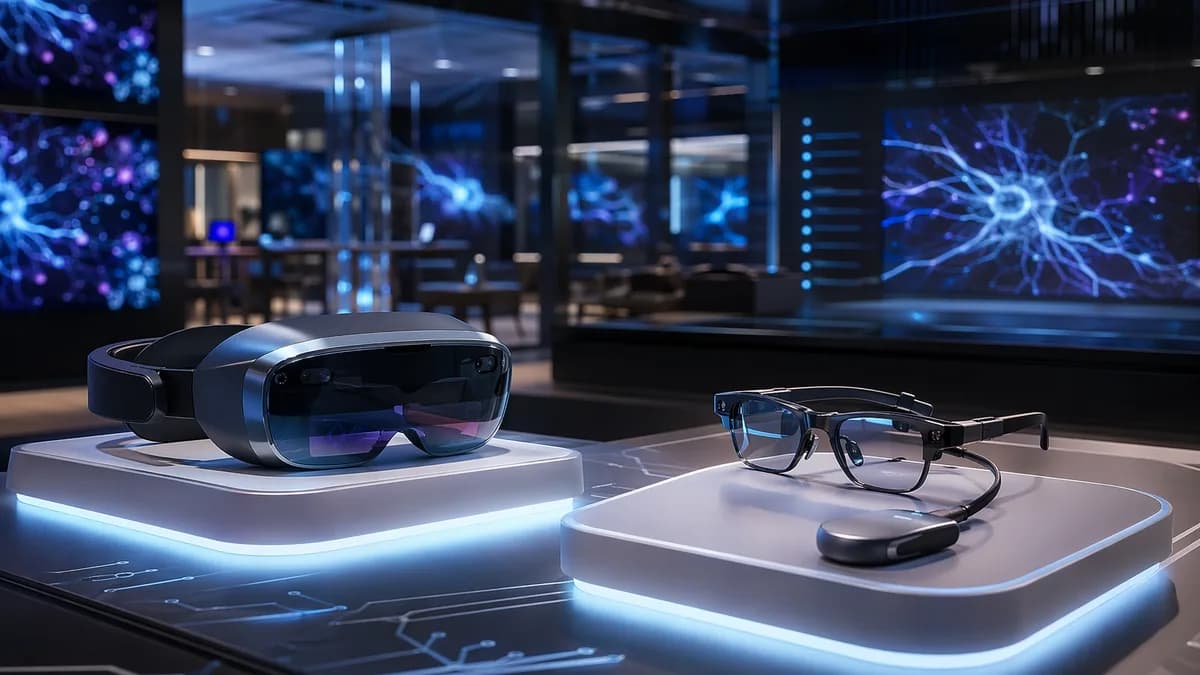
Snap Specs vs Xreal Aura is really a platform bet disguised as a smart glasses comparison: Snap wants AR to start with lenses and social creation, while Xreal wants Android XR to compress a headset-style experience into lighter glasses with a compute puck.
TechnologyJune 27, 2026· 8 min read· By XOOMAR Insights Team
$2,195 Snap Specs Pull Xreal Aura Into Smart Glasses War
Updated on June 27, 2026
XOOMAR Intelligence
Analyst Take
81/ 100
4 sources analyzedHigh confidenceTrend10Freshness100Source Trust84Factual Grounding91Signal Cluster60
That’s the useful way to read the hands-on comparison from Tom's Guide. Both devices put spatial computing on your face this fall, but they ask buyers to tolerate very different compromises: $2,195 standalone AR glasses from Snap, or Xreal’s under-$1,500 Aura setup that shifts compute into a separate puck, according to Trusted Reviews.
“Which one is better for me?” is the wrong question only if you treat them as normal gadgets. The sharper question is which platform risk you can live with.
Snap Specs vs Xreal Aura turns smart glasses into a $1,000-plus platform bet
The symptom is obvious: smart glasses are no longer just lightweight camera frames or private screens. Snap Specs and Xreal Aura are both trying to become spatial computing platforms, but they’re doing it from opposite directions.
Snap’s bet is integration. Snap Specs are standalone AR glasses, with no external compute puck required. Tom’s Guide describes them as a fuller rethink of spatial computing, built around Snap OS, hand tracking, 6DoF, cameras and sensors, and a large base of lens-based AR experiences.
Xreal’s bet is modularity. Xreal Aura uses AR glasses plus a compute puck, running Android XR. The glasses are lighter on the face because the compute and battery live elsewhere. That makes Aura less elegant in public, but potentially more comfortable for long sessions at home, on flights, or on public transport.
This is why early buyers aren’t just choosing hardware. They’re choosing which annoyance feels less costly: bulky standalone glasses, or lighter glasses tethered to a puck.
Snap OS gives Snap Specs a creator base, while Android XR gives Xreal Aura a broader device path
Tom’s Guide gives Snap the clearest software advantage today because of scale inside its own AR world: 450k developers have made more than 5 million lenses. That matters. Spatial computing glasses need more than a beautiful demo. They need repeatable reasons to put them on again.
Snap’s strength is that its AR work already has a native culture. The examples cited by Tom’s Guide are not generic floating windows. They include labeling items on a shelf and showing a visual guide for how to do an ollie on a skateboard. That points to AR as a camera-native, context-aware layer over the real world.
Xreal Aura plays a different game. Android XR brings it closer to a general-purpose spatial device. Trusted Reviews says Aura supports up to five floating app windows at once, with Gemini AI assistant built into the experience. Tom’s Guide also notes demos such as Demeo tabletop gaming and Gemini Live feeling more connected to the real world through optical see-through.
XOOMAR analysis: Snap looks stronger if you want expressive AR and creator-led experiments. Xreal looks stronger if you want Android XR as a route into productivity, media, and headset-like computing. But the source material supports one important caution: Tom’s Guide frames Snap as having the software advantage now, not Xreal.
That distinction matters. Xreal has the broader platform story. Snap has the larger demonstrated AR creator base.
The numbers behind Snap Specs vs Xreal Aura: price, weight, field of view, and compromise
The spec sheet shows why this is not a clean win for either side.
| Category | Snap Specs | Xreal Aura |
|---|---|---|
| Price | $2,195 | Under $1,500 before tax |
| Form factor | Standalone AR glasses | AR glasses plus compute puck |
| Weight | 132 grams or 136 grams | More than 95 grams for glasses |
| Display | Waveguide lenses | Prism-based Micro-OLED |
| Field of view | 57-degree FOV | 70-degree FOV |
| Chip | 2x Snapdragon chips | Snapdragon Reality Elite |
| OS | Snap OS | Android XR |
| Tracking | 6DoF and hand tracking via cameras and sensors | 6DoF spatial and hand tracking via 2x world-facing cameras |
The blunt read: Snap is asking buyers to pay more for standalone freedom and a mature lens culture. Xreal is asking buyers to accept a compute puck in exchange for lighter glasses, wider field of view, and Android XR.
Trusted Reviews adds more Aura detail: dual Sony Micro-OLED panels, 1,920 x 1,200 per eye, 120Hz refresh rate, electrochromic dimming, a 4,455mAh battery in the puck, and configurations with either 12GB of RAM and 256GB of storage or 16GB of RAM and 512GB of storage.
None of that answers the daily-use question. It only narrows it. If the glasses sit in a drawer after two weeks, the better field of view won’t save them.
The normal-person problem is still comfort, social friction, and repeat use
Tom’s Guide is direct about Snap’s weakness: the design is bulky. The piece says a photo of “Evan’s ear struggling at the back” went viral, and that even though Snap has worked to reduce size and weight from previous developer hardware, the glasses are still chunky.
That is the hard ceiling for face computers. People will tolerate bulk in a headset at home. Glasses have to survive public judgment, fit pressure, heat, and fatigue. Xreal partially dodges that by moving compute off the face, but the puck creates its own social and practical drag.
This is where the broader smart-device question keeps resurfacing. As XOOMAR has covered in BYOK Turns a $199 Plastic Slab Into a Writer's Escape, focused hardware lives or dies on whether it earns a place in a daily routine. Smart glasses face the same test, only harsher, because the device is visible on your face.
And unlike simpler smart eyewear, these products are expensive. Tom’s Guide mentions display-free AI glasses like Ray-Ban Metas and ambient computing glasses like Even Realities G2 as more limited standalone options. That helps explain why Snap Specs and Xreal Aura feel like a different category. They’re trying to do real AR, not just add a camera or subtle screen.
For readers tracking where Meta sits in that simpler smart glasses lane, see XOOMAR’s Meta Smart Glasses coverage.
Creators, gamers, commuters, and developers will grade the same glasses differently
Creators have the clearest Snap case. A platform with 5 million lenses gives them an existing format to build for and distribute through. If your work starts with camera effects, social AR, or location-aware visual overlays, Snap Specs fit the job more naturally.
Gamers and media users may lean Xreal. Tom’s Guide highlights Demeo tabletop gaming and says the optical see-through display made experiences feel more accurately merged with the world. The 70-degree field of view also gives Aura an immersion edge over Snap’s 57-degree FOV.
Commuters get a mixed answer. Xreal Aura could make sense on flights or public transport, according to Tom’s Guide, but the compute puck limits where users will feel comfortable wearing it. Snap avoids the puck, but its bulk may be the bigger barrier in public.
Developers face a harder call. Snap offers a proven AR creation base. Xreal offers Android XR and the possibility of a more general spatial app path. The winner for developers won’t be decided by launch specs. It’ll be decided by tooling, distribution, user retention, and whether buyers actually keep using the glasses.
Choosing between Snap Specs and Xreal Aura depends on the job your face computer has to do
Buy Snap Specs if the main job is social AR, lens experimentation, and standalone spatial computing. The price is steep, but the value case rests on Snap OS, no puck, and the existing lens library.
Buy Xreal Aura if the main job is a lighter headset-like experience in glasses form. Android XR, Gemini, multiple floating app windows, Micro-OLED displays, and the wider field of view make it the more obvious pick for media, gaming, and general spatial computing experiments.
Wait if you need certainty. The source material does not establish all-day comfort, mature productivity depth, prescription details, resale strength, or long-term battery behavior. A demo matters more here than it does for a phone or laptop, because fit, eye strain, brightness, and interface feel can erase a spec-sheet advantage fast.
The next signal to watch is repeat use. If Snap can turn its lens base into daily AR habits, its bulky design becomes easier to forgive. If Xreal can make the puck feel invisible in real use, Android XR gets room to prove itself. The fall winner won’t be the pair with the flashiest demo. It’ll be the one people still reach for after the novelty fades.
The Bottom Line
- These devices show smart glasses shifting from accessories into full spatial computing platforms.
- Buyers are choosing between Snap’s integrated AR ecosystem and Xreal’s modular Android XR approach.
- Pricing above $1,000 makes platform risk and long-term software support as important as hardware specs.
Snap Specs vs Xreal Aura
| Category | Snap Specs | Xreal Aura |
|---|---|---|
| Price | $2,195 | Under $1,500 |
| Core approach | Standalone AR glasses | AR glasses with separate compute puck |
| Platform | Snap OS | Android XR |
| Main bet | Social AR, lenses, and creation | Headset-style spatial computing in lighter glasses |
| Key tradeoff | More integrated but expensive | Less elegant in public but potentially more comfortable for longer sessions |
Smart Glasses Price Comparison
Snap Specs
$2,195
Xreal Aura ceiling
$1,500
Sources

Written by
XOOMAR Insights Team
Research and Editorial Desk
The XOOMAR Insights Team pairs automated research with human editorial judgment. We track hundreds of sources across technology, fintech, trading, SaaS, and cybersecurity, cross-check the facts, and explain what happened, why it matters, and what to watch next. We do not just rewrite headlines. Every article is fact-checked and scored for reliability before it goes live, and we link back to the original sources so you can verify anything yourself.
Explore More Topics
Related Articles
 Technology
Kmart Smart Glasses Sell Out Despite Major Security Risks
Budget smart glasses selling out at retailers like Kmart often lack basic tamper protections, risking covert recording and data leaks, making them a dangerous p
Aug 9, 20266 min
 Technology
ICE Plans Deploy $20M Electric Shock Gloves
ICE is pursuing a contract worth up to $20 million to arm agents with electrified gloves that deliver painful shocks to 'achieve compliance in less than three s
Aug 12, 20266 min
 Fintech
Wellington's Leadership Crisis Hammers New Zealand Dollar
The New Zealand dollar slid as domestic political instability, with PM Christopher Luxon surviving a second leadership challenge, outweighed a predictable U.S.
Aug 12, 20267 min
 Fintech
NYC Subpoenas Four Prediction Markets Over Fake Ad Videos
New York City launched a formal investigation into four major prediction markets, demanding answers on allegedly deceptive ads and whether they target minors, i
Aug 12, 20265 min
 Fintech
AI Compliance Trap Costs Firms Billions
Financial firms using generative AI are creating a silent compliance crisis. Regulators are applying existing 'show your work' rules to AI decisions, exposing f
Aug 12, 20267 min
 Global Trends
Iran Conflict Shatters Europe's Summer Travel Economy
Conflict in Iran, combined with a cost-of-living crisis, has destroyed consumer confidence, causing a structural shift to last-minute travel bookings and costin
Aug 12, 20268 min
 Fintech
Goldman Sachs Buys Income ETF Rival For $2.3 Billion
Goldman Sachs will pay up to $2.3 billion for ETF firm Neos, signaling a strategic shift to buy growth engines instead of building them.
Aug 12, 20265 min
 Fintech
Crypto.com Now Lets You Bet on Tesla After Hours
Crypto.com is blurring the line between crypto and legacy finance by offering 24/7 trading of tokenized U.S. stocks and ETFs to European customers, starting at
Aug 12, 20266 min
 Global Trends
Putin Warns of Retaliation for Commercial Ship Seizures
President Vladimir Putin has threatened direct retaliation against Western nations for seizing Russian commercial ships, calling the actions 'piracy' and riskin
Aug 12, 20265 min
 Fintech
Russia Cuts Retail Crypto to Bitcoin, Ether, USDT
Russia has restricted legal retail crypto trading to only Bitcoin, Ether, and USDT, imposing an annual purchase limit of about $3,600 and creating a two-tier fi
Aug 12, 20265 min
Don't miss the signal
Get our weekly roundup of the stories that matter across tech, fintech, and trading. No noise, just signal.
Free forever. No spam. Unsubscribe anytime.