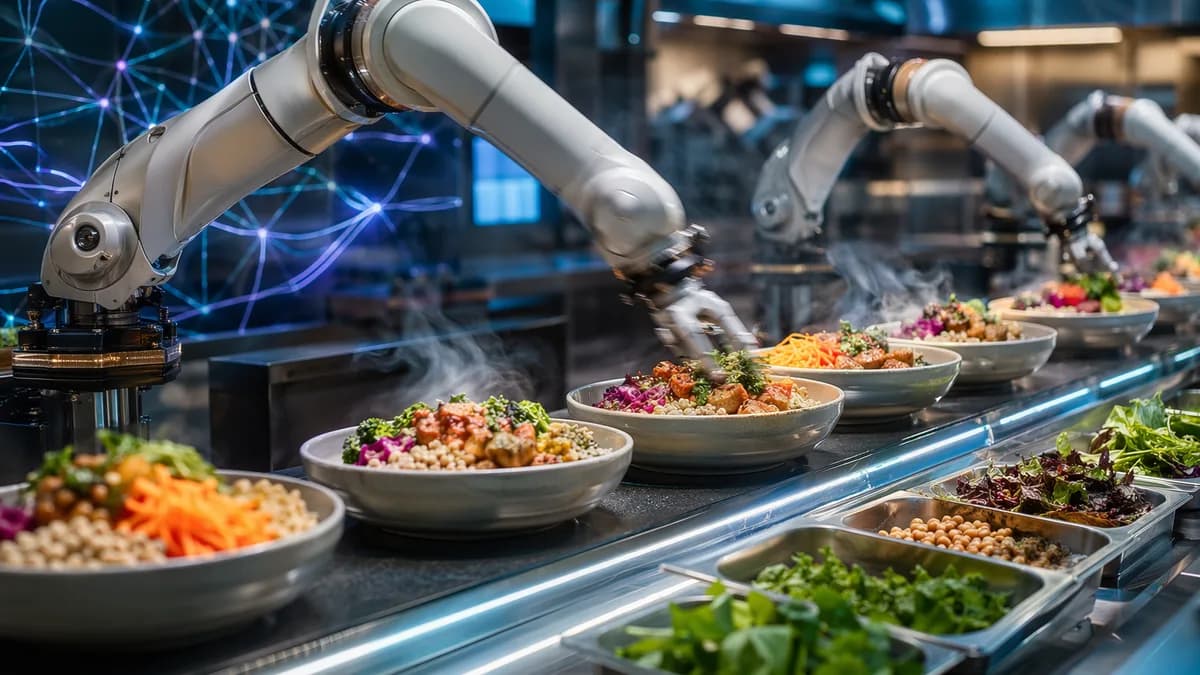
On Tuesday in Aspen, Marc Lore put a hard number on the Wonder robot kitchen thesis: 500 bowls an hour from one machine, versus roughly 30 to 45 from a human worker.
XOOMAR Intelligence
Analyst Take
That gap is the whole story. Lore isn’t pitching a cute food robot. He’s arguing that fast-casual economics can be rebuilt around throughput, consistency, and tighter control of labor per order, according to PYMNTS. The system builds burrito bowls, salads, and poke bowls by spinning each bowl on a turntable while ingredients drop in based on the customer’s digital order. Lore said it produces “no errors.”
Tuesday in Aspen: Wonder’s 500-bowl robot turns fast-casual labor math into a knife fight
The trigger was Lore’s appearance at the 25th annual Fortune Brainstorm Tech conference in Aspen, where he described an “infinite bowl-making machine” that can produce 500 salads, Tex-Mex, and poke bowls in an hour, Fortune reported.
“I don’t know exactly how many a single person can do, but it’s not going to be more than probably 30 an hour, maybe 45,” Lore said.
That puts the machine’s claimed output at roughly 11x to 17x a single worker’s pace on this task. XOOMAR analysis: even if real-world output lands below that maximum because of demand swings, ingredient refills, cleaning, maintenance, or order mix, the productivity spread is still large enough to pressure the assumptions behind human assembly lines.
The Wonder robot kitchen matters because bowls are a perfect automation target. They’re modular. Portions can be standardized. Customization can be mapped from online orders into a mechanical sequence. Delivery packaging is natural. No one has to plate a delicate entree or make a judgment call about doneness.
| Production model | Reported hourly output | Core constraint |
|---|---|---|
| Wonder robot kitchen | 500 bowls | Utilization, refills, uptime, cleaning |
| Human worker | 30 to 45 bowls | Speed, fatigue, error rate, staffing |
December’s $186.4 million deal turned Sweetgreen tech into Wonder’s next test
Wonder paid $186.4 million in December to acquire the technology from Sweetgreen, according to PYMNTS. Bloomberg reported that the deal transferred Sweetgreen’s Infinite Kitchen automation business to Wonder, while Sweetgreen continues using the system under a supply agreement.
That matters because this isn’t lab hardware. Restaurant Dive reported the technology is already live in more than 20 Sweetgreen locations. Fortune put the number at 32 locations. Restaurant Business reported that Wonder plans a Manhattan test this year, followed by 50 to 100 installations across Wonder kitchens in 2027.
XOOMAR analysis: the acquisition compresses Wonder’s development risk. Lore isn’t asking investors or operators to believe in a prototype from scratch. He’s buying a commercialized system and trying to fit it into a broader, vertically controlled food platform.
That playbook echoes the wider business automation trend we’ve covered in LLM Platforms for Business That Slash Busywork in 2026: the value doesn’t come from replacing one task in isolation. It comes from redesigning the workflow around the machine.
Lore’s ecommerce playbook puts fulfillment ahead of restaurant theater
Lore’s background matters here. Fortune noted that he previously sold Diapers.com and Jet to Amazon and Walmart, respectively, for $3.8 billion before founding Wonder in 2018. His instinct is not old-school restaurant craft. It’s logistics, density, software, and repeatable execution.
Wonder has been described as a “vertically integrated food platform.” Fortune said it owns 26 restaurant brands, while Restaurant Business has described 29 restaurant concepts and 83 brick-and-mortar stores. The exact count varies by source, but the structure is clear: multiple brands run through shared kitchens.
That’s why the bowl robot is strategically different inside Wonder than it would be inside a single salad chain. A standalone chain automates one menu. Wonder can route volume from multiple concepts through shared equipment, then connect that kitchen output to owned delivery capacity after buying Grubhub in a deal valued at $650 million.
The Wonder robot kitchen turns a restaurant into something closer to a fulfillment node. Digital orders arrive. Software translates those orders into production instructions. Hardware executes the repetitive parts. Humans handle the tasks the system hasn’t automated or shouldn’t automate yet.
From Infinite Kitchen to sauce and beverage machines, automation is moving deeper into the back-of-house
Wonder isn’t stopping at bowls. Fortune reported that Lore said an “infinite sauce machine” can produce 500 sauces an hour from 152 raw ingredients. An automated beverage system is planned for next year.
Restaurant Business also reported that Wonder wants Spyce’s team to help create equipment that could let the company move from “30 restaurants in a 21,000-square-foot kitchen” to “100 or more restaurants,” and from “540 unique meals” to “literally thousands of unique meals.”
“You add more complexity, you get more errors, right?” Lore told Restaurant Business.
That line explains the real bet. The machine is not just about replacing a person scooping rice and protein. It’s about adding menu complexity without letting operations collapse under the weight of customization.
Food robotics has a long history of impressive demos that struggle once they hit real kitchens. Ingredients are messy. Cleaning cycles are unforgiving. Tight margins punish downtime. That’s why boring reliability will matter more than stagecraft. The same rule applies across robotics categories, from kitchen machines to the consumer hardware we track in Shark Grabs Best Robot Vacuum 2026, Eufy Barges In: the winner is the product that keeps working after the novelty fades.
Workers, customers, rivals and investors will score the Wonder robot kitchen differently
The labor angle is unavoidable. PYMNTS cited National Restaurant Association data showing full-service restaurants run labor at a median of 36.5% of sales, and only 42% of U.S. restaurants were profitable in 2024. It also noted that minimum wages are rising across 22 states in 2026.
XOOMAR analysis: those numbers explain why operators will study this system closely. If a machine can raise throughput and reduce labor intensity per order, it gives restaurants more room to absorb wage pressure, extend operating hours, or protect margins.
Workers may see a different story. A machine that handles repetitive prep-line output at this scale will raise concerns about hours, job redesign, and fewer entry-level roles. Restaurant Business reported Lore’s view that humans would still be needed for cleaning robots, stocking ingredients, final assembly, and certain in-between steps. That’s a labor shift, not proof of painless transition.
Customers will judge the result more simply:
- Speed: Does food arrive faster during peak demand?
- Accuracy: Does the order match the digital ticket?
- Quality: Do portions and texture hold up?
- Price: Does automation show up in the bill or only in margins?
- Feel: Does the meal still seem made for a person, not stamped out by a machine?
Investors will ask a harder version of the same question. If the Wonder robot kitchen lowers unit costs and supports dense multi-brand kitchens, it can justify a bigger growth story. If hardware costs, maintenance, cleaning, or downtime eat the savings, the model becomes capital hungry fast.
2027 installations make reliability the real deadline
The next milestone is practical, not theatrical. Restaurant Business reported a Wonder test in New York City next year, then 50 to 100 installations in 2027. Food On Demand reported that Wonder aims to install Infinite Kitchen in half of all new locations starting in 2027 and ultimately operate more than 100 restaurants across cuisine types from a small shared kitchen.
That rollout will test the thesis beneath the headline: throughput becomes a moat only if the machines run consistently, clean quickly, integrate with real kitchen workflows, and stay busy enough to justify their cost.
If Wonder proves that 500 bowls an hour can translate from conference-stage claim to commercial kitchen performance, fast-casual chains won’t treat restaurant robotics as a novelty. They’ll treat it as a new operating benchmark. If the system stumbles on uptime, maintenance, or food quality, the lesson will be narrower but still useful: automation wins first where the food is modular, the workflow is repetitive, and the robot can stay boring.
Impact Analysis
- Wonder’s claimed 500-bowl hourly output could reshape labor economics in fast-casual restaurants.
- Standardized bowl formats make food prep a practical target for automation.
- If performance holds in real operations, competitors may face pressure to automate similar workflows.
Wonder Robot Kitchen vs. Human Worker Output
| Production model | Reported hourly output | Operational implication |
|---|---|---|
| Wonder robot kitchen | 500 bowls per hour | Designed for high-throughput, standardized bowl assembly |
| Human worker | 30 to 45 bowls per hour | Much lower output for the same task |
Reported Bowl Production Per Hour
Primary Sources & Disclosures

Written by
XOOMAR
Data desk
XOOMAR is a capital markets software and data company. Every brief on this site starts from a dataset the company collects itself from primary sources (CFTC, SEC EDGAR, FINRA, the Federal Reserve, exchange APIs) and names the numbers it is built on, with a link to the data page so you can check them. Briefs are reviewed before they go out and corrected in place when the data is revised.